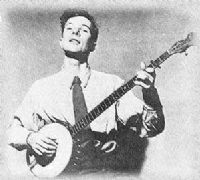
In Pete Seeger's own words he had his banjo neck extended "with two more frets." Of course the oft-repeated misnomer of it being "three more frets" is because of appearances; that is; we see three more sections of fingerboard created because of those two extra frets.
Musically, the result is access to 1-1/2 more steps on the scale. This is the same as saying there are 3 more half-steps. If you're going for the "Pete added three" idea you say it the second way.
I wish somebody would have clarified this for me when I first looked into long-neck banjo. That, and that the common tunings are just C (Seeger) or G tunings if capoed at the third fret. There is no big mystery about the common tunings.
13 Comments |
 | Banjo Lefty says:
8/18/2016 6:57:12 PM
You're almost right. We add three frets because we replace the nut with a fret as well, then extend the neck three sections (adding two more frets). So there are three extra sections AND three new frets.
|
 | phdm says:
8/18/2016 7:44:42 PM
Ah, but here is the full story:
(From The Fretboard Journal, Number 15, Fall 2009 and its fantastic article on Pete's legendary banjo)
"...One song , “Viva La Quince Brigada,” was particularly troublesome to play. Seeger favored C tuning for certain songs because of the bass range it offered his banjo, but C minor was still too high for him to comfortably sing the melody.
“If I had a longer-necked banjo,” he remembers thinking, “I could play it in Bb minor–and I could reach that.”
It was an idea that was radical and elegant all at once, and Seeger acted on it quickly, dragging his Vega Whyte Laydie down to luthier John D’Angelico’s Lower East Side shop for what amounted to major surgery. [1944]
“I got him to saw off the neck,” Seeger says casually, more than 65 years later, “and he inserted a little piece of wood where two frets would be. He glued it together with pegs, I think, to make sure the glue would hold.”
And hold it did, for at least half a dozen years; considering D’Angelico’s legendary skill, probably quite a bit longer. We may never know. Like the punch line to a bad musician’s joke, the instrument was stolen from the backseat of Seeger’s car in 1949, while he ducked into a café to grab a cup of coffee.
“I never saw it again,” he says. “Somewhere in America is a Whyte Laydie with two extra frets.”-
From this it is clear that Seeger's first extended neck banjo was extended by only one full tone or step, allowing him to finger the song in C, but coming out one full step lower, in Bb. This was done by removing the original nut and replacing it with the first of two frets. A second fret was added and below that the new nut. This is why the very first of Seeger's long neck is said to have installed two frets.
After his first long neck was stolen, he had a series of replacement long neck banjos which, unlike the original, had three frets added - one replacing the original nut and TWO additional frets, and then the new nut. This then allowed Seeger (and all of us) to finger/tune in C and get A, or finger/tune to G tuning and get F. This three extra frets then became the standard for Seeger long necks.
If you can find copies of that Fretboard Journal edition, it is just wonderful. Great photos of his lignum vitae necked banjo that he used for his last 60 years.
Hope this helps. - Peter
|
| phdm says:
8/18/2016 8:47:19 PM
Whoops - slight correction on my last post - "...or finger/tune to G tuning and get E."
(Not F when the long neck is fully un-capoed.)
Peter
|
 | Helix says:
8/19/2016 7:12:29 AM
In the village, the peaceful village.
|
byronmuseuminfo says:
8/25/2016 12:23:24 PM
Let's not be too clever when explaining our instruments. Folks can count without our help.
Simply compare a typical long-neck banjo sitting next to a typical regular banjo and you will only be able to count two more frets -- two more pieces of wire -- not three.
Yes, I can relate that in our geek universe counting begins at zero, not one, but let's be fair and clear and provide the most straightforward, verifiable explanation: There are two more frets set between three more sections of fingerboard. (The prototype story is interesting but not helpful in understanding the concept of a typical long-neck banjo today).
|
| Banjo Lefty says:
8/27/2016 4:19:35 PM
I don't know what you're looking at, Byron. My Hatfield has 22 frets, not including the nut, and my Goldtone longneck has 25 frets, also not including the nut. That's 3 more pieces of wire, not two.
|
byronmuseuminfo says:
8/27/2016 5:52:02 PM
Well of course between brands there's variation of number of frets from the 5th to the HEAD. Let's just be a friend and not work so hard to confound the uninitiated, ok? Let's just count the frets -- the fret wires -- from the 5th to the NUT, where the change we are talking about takes place. (It seems only fair, actually obvious, that this means within the same brand !). There are two more frets set between three more sections of fingerboard.
Or, let's just keep on saying that "three frets were added" and every newby will just have to distill what that means on their own. I can think of worse things.
|
| Banjo Lefty says:
8/27/2016 8:22:27 PM
Ok, I counted. The pip on my Hatfield, a standard bluegrass banjo, sits just behind the fifth fret up from the nut, so there are five pieces of fretwire between the nut and the place where the fifth string enters. On the Goldtone, which is a standard-sized longneck, there are eight. So three frets have been added. Frankly, I don't think there's any difference between brands; every longneck of whatever brand I've ever seen has twenty five frets in total, and the fifth string always enters at fret number eight. I'm sure there are oddball instruments around, particularly those that are custom made, but my understanding is that there is a standard for longnecks, and that standard is three frets longer than normal.
You can also do this musically. A bluegrass banjo is tuned in G. A longneck is tuned in E. There are three semitones between G and E, and each semitone requires a fret.
|
byronmuseuminfo says:
8/30/2016 4:12:51 PM
I stand corrected, and thanks for sticking with it. Counting fret wires on a Deering Vega open back banjo (which has 22) against a Deering Vega open back long neck banjo (which has 25) means after all that there are three more fret wires required to construct a Seeger pattern long neck. The Deerings being a good common baseline.
|
 | boulderfolkie says:
8/31/2016 6:56:50 AM
Don't EVEN bring up a Vega Excel or my Chatfield when counting fret-wire from the 5th peg! Your eyes will bleed.
|
| Banjo Lefty says:
9/3/2016 1:47:37 PM
Post a photo?
|
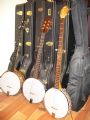 | darwinyarwin says:
10/7/2016 9:34:04 AM
Hey - trivia! I just looked at my Seeger "How to play the 5-string banjo" And there is the exact quote:"with two more frets." (also, if you look at my Ode Model 21 long neck or my Gibson RB-175, both of them have 3 more fret wires ... counting the one where the nut would be on a 22 fret banjo.)
|
| phdm says:
10/9/2016 11:13:42 PM
Darwin Yarwin - yes, that quote about two frets on Pete's first long neck banjo was accurate at the time Pete first wrote his banjo book - in 1948. As noted in my earlier post on this topic, that original extended neck banjo, with the two fret extension, was stolen from his car in 1949. His subsequent extended neck banjos had three extra frets, so that in G tuning, he could get down to playing in open E, or A in C tuning. By the time he and then Dave Guard of the Kingson Trio made the Vega long neck THE must-have banjo for the 1950s-1960s folk revival, three extra frets on the long neck banjos had become standard.
|
Post a Comment
|
You must be logged in and a member of this group to post a comment.
|