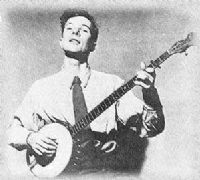
<
Back to Home
Scale question
From rands on 10/21/2015 12:31:31 PM
I have learned more about the banjo in the past three years than I ever even dreamed existed before. As with many things in life; the more I learn, the more I realize I don't know squat.
Anyway, after getting my long neck, and finding the fret spacing to be more of an adjustment than I anticipated, even with my long fingers, I started researching a little. I found my banjo, like most is based on a 27" scale, extrapolated to a 32" or 32 1/4". It seems most all makers of long necks use the "vega" scale, as if it were some holy grail of scales because Pete's banjo was a modified Vega. I have read here that people with small hands or mobility issues can benefit from a shorter scale. I think my Goodtime is a 26 3/16" scale. Yet , all of Deerings long necks, Vega or otherwise, are based on a longer scale. I think Goldtone is the same. Anyone know why? It seems a shorter neck would be easier to play, though slightly, and when capoed at the third fret, would be identical to their regular instrument, fret wise.
5 Comments |
 | mainejohn says:
10/21/2015 1:15:07 PM
Excellent point, but I don't have an answer.
|
 | John Gribble says:
10/22/2015 3:57:21 AM
As Tevye sang in "Fiddler on the Roof," "Tradition!"
It is interesting that this issue hasn't come up before. I suppose it could be any length a player might want. Seeger himself was a good-sized fellow. I myself am more trollish in stature and the uncapoed neck is a fair reach. I had never measured my Gibson longneck, so I did and discovered that from the capoed third fret it is 27-1/8 inches and from the nut it is 32 inches.
I recently had an experience concerning scale length which taught me something. My #1 player for several years has been my Bowlin low-tuned fretless with a 25-1/2 inch scale. I wanted another fretless to tune to "normal" (G or A) tuning and ordered an instrument from Wayne Sagmoen. I specified a 25-1/2 scale because I didn't want to have to relearn where the notes are. I didn't make any other specifications for the neck. When it came, I discovered I still had to relearn where the notes are. The neck on the new banjo is both thinner and more narrow than the Bowlin. My hand had to learn the whole new neck. Scale length is only part of the equation.
|
 | rands says:
10/22/2015 9:05:24 AM
I hear you, John. My Pisgah long neck feels much fatter than my Goodtime. It isn't just the fret Spacing that is different.
I wonder if you would indulge me in a little experiment. Capo your Gibson at the third fret and compare it to whichever of the other banjos has the most similar feeling neck. I am interested in your description of the difference. It seems to me that, whatever the difference, it would be exaggerated when extrapolated to long neck dimensions.
I will try my own comparison, but mine will probably be more of a neck difference than scale difference. By the way, my Goodtime is a 26 1/4".
|
 | calypsojimmy says:
10/30/2015 10:36:12 AM
My guess would be: The rise of the whole longneck banjo thing really revolves around Pete Seeger. In the 1940's Pete was playing a lot of union halls and the like, leading large groups of people in song and singing. This was before things like PA systems and sound reinforcement & such. Pete made numerous adjustments in order to be heard over and above large groups of people: He used picks & learned to clawhammer with fingerpicks on backwards, he invented a playing style he called "whamming" which is totally focused on volume, he cranked up head tension max, for max volume and "cut," etc. As it turns out... longer scale lengths are usually capable of providing more volume & string tension than shorter scale lengths. So I am guessing that scale length is, in part, about volume. That, and comfort... Pete was relatively tall... 6' 3" and had long fingers, so the longer scale was probably comfortable for him. &At some point, lots of people end up wanting to sound just like Mr. Seeger and "Voila!" you've got a marketable long neck banjo design.
|
byronmuseuminfo says:
8/18/2016 3:16:28 PM
Just re-conditioned a 50 year-old Harmony long-neck banjo. The neck is not adjustable but its imbedded rod means it is very straight and stable (not just my experience, apparently). It gives up just the right amount of relief when loaded with strings.
And, the "Reso-Tone" hoop is actually a much better musical engineering feat than you would think. despite being made of Bakelite, or maybe because of it, it carries a good sonic ringing.
Short story: this American-made instrument is not actually a joke unless you've judged it only by its price (when new or now). Instead judge the sound of this one behind a screen and you will not think of it as an amateur instrument. It sounds great.
This one was fine with original head, tuners, hooks and tailpiece but I swapped out all of those and stripped off the beat-up chrome plating on the Bakelite hoop (it's a fine black color underneath, just waxed and buffed it). The original head was starting to split, the original tuners were merely passable and the plating on the original hooks had badly corroded (this is a 30 hook instrument). I put on a no-knot tailpiece just cause I had one.
Bottom line, anyone wanting to try a long neck can pick up one of these old Harmonys under $200. to include all replacement parts as wanted. Oh yeah, I did put in a new nut but only to cut it for the spacing I like).
By the way, to clear up an oft-repeated Seegerism, Pete did not add THREE frets to his model. In his own book he explains he had TWO frets added. It's just that those two fretsseparate three more fingerboard sections (if you have to say that Pete added three of something!). Pete's banjo adds 1-1/2 full steps, but that's just another way of saying three half steps (again if you have to say Pete added three of something).
|
Post a Comment
|
You must be logged in and a member of this group to post a comment.
|