 | Pickin furry paws says:
6/3/2014 11:09:40 PM
Mine is not really a BJ anymore...so I don't know how much this helps. Head slightly under G# to G# depending on weather. 89 on drumdial, but I use a Burlile...less than what it used to be. Tailpiece is a replica Grover, sometimes I have it pointing up, sometimes straight across...but this depends on the type of head crown height I use. It's feet are 5/16" away from the head surface. Remo and AMB heads...9.5-11-21.5-20-10 on the strings...Sosebee bridge. Rods mostly dead, 1/16 turn on the top rod.
|
 | ElvisHimSelvis says:
6/4/2014 11:29:05 PM
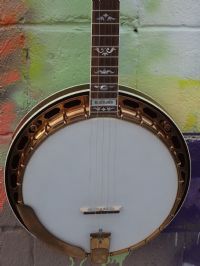
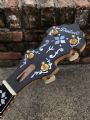
Mine is not really a BJ anymore...I had a custom walnut neck and resonator built by Ed Weber in Nashville, TN... I kept the BJ inlay on headstock and neck, so it still appears to be a BJ, except for by block at the 21st fret says "MOHLERTONE" as Mohler is my last name, it originally said MASTERTONE there... I also had a new rim made, basically the same Gibson design... I have Remo frosted Diplomat head, medium crown, tuned to G#... bridge is likely a stock Gibson bridge at 11/16" (the neck was cut and fit specifically for this bridge height, and my neck builder explained to me that the original BJ necks are cut specifically for 5/8" bridge)... have original BJ Presto tailpiece and it is set at 5/16" above head... string height at 12th fret is 3/32" and at 22nd fret is 1/8"... I recently installed Steinberger Gearless Tuners purchased from Stewart-MacDonald... the fifth-string tuner is still the original BJ one... I am using GHS PF150 Light strings (10-12-14-22-10)... I play bluegrass banjo, three-finger style... COMMENTS: I found the original neck to be to too thin and unstable so the new neck is a slight V from fret 0 to 5 and starts semi-thin and tapers up to standard thickness at about the fifth fret, the remainder of the neck is standard Gibson RB-75 etc. thickness. The Steinberger tuners are very stable and allow for precise tuning of each string without any slipping past the target pitch whether tuning downward or upward. These tuners are not for the player that likes to occasionally change the pitch of the string during a tune. I stopped using the Scruggs/Keith type tuners long ago so these work fine for me, and to tune down the fourth string to C, or to go to D tuning is not as much trouble as one might think with the tuners being equivalent to a 40:1 gear ratio. I am going to upgrade the fifth string tuner as well, as it seems to bind sometimes, but have not gotten around to it yet. I tried a couple of other tailpieces after the rebuild of the banjo but none sounded a good as the original one that came with the BJ, the others seemed to cause lots of overtones and I prefer the more vintage of the Presto anyway. I did have the flange re-plated including the copper flashing process and brushed look, as the original flange turned to a dull black, the other hardware looks distressed the way it was designed to look and I figure the flange will catch up one of these years. The walnut neck brightened up the overall sound of the instrument compared to the sound of the original mahogany, yet not as harsh and bright as a maple neck. I would describe the sound as being the best of both maple and of mahogany, plenty of growl all over the instrument like a pre-war instrument with a mahogany neck and plenty of punch and clarity like maple neck banjos have. Overall I really love my banjo now, it feels great to play and sounds really good and when people ask me what it is I tell them it is a Custom Walnut RB-75 Mohlertone.
|
 | Mike Casey says:
7/6/2014 12:29:07 PM
Mike Casey says:
6/10/2014 7:00:21 PM
Medium crown height works very well for my Blackjack setup. I use a standard over the counter Weatherking medium crown head. I tighten it to an even (or as even as I can get it) 92 on the DrumDial I still have some stretcher band showing above the tone ring. With the high crown I sometimes wind up with more stretcher band sticking up than I want. I use a Scropion 5/8 maple ebony bridge that weighs in at 2 g. I have used a Scorpion 1.8 g. and I like the sound that weight provides very much. I can go either 1.8 g or 2 g and get the sound I like. Some folks like a heavier weight, 2.2 g 2.4. g etc. Like everything else banjo you have to find the sound you are looking for. The tailpiece is the stock Presto and it rides at about the place where the ebony meets the maple. It puts enough downward pressure on the strings to give it a little zip. The strings are 10, 11, 12, 20JD and 10. I have used a 13 instead of the 12 with pretty good results too. The action is set at 7/64 at the 12th fret. The coordinator rods are set to finger tight with a tweak of a wrench. I don't want to stress the rim by adding any "egging" forces. This banjo has always been a great sounding banjo with a very nice old patina to the tone. The neck is very playable with almost no truss rod adjustment added. It sounds good in a band setting and has a very rich voice for backup. It is a very mature sounding banjo to me. The only not stock feature I've added are a set of Ron Barnes Big Butterscotch tuning buttons which give it one heck of a vintage look. These buttons are larger than most and give me a great positive feel and the necessary leverage to get the tuning just right. He fit them to the shafts and there is absolutely no play so all your tuning effort is directed at tuning and not correcting for button sloppiness. They look good and they perform great.
|