| Mike Casey says:
10/6/2013 1:49:48 PM
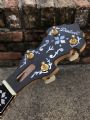
The part about Jim Mills early involvement is absolutely true. I spoke with him personally when I heard this model was being developed. He told me he was playing a prototype right before I called. I asked him a few questions, would it have the V neck, the clamshell tailpiece and generally, did he like what he was hearing from it,. He confirmed these would have the V neck feature, but I don't recall what he said about the tailpiece. He said he thought it was a great sounding banjo, really, really good, and advised I order one, get on the list, because these were going to be in high demand. He was, of course, correct about everything he said except one. It would not be the Gibson Jim Mills' model.
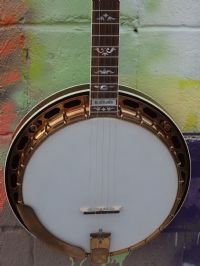
In my opinion it is one of the best Gibson models produced during its time in the catalog. Mine sounds absolutely great and has since day one, March 2004. As an aside mine and one other I know about came without the Gibson oval sticker inside and the Crowe ring in my Blackjack did not have the Gibson name or serial number stamped into the foot. The tone ring was atypically unmarked and weighed an ounce less than others I've weighed. I sent it to Bill Sullivan for verification and he confirmed it was indeed a Crowe ring. Stamped on the inside of the rim is 75-0304-X and the letters BLK over JK. Note the typical serial # yy/mm is reversed. I wonder if anyone has had one of these tone rings analyzed for its alloy, specifically the lead content? I have heard that these had a higher lead content and that this contributed to the rings very good bass response. I talked to an experienced engraver who told me the Crowe rings were easier to engrave, took to the graver better, than the other Gibson rings in use. That might testify to the higher lead content making the ring a little "softer" than the others. I don't know, but would sure like to know what the lead content is in these rings. I'm guessing above the 10% level.
|
| Mike Casey says:
10/7/2013 6:10:50 PM
The first Blackjacks had gold plating over the copper flashed metal parts. The gold plating was rubbed with steel wool or some light abrasive to give the gold plating a worn through old look. These examples did not tarnish, turn green, if at all as the copper was not exposed to the atmosphere being protected by the gold plating. Mine is one of the first production run and the gold plating received very little of the rubbed out effect and still looks great to this day. After some time and I'm not sure when this happened, but Gibson turned out some Blackjacks that were just copper plated or received very little gold plating. These, of course, had tarnishing problems because the copper was completely exposed to the atmosphere. They eventually abandoned this practice and returned to the gold plating and "aging" it with the light abrassive. Regardless these banjos do sound very good and enjoy a very good reputation today.
|
 | Pickin furry paws says:
10/13/2013 8:22:00 AM
Classic case of Gibson mishandling a product line. To answer Mike's tonering question, the lead content does NOT increase the bass response. Lead is used for machining purposes only, as it allows the ring to be machined at a greater speed on the lathe. A high copper-tin content ring cannot be spun quickly, since the copper in particular reacts poorly. Ever watched the old Huber video he produced? The tonering being machined in that video is spinning very slowly, about 100 rpms. The more lead in the ring, the faster they can be produced in large quantities--a fact which makes sense considering Gibson's business practices. The lead content varied from 14 - 18%. There's no need to guess at lead's sound properties either--historically, it has been known as a cheap metal, and believe me, it isn't a tone metal. Lead is used only for its machine purposes, as some is always needed in a ring in order to have any hope of cutting it. I have seen several of the earliest BJs fitted with good replica rings, and they are absolutely killer banjos.
The reason the BJs sounded good early on was because of the care put into the workmanship. Rims were chosen carefully, necks were lacquered and shaped by hand, and as mentioned before, parts were antiqued the right way. Unfortunately, Gibson didn't maintain these standards.
|