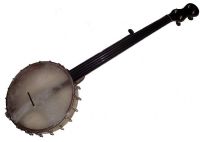
I'm still working on learning various tuning options for a fretless banjo. Am I correct that the Keys of B and E are essentially no-go zones in terms of re-tuning to get to them, since strings likely would pop trying to get there? Thanks.
17 Comments |
 | guywolff says:
1/24/2014 7:00:16 AM
I will start as speaking of a fretted banjo first for sanity .. So B would be gDGBG+3 and E would be gCGCD+4 .Without a fifth string capo you might want to put the fifth string down to to note of your first string . . For E you could also do a D tuning and Capo at the second fret , Say aAF#AD Note :+ 3 means capo at the third fret .Being a fretless you can move the bridge that distance in towards the neck to raise the tone the same amount . Very easy to do if you have a Snark tuner .. So for B : tune in G and then move the bridge till you get a B note on the third string with the tuner.
|
 | BlowingRockNC says:
1/24/2014 7:07:30 AM
Guy, thanks, but I'm not sure what you propose is really very practical, but I guess it's doable. For me, I think B and E are out of reach for the timebeing.
|
| BlowingRockNC says:
1/24/2014 7:10:19 AM
Guy, an addendum---I think playing around E chords in the first postion is doable, with the 5th string dropping down 2 full steps...or not. B is a tad more difficult to deal with from a chording standpoint, but not impossible. For now, I'm focusing mostly on just trying to learn a fluid 2 and 3-finger OT picking style to use with the fretless.
|
 | alubin says:
1/24/2014 7:28:55 AM
You could try using a different tuning for B and E, instead of basing it off of gDGBD. For instance, you could try open D up a step for E (g#EG#BE or eEG#BE), like guywolff suggested. You should be able to tune up to those notes with no broken strings without using a capo. For B you could try double-C down a half step (f#BF#BC#) or just make up a tuning, like f#D#F#BD# and play around with it to find the tunes. It's good to use a tuning that lets you use a lot of open strings in the tune, especially on a fretless, IMHO.
|
| BlowingRockNC says:
1/24/2014 8:17:29 AM
Adam, thanks for the suggestion. I guess I didn't understand Guy. I can see that there are all sorts of things to try out. Thanks. Bill.
|
| BlowingRockNC says:
1/24/2014 8:21:13 AM
I've got remember that I can tune down as well as up.
|
| BlowingRockNC says:
1/24/2014 8:22:25 AM
Of course, tuning down too much can cause things to get a little sloppy when playing. I'll just have to experiment, which I think is a major part of OT playing.
|
 | Marc Nerenberg says:
1/24/2014 11:48:48 AM
I generally keep my fretless anywhere from 3 to 5 semitones lower than "usual" pitch. I use Nylgut strings.
|
| Marc Nerenberg says:
1/24/2014 11:50:27 AM
Though, I wonder why you are looking at fretless in terms of chords. Fretless is a melody instrument, not a chord oriented instrument. You'll find it much easier, I suspect, if yu can break out of that chord oriented mind set.
|
| BlowingRockNC says:
1/24/2014 12:26:21 PM
Marc, I agree about the chords versus melody notes. I've learned quickly that chords aren't much in use or very practical with a fretless banjo, and that's why I'm looking at various tunings that are relatively simple and easy to accomplish. For B and E, I mentioned chords because I didn't think there were realalitisc choices for tunings, but I was wrong again. Also, it's great to hear that you find dropping down 3 to 5 semitones to be just fine, if not preferred. That's great to know. You see, there's a whole lot I don't know, with much to learn. Thanks. Bill.
|
| BlowingRockNC says:
1/24/2014 12:34:20 PM
Marc, I agree about the chords versus melody notes. I've learned quickly that chords aren't much in use or very practical with a fretless banjo, and that's why I'm looking at various tunings that are relatively simple and easy to accomplish. For B and E, I mentioned chords because I didn't think there were realalitisc choices for tunings, but I was wrong again. Also, it's great to hear that you find dropping down 3 to 5 semitones to be just fine, if not preferred. That's great to know. You see, there's a whole lot I don't know, with much to learn. Thanks. Bill.
|
| guywolff says:
1/24/2014 3:15:44 PM
I am another vote for Nylgut and as always like to hear anything Mark has to say .. He is a smart one .. Yours Guy
|
| BlowingRockNC says:
1/24/2014 4:27:26 PM
Guy, I'm using Nylgut on my mountain banjo, and I've order a Pisgah fretless banjo with Nylgut. It seems to me that fretless banjos were made for Nylgut, or the other way around depending on your point of view.
|
| guywolff says:
1/25/2014 11:37:33 AM
My main fretless is made by Kevin Fore and has a brass fingerboard and man do those string slide !I have an Ashborn copy on loan from David Oakes who is an Ashborn Scholar and again those strings are so great .I know you will enjoy that Pisgah !He dose a great job ..
|
 | Strumelia says:
2/26/2014 2:13:36 PM
Just position the bridge to give you a 25" scale, and tune to A. Then slide the bridge up until it plays in B. That's it.
|
| Strumelia says:
2/26/2014 2:16:02 PM
Just position the bridge to give you a 27" scale, and tune to G. Then slide the bridge up until it plays in E. That should do it.
|
| Strumelia says:
2/26/2014 2:19:37 PM
Oops sorry, for the second one I mean:
Just position the bridge to give you a 26" scale, and tune to G. Then slide the bridge DOWN a step and a half until it plays in E. That should do it.
|
Post a Comment
|
You must be logged in and a member of this group to post a comment.
|