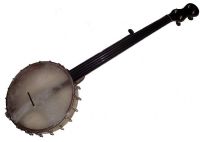
I am kinda curious to know how precise finger placement needs to be for the normal ear not to be too (read that excessively) bothered by flats or sharps.
I recently learned of the cent measurement in note analysis, and it seems to me that my ear may be lenient when it come to deciphering whether a C ( OR ANY NOTE) is C +- 5 or 6 cents.
Sometimes I notice that my finger will land a good quarter inch off the mark, but the tone that is plucked works just fine in the music.
I know there are psychological reasons why this may be true, but I'd like some enterprising young person to really give this question a go.
By the way - I play violin where tone error detection can be in millimeters.
15 Comments |
 | Harpist says:
2/13/2013 1:36:53 AM
I'm not an enterprising young person - more of a feckless older person, but my take is this. On the banjo, there are open strings ringing all the time, as well as the notes you are playing. If you play a note that is meant to be in unison, or an octave away from a note played before, or still ringing, it is important that it is dead in tune. The same is true if the notes are a fifth apart. Starting from the tonic note in the major scale, the third above that, and the seventh, can be quite flexible as something a little out of tune (by classical standards) here can give the flavour of another mode, or can make the tune sound bluesy. These notes are often played as slides on the fretless.
|
 | Strumelia says:
2/13/2013 7:18:38 AM
I find fretless banjo notes can be a little bit off and still give a colorful down home feel, whereas with fiddle the same can be true but there is a little less leeway in intonation and still have it sound good, colorful or not.
|
| Strumelia says:
2/13/2013 7:19:42 AM
P.s. why would an 'enterprising young person' be better to answer such questions ??
|
 | Annon says:
2/13/2013 4:48:05 PM
I surmised that someone with an interest in a project whereby the physical and mental demands needed to form a test group, perform lengthy intonation experiments with their sense of hearing, gather the data into a coherent form, and write a synopsis might take a youthful person; perhaps a music student who might find the project worthy of academic consideration.
I know of no one my age who is so disposed, and thus I recommended a youngster to take on the project - however, all comments from experienced and not so experienced players are welcome and appreciated.
|
| Harpist says:
2/14/2013 12:34:45 AM
Ah, si jeunesse savait, si vieillesse pouvait!
|
| Annon says:
2/14/2013 12:57:51 AM
No es una problema. Me encanta la oportunidad a habla con los personnas le gustan musica. especialamente musica de la canding.
|
| Strumelia says:
2/14/2013 7:15:11 AM
I find that fiddle and banjo players tend to go through 3 phases in their musical lives-
1) when young they don't want to spend much energy on the minutiae of intonation- they just want to play and have fun!
2) second phase is middle age is when they want to learn every detail they can about intonation, historic music accuracy, head tension, string comparisons, etc.
3) third phase is when they get older, they don't want to spend much energy on the minutiae of ANYTHING - they just want to play and have fun!
I find myself beginning to slide into category 3 these days. ;D
|
| Strumelia says:
2/14/2013 7:16:18 AM
i hope my post is taken in the spirit of humor it was intended. :)
|
| Annon says:
2/14/2013 4:40:59 PM
Of course Strumelia; your post was taken in good spirit.
These days I find myself reading many books on music, but not so much about how to play. These books, such as BRIDGE OF WAVES, S'WONDERFUL, HOW MUSIC WORKS, CLASSICAL MUSIC, EVERYTHING IS CONNECTED, and many others are about why there is music and how we perceive it in our minds.....what it does to us and why it seems to be important to the human race.
Intonation accuracy for fretless banjo was just a quest to examine human endurance.
For whatever reasons my wife may disagree, I do in fact have a sense of humor.
I think I am still in the first phase..:)
|
 | erikforgod says:
3/16/2013 5:00:23 AM
Well I have just started playing fretless only about 3 weeks ago or so, after playing clawhammer since June of 2011. I was recently working on having more of what some folks call a "fiddle-grip"( having the banjo a bit deeper in the palm. I have found this to be helpful when playing out of the first position, as long as its not too deep in my palm. Playing that way does help a bit with the precision and still allows me to quickly use the pinky to stretch out and hit certain notes. I feel that the fretless is a soloists dream and if you have a good ear,you'll have no problem playing one. Part of the ambience of the fretless sound...probably what attracts all of us is that lack of absolute precision in intonation when playing. This creates a certain tension in the playing that is unique to the fretless banjo only in my opinion.
|
| Annon says:
3/16/2013 4:55:45 PM
Thanks Erik, what a great comment. You brought to my attention some things I have not considered. By the way, I finally installed a permanent nut on my salad bowl banjo; the installation lifted the strings from the board ever so slightly more than the temporary - the instrument became a little more difficult to play, but the tones are clearer for some reason. Im still not very good with my pinky though, perhaps its a lack of strength.
|
 | grumpsie says:
4/26/2013 12:43:10 AM
To be honest I think as time passes and you get more used to it, intonation becomes more fluid. Once you can hear yourself play and anticipate notes, sliding in gets easier. Once your hand grows used to the distances, your fingers hit the spot you want. After a while you'll be playing with fractional note steps in slides and stuff. Listen while you play and correct your fingerings as you go, and you will learn quickly.
In terms of how forgiving intonation is, in my experience nylon strings are more forgiving, and seem to "learn" what notes you like after a while, and give me what seems to be the same note within quite a wide band (1/4 of an inch or more), whereas the steel strings seem to require a more exact touch to sound right.
But either way, it shouldn't take more than a day or two to get to where you can just play if you're already ok with a fretted. Think of it as any other technique: you'll probably never perfect it, and you'll always be improving, but you need to get over the imperfections and just let yourself play to get past some of the stumbling blocks.
Best way to learn wd probably be to play a tune you know well on fretted banjo or on another instrument. And don't be intimidated, it's really not that difficult.
|
| Annon says:
4/26/2013 1:29:53 AM
Thanks grumpsie; I have only played a fretless, so, except for violin, which is pretty critical, I do not have much experience, but Im now getting the hang of it....I think. Unless the note I screw up is bothersome to my own ear, Ill just continue to play and work harder the next rime around. thanks for the comment and advice.
|
 | banjoboyd says:
12/17/2013 1:45:22 PM
Annon - so there's a couple things here...
The +/- 5 cent discrepancy you describe is sometimes referred to as a Just Noticeable Difference or JND. The amount changes depending on timbre, register, and duration...but 5 cents is a good ballpark figure.
That much has to do with human error. But there are also issues of tuning. Basically, once you leave equal-temperament, the tuning of any interval becomes contextual. That means that as you change key/mode, the theoretical positions of each note shift around a bit. The classic shift is the 81:80 syntonic comma, which is about 21.5 cents...this is the difference between a "harmonic" major third, 5:4, and a pythagorean major third, 81:64. frets eliminate this distinction and sort of average 5:4 and 81:64 into the same pitch.
ALSO there is a theoretical model called Harmonic Entropy...one of the things this model tells us is that different intervals have different tolerance for tuning error. Major 2nds can be off from their ideal position by as much as 15 cents, and will not sound wrong...but a Perfect 5th sounds awful at 15 cents error. Of course, this is also relative to key...a D is a 2nd in C major but a 5th in G major.
Say your banjo scale length is 25"...that's 635mm. The following calculation
635-635(80/81)=~7.84
gives the distance of the syntonic comma from the nut. So if 21.5 cents from the nut is 7.84mm, then your 5 cent JND would be roughly a quarter of that, ~2mm.
Which is ridiculously small and not worth worrying about. Actually, none of this stuff is really worth worrying about, because your ear is the best tool available for determining whether something is right or wrong.
|
| Annon says:
12/19/2013 10:47:32 PM
Well done !!!!
|
Post a Comment
|
You must be logged in and a member of this group to post a comment.
|