| The Pope says:
3/11/2016 10:33:49 AM
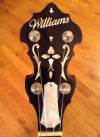
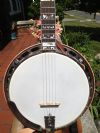
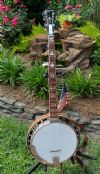
I've got a Williams Kenny Ingram (#9) with the Sullivan rim. In fact, all 3 on my banjos have that rim. I also prefer mahogany necks & rosewood boards. However, with intelligent setups, you can make a pretty big sound adjustment so unless you pick some radical stuff, you can get most any sound. Setup, setup, setup... :-)
|
 | Pickin furry paws says:
3/11/2016 10:53:00 PM
Concerning wood options, I assume you're meaning neck wood. In that department, really any wood works provided it is musical grade quality. If you can source old wood from the Kalamazoo area, that is the most ideal situation, several modern players have been doing this, most recently Jim Mills for his latest banjo acquisition. But even if you don't have connections with rare wood like this, any good wood provided by any of the top neck makers today isn't going to harm your banjo at all.
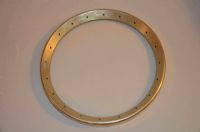
Concerning rims: both the Sullivan and Timeless rims, while they use good wood, the wood is often too heavy. Jim Burlile (and consequently myself) will tell you that the lighter the rim to the tone-ring, the better the sound of the instrument. As an owner of a Sullivan FF rim, I can tell you that anything over 17 oz in weight is going to rob your banjo of some volume in comparison to a good prewar. The best thing I can recommend is when you obtain the ring to weigh it, then depending on it's weight buy a rim that suits it, preferably under 17 oz in weight. The reason is because when you begin attaching hooks, nuts, flanges, etc. you're adding to the weight below the ring, which impacts its ability to effectively vibrate the pot.
Also: ask Robin what the weight of the current rim is. If he won't give you the weight, I'd pass it up and bide your time for a good rim. Right now, there's a good KK prewar rim for sale for $500, that is a massively better rim than almost anything you can buy new.
Now, to add more complexity to the argument (but hopefully make sense): some of the Sullivan FF rims were decently light weight. If you find one that is right on the nose of 17 oz, you can't do much better than that. Plus, the wood itself supplies good tone, as hard dense wood.
Stay in touch Henry.
|
 | HenrytheCat says:
3/15/2016 11:24:49 AM
Thank you both for your comments. Summing up your collective comments, you both think that any neck/fingerboard combo will work well with a Burlile tone ring with appropriate setup, though The Pope has a personal preference for mahogany and rosewood. So, my choices in this regard remain unlimited.
On to the rim. After reading about old KK rims (I knew nothing about them) and thinking about it a while, I decided to take Pickin furry paws’s advice and buy the KK rim listed for sale on BHO. Too late. Already sold. Figures. I sent in a backup offer in case the sale falls through, but I am not optimistic.
Looking through old BHO postings I found one saying that the poster was not pleased with the combo of the BTR with a Timeless Timber rim, so I probably will not keep the TT rim currently associated with the BTR, even if it should weigh 17 oz or less. As for the other modern rims available, I take it that you both like the Sullivan FF rims, with a caveat from Pickin furry paws that the rim should weigh 17 oz or less.
I polled 3 modern rim makers as to the weights of their rims. Steve Huber says that his Engineered rims weigh in at 15.2 oz, give or take a tenth or two. Keebey Schaeffer says that the Tony Pass thin skirt rims run from 16 to 18 oz. Finally, Eric Sullivan weighed 2 rims he had on hand at 18.15 and 18.28 oz.
Thus, to the extent that weight should be the controlling factor, it seems I should be looking at either the Huber rim or a lighter Pass rim. I take it both of these are excellent rims. I have seen that Huber owners gush over their Engineered rims, especially when combined with HR-30 tone rings, and I suspect that the BTR would be as good. And I know that Hopkins and Stelling, heavyweights both, use or have used Pass rims. Do either of you know anything about these rims, especially when combined with a BTR?
Given the frequently combination of BTRs with Sullivan FF rims, I could be inclined to take this combo on faith regardless of the rim’s weight. I don't think I can reasonably ask Mr. Sullivan to weigh all his rims to see if he has one that weighs in at 17 oz or less. Life remains complicated.
Again, thanks to you both. From your comments, I know more than I did, but my choices remain difficult. While I am at it, any views on flat vs. radiused fingerboards or tunneled vs. standard 5th strings?
|
| Pickin furry paws says:
3/16/2016 2:18:10 PM
The HR-30 ring is not a good tone-ring sound-wise. I realize that quite a few dollars went into its research, but all the fancy vibration analysis tools aren't necessarily going to tell you how the rings were cast--in fact, vibration analysis can be very misleading. Huber rings have for years been too bassy to be true prewar tone-rings...go listen to all the early recordings and videos of Earl (I'm talking pre 1960) and you'll hear the difference: the banjo was not as bassy an instrument as it has become with modern tone-rings. This is for several reasons:
1. Gibson rings were cast to produce what the company called "twang," whereas modern rings are produced to produce bass.
2. Gibson rings were cast properly like good bells and not using ingot metal, whereas modern tone-rings are cast in large batches with somewhat cheaper metals.
3. Gibson rings used old casting techniques and different sand, modern rings are cast using (again) modern foundry methods which often differ from old methods, esp. with the annealing process.
4. Prewar rings are not as naturally bassy, rather they produce a lot of ring and clarity; to obtain bass, the head must be loosened and a thicker bridge used. Modern rings differ in that they produce bass naturally, facilitating problems with the tonal spectrum in that when set-up like prewars, they have a strange sound, often too dry, and do not continue to produce volume and "ring" when the head is properly tight.
5. Listening to Earl in the 50s, his 4th string was not anything like the Hubers you hear today. It was nonexistent, a thin tone. The fattest string was the 3rd string! Earl often tightened the skin heads past A, sometimes into the Bb range. B I surmise might have been the tap note when he went to shows, Earl always over-tightened the head for live shows because he knew the head would loosen over the course of the show. Bottom line: want to hear Earl's sound? Put the Burlile ring on a light rim, tighten the head to A or Bb, and use a thin bridge. You will sound more like Earl than you thought possible.
IMHO, the Huber rim is superior to the tone-ring, for the simple fact that lighter wood produces the kinds of things prewar banjos have. Odd thing is, since the rim is better than the ring, I've hear and set-up several Huber TruTones that were 10dBs less volume than my banjo with a heavier rim! I once set up a TruTone RB4, rim weighed 15.5oz tone-ring was 51...do the math, that's a 3.29:1 ratio. My banjo on the other hand had a ring weight of 54.1 to a rim weight of 17.8...ratio goes down to 3.04:1. Even with a slightly worse ring-to-rim ratio, my banjo broke the 100dB mark, Huber didn't even reach 90. The reason? Tone-ring was holding the instrument back.
What I'm saying is the tone-ring can greatly improve a banjo when properly made. Even in banjos with slightly heavier rims, you will obtain better results than an ideal weighted banjo with a poor tone-ring.
If I were you, I'd ask Sullivan to weigh his rims, if that's the rim you intend to use. Heck, why not...it's your banjo, why go on faith alone? I used to trust everyone until I spoke with Jim Burlile...now, I don't trust many builders beyond him. It's your banjo, your tone-ring...discerning players have a right to know the details of products planned for their banjos.
A friend of mine, Cliff Fitch, once used a Burlile for a few months on a Huber rim if my memory serves me correctly. Sounded pretty damn good. Sullivan rim is harder wood, different tone...has a harder edge, perhaps more prewar in that the highs come naturally to the instrument without having to age-in. Although keep in mind there are two kinds of ways you can get higher pitched notes to sound "right:"
1. Use denser wood that supports higher frequencies
2. Use dense but light wood, which vibrates easier
Completely dense wood will give you good highs, but because the rim will be heavier, it won't respond as well to the vibrations of the thinner strings...I know this for a fact since I've owned an FF rim for 7 years. 4th and 3rd contribute the most vibrations to the pot, but the rim is so heavy that the more delicate vibrations from the thin strings don't often make it through. But with a lighter rim, less mass means it requires less energy to make the wood oscillate...which means the thinner strings contribute to the overall shaking of the pot assembly when played. You'll get different highs as a result...but perhaps better overall since the whole instrument is vibrating.
Perhaps too much information...but I think everyone who cares about their playing should know this kind of stuff. Over the past 5 years, I've talked with Jim Burlile so much I've lost count how many calls have passed between us. Every time, I learn something from him or have a tone-theory of mine confirmed. Banjos aren't difficult, but the simple stuff often gets lost in the massive hype and misinformation floating around.
|
| HenrytheCat says:
3/25/2016 3:32:20 PM
Sorry to be so long in responding. I have been out of town.
Again, thanks for your input. Very informative. Based on your comments and what little else I have been able to find, I think I will go with the lighter rim---specically, the Huber Engineered Rim. With average weight about 15.2, they seem to be the lightest around, and they are, so far as I have been able to determine, of very good quality.
I tried to contact Cliff Fitch, who you said had a Burlile/Huber setup for a while, to get his comments on it. It would seem, however, that since he stopped building banjos, he went dark insofar as communication with BHO is concerned. He no longer seems to be a member, and I take that as meaning he would prefer not to be bothered. I will take your word that the setup sounded good.
Again, thanks. Now I am turning my attention to selecting the neck/res wood and other decorative items.
|