
DVD-quality lessons (including tabs/sheet music) available for immediate viewing on any device.
Take your playing to the next level with the help of a local or online banjo teacher.
Weekly newsletter includes free lessons, favorite member content, banjo news and more.
Premier Sponsors


|
Please note this is an archived topic, so it is locked and unable to be replied to. You may, however, start a new topic and refer to this topic with a link: http://www.banjohangout.org/archive/407393
rkdjones - Posted - 02/18/2026: 09:27:50
I made it to the slow-pitch bluegrass jam session last night, my first real jam session ever. I survived and will go back next week. It was easier than I expected, but there were a few unexpected challenges. I am strictly playing backup. There were about 8 people, 2 guitars, a bass, 4 mandolins, a few others. There were no fiddlers. It was slow, maybe 80 beats per minute. A lot of people had some sort of visual aid (e.g.chord progression pulled up on StrumMachine).
The challenges:
- The lead went around the circle and because they mostly sang a song they went to keys that worked for their voice. It meant they played in a lot of different keys: G, A, D, E (not many in C). The 5-string banjo is primarily tuned to play in one key: G. And those are the chords I was practiced in. And a banjo is hard enough to keep in tune in G, maybe I could capo up to A and retune the fifth. But playing in E, for example, with the banjo tuned to open G is questionable. I will use my tenor banjo next week; it works better for playing in different keys.
- There is a formula for taking a musical break which is a little hard for me to get down.
What strikes me is in the classes I've taken, one explicitly advertised to teach students to play in jams, no teacher has ever taught the essentials of playing in jams. They all just taught some tunes that we all played together, not the same as playing in a jam session.
BTW, I am not playing Scruggs style. I play clawhammer which seems to work fine for playing rhythm.
pinenut - Posted - 02/18/2026: 10:47:23
quote:
Originally posted by rkdjonesI made it to the slow-pitch bluegrass jam session last night, my first real jam session ever. I survived and will go back next week. very nice, jams are hard. It was easier than I expected, but there were a few unexpected challenges. I am strictly playing backup. There were about 8 people, 2 guitars, a bass, 4 mandolins, a few others. There were no fiddlers. It was slow, maybe 80 beats per minute. It's hard to hide mistakes at slower speeds
. A lot of people had some sort of visual aid (e.g.chord progression pulled up on StrumMachine).
The challenges:
- The lead went around the circle and because they mostly sang a song they went to keys that worked for their voice. It meant they played in a lot of different keys: G, A, D, E (not many in C). The 5-string banjo is primarily tuned to play in one key: G. nope. And those are the chords I was practiced in. And a banjo is hard enough to keep in tune in G, maybe I could capo up to A and retune the fifth. But playing in E, for example, with the banjo tuned to open G is questionable.I will use my tenor banjo next week; it works better for playing in different keys. yup and that's cheating; your 'real' banjo will know...
- There is a formula for taking a musical break which is a little hard for me to get down. This is tough. Start by memorizing the melodies with fill-in at speed for some of the tunes on the group list. The Tim Jumper book is excellent for this.
What strikes me is in the classes I've taken, one explicitly advertised to teach students to play in jams, no teacher has ever taught the essentials of playing in jams. They all just taught some tunes that we all played together, not the same as playing in a jam session. yup, typical.
BTW, I am not playing Scruggs style. I play clawhammer which seems to work fine for playing rhythm. Awesome! Use the claw-hammer/2F/3F superpower of re-tuning for key changes and I,IV,V = dun for most: G/A = gDGBD + capo, C/D = gCGCD/gCGBD + capo, E = pass.note: this can be confusing to the people playing monotuned instruments (usually linear by fifths). When the question happens, explain that banjos are 'fancy' and need to use additional tunings to compensate for the nonlinear re-entrant tuning "handicap"
I know there is an appropriate banjo-joke here somewhere...
Edited by - pinenut on 02/18/2026 10:53:06
rkdjones - Posted - 02/18/2026: 11:01:35
Thanks, that is really helpful.
Do I need to retune the fifth string going from G to A, or from C to D? That darn fifth string is a blessing and a curse. I could put a spike in my fretboard if I need to. In a different banjo I had the pip at the 7th fret which made tuning between G and A easier.
chuckv97 - Posted - 02/18/2026: 11:04:41
Have capo , will travel (to distant keys). I capo at 4 and play out of C position for tunes in E. For F I capo at 5, C pos.
It takes a heap o’ heaping (practice, experience) to make up a break on the spot with the spotlight on you. I learned to use phrases from tunes I had memorized and inserted them with the right chord changes. Later I could get closer to the actual melody of the song, extemporaneously… is that still a word? Yes, capo/spike the 5th string corresponding to how far up you capo'd. Out of C position capo'd at the 5th fret (key of F) you can spike the 5th at 7 or 10.
Edited by - chuckv97 on 02/18/2026 11:09:36
rkdjones - Posted - 02/18/2026: 11:11:42
I'm all about easy for me, which is still hard for me. The tenor tuned dGBd is something I've playing around with. I know, the 5-string is a more interesting instrument and I am not giving up on it.
My friend, who plays the 6-string, gave me a hard time for wanting to get a tenor guitar. I'm not proud.
steve davis - Posted - 02/18/2026: 11:11:56
My banjo plays any key with or without a capo.
It just takes time to get used to that.
pinenut - Posted - 02/18/2026: 11:15:36
quote:
Originally posted by rkdjonesThanks, that is really helpful.
Do I need to retune the fifth string going from G to A, or from C to D? That darn fifth string is a blessing and a curse. totally. I could put a spike in my fretboard if I need to. In a different banjo I had the pip at the 7th fret which made tuning between G and A easier.
I use spikes for the fifth string. The one at the 7th sees the most use.
DonDublin - Posted - 02/18/2026: 11:18:47
The jam I try to go to most Wednesdays is one of the highlights of my week! Retuning is definitely a pain. I do bluegrass and only retune for A. I should really get a railroad spike. If I were going to play in E I would capo 2 and play D shapes and just not use the drone string except on the IV chord. It’s definitely easier for guitars. And from what I’ve heard, mandolins just make use of closed positions for those more exotic keys.
The old time jam I occasionally go to is specifically structured to stay in one key for an hour so the banjos don’t have to retune. No singing at those jams generally speaking. When I sing at my bluegrass jam I just go with G, C, A, or D depending on what the previous song was. Even though there are a lot of bluegrass recordings in B flat, and they would probably work pretty well for my vocal range, we steer clear of it. C is close enough and most people can handle that pretty well.
pinenut - Posted - 02/18/2026: 11:50:28
quote:
Originally posted by steve davisMy banjo plays any key with or without a capo.
It just takes time to get used to that.
Remember, this is not how the available culture and learning material for claw-hammer is commonly presented.
Playing out of one tuning without a capo is one 'right' way to do it, arguably the best way; gCGBD may be the more versatile tuning for this activity rather than the bluegrass standard gDGBD.
Choosing to pursue the single tuning route takes a lot of time, just for initial entry. Some of the other paths help to flatten the curve and prepare a person to successfully learn to play out of one tuning, if they choose.
In most cases, I believe it's best to "not eat a good hog like that, all at once".
Edited by - pinenut on 02/18/2026 12:01:45
rkdjones - Posted - 02/18/2026: 14:11:50
I'm trying to understand all these comments about playing in other keys without retuning the fifth string. Is it not true that G is dissonant if played with an A chord, or even a D chord? I believe that a note outside the major(minor) scale of the song can be interesting and pleasing to the ear. But playing a G with an A chord or a D chord just doesn't sound very good to me. Is it an acquired taste?
But where does the fifth string in songs in G, or other keys, work well, or do folks just ignore the dissonance? Do you just accept a "fault" in the design of the 5-string banjo for the sake of all the good things it is capable of? Maybe some Scottish bagpipers can explain it to me.
Culloden - Posted - 02/18/2026: 14:31:48
I have spikes at the 7th and 9th frets on all my banjos so I can spike the string to match the key. Sometimes, I have to tune up or down a fret, but I can play in any key, with or without a capo. If you decide to use spikes, those two are all you really need.
chuckv97 - Posted - 02/18/2026: 14:34:49
Capo or Spike your 5th string according to the key…. A , 5th at 7th fret,, B , at 9th fret, D , at 7th or 12th or F#,, E , at 9th fret,, etc
Edited by - chuckv97 on 02/18/2026 14:35:26
Owen - Posted - 02/18/2026: 15:06:58
Another approach, which I'm sure will get almost no endorsement from the assembled throng, is to leave the capo on the peghead, roll/pinch/?? using DGBD and hope you don't snag the "g" too often.
When it comes to "I play this in >>> Bsharp, or E, or F, or minor something or other, or ???,"" then just take a real* break.
[Yer welcome.  ]
]
* ....washroom; coffee; look around and wonder what's going thru somebody else's mind; etc.
BG Banjo - Posted - 02/18/2026: 17:20:25
For the key of E, I tune the fifth down to E for my drone. It was a bit awkward to begin, but over time I can turn it down and back up by ear. It does throw the other strings off a bit , but not any more than my capo does. It only takes a moment once you get used to it.
I spike the fifth for the key even if I'm playing open.
Nopix - Posted - 02/18/2026: 19:11:22
If I capo 2, I tune my 5th string down. But, honestly, I just turn my 5th string off (don't play it) if there's a chord that the 5th sounds dissonant.
But there's just nothing better for your musical health then playing with other folks.
Edited by - Nopix on 02/18/2026 19:14:52
steve davis - Posted - 02/18/2026: 19:21:00
Playing any key on the uncapoed neck is as easy as pretending whatever key you are in is "G".
Dean T - Posted - 02/19/2026: 05:36:41
I also used the non capo, “if the 5th string doesn’t work, don’t use it” method. I also like the way playing outside the key of G, on a G tuned banjo, changes one’s approach, so different keys have different personality. And the more you do it, the more you learn what chords outside the key of G, that the high g string works with, and you can also bring it back into play using barr chords and thumbovers above the 5th fret.
I began my banjo journey with a local country gospel band, before I ever went to an acoustic/bluegrass jam, outside of my friends. Messing with tuning between songs was not an option, so I made do with what I had. My background was with electric guitar and barr chords, so it wasn’t so bad. I played banjo for over 20 years before I bought a used banjo with spikes… now I’m spoiled, and spike for different keys, but still no capo.
Edited by - Dean T on 02/19/2026 05:49:07
Jammin Jim - Posted - 02/19/2026: 06:17:31
Just to get you started, you can make a 5th string capo from a bic pen cap. Do a search here to see how.
Nopix - Posted - 02/19/2026: 06:25:00
quote:
Originally posted by Jammin JimJust to get you started, you can make a 5th string capo from a bic pen cap. Do a search here to see how.
Wow! That's slick, thanks!
Paul R - Posted - 02/21/2026: 11:45:30
Playing in C, D, or E (or in between), I use double C tuning plus the capo. There are spikes on my main banjo and sliders on my #2 and #3. Sonically, I really like the double C tone. It takes a bit of adjustment - re-tune the second and fourth strings, then double-check them all, but to me it's worth it. I would think that for most clawhammer players this is routine.
Last year I got a banjeaurine, which is 5 frets shorter, so in a G-shaped tuning comes to an actual C, and in double C-shaped comes to F. If you suffer from Banjo Acquisition Syndrome, there are plenty of solutions.
rkdjones - Posted - 02/23/2026: 11:10:46
Lots of good ideas here. I guess I should have known that retuning the 5th string during a session is asking for trouble since tension on one string affects all the others. I'll try the pen cap capo to tune open G to open A. I can appreciate that pikes or a 5th string capo would be a good idea to allow me to play in other keys.
On a related note, I am putting together a short scale banjo with a 20" scale that can be tuned up to open C with the same chord shapes as gDGBd (essentially a banjo with a capo on the 5th fret). It is a bit of an experiment.
I would appreciate any thoughts on the Strum Hollow 5th string banjo capo? It seems like a good idea to be able to lock down the capo onto the string. It is not positioned behind the fret and so kind of changes the effective scale length for the fifth string.
Owen - Posted - 02/23/2026: 11:37:46
Does it ^^ have a groove (?) in the bottom surface, so it sits atop/straddles the fret?
gbohmfalk - Posted - 02/27/2026: 07:39:01
Congratulations for taking on jams at your age - I see some graybeard. I started at 75 5 years ago, and the first several were very challenging. I've tried both old-time (clawhammer) and bluegrass and very much prefer old-time, where they have more respect for the banjo tuning struggles. And I don't really like the breaks and just strumming all the rest of the time, but many love the breaks and singing. Many/most bluegrass tunes only have one section, repeated endlessly, while most old-time have at least A & B parts for more interest. Initially I just chorded along but as you get better, doing little riffs and fills will come naturally; now it's great fun, playing harmonies to the fiddler and just noodling melodically, like the clarinet player in a Dixieland band. I constantly use my F7 railroad spike to capo up one step, C/D, G/A, which covers 98% of old-time tunes. Stick with it! But old-time rules!
DocBanjeaux - Posted - 02/27/2026: 08:20:29
If you’re going to play 5string you must either have model railroad spike installed at fret 7, 9 and maybe 10 at least.
Over time you won’t be so frustrated by moving a capo around the neck if you want to play in the open G position.
I would recommend learning to play in the natural D position also.
Melvoid - Posted - 02/28/2026: 09:30:57
As a teacher who DOES teach people to play in a band or jam situation, I'd recommend first that you also get familiar with the key of C (on the 5-string). That way, most any key can be played easily with a capo, using G- or C-position chords shapes.
Dale Diehl - Posted - 03/01/2026: 06:33:03
Three finger guys rely in spikes or fifth string capos.
For key of E I capo at second fret, fifth string at 9th fret and play D position. There's a learning curve for sure, but keep at it. Find a song you already know and force yourself play it in a different key.
Tony Trishka has played stuff in Bflat with out capo. Classical musicians never use capos. But I they are serious about their music.
RB-1 - Posted - 03/01/2026: 13:29:20
quote:
Originally posted by Dale DiehlThree finger guys rely on spikes or fifth string capos.
For key of E I capo at second fret, fifth string at 9th fret and play D position. There's a learning curve for sure, but keep at it. Find a song you already know and force yourself play it in a different key.
Tony Trishka has played stuff in Bflat with out capo. Classical musicians never use capos. But I they are serious about their music.
Well put! But we're just as serious about Bluegrass either.
It doesn't take many little mistakes for turning a song into a train wreck. First the basics, then the frills.....
When you're in a Bluegrass jam, most advice coming from other styles is, to put it frankly, irrelevant.
In Bluegrass banjo, the three main modes are G, C and D. Learn to play in these keys from open G tuning. Like said, G and C go well from open G with the 5th string in G too. To play in D only capo up the 5th 2 frets, so at 7.
And yes you'll need some sort of capo for other keys. My favorites are spikes, I've got them on frets 7,8,9 & 10. I prefer capo's that remain attached to the banjo, like spikes or the Shubb slider.
Re tuning the 5th is NO substitute for capoing!
The (Bluegrass) keys and their capo/spike settings in fret numbers:
G: 0/0, A: 2/7, Bb: 3/8, B: 4/9, C: 0/0, D: 0/7, E: 2/9, F: 3/10.
Playing from dropped C sometimes works wonders, but seriously hampers your back up in the beginning (the 4th string is 2 frets off). In time you'll run into solutions, though.
Of course sometimes it's possible playing in other keys than G,C or D without any capo.
A song like 'Keep On Pushing' by Country Gazette (Alan Munde) is in Bb, but I play it (like Alan) from open G.
A tune like 'Sweet Georgie Brown' is in F. All I do is spiking the 5th to the 7th fret.
Then there is playing in D in open D tuning or in double C (like Jens Krüger masterfully explores).
I could fill an entire page with exceptions like these, but it's all beside the point here. You're new and eager to join a jam and being able to take part.
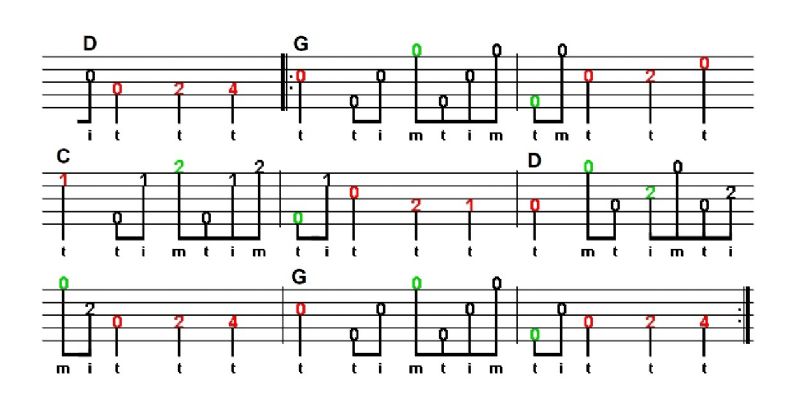
Learn some simple yet tasteful back up arrangements and remember, rolling over the chords can be ok, as long as you're helping the rhythm. You'd be working together with the bass: If you're playing accents, put them on the first beat of a measure. Use your thumb there...
3 finger players should be able to accent anywhere, anytime with any finger, but don't load more onto your tray than you can eat in one time.
Forward rolls (continuing across multiple measures) with most accents on beat 1(except maybe at lead in notes) will give you a starter boost
Here's an example (red: strong accent, green: lighter accent), butdo mind the reversing in the second D measure:
steve davis - Posted - 03/02/2026: 10:32:12
I enjoy playing many keys without using a capo.They each have their own "personality".
Eb,Bb and F are quite happy with the open g on the 5th string.It just depends on where the g note happens.
Edited by - steve davis on 03/02/2026 10:33:38
David M - Posted - 03/11/2026: 14:38:37
A lot of people slate a 5th string (6 fret) sliding capo but my Shubb has been on my Gold Tone for nearly 30 years and I rarely need to touch the 5th string tuning peg after setting the capo, I just don't over tighten it. Only last year I needed to replace the screw and spring for the first time.
Get used to playing out of the G and C keys and you will be able to play in most keys with a main and 5th string capo. I don't jam or play with anyone but I sing a lot and play breaks to most tunes every day.
matthewfbyrnes - Posted - 03/23/2026: 09:55:28
There's a lot of advice out there, and a lot of it is good advice in general, but in your specific situation, I'd follow @RB-1 's advice.
Your goal is to sound nice in a jam as soon as possible. Following RB-1's advice is the best way to achieve that goal.
The only thing I'd add to RB-1's advice is that if you do go the spikes route, you CAN get away with just two, either 7 and 9 (better for E) or 7 and 8 (better for Bb), and then tune the 5th string up or down a half step (one fret's worth) as needed. I've found that I can usually get away with a half-step tuning change on the 5th without it wrecking the tuning of the other strings. And if the guitarist plays open chords without a capo, then you probably won't see Bb or Eb in this jam, so 7 and 9 would be sufficient. But ymmv and spikes are cheap.
In 3-finger style, you can get away with the 5th string not being part of the triad (like having it stay G in the key of F) more easily, but you're playing clawhammer, so you're getting a lot of constant mileage out of that 5th string, and hearing a constant G note throughout all the changes of a song in F (for instance) could get grating. You might eventually decide you like that off-triad drone, but that's spicy. As a beginner in a jam, you'll be happier keeping it mild and getting that 5th string on the triad of the root.
When you've been playing awhile, you might become interested in taking the time to learn all the keys without a capo. IMO, this is easier to make sound good in 3-finger than clawhammer, but it can be done. But as a beginner in a jam, you'll be happier keeping it simple.
Tenor is a different beast. I would switch to the tenor at the jam if you think a tenor fits the music of the jam better, but I wouldn't switch to it just due to difficulties playing in E, D, and C.
BG Banjo - Posted - 03/31/2026: 11:30:02
I do a regular Sunday afternoon country and bluegrass jam almost every week and play all spring and summer with a jam band. I don't think that anyone has ever called out a song in any keys other than G, C, A, D, or E. I think once in a decade someone will call out a Bb. I always spike the fifth for the key regardless, and only use a capo for A. I'm not against capos, that's just how I play. I play up the neck a lot.
Terms of Use | Privacy Policy | Privacy Consent (EU/GDPR Only)
Copyright 2026 Banjo Hangout. All Rights Reserved.


