DVD-quality lessons (including tabs/sheet music) available for immediate viewing on any device.
Take your playing to the next level with the help of a local or online banjo teacher.
Weekly newsletter includes free lessons, favorite member content, banjo news and more.
Premier Sponsors


|
Please note this is an archived topic, so it is locked and unable to be replied to. You may, however, start a new topic and refer to this topic with a link: http://www.banjohangout.org/archive/402355
jsinjin - Posted - 03/16/2025: 20:55:41
I can tell when I’m in tune with my tuner when I go string to string but I can’t tell when it’s off the way my wife and kids can. I’ll just be playing and have no clue it’s out of tune. It’s weird that they can tell so well and it just sounds fine to me. Does anyone else have trouble telling? I try to reset between each practice session but sometimes I forget. But I don’t notice. My teacher can always tell instantly and even which string it is but it all sounds the same to me.
tdennis - Posted - 03/16/2025: 21:30:54
John. it seems you were born to be a banjo player. There is a common joke that most people think the banjo Always sounds a bit out of tune & awry, but players confidently feel they're in tune.
Bill Rogers - Posted - 03/16/2025: 22:51:21
Although I can tell when I’m out of tune, I can’t hear notes the way my sister, the family music whiz, can. I can’t sing a lick because I can’t tell when I’m off key nor can I hear harmony parts. You should work on starting with a banjo you know to be in tune, then de-tuning one string somewhat, then try to get it back in tune by matching string pitch at the appropriate fret. If you keep after it, you should develop your ear enough to keep your banjo in tune. You don’t say whether you can sing. If you can sing on pitch and key, you’ll be able to learn to hear wen your banjo’s out of tune. Incidentally, even if you’re not changing tunings, banjos tend to need their tuning “cleanedup” every tune or two. They will drift enough to be audibly off.
Jerry Hatrick - Posted - 03/17/2025: 01:37:19
Have you tried recording yourself whilst playing (or singing), then listening to the recording later on? You can often hear if any strings or notes are out of tune then, but be prepared to be shocked. I know some recording artistes can’t bear to listen to their own records.
jsinjin - Posted - 03/17/2025: 04:53:52
quote:
Originally posted by Jerry HatrickHave you tried recording yourself whilst playing (or singing), then listening to the recording later on? You can often hear if any strings or notes are out of tune then, but be prepared to be shocked. I know some recording artistes can’t bear to listen to their own records.
When I was in Boy Scouts I worked summers at a camp as a swimming instructor and lifeguard. As the staff we had "programming" for campfire and evening activities that included skits and songs. I was told not to sing but to just mouth the words because as the assistant director said "you can't carry a tune in a bucket!"
banjobob36 - Posted - 03/17/2025: 05:10:22
When we are jamming and I'm picking away on my Gibson the wife glares at me and tells me I'm out of tune I just say keep picking your D45 and mind your own business.
Ziradog - Posted - 03/17/2025: 05:52:07
A banjo player spends half their time tuning, and the other half playing out of tune. I don't have any helpful advice except listen to yourself & to the other instruments playing (if there are any).
Eulalie - Posted - 03/17/2025: 06:00:27
quote:
Originally posted by jsinjinquote:
Originally posted by Jerry HatrickHave you tried recording yourself whilst playing (or singing), then listening to the recording later on? You can often hear if any strings or notes are out of tune then, but be prepared to be shocked. I know some recording artistes can’t bear to listen to their own records.
When I was in Boy Scouts I worked summers at a camp as a swimming instructor and lifeguard. As the staff we had "programming" for campfire and evening activities that included skits and songs. I was told not to sing but to just mouth the words because as the assistant director said "you can't carry a tune in a bucket!"
Music comes as a gift from God for some, a hard-earned skill for others, and a life's work for those who find it difficult to integrate left- and right-brain functions. Apparently, you possess the desire to learn the skill, but learning music demands that the student place himself or herself in the role of a beginner who must place trust in a very patient and accomplished instructor. If you cannot humble yourself and place yourself in the position of a beginner in the hands of a skilled instructor, I refer you to Shakespeare's Merchant of Venice Act V, scene i, line 90.
A Drum On A Stick - Posted - 03/17/2025: 06:30:51
quote:
Originally posted by jsinjinI can tell when I’m in tune with my tuner when I go string to string but I can’t tell when it’s off the way my wife and kids can.
I'm also pretty new to banjo (on year 5 now), and what worked for me when starting out was practicing tuning.
I'd pick up the banjo, and pick each string listening to the notes: gDGBD. Then I'd compare each open string to its adjacent string fretted such that they should be even (using frets 5,4,3,5 in G starting on the bass: D,D.... G,G.....B,B.... etc). Listen for beat frequencies due to uneven tuning. Then I'd strum the open strings and listen carefully to the chord made.
Doing the above several times, I'd try to tune the banjo. For the first few weeks/months of this, I'd end up making it worse. After getting frustrated enough for the day, I'd throw on the tuner and get it properly in tune for my normal practice. Next day, rinse and repeat.
Doing the above slowly trained my ear for those subtle differences and what the "right" tunings sound like. There's a quality to a chord that is perfectly in tune that I find quite recognizable now, even to the point where I disagree with my tuner about how to get it exactly right.
If I remember correctly you play mostly (only?) in open G? I learned tunes in a couple different tunings starting early, so frequent re-tuning was a necessity for me, forcing me to go through the above process frequently.
randybartlett - Posted - 03/17/2025: 07:04:55
I think it is easier with (relatively) new strings.
Sometimes I think pinching 1 and 5 and listening to relative spacing works for me. Then 1 & 3. Then 1 & 4.
2nd string never seems right but playing a standard run up on strings 2 & 1 (0-0, 1-0, 2-0, 3-0) is a test I do.
The harmonics like bugle call rag is also a quick test that my mind can use.
After all this, I look up and everyone went home apparently.
Corwyn - Posted - 03/17/2025: 07:15:00
Piano tuners confidently* tell me that notes that are out of tune with each other make a "beat", a sort of wahwah sound as they go in and out of phase. You might try listening for that instead of trying to notice a minor change in frequency.
* - I can very rarely hear this (or imagine I hear it), so maybe they aren't completely pulling my leg.
Thank you kindly.
jsinjin - Posted - 03/17/2025: 08:09:27
Thanks everyone! Responding to many: I do have an instructor that I meet with every week and she has full recordings of our lessons and a whole set of recordings, song breakdowns, exercises and lessons on Patreon that I use liberally.
Henry V act 3 scene 1 second line.
I have been playing a year and my favorite activity for practice is changing key and going through every chord I can in a type of scale practice and playing each note and fret and memorizing that then pointing to a note on piano sheet music and seeing how fast I can find it or get it from memory in that tuning on each string at the correct fret. It has no purpose but I really enjoy it.
I do have both a tuner and an oscilloscope and I can nail the tuning of my banjo on every string and indeed the tension is enough when even changing to a modal tuning from double D it can knock out other strings.
I do love frequencies and harmonics and with the oscilloscope I love to see how the strings overlap on chords.
But! As I was posting, I can’t tell when the thing is out of tune while playing. And it sounds like a few others can’t. If I don’t tune it up or check my tuning to a key with a tuner I have no idea if I’m in one tune or another or if my instrument is way out of tune. I could tell if the strings were so loose they were sagging but as far as hearing it being out of tune or in the wrong tuning, I’m amazed others can tell instantly. Especially my wife and kids (kids were home from college last week on spring break and let me know).
I’m really fast with the tuner and bought the best one I could find to help me dial it in and since I memorized many of the major and modal tunings I can switch to them quickly with the tuner. I just wouldn’t be able to pick up my instrument or any one and tell if it was tuned or not. I was seeing if others have this ear deficiency.
A Drum On A Stick - Posted - 03/17/2025: 08:42:42
quote:
Originally posted by jsinjin
I’m really fast with the tuner and bought the best one I could find to help me dial it in and since I memorized many of the major and modal tunings I can switch to them quickly with the tuner. I just wouldn’t be able to pick up my instrument or any one and tell if it was tuned or not. I was seeing if others have this ear deficiency.
As a kid I was very fast at using a multiplication table. As fast or faster than kids who could do it in their head. I couldn't multiply in my head though, because I relied so heavily on a table print-out.
Did I have a brain deficiency, or a lack of education and practice due to reliance on a crutch?
Edited by - A Drum On A Stick on 03/17/2025 08:43:37
jsinjin - Posted - 03/17/2025: 09:10:46
As a kid I was very fast at using a multiplication table. As fast or faster than kids who could do it in their head. I couldn't multiply in my head though, because I relied so heavily on a table print-out.
Did I have a brain deficiency, or a lack of education and practice due to reliance on a crutch?
yes but after a full year of daily practice I still can't tell if two notes are different. I used a piano ear training and never got above 50 percent. Now in my PhD I did realize that memorizinf all the integral tables for an integration competition (which I won) was a hindrance since the shortcuts kept me from a later obvious algebraic error in my solution to a transform on an optical wave form derivation. So yes one can rely to much. But this is just a hobby, I quite frankly hate playing by ear and despite a full 12 months with daily practice I still couldn't pick out a C vs G as two notes at all. Every time I take the quiz on brainjo with the instructor playing one version of happy birthday supposedly correctly and the other incorrect I just guess and after about 8-10 songs I get the response "are you sure you were trying, you did ok better than random chance".
but I'm very very fast with an oscilloscope and a tuner. And I absolutely have my multiplication tables memorized.
Dan Gellert - Posted - 03/17/2025: 09:26:17
quote:
Originally posted by jsinjinI was told not to sing but to just mouth the words because as the assistant director said "you can't carry a tune in a bucket!"
You'd be real surprised to find out how many now-master-level musicians have had the exact same experience. Sadly, "common sense" in our culture assumes that a sense of pitch is a gift that you either have or don't. WRONG!
You have to learn that skill, and you still can. Ask your teacher for some advice on that. If they can't help you, or don't think it's all that important, you really need to find another teacher.
Making music is, like speaking a language, about hearing, distinguishing, and imitating SOUNDS. You cannot make anything come out of your instrument that hasn't first gone into your ears, and been processed and perceived by your brain.
The perception has to come first, and it will improve steadily with practice. I've been playing for most of my 76 years, and (though I'm sure a test would show that the physical acuity of my hearing has diminished with age!) I'm still regularly surprised to hear new levels of detail in a favorite recording that I've listened to thousands of times before.
banjered - Posted - 03/17/2025: 09:33:46
"...born to be a banjo player..." Ha! Out of tune, out of pitch and out of luck! My mother's side could not carry a tune in a wheelbarrow but my dad was a singer and harmonica player. I was told that when I was about 4 years old my mother was singing some song like Row Row Your Boat and I reputedly said, "No mom, it goes like this...."
Try singing even in your head in standard G tuning, "From this valley they say..." on open strings 4-3-2 and "Burry me not..." on strings 3-2-1. Some people are born with spot on pitch and timing. I'm not perfect but pretty functional, at least enough to be..."a banjo player." Ha! banjered
BG Banjo - Posted - 03/17/2025: 11:39:24
I have the opposite, I'm playing at a jam and I'm thinking, dang, I'm really out of tune. Then when the song is done, I switch on my tuner to check and I'm right on. Next song I think, dang, I swear that I'm out of tune.
jsinjin - Posted - 03/17/2025: 12:46:29
I’m more fascinated by the idea of fretless instruments and tuning. I can with the oscilloscope tune to the banjo itself at the various frets for a given key and even listen for the overtones to vibrate in synch.
A friend has an upright bass and I can’t imagine finding the “spot” for the correct notes. Of course that goes for any smooth neck instrument from fiddle to yo yo Ma’s cello. I would have to put markers on the side of the thing to find the right points!
Corwyn - Posted - 03/17/2025: 13:32:21
quote:
Originally posted by jsinjinI do have both a tuner and an oscilloscope and I can nail the tuning of my banjo on every string and indeed the tension is enough when even changing to a modal tuning from double D it can knock out other strings.
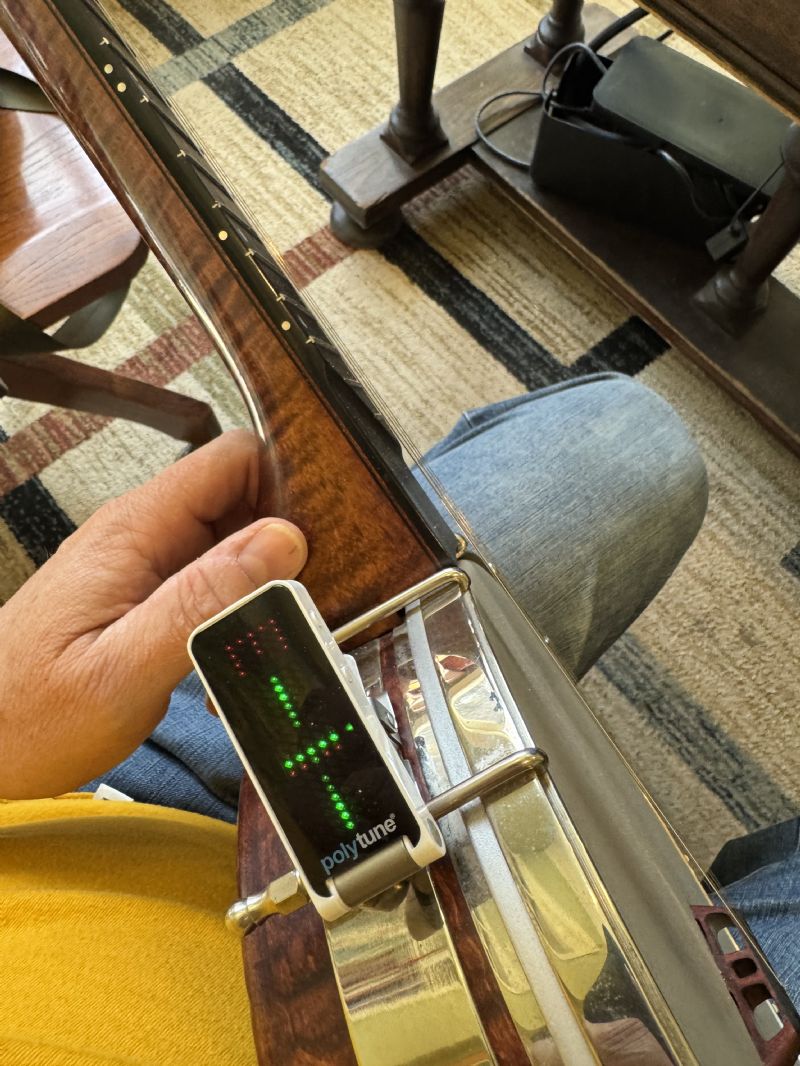
Perhaps get one of the tuners that attaches directly and (semi) permanently to your banjo and leave it there. And then make a habit of glancing at it frequently. This way you are ALWAYS tuning. There are some that are screwed into the back of the head, and some mount between the hooks on the pot.
Thank you kindly.
banjered - Posted - 03/17/2025: 13:48:35
For BG above who suspects that "it is 'them' and not me after all." At our old jam the main fiddle player was a piano tuner and I guess he must have been cursed with perfect pitch. He was always saying, "It's time to tune up again." Poor fellow, he just know what he is missing to be a qualified banjo player. banjered
jsinjin - Posted - 03/17/2025: 15:12:04
I have a friend who is an audio engineer and works as head of audio for a major sports franchise at both the mega stadium and their big practice facility. He has tuning fork pitch and often won’t even go to certain buildings like churches or theaters because the audio is terrible.
But he is one who bad tuning seems to actually physically hurt. I am the opposite where I can’t tell if a middle school-first week with their instruments and no background in music-orchestra is playing baa baa black sheep poorly or like musical savants.
Dan Gellert - Posted - 03/17/2025: 18:23:22
Have you ever tried singing or playing individual notes against a continuous drone? It's the ratio of one frequency to another that makes the interval sound as it does.
wrench13 - Posted - 03/18/2025: 07:07:54
Developing relative pitch takes time but IS a learnable skill. There is a few websites with tools to help you develop that. But its a 2 edged sword sometimes, in jam or with a band, I can tell which instrument and string is out of tune. But that doesn't mean the offender will retune for you! The other nite at a jam, I announced between songs 'Lets all check tuning please' but the offender didn't move a muscle. Had to glare the guy down, seriously, and re announce that before he got the message. The picker next to him thanked me after! When I pay banjo, I just have to accept some out-of-tuneness. I can see how banjo would not be the instrument for someone who has perfect pitch (which I do not suffer from!).
janolov - Posted - 03/20/2025: 11:55:43
I once heard Bruce Molsky tell the following anecdote:
Q: How long does it take to tune a banjo?
A: Nobody knows, it has never been done!
jsinjin - Posted - 03/20/2025: 19:39:29
quote:
Had to glare the guy down, seriously, and re announce that before he got the message. The picker next to him thanked me after! When I pay banjo, I just have to accept some out-of-tuneness. I can see how banjo would not be the instrument for someone who has perfect pitch (which I do not suffer from!).
I would be that guy. I once tried to play with a friend who was learning guitar. We both decided to play together. I couldn't tell a thing and this was way before I knew anything about keys or tunings. I just heard he was in c tuning and I tuned my banjo to double c. We spent two hours with him not being able to stand it and stopping me and having me check and check and check with my electronic tuner. Turns out one of my strings was a sharp instead of the regular string and I had no idea what the symbol was for that on the tuner. I kept saying "no it says it's in tune". But I also couldn't tell. I never can. I once tried randomly tuning my strings just high and low with no pattern at all and it still sounded fine to me.
wrench13 - Posted - 03/21/2025: 04:49:02
quote:
Originally posted by jsinjinquote:
Had to glare the guy down, seriously, and re announce that before he got the message. The picker next to him thanked me after! When I pay banjo, I just have to accept some out-of-tuneness. I can see how banjo would not be the instrument for someone who has perfect pitch (which I do not suffer from!).I would be that guy. I once tried to play with a friend who was learning guitar. We both decided to play together. I couldn't tell a thing and this was way before I knew anything about keys or tunings. I just heard he was in c tuning and I tuned my banjo to double c. We spent two hours with him not being able to stand it and stopping me and having me check and check and check with my electronic tuner. Turns out one of my strings was a sharp instead of the regular string and I had no idea what the symbol was for that on the tuner. I kept saying "no it says it's in tune". But I also couldn't tell. I never can. I once tried randomly tuning my strings just high and low with no pattern at all and it still sounded fine to me.
John, this was an odd situation, as the offender was a regular jam participant , a upper low level picker. A true beginner could be excused, as it takes time to develop the ear that hears out-of-tuneness. Dont feel bad about the tuner thing - I've broken strings because my glasses weren't on and i cound't see the # or b symbol! LOL, lately those become more and more needed!
jsinjin - Posted - 03/21/2025: 05:09:30
Oh I don’t feel bad! We both laughed about it. I’m not actively trying to get better at tuning and it doesn’t hamper my practice. I just don’t worry about not being able to tell if my instrument is in tune or not. I have a tuner always there and I check it regularly. I just can’t hear if I’m in tune or not and I don’t worry about it much.
LouieChee - Posted - 03/21/2025: 05:50:58
Music, like any skilled endeavor, has a talent component to it. I think it can be a sensitive subject but it's the reason why some are challenged by playing a few chords and some compose Minuet in G at 5 years old (Mozart). However, that doesn't mean we can't all have fun playing the banjo!
A large degree of our sense of pitch is innate. A small percentage of people can identify or produce a given pitch without any reference. I've heard that for these people, pitches are distinguishable like colors. It would have taken training for them to identify the sound but the level of understanding has probably mostly been there from the start.
I think others are right in that some degree of relative pitch can be learned/trained, and luckily for a fretted instrument it's not as important. Try not to get discouraged!
banjoak - Posted - 03/21/2025: 15:51:38
quote:
Originally posted by Dan GellertHave you ever tried singing or playing individual notes against a continuous drone? It's the ratio of one frequency to another that makes the interval sound as it does.
Excellent recommendation, IMO works well; but brings up a point with how interpreting or defining 'in-tune" means... and some misunderstanding of concepts, terminology, questions, and what they are listening to/for. As well some assumptions about what other folks are doing, or abilities. That difference might lead to, and explain a bit of confusion, bewilderment, and struggle?
A. Qualitative sound of the perceived relationship of notes to each other, and key; how it sounds in a contextual and holistic way. Might involves bit of the subjective sensory experience.
B. Quantitative based on some external factitious defined fixed numeric metrics; (default table is as tuner is set to read, ET A440); and each pitch on it's own, separate and independent. Perhaps with this, is related to more about getting objective "right" answers, as on test questions?
When folks say they can't tell if "in-tune"... seems most often describing as more focused, zoomed into as based on assumed goal of the latter quantitative (B)... listening by ear to a single note independently, be able to discern specific pitch class name AND if matches the specific defined frequency. For example, hear one single note and identify that as D4 and if 293.66Hz (or amount +/-); independently another single note as G3 and if 196Hz... and so on separately for all notes. Needs to rely on type of memorization. Most folks as listeners, (inc. musicians) don't use this, or have ability to, as it's very difficult; and don't find necessary, nor that useful.
As far as others ability to tell instantly being "out-of-tune" - they are most likely, as most folks normal hearing do... just based on the former, qualitative relationships (A); not likely anything of the latter (B), nor compared to tuner reads. As well, another related aspect to "out-of-tune" - average normal listeners are just using more idea of accuracy/parameters; rather than binary dead-on precision (right/wrong). IOW "out-of-tune" is just referring to sense of noticing when it's outside of the range/parameters... thus sounds odd, sour, rough, discordant, simply subjectively not good.
[some of this A) qualitative relationship vs B) quantitative metric/right answer; might also explain struggle with discerning chords, and rhythm aspects?]
banjoak - Posted - 03/21/2025: 16:13:43
quote:
Originally posted by jsinjinI have a friend who is an audio engineer and works as head of audio for a major sports franchise at both the mega stadium and their big practice facility. He has tuning fork pitch and often won’t even go to certain buildings like churches or theaters because the audio is terrible.
But he is one who bad tuning seems to actually physically hurt. I am the opposite where I can’t tell if a middle school-first week with their instruments and no background in music-orchestra is playing baa baa black sheep poorly or like musical savants.
Tuning fork pitch? Has nothing to do with how sound works for buildings and audio engineering; unrelated and irrelevant.
jsinjin - Posted - 03/21/2025: 16:32:25
I could have someone pick up my banjo, randomly take it out of tune or put it in tune and I wouldn’t be able to tell. I’d just start playing and have no idea if it were some type of tuning like double C or way out of tune and if a friend was in a completely different key I would have no idea. I know this is a learned ability and I tried for a bout a year but I’m convinced I have no idea what one note is compared to another and definitely not any perspective on a chord or a key. They all sound the same to me outside of an oscilloscope.
On this website:
brainjo.typeform.com/to/o7IUL9...o.academy
With this quiz I have never finished where I didn’t get the response “you didn’t score bettter than random chance are you sure you weee listening?” Every song sounds fine to me either way.
banjoak - Posted - 03/21/2025: 18:50:06
From many, many descriptions, might consider possible have amusia. (tone deaf). If so, it's not a matter of learned ability.
Not sure how reliable test on websites, folk could fail those for other reasons. Need a proper diagnosis check, to differentiate whether is actual neurological amusia... or simply other things.
I've had a lot folks think/insist they are tone deaf, tin ear; was based on their failure to do some things; they misunderstood what thought needed to do; unfamiliarity; or small handful other factors. Turns out did not have amusia, can hear in fairly normal range; and learn to play music. (indeed, desire to want to play is good indicator probably don't have amusia)
Amusia is fairly rare. I would think even rarer for someone on BHO; or anyone desiring to play an instrument? Why would they want to? or what hope to get out of it? Good news is probably don't have to worry about tuning, intonation... won't really make a difference.
jsinjin - Posted - 03/21/2025: 20:30:22
I dont worry about it! My goals are to 1)Learn music theory and a bit about music and 2) learn about 8 or so songs I can play by myself by the campfire. I actually don’t enjoy most music in terms of songs. Never see the point in music; car or church or otherwise. It’s just not something I enjoy. But I do enjoy practicing. It’s my peace in the day. I was just commenting here that I scant ever tell when I’m out of tune but others can. That’s all. Music as in playing it, participating in jams or going to hear others play isn’t something I find fun at all. I just don’t get it. I actively work to go to mass that’s either no music or I go to the monastery with the monks that chant. I listen to books, grand rounds at medical schools, a few podcasts and lectures. No Apple Music, Spotify, Amazon or any other music thing and in the car it’s all my lectures and books.
Again, I’m playing banjo for the practice, the sheer craftsmanship of my instrument which I love and because it’s very soothing to me to practice repeat patterns over and over.
eccles - Posted - 03/22/2025: 07:26:53
As Banjoke has said it is possible to be tone deaf and there is nothing one can do about it. Personally I am fortunately in the upper echelon of being able to distiguish between tones but still not as good as my son who is pitch perfect and can play practically anything. I recall a youngster a few years ago who got a decent spanish guitar from his father and after a few weeks wanted to play in church. The pastor was a kindly soul and agreed. After a few minutes of an awful racket he thanked the youngster and led him away. The youngster's father asked me what the problem as and I had to tell him that his son was tone deaf and would sadly never be a musician.
bosborne - Posted - 03/22/2025: 07:39:50
quote:
Originally posted by jsinjinI can tell when I’m in tune with my tuner when I go string to string but I can’t tell when it’s off the way my wife and kids can. I’ll just be playing and have no clue it’s out of tune. It’s weird that they can tell so well and it just sounds fine to me. Does anyone else have trouble telling? I try to reset between each practice session but sometimes I forget. But I don’t notice. My teacher can always tell instantly and even which string it is but it all sounds the same to me.
No surprises here. People who are good to great singers know intuitively when they're on or off pitch. It is a intrinsic capability, but this capability can be improved through practice. Then there are people who cannot tell if they're on or off pitch. They will never be great singers!
jsinjin - Posted - 03/22/2025: 08:18:21
Yes and as my personal statement hero, Wolfgang Pauli said, “it is unwise to seek prominence in a field whose routine chores you do not enjoy.”
I don’t enjoy music, distinguishing one note from another, playing with groups, learning to tell a tune from a few chords and foot tappings and join in. The activity and routine chores to get better bring me no joy. I love practicing patterns, love learning sheet music and love to do this while camping. I’ve learned that is not what banjo culture is all about but the banjo is mine and I’m having fun doing it.
But I did notice just like not being able to tell what chord changes occur I can’t tell when my banjo is out of tune. I spent some time as in a few months with daily practice trying to distinguish tunings, tell what notes are different from each other using a couple of apps and trying to be able to tune my banjo to itself but I just can’t hear two notes and feel when one is higher or lower at all. I can definitely tell the left side of the piano from the right but I can’t tell an A is higher or lower than the note next to it. I guess every single time. I just try and try then I guess and I’m 50: 50
I’m also horribly colorblind with near monochormatic vision yet I went into optical processes in semiconductors for my PhD and used the theory and spectrophotometers quite well even though I couldn’t see the light colors. And I was and remain passionate about that field and my work. But I’ll never become a painter or graphic artist. And I treat none of this as a poor me. It’s factual. I’m fascinated by a Monet painting in terms of how the various dye molecules reflect color even though I can’t see it. In music I’m fascinated by the patterns even though the music doesn’t make sense. I row every day on the lake behind my house, hard and following a program used for training rowers and I’ll never get into a race; I just love my classic wooden single scull and the act of rowing for practice. I have a nice banjo and I love it and I love the act of practicing banjo.
campandstrum - Posted - 04/03/2025: 20:10:02
For a long time I could not hear when I was in tune. Over time I have improved and can easily hear when I am out of tune. Tune often so your ear is training to hear what "in tune" sounds like.
Terms of Use | Privacy Policy | Privacy Consent (EU/GDPR Only)
Copyright 2026 Banjo Hangout. All Rights Reserved.