DVD-quality lessons (including tabs/sheet music) available for immediate viewing on any device.
Take your playing to the next level with the help of a local or online banjo teacher.
Weekly newsletter includes free lessons, favorite member content, banjo news and more.
Premier Sponsors


|
Please note this is an archived topic, so it is locked and unable to be replied to. You may, however, start a new topic and refer to this topic with a link: http://www.banjohangout.org/archive/396550
Diulin - Posted - 03/29/2024: 09:13:39
Having always used PF-150 steel strings (for a few decades) about a month or so ago I decided to try Nylgut on my 1891-94 Stewart Universal Favorite with the Common Sense tailpiece. I love the sound, but my first and fifth strings keep breaking. I tie them with bowlines, I tune them up slowly, even bringing them to within 2-3 steps before leaving them overnight. Usually they break unpredictably, when I'm playing or even when the banjo is just sitting there: only once while I was tuning, and that was the one time I got impatient.
Based on my autopsies, they seem to be breaking at the knot, or possibly at the bridge. I took the banjo to my favorite banjo guru at the Fretted Instrument Workshop (shuttered as of this month after 53 years :( ) in Amherst, MA. He didn't see any issues with the bridge or the tailpiece. I've attached a picture of my tailpiece and bridge and, for what it's worth, a picture of the end that broke off of my most recent string. I should add that this was the third or fourth time that this particular fifth string has broken, since I just keep retying it.
I've seen suggestions for other knots on other threads here, but a lot of those would be difficult or impossible on my tailpiece, where I have to loop the string around before tying the knot. Maybe a figure-8 on a bight might be less prone to breaking, but tough to tie on a banjo string. Maybe I should tie the loop first and then attach it the way I would a steel string with a factory-made loop???
Maybe my cat is chewing on them when I'm away? (I loved that post from a few years ago by someone who had that experience!)
I don't want to go back to steel, but this is my only banjo, so when a string breaks, I just have to stop playing, which makes me very sad!
So any suggestions would be welcome. Are there stronger strings that would still offer that lovely mellow tone? Maybe real gut? I might try adding a steel fifth string to four Nylguts; then at least I'd only be worrying about the first string. I don't have the sorts of tools I might need to do fine adjustments to the bridge or the tailpiece, but maybe there are things I should try with common tools?
Thank you!
ScreamingVegetables - Posted - 03/29/2024: 09:35:35
I am also using Nylgut strings on one of my banjos. I have had strings breaking too and I saw a video where the guy said that he tuned this particular string lower (than concert pitch I assumed). He also said that he was using LaBella 17 strings to tune up to concert pitch because of less breakage. (Seen here: amazon.com/dp/B000EEN9PA?psc=1...t_details).
You mentioned the music store in Amherst. The last time I was there, Lynn Hardy, ex wife of Jay Unger was behind the counter. I bought my first banjo there (an Ode I wish I still had) when either a guy named Jerry or Tony Cramer owned it. Sad that it's gone.
Don Brunetti (Screaming Vegetables)
Diulin - Posted - 03/29/2024: 10:00:43
quote:
Originally posted by ScreamingVegetablesYou mentioned the music store in Amherst. The last time I was there, Lynn Hardy, ex wife of Jay Unger was behind the counter. I bought my first banjo there (an Ode I wish I still had) when either a guy named Jerry or Tony Cramer owned it. Sad that it's gone.
Don Brunetti (Screaming Vegetables)
Yes, that's the one. I remember when Lynn worked there -- a long time ago, maybe just after she and Jay split up. And, yes, Tony Cramer (sp?) owned the shop the whole time. Great guy, super-knowledgeable.
By the way, I put the fifth string back on using a figure-eight knot on a bight, which I tied before looping it around the tailpiece and through itself, the way you would with a steel string with a factory loop. I know there are other folks like us on here who love our non-steel strings but have trouble with them breaking, so I'll post again when I have a better sense of how well that works.
ScreamingVegetables - Posted - 03/29/2024: 10:38:19
Thanks for the update on the Amherst store. I hadn't been in that store in years, though I get to the area once a year because my son owns Wildwood BBQ on Rt 9 in Hadley.
As you probably know, Amherst has a wonderful music tradition. Buffy Saint Marie went to UMass. So did Taj Mahal. The Canterbury Country Dance Orchestra played in Amherst quite a bit and of course, Bill Keith and Jim Rooney also went to school there. I grew up in South Hadley but I never realize how musically rich the area was until I moved away.
Joel Hooks - Posted - 03/29/2024: 10:49:55
It looks like your tailpiece has been bent and pulled by wire strings. Has it been mangled?
Regarding the bowline knot, I'm not sure why that ever became a thing. It is too complicated, ugly, creates a stretched out loop, and caused a weak point at the knot from the binding.
Use a figure 8. It is clean and easy. You can also use a two half hitches, but the figure 8 is all you need. The attachment knot used on Spanish (classical) guitar tie blocks might work but it would be cramped.
To connect to peg: put through peg hole and twist the working end around the string a couple of times then tighten. No knots needed.
"Nylgut" are polyester and are susceptible to any abrasion.
One thing to NEVER do is any of those "stretching" tricks taught on youtube. "Stretching" will cause the string to go false and intonate incorrectly. Your banjo will never sound in tune when fretted.
Also, get rid of that unwound 4th. Aquila did a big disservice to banjosist by doing that and it should have never been done. The 4th was always wound on the banjo as we know it for a good reason.
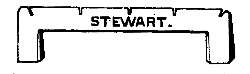
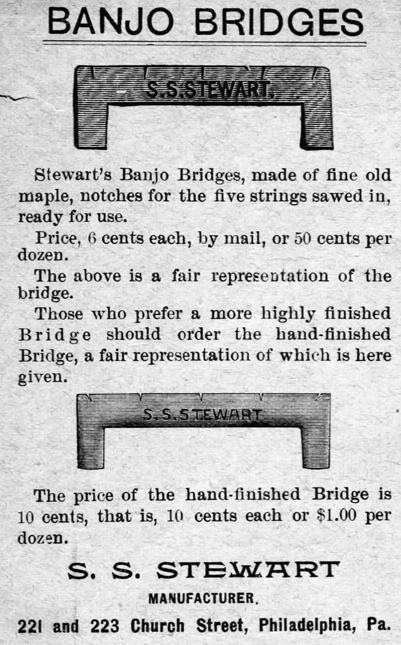
See below for what your bridge should look like.

Joel Hooks - Posted - 03/29/2024: 11:00:08
quote:
Originally posted by ScreamingVegetablesThanks for the update on the Amherst store. I hadn't been in that store in years, though I get to the area once a year because my son owns Wildwood BBQ on Rt 9 in Hadley.
As you probably know, Amherst has a wonderful music tradition. Buffy Saint Marie went to UMass. So did Taj Mahal. The Canterbury Country Dance Orchestra played in Amherst quite a bit and of course, Bill Keith and Jim Rooney also went to school there. I grew up in South Hadley but I never realize how musically rich the area was until I moved away.
... and that entire area had a strong presence of what we call "classic banjo". In fact, "classic banjo" was what all these banjos were designed to play.
Since you are not too far, in May we are having our American Banjo Fraternity Spring Rally in Palmyra, NY (near Rochester) This is the only event focused on the type of music that your SSS was designed around. This is also the best event to hear and play classic era banjos set up and played correctly. There are usually a handful of Stewart banjos there, and I know a couple of people will be bringing some very high end Stewarts.
Since our focus is specifically "classic banjo" and the repertoire that goes with that (not "classical" you won't hear much of that if any), we don't play "old time" but some of our members are very good old time banjoists as well.
Anyway, the rally is free to attend for anyone interested and people who actually know about these banjos can take a look at yours (despite what they might say, 99.9%+ of music stores do not have a clue about how these banjos should be set up).
banjofraternity.org/rally-news/
Diulin - Posted - 03/29/2024: 11:55:21
Joel, thanks for all those tips. I have no trouble with complicated knots, since I spent years as a rock climber, but I like the looks of those simple knots in your picture. I'll wait until another string breaks or (fingers crossed) I just decide to change them all out, but then I'll try those knots. As for the bridges: I'll gladly take a dozen for 50 cents! But, seriously, it would be nice to get some bridges like those. I messaged a guy on Banjo Hangout who advertised some nice one-piece maple bridges (no cap), but I haven't heard back.
I've seen those wound 4th strings (wound around nylon, I guess?), but I haven't had a chance to try one. My problem with the Nylgut 4th that I'm using is that, being softer than the steel I'm used to, it sometimes slips off of the fingerboard if I don't come down straight enough. Maybe that will just take practice.
And thanks, too, that tip on the classic banjo rally. I haven't lived in Amherst since 1988, but I now live closer than that to Palmyra, so maybe I'll see you there. I got away from playing for a long time, but since last year have been getting back into it in earnest.
Edited by - Diulin on 03/29/2024 12:05:49
Diulin - Posted - 04/12/2024: 18:44:11
So, my fifth string lasted about two weeks with a figure-eight loop around the common sense tailpiece. Then it broke just above the knot. As always, it happened when I wasn't even playing it. But that's OK, because now I get to try out Joel's much more elegant knot. Hopefully that will last longer!
I wonder if I could just buy a role of .020" fishing line and cut sections of it as needed. Has anyone tried that? (I'll be there are forums on it!). I'm thinking that fluorocarbon might be better than nylon: stronger, less stretch, more abrasion resistant.
Dan Gellert - Posted - 04/14/2024: 07:59:22
I've used fluorocarbon fishing line for strings, and found that the smallest gauges tend to shred on the frets. Maybe that was a bad spool or something, since my favorite uke strings (Martin fluoro) are even lighter, but also impressively durable.
IMO, FC comes closer to the crackling tone of gut than does either nylon or Nylgut. I wonder why no one has yet marketed a FC set of similar tension to the LaBella 17....?
Edited by - Dan Gellert on 04/14/2024 08:00:17
Joel Hooks - Posted - 04/14/2024: 08:08:18
quote:
Originally posted by DiulinSo, my fifth string lasted about two weeks with a figure-eight loop around the common sense tailpiece. Then it broke just above the knot. As always, it happened when I wasn't even playing it. But that's OK, because now I get to try out Joel's much more elegant knot. Hopefully that will last longer!
I wonder if I could just buy a role of .020" fishing line and cut sections of it as needed. Has anyone tried that? (I'll be there are forums on it!). I'm thinking that fluorocarbon might be better than nylon: stronger, less stretch, more abrasion resistant.
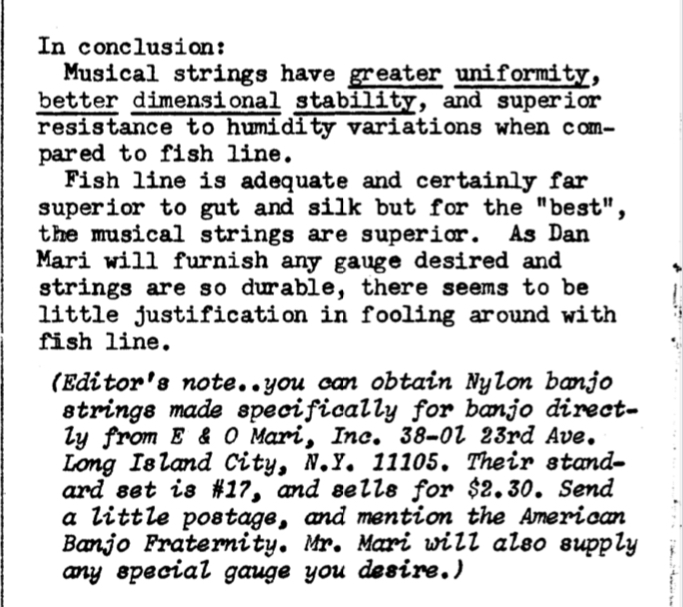
Fishing line is not made the same way as music string. It is made for catching fish, so things like evenness is not important, only tensile strength.
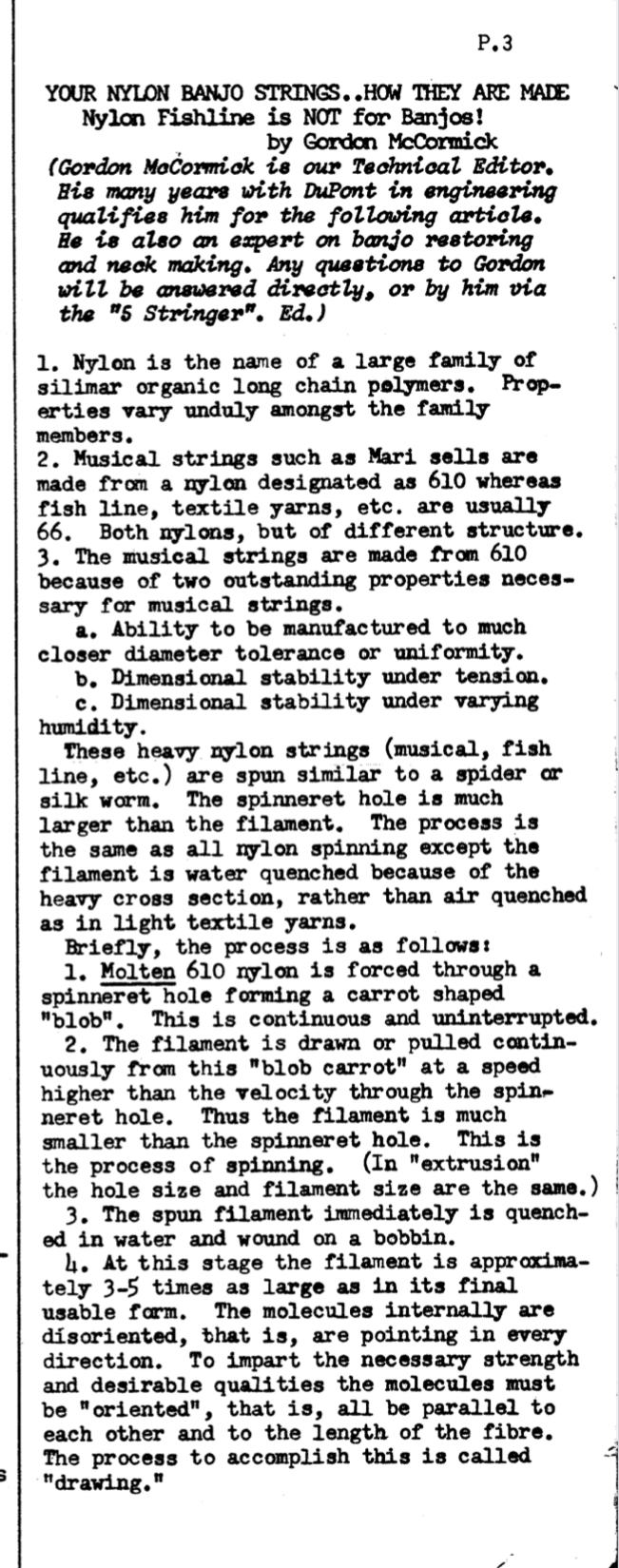
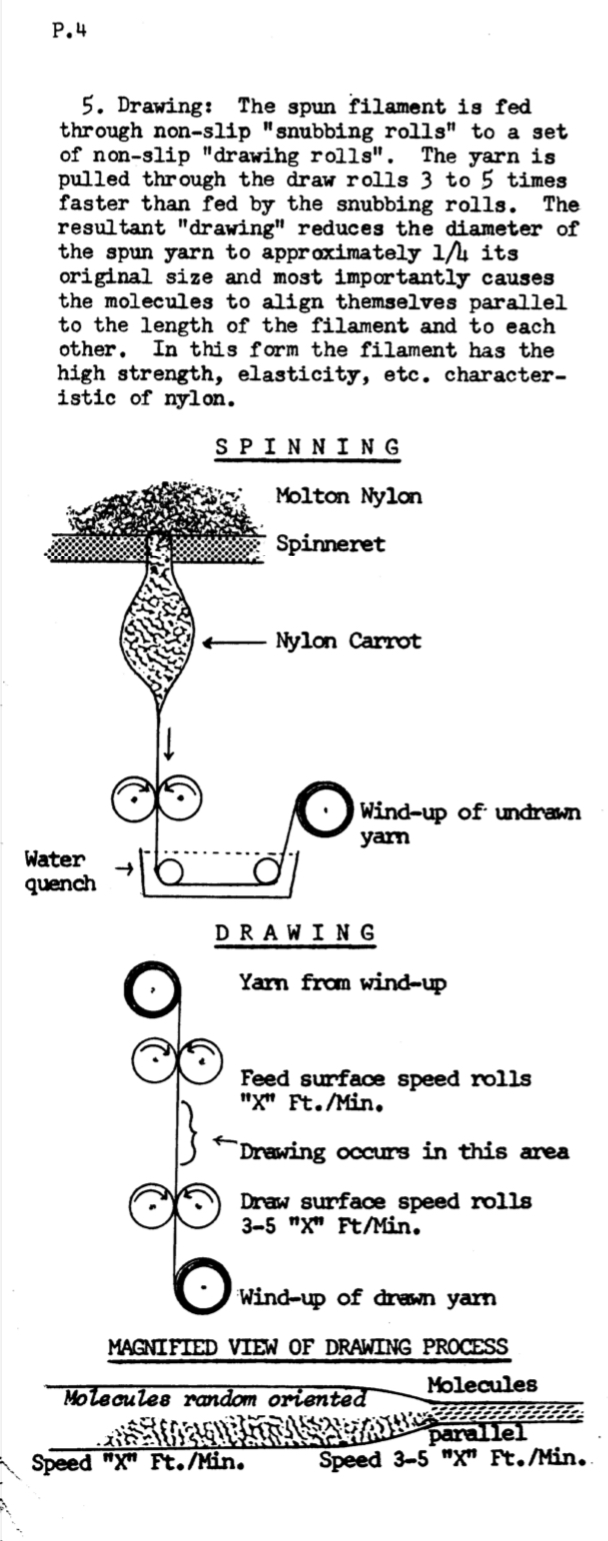
Fishing line is usually extruded, which is a slightly different process than who DuPont makes music strings.
The polyester strings "nylgut" are also extruded which is why they can have problems with being true.
Eulalie - Posted - 04/14/2024: 09:13:32
quote: Originally posted by Diulin
"So any suggestions would be welcome. Are there stronger strings that would still offer that lovely mellow tone? Maybe real gut? I might try adding a steel fifth string to four Nylguts; then at least I'd only be worrying about the first string."
I briefly scanned the other responses to your original post and no one seems to have mentioned the most important thing about stringing. We are all accustomed to buying a set of strings that has been packaged for the average instrument with the average scale length. With gut strings—and with synthetic strings like Nylgut and fluorocarbon—it is important to choose the proper string diameters that suit the scale of your instrument, measured from the bridge to the nut. There are string calculators available online to facilitate this step.
Both Nylgut and fluorocarbon strings have their unique problems. As Joel Hooks likes to point out, Nylgut strings are not nylon; the material and manufacturing process results in a product that demands correct string diameters to avoid breakage. Fluorocarbon can add a nice clear treble sound to your instrument and they last nearly forever. But the material has very different properties than gut, nylon or even Nylgut, and the string diameters need to be properly sized based on the density of the material. In brief, fluorocarbon strings must be thinner diameters than any other material for the same scale length.
I would not recommend mixing synthetics with steel strings. The difference in tension would be problematic and the sound would not be consistent.
Diulin - Posted - 04/14/2024: 11:01:57
Joel, thanks for that article on the making of drawn nylon. Very interesting and helpful. If Nylgut is extruded and therefore weaker and less consistent, what do you recommend? Maybe I'm just used to steel, but I find the Nylgut strings to be kind of floppy, or like "wet spaghetti," as someone said on a different thread.
Joel Hooks - Posted - 04/14/2024: 13:22:53
quote:
Originally posted by DiulinJoel, thanks for that article on the making of drawn nylon. Very interesting and helpful. If Nylgut is extruded and therefore weaker and less consistent, what do you recommend? Maybe I'm just used to steel, but I find the Nylgut strings to be kind of floppy, or like "wet spaghetti," as someone said on a different thread.
I can't recommend anything. As far as I am concerned, the wire strung banjo is a different instrument. Nylon takes commitment and dedication to learn how to play on. Practice and focus on tone production.
Anyone can scratch away at a fiddle, but the dedicated musician spends countless practice hours focused on tone production.
At the point one calls nylon strings "wet spaghetti" then I recommend they continue to play their wire strings. Dynamics and sensitive tone is not for them.
Eulalie - Posted - 04/14/2024: 13:49:06
quote:
Originally posted by Joel HooksAt the point one calls nylon strings "wet spaghetti" then I recommend they continue to play their wire strings. Dynamics and sensitive tone is not for them.
Yes, nylon strings and steel strings produce very different sounds, but one does not like to assign superiority to one type over the other. I think the original poster was describing his experience with low tension from the synthetic strings, and "wet spaghetti" is an unsurprising metaphor.
As for dynamics and tone production, it is certainly possible to extract a variety of sounds from steel strings—of course it depends upon the instrument—but steel strings produce a more present sound than synthetic strings. And I have heard plenty of classic-style players using an unsubtle attack at the bridge without offering a range of dynamics.
When it comes down to it, using synthetic strings to reproduce a 19th-century sound offers only an approximation of real gut strings. Nylon, Nylgut, fluorocarbon, are a poor substitute for the real thing, but who wants to pay for real gut and deal with their inconsistencies and far too frequent breakage.
Synthetic strings are fine. Steel strings are fine. Use what you like and try to get a good sound and make nice music.
i
Diulin - Posted - 04/14/2024: 14:49:30
quote:
Originally posted by Joel Hooksquote:At the point one calls nylon strings "wet spaghetti" then I recommend they continue to play their wire strings. Dynamics and sensitive tone is not for them.
This is just my first venture away from steel strings, and Nylgut is all I've tried so far. As I said, the looser strings are probably something I need to get used to and hopefully learn to appreciate. I've sensed a lot of disdain here for Nylgut, so I thought maybe that was the problem (if it's a problem at all), and I should try a different synthetic. I can't afford to be swapping out strings every few days just to get a feel for all of the options, so I thought I'd ask. I'm sorry if I stepped on any toes with my newbie questions.
Pomeroy - Posted - 04/14/2024: 14:52:59
Eulalie's reference to using string gauges calculated for your scale length and tuning is absolutely critical.
You ask if there are other options than nylgut - Yes there are. You might want to experiment with rectified nylon classical guitar strings. Everyone will have different preferences; personally I intensely dislike nylgut mostly because of the way they feel under my fingers, partly because the off-the-peg 'fit' is as likely not to be a fit at all. Rectified strings have a surface texture more similar to gut. This slight 'bite' assists my playing. Savarez red/yellow/or white card rectified string range can be purchased as single strings and for me are a good substitute when I am not using gut. Plenty of scope to select for tension. Nice tone, nice feel and way more durable than gut. There are many other rectified strings to choose from if Savarez aren't to your taste.
But my #1 preference is for gut trebles and silk bass(es). The sound available to you with gut is unlike anything else. To some extent your touch will adapt to gut strings. Also don't assume 'gut' is one generic type. There are significant differences in regard to sound and appropriateness in, for example unsplit gut and gut that has been varnished. The only drawback is cost. I sometime swap-in a suitable gauge Savarez rectified 1st string to a gut set as this off-sets the breakages that occur most frequently on the gut 1st string and does go some way to saving expense. These preferences for me relate to fingerstyle playing on 19th century instruments. For clawhammer playing (including fretless) on modern banjos I prefer wire strings.
Trial and error (even when calculation is involved) and achieving what feels and sounds best to you is the way to go.
Edited by - Pomeroy on 04/14/2024 15:05:59
Pomeroy - Posted - 04/14/2024: 15:17:44
Just to add that makers of gut strings provide ample guidance on fitting. The nut will need modifying for gut; basically rounding the profile of the top, tapering the leading and trailing edges of the slots and an overall fine polishing. It's straightforward to do this yourself with the right tools.
It's also a good idea to slack off the string tension by a half-step (at least on the 1st string if not all of them) when not playing. The alternative is to come back and find your banjo has one less string than the last time you picked it up.
Also FWIW I like using the bowline knot to attach my strings at the tailpiece. I happen to prefer the knot a distance away from the tailpiece. The sometimes uneven length loops this gives doesn't bother me and certainly has no effect whatsoever on playing. I've never yet had a string break at the knot.
Edited by - Pomeroy on 04/14/2024 15:27:09
Joel Hooks - Posted - 04/14/2024: 18:13:04
Perhaps I need to get my hearing tested, I've used various real gut sets over the years and, all things being the same regarding diameter, I just can't really hear a difference or advantage over rectified nylon. I feel a difference in that gut will often have a tackiness that nylon lacks. But to my non canine ears they sound close enough that I could not tell them apart in a blind test.
I did not mean to be disparaging, but often times people will briefly try nylon only to throw their hands up and say "wet noodles" without dedicating any time to them.
Polyester strings are okay, but they have their disadvantages. For one, I will circle back to the packaged sets in general circulation being too thick. For two, the unwound 4th should have never been a thing offered.
They will eventually go false. This drove me crazy when I was staring as my banjo would slowly develop intonation issues and I did not understand why. They develop flat spots at frets faster than nylon.
For some reason, my skin causes them to squeak if my fingers are very dry. I'm not alone in this as I have read guitarists claim this problem too.
With all that said, the "historical" sized sets I offer work well and give decent service and have proven popular, though my personal preference are Labella nylon.
Pomeroy - Posted - 04/15/2024: 02:01:56
Joel, just to underline that I'm not advocating an 'ideal', simply responding to the OP's question...i.e. are there alternatives? As a player I have a strong preference for very specific options among those alternatives but ask 20 non-wire string banjo players and you'll probably get as many different personal quirks and preferences. As a researcher involved with trialing set-up of early English banjos I have to put my own preferences on a back-burner and be led by evidence. But even then I cannot help but notice the variations.
In my experience it's less common to find a musician who isn't excited and to be frank, - amazed - by their first experience of hearing and feeling gut strings under their own fingers. Part of that is that gut has a sound spectrum and feel that banjo players are just not familiar with today. Familiarisation, 'newness' and difference can be a revelation. But your take on them is your take on them and perfectly valid. Nothing is a fit for everyone.
I think the nub is that if the OP, or anyone, is instinctively unhappy with the sound and/or feel their current synthetic string set it's reassuring to know there are a wide range of other perfectly good non-wire strings they can experiment with. It's a lot of fun to discover what we like best.
Edited by - Pomeroy on 04/15/2024 02:09:17
Pomeroy - Posted - 04/15/2024: 03:18:02
Don, these are the Savarez 520 series strings I referred to:
savarez.com/savarez-520j-high-tension
I don't have any connection to the company, I've simply discovered these strings work really nicely for me. If you select as single strings and create your own set(s) this series offers a wide scope to adapt to the gauge/tension requirements of different banjos. Not so if you buy a pre-packaged set. Cost in the US is I think around $12-$13 per set.
Pomeroy - Posted - 04/15/2024: 04:56:12
quote:
Originally posted by Joel Hooks
Anyone can scratch away at a fiddle, but the dedicated musician spends countless practice hours focused on tone production.
At the point one calls nylon strings "wet spaghetti" then I recommend they continue to play their wire strings. Dynamics and sensitive tone is not for them.
Re-reading the posts here I do need to take issue with this specific comment. It is not helpful or supportive to say the least, because it blatantly substitutes opinion for fact.
Indeed musicians do carefully focus on developing their tone; on both wire and non-wire strings. There is absolutely no justification for advising that a person's dislike of one type of string is an 'indicator' that 'dynamics and sensitive tone is not for them'. Nor are non-wire strings the sole domain of sensitivity, touch and dynamics. That is plain misleading. Dictatorial even.
There is no logical reason whatsoever to assert that a player who dislikes nylgut should go back to wire strings as they are 'incapable' of dynamics and sensitive tone. That's an outrageous falsehood! We excel when we find what is right for us as individual musicians, not when we are falsely advised that the 'fault' lies inherently 'within' us.
Edited by - Pomeroy on 04/15/2024 05:12:01
Eulalie - Posted - 04/15/2024: 05:47:43
I'll just add one more note to this discussion. A Stewart Universal Favorite has a typical scale length of 27 inches = 68.58 centimeters.
According to a string calculator, at an average string tension of 3.2 kilograms the first string d' at A=440 (in millimeters) should be Gut = 0.44; Nylon = 0.50; Nylgut = 44; Fluorocarbon = 0.37.
The fifth string at a slightly higher string tension of 3.8 kilograms g' at A=440 (in millimeters) should be Gut = 0.36; Nylon = 0.41; Nylgut = 41; Fluorocarbon = 0.30.
Of course it's much easier to just buy a prepackaged set, but you are going to get vastly different results with a 27 inch scale than an instrument with a shorter 25 or even 26 inch scale. This process can be a giant pain in the rear, but by sorting out the proper gauges for your particular instrument you may have less of the flexible pasta experience and more of the tone you like.
Pomeroy - Posted - 04/15/2024: 06:04:20
...add to that on pre-c.1880 fretless banjos we can't take for granted or assume what an individual scale length was in practice. There are clues. And there are contradictions.
I totally agree with you that the process can be a giant pain in the rear but worth all the time and effort when it all falls beautifully into place. 
Edited by - Pomeroy on 04/15/2024 06:07:41
Diulin - Posted - 04/15/2024: 07:05:02
Wow, I am totally out of my league here! I think it's really cool that there is such an array of options and so much wisdom on this forum, and I hope to learn more about it all in time, but for now, I think I'd better get back to just playing on what I've got! If I can get to the ABF gathering this summer, maybe I can learn more there.
Joel Hooks - Posted - 04/15/2024: 07:25:46
quote:
Originally posted by DiulinWow, I am totally out of my league here! I think it's really cool that there is such an array of options and so much wisdom on this forum, and I hope to learn more about it all in time, but for now, I think I'd better get back to just playing on what I've got! If I can get to the ABF gathering this summer, maybe I can learn more there.
ABF rallies are the place. I'll be there. There will be plenty of period banjos to hear (and try out).
Djingo - Posted - 04/19/2024: 07:13:11
Yikes, sorry to hear about all this breakage. I have a Universal Favorite too with Nylgut strings and I've not broken any strings in years. I did invest in a more solid bridge but I doubt that is your problem? Thanks for sharing all of the string wisdom here. I hope I can avoid the eccentric customization. Good luck!
Terms of Use | Privacy Policy | Privacy Consent (EU/GDPR Only)
Copyright 2026 Banjo Hangout. All Rights Reserved.