
DVD-quality lessons (including tabs/sheet music) available for immediate viewing on any device.
Take your playing to the next level with the help of a local or online banjo teacher.
Weekly newsletter includes free lessons, favorite member content, banjo news and more.
Premier Sponsors


|
Please note this is an archived topic, so it is locked and unable to be replied to. You may, however, start a new topic and refer to this topic with a link: http://www.banjohangout.org/archive/396466
Paul Roberts - Posted - 03/23/2024: 13:24:53
David Politzer is a professor of theoretical physics at Caltech. Politzer is a winner of the Nobel Prize for physics. Politzer, who is a banjo player, has done extensive research into the physics of the banjo. In his recently published article, Inharmonic Partials and Banjo Ring, Politzer refers numerous times to the Banjo Bolster - an overtone remover/tonal enhancer - calling it an “insanely clever device”.
“Banjo sound is rich in inharmonic partials,” writes Politzer, “i.e., strong frequency components of a plucked note that are not integer multiples of the pitch frequency.”
In other words, the sound of a banjo contains certain frequencies (overtones) that are actually out of tune with the fundamental frequency of any note being played. If my interpretation is correct, it would seem that the banjo has inherent characteristics that result in the instrument fighting itself, in attempting to achieve a fully harmonious sound.
Tom Collins puts it this way in his YouTube video The Banjo Bolster: A Gamechanger: “So let's frame the problem that we're all trying to solve by cramming stuff into the back of our banjos. The banjo is a wild cantankerous beast. And, oftentimes it sounds a little too wild for the context that we're playing it in. Now, we love these overtones. These overtones are what makes the banjo so rich and interesting to listen to. But at the same time these overtones can make the banjo seem unfocused and it can be hard to hear that clear, fundamental pitch that we want to hear.”
“From time immemorial, banjo players have been looking around their environment to try to find to find the next thing to stuff inside their banjo to try to make it sound just a little bit better,” Tom says. “I think I have the answer to all of our banjo prayers today. It’s called the Banjo Bolster.”
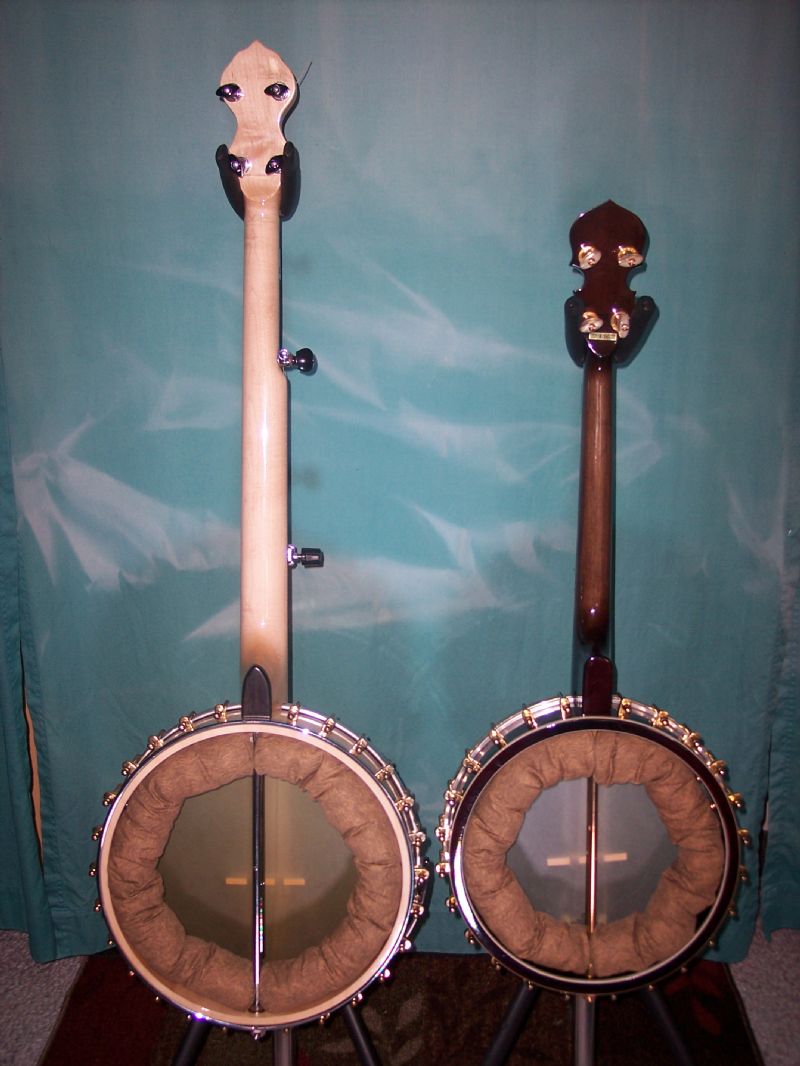
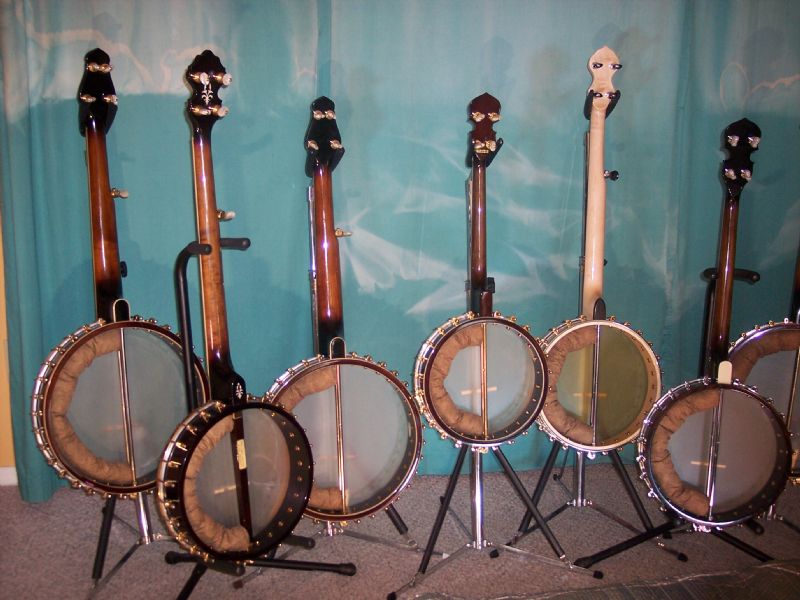
Along with a host of others, I, too, am enthusiastic about the Banjo Bolster. Using them in all of my seven banjos, I find that using them is the fastest, most efficient, user-friendly, and unique approach I've ever come across to revive and beautify their sound, to fine-tune and enhance their expressive qualities. Through the many ways I can configure the device - including using two per banjo to go around the full rim circumference - the bolster allows me to achieve the sounds I’ve been chasing for 60+ years. I agree with Professor David Politzer: the Banjo Bolster is an insanely clever device!
Bob Buckingham - Posted - 03/24/2024: 05:38:07
Heck yeah, that out of tune sound has been one of the great attractions for me since day one. It is not with the primary notes, unless you are playing a D7 chord in G tuning or a similar dischordant combination (which for me make the banjo a pure joy). I do not condone using any one thing to attenuate the wild side of a banjo. Each banjo responds differently to being stuffed.
Back in the days before banjo heads made the big advances they have in the past 40 to 50 years there was a legendary fellow named Big Johnson. He was a big fellow and when he sat down and cradled his banjo, and his prominent belly (i.e. banjo callous) was positioned just so, the tone of that banjo was sublime. He could win a contest on the tone of that combination alone. His playing was also very good. Years ago Hilaire Burhans showed me that a plastic grocery bag will do the trick as will an old sock, a stress ball, a stuffed animal and any number of things that you don't have to buy. I've got a couple with skin heads and need no stuffing as they actually sound fine without it.
It is certainly heartwarming to have one so enamored of a product to pitch it here. If the shoe fits wear it. For me, I've found a job for those socks who's pair partner got lost in the wash.
Paul Roberts - Posted - 03/24/2024: 06:49:03
Hilarie Burhans, clawhammer banjo
Edited by - Paul Roberts on 03/24/2024 06:52:11
Paul Roberts - Posted - 03/24/2024: 07:00:38
quote:
Originally posted by Tractor1has anybody used one in a masterclone scruggs styling?
Posted recently on another thread:
Mar 12, 2024 - 10:43 AM

Laurence Diehl
Seattle, WA, USA
5991 posts since 3/6/2006
Okay, consider me convinced!
I was a bit skeptical at first. I play resonator banjo and stuffing doesn't work very well. But this is not about stuffing. What I like most about the bolster is that you can dial in the suppression of overtones with a high degree of granularity. I spent years wrestling with tones with my Stratocaster so I am familiar with notching/boosting, Parametrics etc. I was experiencing an over-ring from my fifth string and I was able to just make it go away with the bolster. The configurations are limitless and I may never be done experimenting, but at some point you have to call it good. And $28 for a handmade item? I spend more than that on a thumb pick. Any tool that gets you closer to the sound that you love is well worth the price, and is well worth 28 bucks just to find out (okay, it's refundable).
Thanks Ric!
Bronx banjo - Posted - 03/24/2024: 10:51:13
I wonder if an example of inharmonic overtones is that harsh, hollow sound that I hear when I pick the banjo without anchoring my ring and little finger on the head. When I anchor my fingers, that unpleasant tone disappears and I really like the sound. I also question whether those of us who pick 3 finger style need any enhancements inside the pot because anchoring fingers on the head eliminates those harsh tones. I notice that most players who do use something to stuff in the pot are clawhammer players, a style in which fingers don’t anchor. Therefore they would need something inside the pot to accomplish the same thing that anchoring does.
davidppp - Posted - 03/24/2024: 11:11:49
Bronx banjo -- I had a seasoned pro try out the Banjo Bolster, and he said more or less the same thing about anchoring. Zero, one, or two fingers anchored where and how he chooses offer a range of head mode damping that is inaccessible with the bolster installed. It does a pretty complete job by itself.
One aspect I thought "insanely clever" is that adding yet more fiberfill (the actual secret sauce) does relatively little more than what the BanjoBolster provides.
I figure that "what sounds better" is a personal choice and not physics. But a question that has driven me for years is: What is it about banjos that makes people say that they ring? And what's the banjo physics that produces that sound?
By the way, the other strings, no matter how tuned and/or fretted, provide another set of inharmonic partials that can't be eliminated in normal playing.
davidppp - Posted - 03/24/2024: 16:03:16
I like to hear 'em ring, and I'm pretty sure that it's the head "inharmonic partials" that do that. They provide anything between the “ping” of a taut mylar head and the “boing” of a looser skin head with each note.
Alex Z - Posted - 03/24/2024: 23:11:16
"I like to hear 'em ring, and I'm pretty sure that it's the head "inharmonic partials" that do that."
Amen.
You take your 9 foot Steinway Model D concert grand for $200k in perfect piano tuning, you got inharmonic partials coming out all over the place. Nothing wrong with that. That's why it sounds like it does.
As Mr. davidppp says, preferred sound is a matter of personal choice. Not all banjos need dampening to sound good to the player.
A question I have on stuffing material, is "How does the material know it is capturing only the inharmonic partials, and letting the harmonic partials through? Or are all the partials -- by the design,materials, and tuning of the instrument -- somewhat inharmonic, and the material simply filters out higher frequencies?"
KennyB - Posted - 03/25/2024: 04:24:19
When I first saw references to the banjo bolster I was reminded of this video, and similar information, that took me a while to dig up again.
youtube.com/watch?v=euUSfb8LfMw
The relevant part is from 6:20 onward.
Basically, the practice of taping the edge of a bodhran (Irish drum) creates an edge loading effect, reducing the reflections of vibrations travelling from the center of the head, outward, and reflecting back inward by the hard edge of the rim/head contact. I suspect the banjo bolster does the exact same thing. Reducing the hard, mechanical impedance mismatch that tone rings create.
Tractor1 - Posted - 03/25/2024: 05:58:07
when I built my master clone the poplar lined resonator softened the tone- another one with harder wood was harsh--
however on my baritone it didn't seem to matter--
John hatrford mentioned lining them with velvet
davidppp - Posted - 03/25/2024: 07:12:29
Alex Z --
The material (i.e., the fiberfill inside the bolster) simply does what it's good at. It damps air vibrations. Interestingly, at the densities used, it pretty much fails at that above 4000 Hz. The key to its selectivity below that frequency is that the air inside the pot couples strongly to the head and very weakly to the strings. (Note that even though the strings and head are coupled, to succeed as a musical instrument, their combined modes must be "mostly string" and "mostly head" so that you can hear the notes of the strings.) So, the bolster damps the head directly and the strings only indirectly.
In the write-up linked by the OP, I explain that behavior by analogy to two weakly coupled oscillators with only one directly damped.
I also describe an experiment that supports that conclusion. I record a series of plucks on the 1st string with a series of head tensions, going from 80 to 91 on a DrumDial. Spectrograms show that the bolster is most effective at reducing the strength of the partials whose frequencies increase with head tension and leave the partials that are independent of head tension pretty much alone.
You also have to damp all the unplucked strings to eliminate all inharmonic partials -- approximately, i.e., to the extent that an acoustic guitar does naturally. The resulting sound is still clearly a banjo rather than a wood-topped instrument because of the sound distribution among the harmonic partials.
Another experiment and set of recordings identify the difference in sound output between the bolster and a sponge stuffed under the co-rod at the neck joint. Sponge or sock stuffing in much more indiscriminate at reducing all the highs. That can be understood, too, in terms of the physics...
Alex Z - Posted - 03/25/2024: 08:53:07
"Spectrograms show that the bolster is most effective at reducing the strength of the partials whose frequencies increase with head tension and leave the partials that are independent of head tension pretty much alone."
Thanks. Figure 9 now makes sense to me. And the difference from guitars. Will go back and reread section VII.
NotABanjoYoda - Posted - 03/25/2024: 09:28:29
I dont think Im going to listen to a business trying to convince me my banjos have a problem so that I will then listen for a problem. I get creepy snake oil jitters everytime I see these thread-ads. Yeah, dampening does change how an instrument sounds...but Life has enough real problems.
I like harsh loud banjos and if I didnt, Id do like my Grammy said....put a sock in it! Earl didnt need one...and now Grammy's advice mum.
Tractor1 - Posted - 03/25/2024: 11:20:55
I don't see much elsewhere--on the mentioned (in one of the links) --di-pole cancellation--google calls it out as an electrical engineering subject--not any mention of wave travel-
wave travel on a molecular level is still un explained completely -- not to say others don't understand and have complete knowledge on it--and definitely cudos to those'' including David'' that have captured and explained so much --
We have a note leaving the bridge at differing times and hitting the rim at various times for that reason --along with the differing distances between the --bridge and rim that also differs in time--then we have reflection-angle of incidence etc.--what about the whispering? gallery note -- what goes on in the tone ring molecules--exactly --then the energy flow from ring to rim--why a slip fit or a tight fit matters --grain orientation in the rim--I would love to see the actual molecules
I did notice the j-pegs showed a rounded off attack on first few milliseconds-
Laurence Diehl - Posted - 03/25/2024: 12:24:12
I know we're all suspicious of anything that looks like a sales pitch. After all, we are bombarded with them 24 hours a day. I frankly don't care if anybody on here buys a Banjo Bolster or not. This is America, you have the freedom to NOT buy something if you don't want to. But we are banjo players. We tinker with things. This is one of those things. It might work for you, it might not. But if you reject it without trying it then you won't know what you're talking about because you have to try it to know - then you can reject it. Not that I care either way.
PS I thought the science was mildly interesting, but I still just rely on my ears, just like always.
Helix - Posted - 03/27/2024: 04:02:53
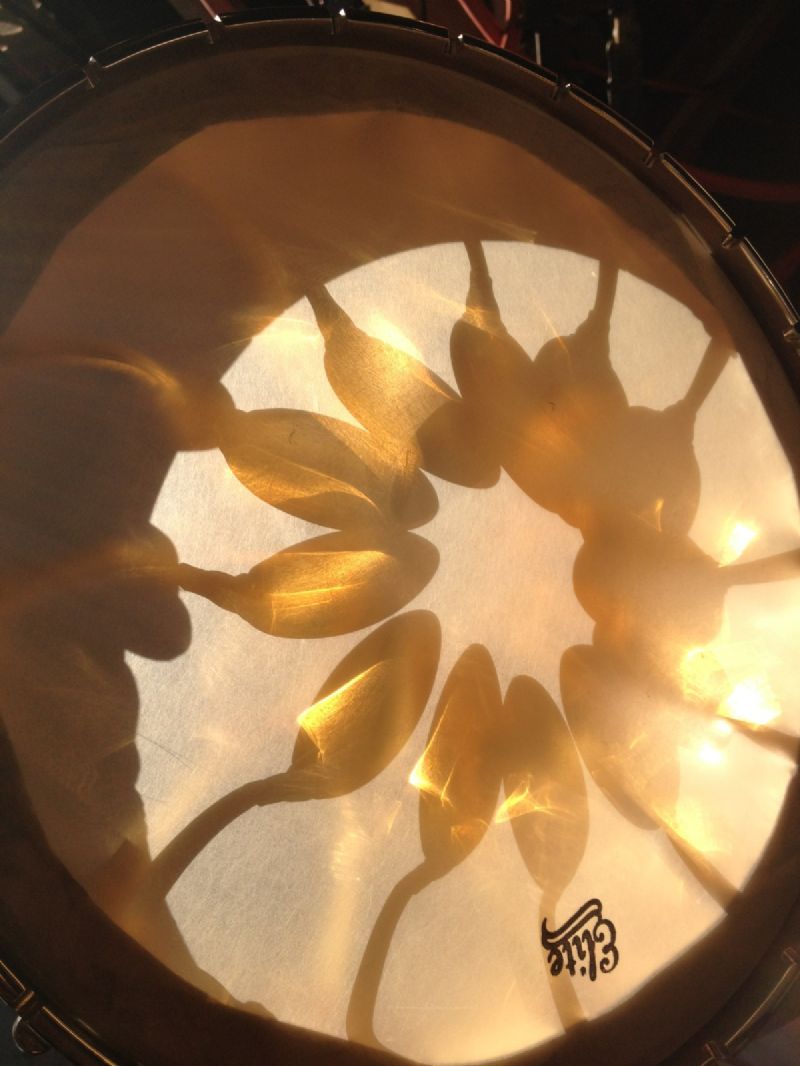
Um...You might wish to take another look at the game changer promotional photo. It's tacky and looks like something organic instead of a helpful friend.
This photo demonstrates an interdependence between optics, hydraulics, and acoustics.
I think there is much more going on inside the rim that can be harnessed for pleasing musical contributions for band members as well as soloists.
Edited by - Helix on 03/27/2024 04:08:01
llcbean - Posted - 03/27/2024: 07:34:43
What people look for and like in tone varies widely of course, but it's clear that players have stuffed their banjos for a long time and there's plenty of discussion to be found on what works best. Since so many people stuff, that would indicate to me that there's a reason to do so and folks are trying to improve on something they think can be better. In my experience the bolster helps me adjust my tone effectively and in a way that nothing else i had tried did. The science supports the results, but my ears are the reason i use it. I've bought plenty of other accessories that didn't work for me. This is not one of them.
Lew H - Posted - 03/28/2024: 12:22:47
I'm still puzzled! I've never understood why people take up the banjo if they don't like the sound of it. I have several banjos that have different tones ranging from a simple Kay to a Vega style M tuba phone conversion, to a Gibson RB175 to a Deering Sierra open back. They all have different tones and I like the tone of every one. CONFESSION: I have friends--fellow oldtime jammers--who stuff their banjos. I have begun stuffing some to reduce the volume of my banjo: "Too loud" they tell me. I don't think my banjos sound as good when they are stuffed.
Owen - Posted - 03/28/2024: 13:54:54
Tongue-in-cheek, I'm reminded of a joke (?) about a taxidermist ... with a twist:
You stuff banjos?!?!?!
... Stuff this one where yer granny can't see it.
[P.S. Don't mind me ... I'm harmless.  Now back to regular programming.]
martyjoe - Posted - 03/29/2024: 23:30:19
We have been stuffing all sorts of dampeners/filters into our banjos for years. The way I construct banjos the only way in is to remove the head. To restrict the amount of sound bouncing around inside the pot I rough sand the entire inside, apply finish coats and rough sand again. Makes a big difference it transforms it from a bathroom kind of sound to something more like the kitchen.
Fathand - Posted - 04/25/2024: 21:38:56
Wasn't there a book or an expression, "That Half Barbaric Twang"?
Isn't that why we play banjos, because we like that sound? If we wanted clean sounding notes with less overtones, we'd play tuning forks, keyboards or electric guitars set to clean mode. The banjo spoke to me listening to two guys frailing an RB100 and a Framus, neither were stuffed with anything.
JackGrave - Posted - 04/26/2024: 04:28:56
For me it's still unconvincing gimmick, maybe useful for some extreme cases. Like one videos in post above where it's somehow mellows sound one of the fretless banjos strung with nylon strings.
But in my amateur opinion there is plenty variables which could matter: pot material, drum head (top/bottom frosted/fybreskin/clear/real skin etc.); bridge (plain/ebony top/bone inserts (y/n)) two/three footed, Seeger type bridge...
Neck wood and most importantly are of contact where neck meets pot.
Strings winding material and string age.
List could me mile long I believe.
IMHO most important is players technique. Main question for me is: Why I should stuff something in to my banjo? If I need to play somehow quieter I would use mute and softer pick. JS
Frailblazer - Posted - 04/26/2024: 06:34:40
banjobolster.com/pages/banjo-b...timonials
banjobolster.com/pages/video-r...o-bolster
banjohangout.org/reviews/searc...edir=true
Edited by - Frailblazer on 04/26/2024 06:36:32
Paul Roberts - Posted - 04/26/2024: 09:08:25
A tone-chaser’s mind is an open mind - always yearning to explore and reveal the tone color spectrum of an instrument; always plunging deeper into the mysteries of sensitivity and nuance in order to express one's creative instincts.
The banjo is a tone-chaser’s dream - a thing of parts - with each part contributing to its sound and the many ways those parts can be made and adjusted to effect tonal change, as well as play-ability.
Among those extolling the virtues of the Banjo Bolster is David Politzer, a banjo player and physicist who has done extensive research on the physics of the banjo. Politzer is professor of theoretical physics at the California Institute of Technology, a member of the American Academy of Arts and Sciences, and winner of the Nobel Prize for physics. In a recently published article, “Inharmonic Partials and Banjo Ring”, Politzer refers numerous times to the Banjo Bolster, calling it an “insanely clever device.”
In a BHO thread, Politzer writes, “Ric Hollander invented a gizmo, which his wife now fabricates and they sell: banjobolster.com/. It works to an astonishing degree to damp the metallic overtones and not the musical ones -- and has virtually NOTHING in common with the sponges, rags, and socks that people stuff between the head and dowel stick or co-rod at the neck.”
The invention of the Banjo Bolster is a once in a blue moon achievement. If you’re into chasing tone, I highly recommend checking it out. As you maybe able to tell, I’m quite over the moon about it. They're anniversary sale is going on until May 2. Time for me stock up on some more. Since I like to use two bolsters in each of my banjos, the ten I already have aren't quite enough for my seven banjos : )
Enjoy your explorations in the tone color spectrum of the banjo!
NotABanjoYoda - Posted - 04/26/2024: 09:24:58
I remember those shake weights. The commercials sold them to men chasing tone.
lol
Lew H - Posted - 04/26/2024: 10:50:20
These are great for people who want their banjo to sound not quite like a banjo. LOL
Terms of Use | Privacy Policy | Privacy Consent (EU/GDPR Only)
Copyright 2026 Banjo Hangout. All Rights Reserved.


