DVD-quality lessons (including tabs/sheet music) available for immediate viewing on any device.
Take your playing to the next level with the help of a local or online banjo teacher.
Weekly newsletter includes free lessons, favorite member content, banjo news and more.
Premier Sponsors


|
Please note this is an archived topic, so it is locked and unable to be replied to. You may, however, start a new topic and refer to this topic with a link: http://www.banjohangout.org/archive/389105
woodpekkerfrommars - Posted - 03/03/2023: 14:40:33
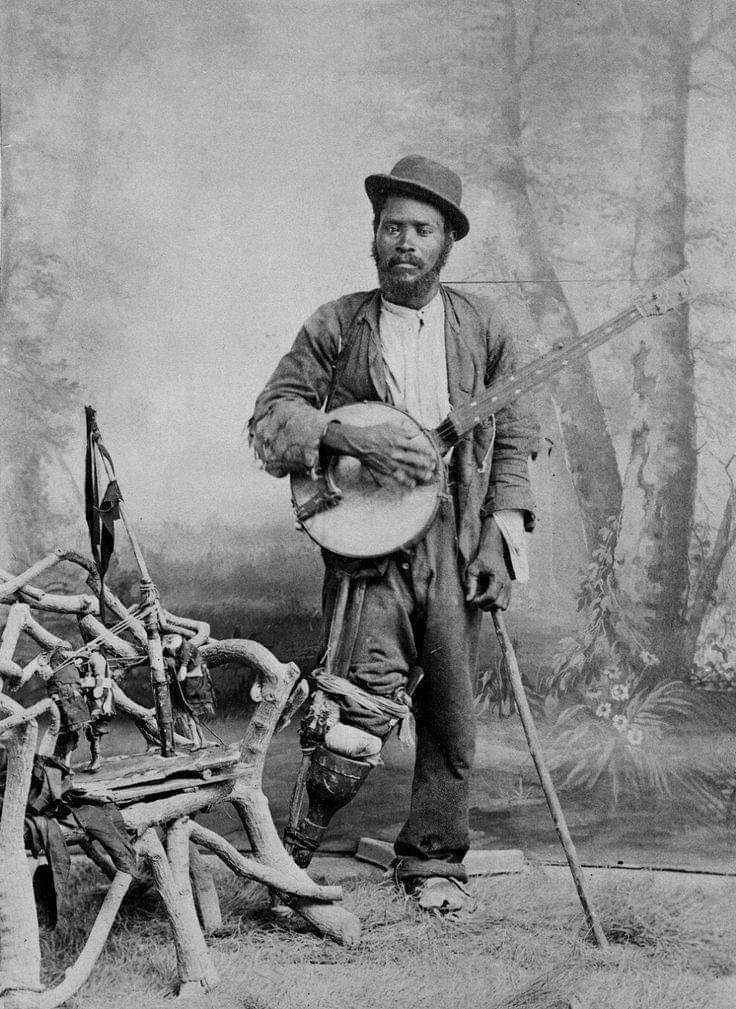
I just saw this picture on a Facebook page called "Old Photos". The caption said it was taken in 1865. Now, I don't know for sure but my feeling was that scoops on banjos wouldn't have been around at that time so I dispute the photos claimed date.
Can anyone clarify the history of the scoop on banjos and when they might have started being included on designs? I did have a quick look at old posts and people seem to say that some banjos may have had frets removed lower down the banjo but that actual carved out scoops are a relatively modern phenomenon.
Edited by - woodpekkerfrommars on 03/03/2023 14:41:31
csacwp - Posted - 03/03/2023: 15:49:45
banjohangout.org/topic/388660
What you are seeing in that photo is not a scoop in the modern sense.
Culloden - Posted - 03/03/2023: 17:53:44
The scoop you see in the photo is a result of the neck making process that was used on those days. The frailing scoop that is commonly used on modern banjos is a newer idea that is supposed to help a person play over the end of the fingerboard for a more mellow tone.
Classic old time banjos like Vega, Stewart, Fairbanks and others from the turn of the century didn't have frailing scoops. The manufacturing process had evolved by that time into the design that is still used today.
I hope that made sense.
m-m - Posted - 03/04/2023: 04:22:00
this article is illuminating:
banjonews.com/2008-07/heres_th...rlin.html
OldPappy - Posted - 03/05/2023: 12:01:26
As said above what you see in the photo is due to how the neck was made on many banjos at the time, and very common, so there is no reason to doubt the authenticity of the photo.
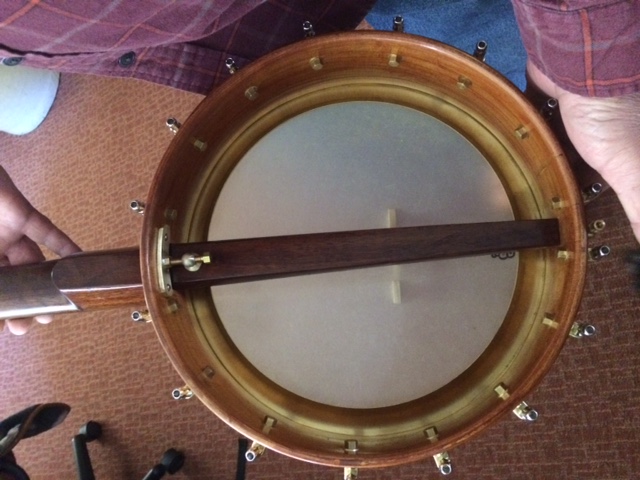
Instead of having a "heel" cut to fit the radius of the rim and a dowel stick as on more modern banjos, the neck was formed with a "perch pole" that went through the rim. The perch pole was often integral to the neck, and sometimes simply a piece attached to the bottom of the neck. The same approach is often used on modern made gourd banjos.
I have built a couple of banjos using that neck design and I like the results.
It eliminates two of the more complex steps in building a dowel stick design which requires a compound radius on the heel and a compound angle in setting the dowel.
It also eliminates the need for the rim to be sturdy enough to support the neck which allows thinner walled rims. A lot of homemade banjos used grain measures, and cheese hoops for rims, and with this design the rim is supported on the perch pole and only has to be strong enough to support the head.
OldPappy - Posted - 03/06/2023: 07:34:39
Below is a picture of one of my banjos with the perch pole design.
Terms of Use | Privacy Policy | Privacy Consent (EU/GDPR Only)
Copyright 2026 Banjo Hangout. All Rights Reserved.