DVD-quality lessons (including tabs/sheet music) available for immediate viewing on any device.
Take your playing to the next level with the help of a local or online banjo teacher.
Weekly newsletter includes free lessons, favorite member content, banjo news and more.
Premier Sponsors


|
Please note this is an archived topic, so it is locked and unable to be replied to. You may, however, start a new topic and refer to this topic with a link: http://www.banjohangout.org/archive/385409
Ziradog - Posted - 09/01/2022: 05:50:34
This is my first banjo with non-steel strings. Scale is 23-3/4"-ish, came brand new with Nylgut Reds on it. The problem I am having is that sometimes the fifth (especially) and fourth strings squeak when I strike then with my thumb. When it happens, it happens a lot (like all the time during that practice session). Other times (75% or so) it is fine. I'm not sure if this is a technique thing on my part, or the skin on my thumb is sweaty (or drier than normal), or what. Any suggestions?
Joel Hooks - Posted - 09/01/2022: 06:14:16
My suggestion is to use nylon music strings.
I've had very limited experience with those red strings, mostly playing other people's banjos that had them. They had a strange feel and they seemed almost lumpy if I remember correctly. Weird texture but, again, I have limited experience with them. I also remember them being hard as if trying to be wire strings but not.
With the regular "nylgut" polyester, which I have not used in years so they could have changed, I got horrible squeaking from both hands. Any left hand movement up and down the neck with my fingers touching the strings and they would squeal. When playing fingerstyle the tips of my bare fingers produced short little squeaks that reminded me of the pick noise bluegrassers get.
Another problem I had with "nylgut" polyester is that they would sometimes be "false" or uneven in thickness and or density causing intonation problems. This is a known problem due to the extruding process they use. Because of the way they stretch it seems to get worse over time.
I like LaBella nylon. Through their website they sell singles in any size you could ever want. Get the silver plated copper wound on floss for the forth string.
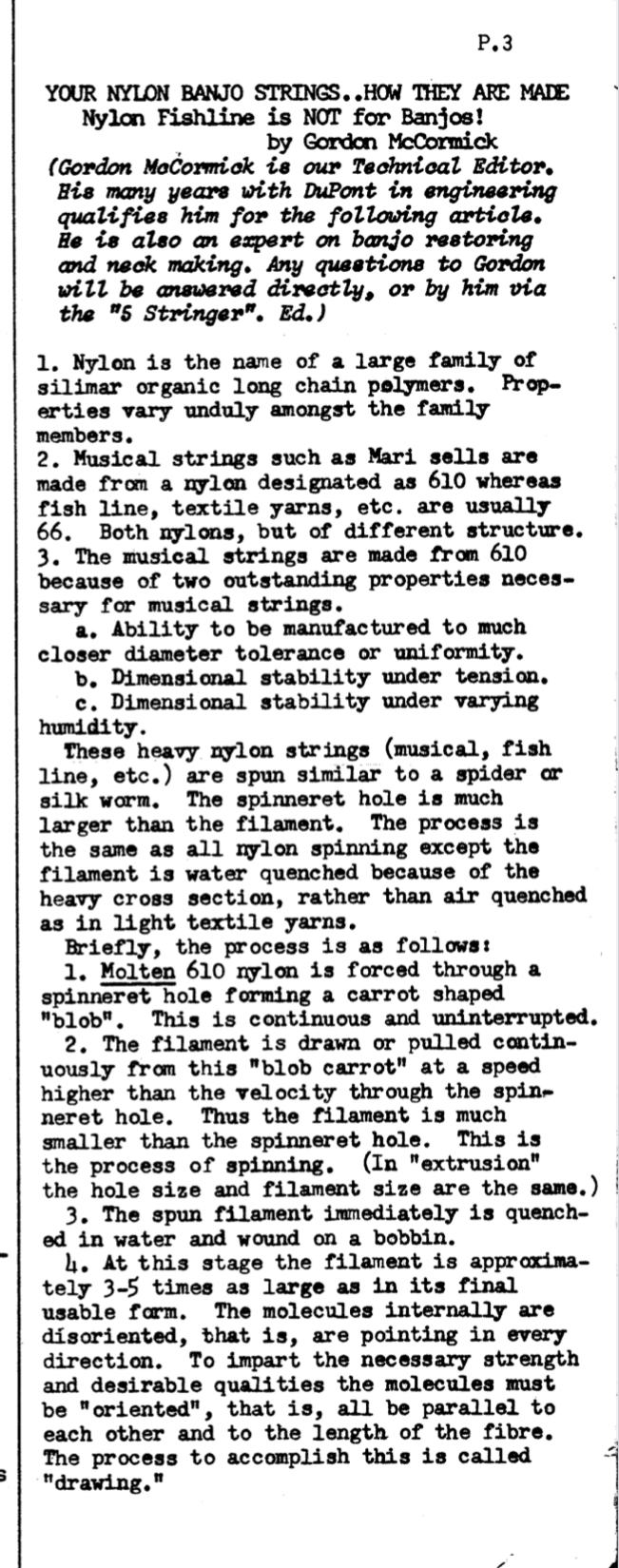
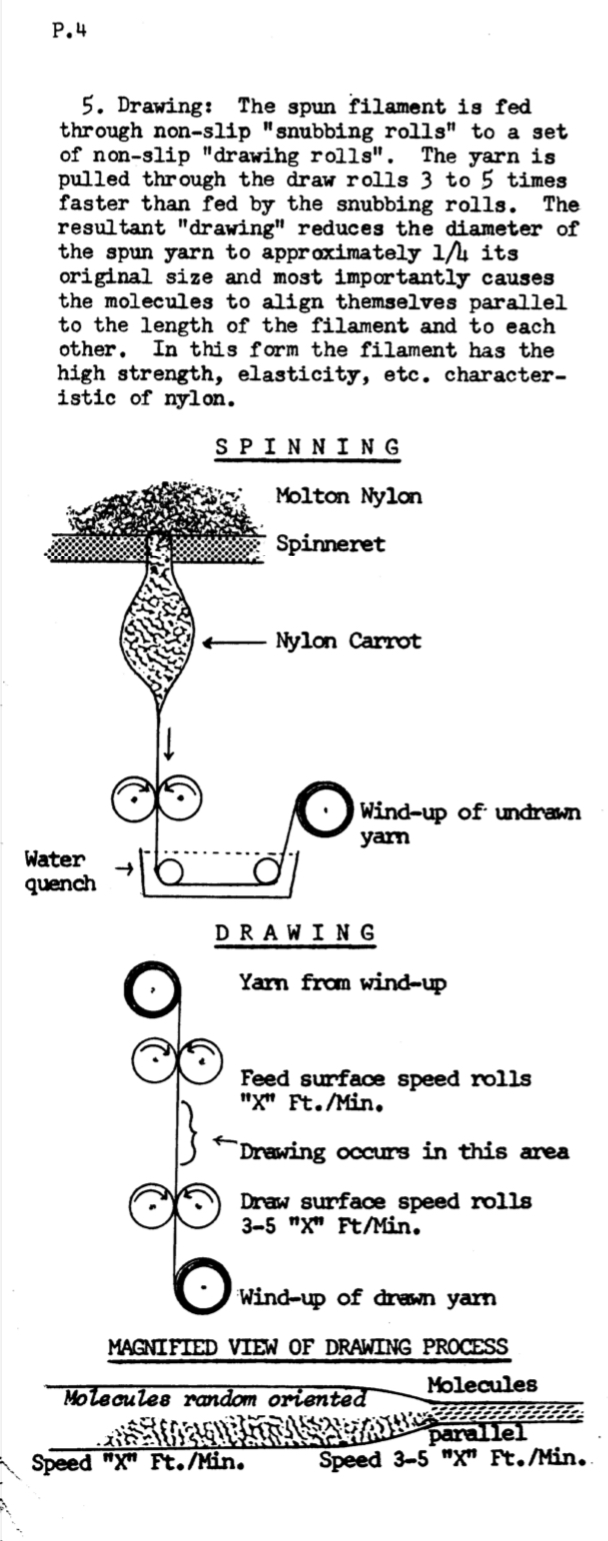
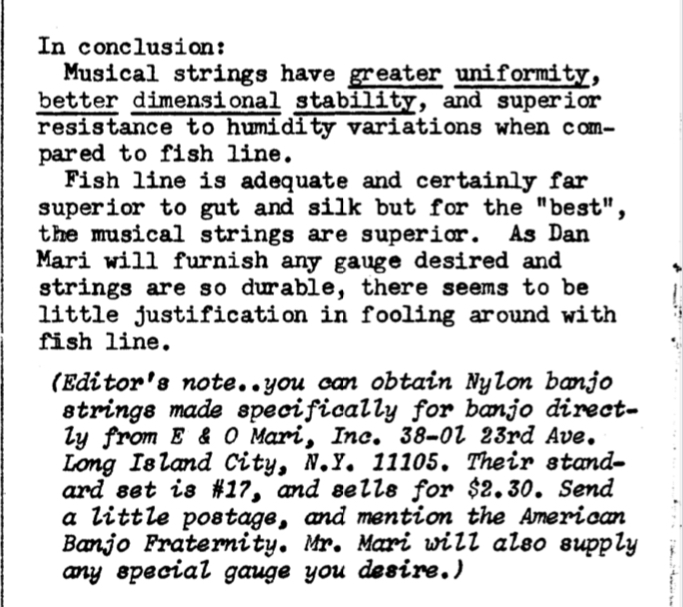
Below is an article describing the difference between extrusion (how cheap fishing line is made) and how music strings are made.
G Edward Porgie - Posted - 09/01/2022: 06:26:13
I agree with Joel. Although I haven't used the Reds, I have used some of the Nylgut strings and I will never use them again.
A Drum On A Stick - Posted - 09/01/2022: 07:05:54
I like the tone of the reds on smaller instruments like ukuleles, and use them often there. But that said, squeaking is a recurring issue.
I haven't had that issue with the regular nylguts.
But I'd go with Joel's suggestion and try the labellas. They really are nice strings so long as you don't want to tune down to a lower-than-standard pitch.
Bigdepartment - Posted - 09/01/2022: 09:25:16
I take the sheen off with superfine sandpaper to eliminate the squeak, just by the right hand
HalRay - Posted - 09/02/2022: 07:39:25
I use the Aquila 11b reds on my Lyon and Healey. I did have the squeak problem with the 5th string. Thanks to Bigdepartment I have eliminated the squeak. I used OOOO steel wool to take the sheen off and problem fixed. Thank you Bigdepartment .
mimmo2us - Posted - 09/04/2022: 00:55:23
Hllo everybody,
This is Mimmo (Aquilastrings owner-Italy)
I would like to give my contribution on this discussion:
1) extrusion of plastic materials: the scheme reproduced here is not applicable to monofilaments but only to yarns (i.e., multifilaments). However these schemes are very approximate and there are some mistakes. Actually the yarn estrusion line are differents (see in youtube some examples).
The extrusion systems for monfiliaments (fishing line or musical strings) are a bit different. Basically the big difference in the accuracy quality of the diameters is given by the fact of using a gear pump in the head of the extrusion line. All the rest of the plant is exactly the same for both.
The polyamide mentioned here (PA 6-10) is wrong: the nylon commonly used for musical strings is instead the PA 6-12, commercially called Tinex by Du Pont. For fishing line the polyamide employed are PA 6 and PA 66: not good for music.
La Bella does not produce the strings with their own plant: they buy plastic strings from the monofilament producers. Generally speaking, there are no string brands in the world that produce plastic strings theirshelf except; just recently Daddario bought a single small plant for the production of strings, but not those of their highest quality.
We at Aquilastrings runs six lines and produce, every month, six million strings about of which most sold to colleagues such as Daddario and Martin guitar (just to name two among the dozen) and to the china musical instrument's factory. I am a chemist and I lead the extrusion lines so this is my own job since 20 years. So I am totally involved.
Now we come to the complaints I have read that deserve support:
the first thing to observe is that on the thousands of packaged banjo sets we sell every year that is the first time I've heard that nylgut strings produce squeak (this is the situation that happened to Ziradog).
But it has also been said by him that they are strings that were tested years ago, not those made nowday.
As for the red series: they can sometimes produce squeak but only in cases where the fingers are indeed very dry and hard. but actually here too it is the first time I hear about this situation. The problem is instead greater in classical guitar with the Sugar sets: just put a little hand cream on the fingers to eliminate the problem.
I would suggest allowing me to send him a set for free with the latest version of nylgut and hear his opinion. Ziradog and Joel Hooks: what do you thinks? If it is ok for you please send me a mail to aquila@aquilacorde.com
Here you can hear the sounds of the nylgut and the red series:
youtube.com/watch?v=l1bd1Y5QAxg
youtube.com/watch?v=-flwbxxLoAM
Here is a test between nylon and red series:
youtube.com/watch?v=Qa09euugcy8&t=373s
Ciao
Mimmo
Edited by - mimmo2us on 09/04/2022 01:10:02
davidppp - Posted - 09/04/2022: 19:27:59
André Sogovia, Julian Bream -- didn't those guys squeak just a bit once in a while?
mimmo2us - Posted - 09/05/2022: 00:28:02
quote:
Originally posted by mimmo2usHllo everybody,
This is Mimmo (Aquilastrings owner-Italy)
I would like to give my contribution on this discussion:
1) extrusion of plastic materials: the scheme reproduced here is not applicable to monofilaments but only to yarns (i.e., multifilaments). However these schemes are very approximate and there are some mistakes. Actually the yarn estrusion line are differents (see in youtube some examples).The extrusion systems for monfiliaments (fishing line or musical strings) are a bit different. Basically the big difference in the accuracy quality of the diameters is given by the fact of using a gear pump in the head of the extrusion line. All the rest of the plant is exactly the same for both.
The polyamide mentioned here (PA 6-10) is wrong: the nylon commonly used for musical strings is instead the PA 6-12, commercially called Tinex by Du Pont. For fishing line the polyamide employed are PA 6 and PA 66: not good for music.
La Bella does not produce the strings with their own plant: they buy plastic strings from the monofilament producers. Generally speaking, there are no string brands in the world that produce plastic strings theirshelf except; just recently Daddario bought a single small plant for the production of strings, but not those of their highest quality.We runs six extrusion plants and we produce, every month, more or less six million strings of which most sold to colleagues such as Daddario and Martin Guitar (just to name two among the dozen) and to the china musical instrument's factory (mostly ukuleles). I am a chemist and I runs the extrusion lines; so this is my own job since 20 years.
2) Now we come to the complaints I have read that deserve support:
the first thing to observe is that on the 10,000 of packaged banjo sets we sold in 2021 that is the first time I've heard that nylgut strings produce squeak (this is the situation that happened to Ziradog ans, of course, I trust him).
But it has also been said by him that they are strings that were tested some years ago, not those made nowday.
As for the red series: they can sometimes produce squeak but only in cases where the fingers are indeed very dry and hard. But actually, here too, it is the first time I hear about this strange situation. The problem is instead greater in classical guitar and concerns our 'Sugar' set: just put a little hand lotion on the fingers to eliminate the problem.
My conclusion:
I would suggest allowing me to send them a set for free with the latest version of nylgut and reds and hear his opinion: Ziradog and Joel Hooks, are you of the game? If it is ok for you please send me a mail to aquila@aquilacorde.com
Here you can hear the sounds of the nylgut and the red series:
youtube.com/watch?v=l1bd1Y5QAxgyoutube.com/watch?v=-flwbxxLoAM
Here is a test between nylon and red series:
youtube.com/watch?v=Qa09euugcy8&t=373s
Ciao
Mimmo
mimmo2us - Posted - 09/05/2022: 00:35:47
quote:
Originally posted by mimmo2usquote:
Originally posted by mimmo2usHllo everybody,
This is Mimmo (Aquilastrings owner-Italy)
I would like to give my contribution on this discussion:
1) extrusion of plastic materials: the scheme reproduced here is not applicable to monofilaments but only to yarns (i.e., multifilaments). However these schemes are very approximate and there are some mistakes. Actually the yarn estrusion line are differents (see in youtube some real examples, not just an old diagram).The extrusion systems for monfiliaments (fishing line or musical strings) are just a bit different. Basically the only difference in the accuracy quality of the diameters is given by the fact of using a gear pump in the head of the extrusion line or not. All the rest of the plant is exactly the same for both. When there is the gear pump the diameter is more stable BUT the huge point is just one: the experience of the worker that run the extruder. In other word you can have the best extruder plant ever but if the worker that follow the line has scarce experience you can expect the worse string.
The polyamide mentioned in the diagram (PA 6-10) is not the right one: the nylon commonly used for musical strings is instead the PA 6-12, commercially called with the brand name Tynex by Du Pont.For fishing line the polyamide employed are PA 6 and PA 66: they are not good for music.
La Bella does not produce the nylon strings theirshelf: they buy plastic strings from the monofilament producers. Generally speaking, there are no string brands in the world that produce plastic strings theirshelf except rwo: recently Daddario bought a single small plant for the production of the nylon strings of the cheaper lines.We runs six extrusion plants and we produce, every month, more or less six million strings of which most are sold to our colleagues such as Daddario and Martin Guitar (just to name two among the dozen) and to the china musical instrument's factory (mostly for ukuleles). I am a chemist and I runs myshelf the extrusion lines together with some collaborators; so this is my own job since 20 years. And it is nothing but easy.
2) Now we come to the complaints I have read that deserve support:
the first thing to observe is that on the 10,000 of packaged banjo sets we sold in 2021 that is the first time I've heard that nylgut strings produce squeak (this is the situation that happened to Ziradog ans, of course, I trust him).
But it has also been said by him that they are strings that were tested some years ago, not those made nowday.
As for the red series: they can sometimes produce squeak but only in cases where the fingers are indeed very dry and hard. But actually, here too, it is the first time I hear about this strange situation. The problem is instead greater in classical guitar and concerns our 'Sugar' set: just put a little hand lotion on the fingers to eliminate the problem.
My conclusion:
I would suggest allowing me to send them a set for free with the latest version of nylgut and reds and hear his opinion: Ziradog and Joel Hooks, are you of the game? If it is ok for you please send me a mail to aquila@aquilacorde.com
Here you can hear the sounds of the nylgut and the red series:
youtube.com/watch?v=l1bd1Y5QAxgyoutube.com/watch?v=-flwbxxLoAM
Here is a test between nylon and red series:
youtube.com/watch?v=Qa09euugcy8&t=373s
Ciao
Mimmo
mimmo2us - Posted - 09/05/2022: 02:18:03
Sorry guys! I have done my text 3 times. any suggestion how to do in order to delete two of them?
thanks
Mimmo
Joel Hooks - Posted - 09/05/2022: 07:14:50
quote:
Originally posted by mimmo2usSorry guys! I have done my text 3 times. any suggestion how to do in order to delete two of them?
thanks
Mimmo
Thank you for the offer but your strings are much thicker than any used for regular 5 string banjo in the late 19th century. There is also the situation of the unwound 4th that you provide now, something that was not ever used on banjo.
There is more to the wound 4th than just the diameter and density, a wound string provides a different tone color which was used to great effect in compositions for the banjo during the classic era.
I have read all about how nylon is less dense than gut so it needs to be thicker, but there is more to it than that, mainly the way they break or snap off of the fingertips and energy that is lost to torque as the thicker strings roll under the fingers.
In real world, side by side comparison, the historical thinner sizes are louder and sharper toned than your thicker strings which have a duller and thicker tone which requires much more effort to play on.
We currently have two string sets that are supported with historical documentation.
The first set was given in the publication "Observations on the Banjo and Banjo Playing" by S. S. Stewart and published in 1892:
archive.org/details/Observations
those are .018, .022, .028, .024 wound, .018
The other set of sizes were provided, and used, by Fred Van Eps, Paul Cadwell (the first person we know of to use nylon on banjo directly after WW2 ended), Bill Bowen, Cliff Spaulding, and on and on... basically anyone who played banjo during the classic era and was still living after WW2.
.017,. .019, .021, .024w, .017 Substitute .023 for heaver third.
Having had the opportunity to measure original extant examples of classic era gut and silk strings, we have found them to be equivalent to the above set of .017, which were the same as the original set of LaBella No. 17 before they made them thicker. Given that those original strings were made of gut or silk, they could have shrunk, and we have measured strings that are a thousandth thinner at .016.
Labella also offered sets that were .001 and .002 larger. There current set is .019.
All of the above string info are for strings that post date about 1884 when the standard pitch of the banjo began to be raised from A to B flat, to the standard C that we use today.
The above information only applies to historically informed playing and not the modern trends in what is called "old time" today which, in attempt to simulate wire strings, prefer very thick strings.
There is only a small number of people playing historically informed banjo so I do not believe it would be worth your effort to make the correct sizes of strings. It is easy enough for people to order singles directly from Labella and make their own sets.
mimmo2us - Posted - 09/05/2022: 12:33:01
Dear Joel,
first of all I would like to thank you for the historical information you have given me: although I am not only am owner but also a researcher in matter of historical musical strings of the past times (aquilacorde.com/en/mimmo-peruffo/) unfortunately around the problem of banjo strings of the past times I could not find anything.
The consequences of this your information are that I will modify some things on our web page. The data you have reported allow me to make some interesting calculations, referring both to the strings of PA 6-12 (the one used by practically everyone of the brands) and to the gut (the nylgut has the same density as the gut so they are the same gauges).
The pitch standard in Europe, after the Vienna congress of 1885, was stabilized at A-435 Hz but I have no interest in calculating the tensions since I heard that there were in use banjos with different vibrating lengths and I am not an expert in this field.
First I must make a clarification: the strings called 'red series' have nothing to do with an historical setup: they use a bio plastic recently discovered in Italy charged, during the extrusion phase, with metal powder in order to increase the density and so to have a very bright sound, as if they were steel strings.
In this set I have chosen to eliminate the fourth wound string to be able to introduce an unwound version string for the first time just because we are at the extreme limits of today's technology.
In short, it was my precise choice that has nothing to do with the historical frames of the past.
And now my observations on the datas found in the ''Banjo and Banjo Playing" book by S. S. Stewart published in 1892.
here are the gauges you have mentioned (but I have not found them in the book: were they are?)
.018, .022, .028, .024 wound, .018 inches.
These diameters are referred to gut strings whose density is 1.30.
In the book it is written that the 3rd is a violin 1st. In fact, by conversion in mm it is of .71 mm, that was exactly the average of the violin 1st in those times and, incidentally, it is the same diameter of Paganini 1st string I checked in Genoa years ago (ricerche.aquilacorde.com/i-nos...-budello/) (jstor.org/stable/41701279)
Now the La Bella N 17 nylon gauges are:
0.019; 0.022; 0.028; 0.025W; 0.019 inches.
Here is the deal: we cannot comparate the historical gut gauges of the 1892 with those of La bella N 17.
Why? The problem is that in the la bella N 17 set was not considered that these are made in nylon while in the original historical set of 1892 they are gut strings; whose density is 1.30 (while the PA 6-12 Nylon is only 1.04).
So the La Bella N 17 set has less tension than the original set of the 1892 book.
In order to fix this mistake need a conversion between gut to Nylon.
here are the right gauges that comes from the 1892 gut set:
.020; 0.0246; 0.0313; .024w; 0.020 inches.
And now few things about the 4th wound: in the past times (till 1950's) it was made with genuine silk cores, not nylon multifilament. The difference is that if we employ a nylon yarn/multifilament the sound is quite brighter than the original ones.
Now here are my conclusion: I have a deal of interest to make the old set again and in the exact way how it was described in that manual of 1892: I am a gut string maker also. I am also in condition to make a good genuine silk wound 4th.
Even more: I would like to realize the synthetic version of this set seeing that Nylgut has the same density of gut.
If I consider the diameter in mm (unfortunately I live in EU...) these are the diameters of gut or nylgut strings:
.46mm, .56mm, .71mm (a violin 1st of late XIX century) , .61mm wound on silk core, .46 mm
Joel, are you interested/available to test both the sets?
Mimmo
Edited by - mimmo2us on 09/05/2022 12:51:40
Joel Hooks - Posted - 09/05/2022: 13:58:17
mimmo2us page 18 "The Banjo Strings", the sizes are provided in English Standard Wire Gauge.
archive.org/details/Observatio...w=theater
Yes, I understand about the density difference, but the fact is that the people who played on gut or silk strings, professional banjo players who lived through that era, choose the .017" sizes in nylon based on their preference and experience.
Again, it has to do with the feeling on the fingertips.
Thank you for the offer, it is very generous, I would be happy to try them. But I think your efforts will be wasted on me. I doubt that sending me a set of strings will help your sales.
Your offering of very thick strings have created a general trend in very heavy strings which is what most of the old time people seem to like now.
Since they are trying to get wire string tensions and not treating it like a different instrument, you offering the period sizes will likely not be very popular or sell very well.
mimmo2us - Posted - 09/05/2022: 22:32:50
Ciao Joel,
Perhaps it is better that I clarify my position: I am not interested in recreating these sets for a business question; I am interested in being an enthusiast and researcher: it is for passion only (in the 2021 we sold about 10,000 banjo sets so no necessity to increase the business).
For example with the ukulele I did a research about the string setup that was used in the past finding numerous samples of old gut strings and also the methods were it is written about strings.
I did the same thing for the 19th and 20th century guitar equipped in gut and silk wound basses. In short, I do it with passion because I like the idea of recreating something that has disappeared and that no one can feel anymore because no one do replica of the original sets and the related sound.
My intention is therefore to create this original 1892 set in gut and the fourth wound silk (I have not found other 19th century banjo methods than talking about string diameters) and its exact replica with synthetic material.
About the fact that our sets employ thicker strings: when I started to create our banjo sets I asked the opinion and sent out samples of strings to several 'old time' US banjo players in order to create something of good. No one told me that the historical sets employed thinner diameters.
I will modify our web page introducing a real replica of an historical set plus its synthetic version.
Thank you very much for your contribute
Mimmo
Ps: we have a good collaboration with the la Bella owners (Riccardo Cocco ans son) because we sometime supply them with gut strings and because they comes from center Italy (I have done extensive researches in that place discovering many things about the old italian way to make gut strings....). But I had a very good relationship with the 'engine' of the company that was Daniele Mari.
Mimmo
Edited by - mimmo2us on 09/05/2022 22:46:30
mimmo2us - Posted - 09/06/2022: 00:46:31
..This morning I have realized the exact replica of the gut set plus a 4th wound on a genuine silk core in order to hear which kind of sound it was.
This set is what it is described in the "Observations on the Banjo and Banjo Playing" by S. S. Stewart and published in 1892 that Joel Hooks kindly shared here:
archive.org/details/Observations
Here is my test on the original set that from now is still in life:
youtu.be/qxKFcnPfYCk
Mimmo
Edited by - mimmo2us on 09/06/2022 00:47:48
dbrooks - Posted - 09/06/2022: 04:32:09
This is an enlightening conversation on several levels. Joel (along with John Cohen and others) has truly valuable information about the instruments and playing styles in the classic banjo era. Mimmo shares his deep research and significant efforts to provide several varieties of nylon strings for the current market. As banjo enthusiasts, we benefit from the work and views both of them.
I am a very satisfied Nylgut user. I have used the classic string on my Bay State banjos and minstrel strings on my tackhead and minstrel replica banjo. When my son gave me an S.S. Stewart Thoroughbred banjo in largely original condition, I installed La Bella strings and a two-foot bridge from Joel Hooks. I'm happy trying to live in both worlds and hearing from both of these fine gentlemen.
David
Ziradog - Posted - 09/06/2022: 05:28:01
Mimmo -
Thank you for your offer, and your enlightening post. As far as I know the red strings I have are current, I have only had the banjo ~2 months. I will try your suggestion of moisturizing my skin, although I fear "gunking up" the strings that way (I usually wash my hands before playing any instrument to avoid getting sweat, oil, etc. on the strings & wood). I may then try some other strings if I am not successful. I generally like the sound of the reds on this instrument, but I haven't tried any others yet.
R.D. Lunceford - Posted - 09/06/2022: 13:57:32
I am also a fan of Nylguts. FWIW I like the sound and feel.
My only "criticism" is that I wish they were still supplied in the more natural looking cream/ivory color rather than the bright white.
Ciao Mimmo;
RD
Edited by - R.D. Lunceford on 09/06/2022 13:58:15
mimmo2us - Posted - 09/07/2022: 03:29:49
quote:
Originally posted by R.D. LuncefordI am also a fan of Nylguts. FWIW I like the sound and feel.
My only "criticism" is that I wish they were still supplied in the more natural looking cream/ivory color rather than the bright white.
Ciao RD!
the syntetic version of the 'historical set we are going to introduce will employ rectified nylgut (rectified exactly like gut strings) and with a similar clear brown/yellow color. The Brand name will be Aquila banjo 'Historical' available in two ways: genuine gut silk plus a genuine silk wound string 4th or the synthetic version that is rectified nylgut with a 4th wound with a synthetic yarn that imitate silk (no nylon here).
Ciao
mandobanjolibrarian - Posted - 09/07/2022: 12:32:14
quote:
Originally posted by mimmo2usthe syntetic version of the 'historical set we are going to introduce will employ rectified nylgut (rectified exactly like gut strings) and with a similar clear brown/yellow color. The Brand name will be Aquila banjo 'Historical' available in two ways: genuine gut silk plus a genuine silk wound string 4th or the synthetic version that is rectified nylgut with a 4th wound with a synthetic yarn that imitate silk (no nylon here).
Ciao
Hi, Mimmo.
Just curious: any estimate on when these new "historical" strings will be on the market? I'm intrigued, though I've been very happy with my Nylgut AQ-5Bs so far. Looking forward to giving the historicals a try.
mimmo2us - Posted - 09/08/2022: 03:08:21
My dear friends,
Actually this set in gut ans wound silk and its synthetic version will be available from the next week but....
but the real problem is the distribution. They are very slow. So the only chancefor now is our on line store. But if you live out of EU the shipping costs that are damn high; especially after the pandemic time.
Said that this set will be the exact replica of the 1892 set but... there is a but: I have found almost 30 banjo methods from 1860 to 1910 were the few source that mentioned the kind of strings wrote different things than this 1892 method were I have realized the described set of strings.
In short: in these methods 90% of the cases I found this tuning: B; G dies; E; A (wound); E instead the open G set with the 4th lowered to C (not D 4th, typical of nowday bluegrass banjo etc) .
Well, in some of these methods it is suggested to employ normal violin gut strings for the strings 1,2,3. the 4th must be a guitar silk wound D and the 5 is like the 1st. the violin gauge average were E .66 mm; A .85 mm; D 1.12 mm. Crazy-
But my question is: what the hell is this tuning that was so common in these methods: B, G dies; E; A; E ?
In conclusion, in our banjo webpage at the new 'historical banjo set' I will add the link to the original book of 1892..
---
I have a very last question guys: we have two 'modern' sets: one is all nylgut and one has the 4th a unwound red: I wonder if it is the case that the unwound red 4th is replaced by a normal wound string (I have made one employing a very strong and thin stainless wire instead the soft silvered copper wire, so it last a very long time)
Thanks for your kind support my friends
Mimmo
Edited by - mimmo2us on 09/08/2022 03:26:55
Joel Hooks - Posted - 09/08/2022: 05:47:59
mimmo2us , did you get my email?
It is very confusing as the banjo was a transposing instrument after about 1884.
By 1884 the banjo was widely pitched to C. But the music in the United States was still published in A until 1909. This is very confusing today and was confusing then too.
By the "official" change over in 1908, and then again in 1909 to C notation (music printed in a pitch that better matches the banjo, one octave higher) the plectrum was becoming popular and I strongly believe that this contributed to the banjo losing popularity.
In my article archive.org/details/abf-5-stringer-219 I provide a "Timeline of Pitch." While there was some crossover, this timeline is supported with provided documentation which can be checked.
So, again, read carefully the tutors that I have scanned and posted on the internet archive. From after about 1884 they will all say that the banjo is pitched to C but the music is written in A.
Adding the source material to the strings is a great ideal. If it were me I would put something like "String sizes provided by S. S. Stewart in his 1892 article Observations on The Banjo and Banjo Playing".
I would be very interested in trying one of your steel wound floss strings. This would mimic the original "silk and steel" that are no longer made. This was something that Fred Van Eps recommended to use in his 1921 catalog.
But for the 1892 set, I would use a silver plated copper wound over floss as that is correct for the time.
4th strings wear out and people should just accept that and replace them.
mimmo2us - Posted - 09/08/2022: 06:05:58
Thanks Joel, Yes, I have read the document you sent me several times almost around the question of strings; the pitch standard and the confusion about 4th A that in real things is on the piano a C note.
The open question is that there are some methods that suggested violin strings, that are quite thicker.
-------
yes I will ad to the text of the gut replica something of very similar to what you suggest me and a wound 4th silvered copper. But I am pretty sure that 99% of people will complain when they will realize that the 4th will wear out before the other strings; even before the 1st and 5th that are the gut thinner ones.
-------
the 4th wound employing thin steel solve all the problems. Note that on both the cases the core is genuine silk in the same proportion suggested in the old document.
I would like to send you the exact replica of this set: is still possible? Feel you free to accept or not.
--
I have not receive your mail. was the mail right? aquila@aquilacorde.com
----
here is the source that mention violin strings: which is you comment?
archive.org/details/winner-ide.../mode/2up
thank you for your article!
Mimmo
JanetB - Posted - 09/08/2022: 17:38:32
I'll share my very recent discovery concerning the red nylgut squeak. The 5th string squeak was unacceptable for the recordings I often do to share a Tune of the Week or Month. I had tried lotion, mineral oil, and lemon oil on my thumb. The squeak was even squeakier. Sanding the string with fine sand paper didn't help.
The only thing that worked was getting my thumb a bit wet, but it would often dry before the recording was done. Then this past week I discovered that if I rubbed my thumb on a candle the squeak disappeared. I also rubbed the string where my thumb contacts it. Great success and no more problem, though it needs to be done again after a day or two. So what do you think?
FYI the California climate in the foothills is very dry during this drought and heat.
csacwp - Posted - 09/09/2022: 06:59:03
quote:
Originally posted by mimmo2us..This morning I have realized the exact replica of the gut set plus a 4th wound on a genuine silk core in order to hear which kind of sound it was.
This set is what it is described in the "Observations on the Banjo and Banjo Playing" by S. S. Stewart and published in 1892 that Joel Hooks kindly shared here:
archive.org/details/ObservationsHere is my test on the original set that from now is still in life:
youtu.be/qxKFcnPfYCk
Mimmo
Mimmo, this is a good start, but if you are interested in historical banjo setups, you should try these gauges with a period-correct bridge and setup. The modern bridge you are using is unsuited to gut strings and really holds the instrument back.
mimmo2us - Posted - 09/09/2022: 07:07:23
quote:
Mimmo, this is a good start, but if you are interested in historical banjo setups, you should try these gauges with a period-correct bridge and setup. The modern bridge you are using is unsuited to gut strings and really holds the instrument back.
Yes, you are right (in these few days I spent hours to read almost 30 old methods plus the Joel articles) but please take in consideration that I am a string maker, no a real player. my first intention was to check which kind of sound can produce a similar set installed on my banjo that, just a few minutes before, had the reds. So I have recognized the difference between them.
If the results were these one with the wrong bridge I cannot image when everything will be done right, which can be the final sound. A lot better, I image.
However I am in contact with Joel: this set and its synthetic version will be sent soon to him. He will be able to adjust everything, bridge enclose. But again, the first impression was huge: they sound bright, even and powerful. Soon I will arrange the first synthetic version: the original made with gut is too expensive and cannot last a long time.
----
The problem is now another: several methods from 1865 to 1905 suggested violin gut strings E; A; D for the banjo strings,1; 2; 3 and a guitar wound 4th for the banjo bass 4th string. The violin E had a gauge range .65-.73 mm (while in the 1892 set I have realized the 1st is of .46 mm only) . They are indeed very thick. I wonder which can be the explanation as the tuning is the same. In one method it is suggested that the 3rd must be a Violin 2nd (so it is around .90 mm) while in the 1892 method it is supposed to be a violin E (.71 mm about). Maybe the standardization was still far: some employed thick strings; other very thin. Any suggestion?
Edited by - mimmo2us on 09/09/2022 07:19:10
csacwp - Posted - 09/09/2022: 07:35:22
quote:
Originally posted by mimmo2usquote:
Mimmo, this is a good start, but if you are interested in historical banjo setups, you should try these gauges with a period-correct bridge and setup. The modern bridge you are using is unsuited to gut strings and really holds the instrument back.
Yes, you are right (in these few days I spent hours to read almost 30 old methods plus the Joel articles) but please take in consideration that I am a string maker, no a real player. my first intention was to check which kind of sound can produce a similar set installed on my banjo that, just a few minutes before, had the reds. So I have recognized the difference between them.
If the results were these one with the wrong bridge I cannot image when everything will be done right, which can be the final sound. A lot better, I image.
However I am in contact with Joel: this set and its synthetic version will be sent soon to him. He will be able to adjust everything, bridge enclose. But again, the first impression was huge: they sound bright, even and powerful. Soon I will arrange the first synthetic version: the original made with gut is too expensive and cannot last a long time.
----
The problem is now another: several methods from 1865 to 1905 suggested violin gut strings E; A; D for the banjo strings,1; 2; 3 and a guitar wound 4th for the banjo bass 4th string. The violin E had a gauge range .65-.73 mm (while in the 1892 set I have realized the 1st is of .46 mm only) . They are indeed very thick. I wonder which can be the explanation as the tuning is the same. In one method it is suggested that the 3rd must be a Violin 2nd (so it is around .90 mm) while in the 1892 method it is supposed to be a violin E (.71 mm about). Maybe the standardization was still far: some employed thick strings; other very thin. Any suggestion?
The banjo evolved a great deal between 1865 and 1885, both in construction and tuning/stringing. The tuning was elevated from A in 1865 to Bb by the mid-late 1870s to C by 1884 with string gauges decreasing in tandem. Also, a lot of the methods that were published in the late 19th century were written by non-players looking to make a quick buck on a growing fad. I'd keep that in mind when analyzing the information in tutor books. The strings described by the professional players of the era were almost invariably quite thin (Albert Baur mentions one player who used heavier strings and denotes that he was an outlier).
Edited by - csacwp on 09/09/2022 07:37:24
mimmo2us - Posted - 09/09/2022: 07:38:29
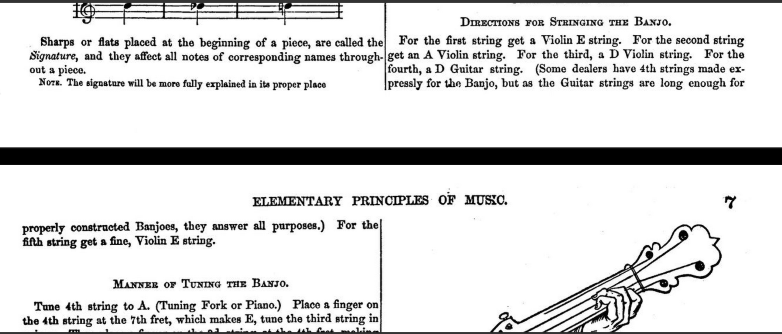
This is from a 1865 banjo method: Violin strings are employed.
mimmo2us - Posted - 09/09/2022: 07:46:26
quote:
Originally posted by csacwpquote:
Originally posted by mimmo2usquote:
described by the professional players of the era were almost invariably quite thin (Albert Baur mentions one player who used heavier strings and denotes that he was an outlier).
Thanks! The problem is that when one make a method many will follow the suggested indications. However, despite that, I have realized that the general direction was about the thinner gauges like those suggested in the 1892 method: i will do the set soon even for the market. Thanks for the information and suggestions. Now I go right now to realize and install the synthetic version of the gut set. An amateur video in YouTube video will follow soon and it will be shared here soon.
Mimmo
Edited by - mimmo2us on 09/09/2022 07:48:05
csacwp - Posted - 09/09/2022: 07:54:45
quote:
Originally posted by mimmo2usquote:
Originally posted by csacwpquote:
Originally posted by mimmo2usquote:
described by the professional players of the era were almost invariably quite thin (Albert Baur mentions one player who used heavier strings and denotes that he was an outlier).
Thanks! The problem is that when one make a method many will follow the suggested indications. However, despite that, I have realized that the general direction was about the thinner gauges like those suggested in the 1892 method: i will do the set soon even for the market. Thanks for the information and suggestions. Now I go right now to realize and install the synthetic version of the gut set. An amateur video in YouTube video will follow soon and it will be shared here soon.
Mimmo
I look forward to it and to trying the set myself.
mimmo2us - Posted - 09/09/2022: 08:34:47
... everything is too fast I image... Here is, just realized, the very first synthetic version of the 1892 gut banjo set.
yes; everything is wrong and not historical here. Even the player (I am just an amateur with wrong or scarce technique). But who is expert can easily realized which kind of sound we can obtain making everything in the proper way starting from the suitable bridge.
youtu.be/XdcATO1sa_s
Mimmo
Edited by - mimmo2us on 09/09/2022 08:37:51
GChicco - Posted - 09/09/2022: 10:13:58
I recently ( about two weeks ago) put a set of Aquila Nlygut strings on my 1890's Pollmann Banjolin. I am pleased with the sound, sort of earthy and the feel of the string. I haven't noticed any "squeaking" but I'm still getting used to them. I was surprised how quickly they settled in, virtually no stretching like regular nylon strings, although when I change tunings they seem to require more turns than the steel strings I had on it previously.
So far I am happy with them and plan to put a set on my 1882 Martin (guitar) to see if it improves the treble quality.
Bart Veerman - Posted - 09/10/2022: 10:53:35
Could you PLEAZZZZZE print your string gauges on the packages as for banjo players it is very important to know to what specifications to re-slot the bridges and string nuts.
Bart Veerman - Posted - 09/10/2022: 22:52:27
It's hard to see on this picture but it looks to me like the strings are exiting from the top of the tail piece. If so, you need to route them thru the tail piece's front "claw cut-outs" so they come out from the bottom of the tail piece
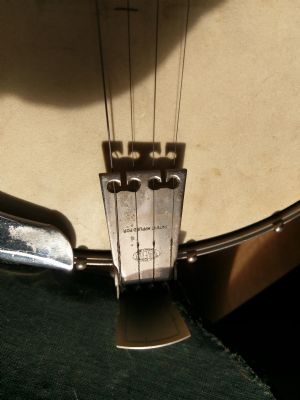
Looks like a cool banjo!
Terms of Use | Privacy Policy | Privacy Consent (EU/GDPR Only)
Copyright 2026 Banjo Hangout. All Rights Reserved.