
DVD-quality lessons (including tabs/sheet music) available for immediate viewing on any device.
Take your playing to the next level with the help of a local or online banjo teacher.
Weekly newsletter includes free lessons, favorite member content, banjo news and more.
Premier Sponsors


|
Please note this is an archived topic, so it is locked and unable to be replied to. You may, however, start a new topic and refer to this topic with a link: http://www.banjohangout.org/archive/383719
DWFII - Posted - 06/07/2022: 10:13:00
This question probably belongs in the music theory forum but I am a little too 'basic' for that level of discussion.
I have a version of Utah Phillips song-- Rock Salt and Nails-- that is chords and words it begins in G and ends in G, with chords of F, Em and C... along with G, of course.
And I have just located the original version of that same song and it is in C--all melody notes with some chord designation. I'm not interested in the chords in this version, per se. I hope to transpose to G and end up with a melody I can play and then try to arrange for 2FIL banjo.
If I were transposing for clarinet, for instance, I don't think this would be a problem as I have done that a number of times.
My problem is two-fold: first: the key of G contains an F#-- I know/assume that the key signature probably doesn't matter, but none of the fretting called for in the chord and vocal version contains an F#. So that's kind of giving me pause. Iam not done transposing but i don't immediately see any note from the C version moving to F (or F#) in th eG version. So that may issue be moot.
The second problem is that the original version (in C) begins with C below the staff and goes to middle C. Transposing from C to G involves raising each note four whole notes. So middle C ends up as G above the staff when the melody is raised from C to G. That would be a fairly high note relative to the rest of the song.
So what do i do? It seems like I would need to play a G on the fifth fret of the first string to get that high register sequence.
If it's not already clear, i am kind of rusty if not completely ignorant. But any help would be appreciated ...if I can understand it. xD
Too bad there isn't a software program that will transpose and simultaneously re-write in tab.
Alex Z - Posted - 06/07/2022: 10:44:29
Just to get really clear:
-- You want to take the original version of the melody, which is written in C, and transpose it to G to play on the banjo.
-- At this point you don't care about transposing chords.
Question: what design of banjo are you playing (5-string, tenor, plectrum) and what will be the tuning when you play the song in G?
Alex Z - Posted - 06/07/2022: 10:49:03
If the version in G does not include an F# but does include a plain ol' F natural, then the C version will have to include a Bb instead of a B natural. We'll get to how this works later.
Also, terminology when you're reading various explanations: A "whole" step is two "half steps." Therefore, from C up to G is not four whole steps but rather 3-1/2 steps: C-D, D-E, E-F (half step), and F-G. This will help avoid some confusion about intervals when transposing. Again, more later.
Alex Z - Posted - 06/07/2022: 10:53:06
If the version in G does not include an F# but does include a plain ol' F natural, then the C version will have to include a Bb instead of a B natural. We'll get to how this works later." Ignore this -- I didn't see the key signature sentence below.
"My problem is two-fold: first: the key of G contains an F#-- I know/assume that the key signature probably doesn't matter, but none of the fretting called for in the chord and vocal version contains an F#. "
The "key signature" does matter, because the key signature of G contains on sharp -- F#. This means that all F's played are to be played as F#, unless otherwise notated.
Alex Z - Posted - 06/07/2022: 10:56:01
So we can see that transposing (without simply slapping on a capo) involves some knowledge of scales and key signatures. So best to go slow.
Now, if you are going the capo route, that's a different question with different answers.
janolov - Posted - 06/07/2022: 11:05:13
1. Probably the key is not G major, but rather a modal key - G Mixolydian (G-A-B-C-D-E-F-G). There are a lot of well known banjo tunes that is in G Mixolydian, for exampole Old Joe Clark, June Apple (first part), John Hardy and others. If you have notation in C it will be C Mixolydian (C-D-E-F-G-A-Bb-C).
2. It should be a high note in both C and G, so what is the problem. Fifth fret is not a rare position.
3. There is actually a software - TablEdit - that can read notation, and transpose it to another key, and show the result in banjo tab. It is a rather new item in TablEdit, and I have not try it, but theoretically it would work, but there may be reading problems and problems identifying what string at what fret shall be played.
DWFII - Posted - 06/07/2022: 11:36:12
Ok...sorry for the confusion...
Below is the chord version of Rock Salt and Nails:
And a pdf of the original composition by Utah Phillips, key of C: (ignore my notes)
And just for the heck of it (and maybe some constructive criticism), here is my first effort at transposing Rock Salt and Nails from C to G (just scribbled that out this morning):
Maybe this will help?
(They didn't sequence in the order I intended.)
Edited by - DWFII on 06/07/2022 11:40:53
elkinsfiddler - Posted - 06/07/2022: 13:22:51
With all due respect, I guess I don't understand the problem. If you'll excuse my simplistic approach, I'd tune the banjo to Drop C (or Double C) and play C, Am, F, G7 chords (just conventional C scale 1,4, 5 chords - see circle of fifths). If I wanted to play the tune in G, I'd tune to open G and play G, Em, C, D7 (again just conventional G scale chords). I'm an ear musician so I'd just sound out the melody by poking around within those chords. If you aren't an ear musician, I can't offer any useful advice.
Let me editorialize a bit about Bruce Utah Philips, The Golden Voice of the Great Southwest. He is far and away my favorite singer/songwriter. I've heard him in concert several times and gave him a bucket (small) of beer to drink on a hot day in July when he was playing at the Smithsonian Folks Festival in Washington, DC. In return he gave me a signed original copy of his song book of his songs. My favorite in that collection is The Goodnight-Loving Trail although I sing a number of the other songs as well.
banjered - Posted - 06/07/2022: 13:43:24
I play/sing this song quite often. Utah is one of my favorite singers and I've learned 7-8 or so of his songs. I have Aquila Minstrel strings on my banjo so it is lowered from the key of G down to D (dADF#A). Another step down and it would be in the key of C (cGCEG). I play the melody as I sing and yes you can get most of the notes out of the chords that you have shown above. Since the above keys are in the G key pattern, the fingering on the left hand is the same for whatever key you end up with, the key of D just happens to match the pitch of my voice best. It is not a complex tune to figure out and it would be a good one to figure out by ear. However if you'd like a tab, you can take your G key/tuning and figure out each note on each string. I use it all – ear, tab, notation and can interchange them pretty easily now, happens with time. I specifically tabbed out "The Hills of Mexico" to see what was going on in the song and play it out of straight G tuning or G modal, but since I am in D tuning that would be D and D modal. Hope this is helpful and not more confusing. banjered
Old Hickory - Posted - 06/07/2022: 13:51:43
quote:
Originally posted by Alex Z
The "key signature" does matter, because the key signature of G contains on sharp -- F#. This means that all F's played are to be played as F#, unless otherwise notated.
It's already been established that the song is Rock Salt and Nails, that in the key of G does occasionally go to an F chord (the flat VII), so the Fs in those phrases will be naturals and outside the scale of the key.
mandobanjolibrarian - Posted - 06/07/2022: 13:58:16
I saw Utah perform at the Noe Valley Ministry in San Francisco back in the 90's with my brother. Great music, great stories, and plenty of sing-alongs. I believe it was a Wobbly benefit show, if I remember correctly. There was an especially rousing rendition of "Hallelujah! I'm a Bum," and the audience sang the refrain with gusto:
Hallelujah! I'm a bum, Hallelujah bum again,
Hallelujah! give us a handout and revive us again.
How did you end up getting a hold of the melody to "Rock-salt and Nails" so quickly, D.W.?
Old Hickory - Posted - 06/07/2022: 14:41:42
quote:
Originally posted by elkinsfiddlerWith all due respect, I guess I don't understand the problem.
I believe his challenge is not about playing the song. He laready has chords for the key of G. I believe his challenge is that he wants a copy of written standard notation of the melody in G. He has notation in C, apparently of Utah Phillips' original version. So to have that in G, he has to transpose it himself by hand.
He believes he can do that, but the use of F natural or an F major chord in the key of G version is causing him confusion since he knows that the key G is supposed to contain F#.
DWFII - Posted - 06/07/2022: 14:45:26
quote:
Originally posted by mandobanjolibrarianHow did you end up getting a hold of the melody to "Rock-salt and Nails" so quickly, D.W.?
In another thread it was mentioned that Phillips (?) had published a book Starlight on the Rails. An internet search came up with a pdf of the whole book--collections.lib.utah.edu/file?id=716372, I riffled through it until I hit the page with the song song, and did a print-screen. IIRC, I then dropped it into a photo program (paint.net) and saved it to .png. Printed that and then scanned the result into pdf. And there you have it.
I converteded my few bars of the transposed version into tab a few minutes ago and when I hesitantly plyed through it, it sounded about right. Nothing like Joan Baez's verstion though--mostly the right notes but not as sweet.
DWFII - Posted - 06/07/2022: 14:53:14
quote:
Originally posted by Old HickoryI believe his challenge is not about playing the song. He laready has chords for the key of G. I believe his challenge is that he wants a copy of written standard notation of the melody in G. He has notation in C, apparently of Utah Phillips' original version. So to have that in G, he has to transpose it himself by hand.
He believes he can do that, but the use of F natural or an F major chord in the key of G version is causing him confusion since he knows that the key G is supposed to contain F#.
Prettymuch spot on.
Again, FWIW, i may be out-of-my-mind to think that I can do this. I am coming back to music after a good forty years and that from clarinet and recorder and penny whistle. I used to transpose songs in a number of differnt keys to bflat and sometimes back to C (my wife played flute). But I was always a 'mechanic'--relying on visual aids rather than a musician. Still am i suppose. I never really understood the theory.
I want the melody so that I can 'arrange" it for 2FIL banjo and have it still be recognizable--bum-dittys and drop thumb and pinches etc.. All the goodies.
DWFII - Posted - 06/07/2022: 14:56:44
quote:
Originally posted by banjeredHowever if you'd like a tab...
Yes, please...in G?

Old Hickory - Posted - 06/07/2022: 15:03:52
quote:
Originally posted by DWFIIThis question probably belongs in the music theory forum but I am a little too 'basic' for that level of discussion.
Yeah, it does. I think you'd get the same answers there that you've received here.
Old Hickory - Posted - 06/07/2022: 15:22:19
quote:
Originally posted by DWFIII want the melody so that I can 'arrange" it for 2FIL banjo and have it still be recognizable--bum-dittys and drop thumb and pinches etc.. All the goodies.
What I'm not understanding is if you aleady have the chords in G, can hear the melody in your head as you play the chords, and can maybe hum or sing the melody as you play the chords . . . why do you need the notation? Why don't you just use the chords as the basis for your two-finger thumb-lead arrangement? And tab that out as you create it?
I don't see what the standard notation gets you . . . unless it's a waystation on the path toward writing the single line melody in tab, which you will then expand into your 2FTL arrangement.
I realize you're somewhat new to this, but I assume you're aware that any banjo arrangement -- clawhammer, 2FTL, 3-finger -- makes musical choices that nearly always result in some notes being dropped, changed or displaced. Self-accompanying finger-style banjo rarely plays a literal melody.
So, sure, you can start with the written notation in G. But chances are you're going to jettison at least some of the notes.
DWFII - Posted - 06/07/2022: 15:42:42
quote:
Originally posted by Old HickoryWhat I'm not understanding is if you aleady have the chords in G, can hear the melody in your head as you play the chords, and can maybe hum or sing the melody as you play the chords . . . why do you need the notation? Why don't you just use the chords as the basis for your two-finger thumb-lead arrangement? And tab that out as you create it?
I don't see what the standard notation gets you . . . unless it's a waystation on the path toward writing the single line melody in tab, which you will then expand into your 2FTL arrangement.
I realize you're somewhat new to this, but I assume you're aware that any banjo arrangement -- clawhammer, 2FTL, 3-finger -- makes musical choices that nearly always result in some notes being dropped, changed or displaced. Self-accompanying finger-style banjo rarely plays a literal melody.
So, sure, you can start with the written notation in G. But chances are you're going to jettison at least some of the notes.
2F Index lead....
Yes, being new has a lot to do with it. i asked something similar to what you're suggesting in another thread--ie. could melody notes be extracted from chords. the answers I got were kind of all over the place but I came away thinking "yes you could but it would be laborious."
I have the chorded version...it has 4 measures and 8 notes all being played in a G chord. The melody note choices in a G chord seem to limit me to four notes--D, G, B, G.
Are all eight notes one of those four?
From what I'm seeing the answer is "no."
The original melody, when transposed, suggests that there is an A in there and that the Ds are not played at all. I think that's part of what make it so difficult. And where is that A when I'm brushing the G chord?
I don't know. I thought I was getting somewhere but maybe I'm falling down a rabbit hole with this line of inquiry.
[sigh]
Edited by - DWFII on 06/07/2022 15:44:37
banjered - Posted - 06/07/2022: 15:42:45
Sorry, lack the tech to post tab, audios, videos, anything beyond words. banjered
DWFII - Posted - 06/07/2022: 15:46:46
quote:
Originally posted by banjeredSorry, lack the tech to post tab, audios, videos, anything beyond words. banjered
No worries...I was joking. Hence the big grin. I wasn't expecting it, really.
Alex Z - Posted - 06/07/2022: 21:06:37
I'm hearing a C chord, not an F chord, in early recordings of "Rock Salt and Nails" in the key of G -- that is, a subdominant IV, not the flat VII.
Maybe the F chord was added in later cover versions. So if the intent is to play the original, then don't have to worry about how to notate an F natural in the key of G.
Alex Z - Posted - 06/08/2022: 06:23:14
Mr. DWFII did show a link to the original Utah Phillips publication, which appears to have been hand written by Utah Phillips himself. I looked up the book and found the song also.
"Rocksalt & Nails" (which is how the title is written) is written in that book in the key of C, and there is no flat VII (Bb) chord or note, but rather an F chord with an F note at the point where later recordings substitute a flat VII chord.
So -- and I say this in good nature, because we tend to jump to conclusions quickly on the BHO -- it has not "already been established" that the song, if played in G, has a F chord or an F natural note. And the original song is not in a modal key, but rather plain old C scale.
Now the poster can play the song in any key he wants, with any chords he wants, which liberty later recordings take. But if he wants to play it in G with the original chords, then the plain old G scale is sufficient, and the conventional key signature works fine.
Hope this helps.
Edited by - Alex Z on 06/08/2022 06:24:03
Old Hickory - Posted - 06/08/2022: 21:26:39
quote:
Originally posted by Alex ZSo -- and I say this in good nature, because we tend to jump to conclusions quickly on the BHO -- it has not "already been established" that the song, if played in G, has a F chord or an F natural note.
In equally good nature, I would say it "had already been established" that DW was in possession of, confused by, and asking about a set of chords for Rocksalt and Nails in the key of G that included the flat VII F. In the context of my post and what I was replying to, it's clear that's what I meant.
That Utah Phillips wrote the song in C with no flat VII doesn't change the fact that DW was working with an arrangement in G that did include that chord.
DWFII - Posted - 06/09/2022: 05:24:06
quote:
Originally posted by Old HickoryIn equally good nature, I would say it "had already been established" that DW was in possession of, confused by, and asking about a set of chords for Rocksalt and Nails in the key of G that included the flat VII F. In the context of my post and what I was replying to, it's clear that's what I meant.
That Utah Phillips wrote the song in C with no flat VII doesn't change the fact that DW was working with an arrangement in G that did include that chord.
I'm almost afraid to ask this question...not only because I'm not sure what you fellers are talking about but because the answer may raise more questions that I'm prepared to deal with.
But here goes:
What's "the flat VII F?"
Or is that so far above my pay grade it's not it's not gonna make any sense to me?
I guess it may seem odd or puzzling as to why I wanted to transpose the original Utah Phillips version to G, but the simple answer is that I had a version in G, which seemed to pose no problems when playing except for the biophysical obstacle of creating the F chord. Otherwise all the chords were in reach of the first five fretts.
I worried about the F# in the key of G because I knew, from the circle of fifths, that the key of G contained an F# but I didn't see any flats or sharps in the chorded version--none of the chords called for contains a sharp.
I wondered why--was I mistaken or did the G melody just, by happenstance, not have an F#.
Edited by - DWFII on 06/09/2022 05:25:12
250gibson - Posted - 06/09/2022: 05:37:03
quote:
Originally posted by DWFIIquote:
Originally posted by Old HickoryIn equally good nature, I would say it "had already been established" that DW was in possession of, confused by, and asking about a set of chords for Rocksalt and Nails in the key of G that included the flat VII F. In the context of my post and what I was replying to, it's clear that's what I meant.
That Utah Phillips wrote the song in C with no flat VII doesn't change the fact that DW was working with an arrangement in G that did include that chord.
I'm almost afraid to ask this question...not only because I'm not sure what you fellers are talking about but because the answer may raise more questions that I'm prepared to deal with.
But here goes:
What's "the flat VII F?"
Or is that so far above my pay grade it's not it's not gonna make any sense to me?
I guess it may seem odd or puzzling as to why I wanted to transpose the original Utah Phillips version to G, but the simple answer is that I had a version in G, which seemed to pose no problems when playing except for the biophysical obstacle of creating the F chord. Otherwise all the chords were in reach of the first five fretts.
I worried about the F# in the key of G because I knew, from the circle of fifths, that the key of G contained an F# but I didn't see any flats or sharps in the chorded version--none of the chords called for contains a sharp.
I wondered why--was I mistaken or did the G melody just, by happenstance, not have an F#.
The flat VII F is an F chord in the key of G. As you mentioned in the key of G the 7th is an F#. That is why an F natural chord is called a flat VII.
if you don't want to use the F chord, then forget entirely about the version you gave with chords in G. Just transpose the hand written notation to G and also transpose the chords from that version.
Also, the melody contains no 7th degree. Flat or otherwise
DWFII - Posted - 06/09/2022: 06:24:37
quote:
Originally posted by 250gibsonThe flat VII F is an F chord in the key of G. As you mentioned in the key of G the 7th is an F#. That is why an F natural chord is called a flat VII.
if you don't want to use the F chord, then forget entirely about the version you gave with chords in G. Just transpose the hand written notation to G and also transpose the chords from that version.
Ah! Thanks for that.
So how do you transpose the chords?
mandobanjolibrarian - Posted - 06/09/2022: 07:36:06
There's a gajillion charts and tools and gizmos out there to transpose chords from one key to another, free to use on the web. Here's one that's pretty straightforward; just follow the instructions in the small print underneath the table.
250gibson - Posted - 06/09/2022: 08:12:22
quote:
Originally posted by DWFIIquote:
Originally posted by 250gibsonThe flat VII F is an F chord in the key of G. As you mentioned in the key of G the 7th is an F#. That is why an F natural chord is called a flat VII.
if you don't want to use the F chord, then forget entirely about the version you gave with chords in G. Just transpose the hand written notation to G and also transpose the chords from that version.
Ah! Thanks for that.
So how do you transpose the chords?
You essentially take the chords of the original, In this case C, F, and Am and assign them a number in relation to the key/tonic. Since the key is C, the C chord would be 1maj (I) the F chord would be 4 maj (IV) and the Am chord would be 6 min (vi). Then to get to the key you want, you reverse the process for the new key/tonic. So the 1maj (I) in the key of G would become G. The 4 maj (IV) in the key of G would become C and the 6 min (vi) in the key of G would become Em.
Old Hickory - Posted - 06/09/2022: 08:18:35
quote:
Originally posted by DWFIISo how do you transpose the chords?
By counting.
Really, it's as simple as that. And that's where the concept of the "Nashville Number System" or just "Number System" comes in.
To explain, here's a little bit of theory as I understand it (starting with scale notes, but we'll get to chords).
Scales have 7 notes plus the octave (next higher version of starting note). Notes have letter names from A through G. Every scale uses all 7 letter names. This means the pattern of whole and half notes that is the same for every scale results in some letter notes having to be called sharp or flat. Major and minor scales follow different patterns. The pattern for Major scales is:
1 whole> 2 whole> 3 half> 4 whole> 5 whole> 6 whole> 7 half> 8
There are whole steps between most letter notes except B>C and E>F
The scale for C Major, for example is C-D-E-F-G-A-B-C
The scale for G Major is: G-A-B-C-D-E-F#-G
Following the rule of using every letter name, the 7th note in the G Major scale has to use the letter F. But to follow the Major scale pattern of whole and half steps, the 7th note in the G Major scale has to be raised a half step from F to F#. While you could also think of this note as G-flat, we don't call it that because G is already being used for the 1 note and calling it G-flat would omit the letter F. But I digress.
Now on to chords.
The simplest way to form chords (and we're only interested in three-note "triads" here) is to start with any letter note then skip notes to add the next two. That is, for example, start with A, skip B, use C, skip D, use E. So you have: A-C-E. Experience tells us this is an A minor chord. I won't discuss here here the intervals between A>C and C>E that define this chord as minor.
Stay with me, we're finally getting to the part about transposing.
Another way to form chords by the every-other-note method is to use only notes within a particular scale. We'll stay with Major. If you do this in the key of G Major, the resulting chords would be:
1: G-B-D G Major
2: A-C-E A minor
3: B-D-F# B minor
4: C-E-G C Major
5: D-F#-A D Major
6: E-B-G E minor
7: F#-A-C F# diminished
The chords built on the notes of a given scale are called that key's "diatonic" chords. I believe diatonic simply means "of the scale."
Just as the pattern of whole and half notes is the same for every Major scale, so is the pattern of Major, minor, and diminished chords. That is: the chords built on the 1, 4 and 5 notes of a Major scale will be Major, the chords at 2, 3 and 6 will be minor, and the chord at 7 will be diminished.
That's where the number system comes from. By musical convention, the numbers for chords are often written as Roman numerals, with capital letters representing Major and lower-case representing minor. I think diminished is lower case with a degree symbol added.
So the true 7 (or vii°) chord in the key of G is F# diminished. This chord is rarely used in bluegrass, folk and country. Something that happens a lot in these genres, however, (and rock and pop, too) is to use the chord a whole step down from G. That would be F Major. It's one-half step down (flat) of the true vii° F# diminished, so it's called the "Flat VII."
How all this applies to transposition:
If you know the chords to a song in one key, all you have to do is figure out any chord's scale degree (number) in that key to then figure out the chord at the same scale degree in the key to which you're transposing. As I said way back the beginning: count.
So, for example: if a song uses an E minor chord over a phrase in the key of G, what chord would it use for that phrase in the key of C? Let's count. E is the 6th note of the G scale and E minor is the vi chord. The 6th note in the C Major scale is A, and we know we need a minor chord (the vi), so the transposed chord is A minor. Do the same for every chord in the song. If a chord is Major or minor in the source it will be the same in the transposition. Only the letter name will change.
Eventually you'll remember these. Or at least for the keys you most often play. Until then, all you need to do is count. If you need a cheat sheet, no harm in writing it out. There are in fact tables listing all the chords for all the keys, making it easy to transpose until you've finally remembered them.
- - - - - - - - - -
But none of this explains why the F in your G Major version of Rocksalt and Nails,would transpose to B-flat in C, but Utah Phillips' C Major version of chords doesn't go to a B-flat there. In fact, I think his also goes to F, but in the key of C. What gives?
The answer is simply that whoever wrote out those key of G chords chose to re-harmonize that phrase and use the flat VII chord instead of the IV Major as written by Utah Phillips. Or maybe whoever wrote out the chords was transcribing some artist's recorded version. Either way, it was just someone's musical choice.
And now you have a choice: If you like the sound of the F chord (flat VII) in that phrase in the key of G, you can keep it. If you like the sound of Utah Phillips' original, then you would use a C chord (the IV chord). Your choice.
Old Hickory - Posted - 06/09/2022: 13:47:16
quote:
Originally posted by 250gibsonAlso, the melody contains no 7th degree. Flat or otherwise
And neither do the chords as originally composed.
I'm guessing it came from Joan Baez's version, included on her 1969 album David's Song. In the key of C, on the first syllable of the chord change in the last line of every verse, she goes to the flat VII chord (B-flat) and then resolves that to the IV (F).
She doesn't sing a flat 7 note and doesn't change the melody. She sings an F note, the 5 of the B-flat chord, that resolves nicely as the root of the F chord where the melody continues on the F note before moving down to the C.
Since the album peaked at #36 on the US Billboard charts, I imagine Joan Baez's version was the source for many subsequent covers that included the flat VII chord that Utah Phillips did not write.
DWFII - Posted - 06/09/2022: 18:19:59
Well, i really appreciate the time you all have taken to help a newbie. I esp. appreciate the detailed post of Ken's--i have skimmed it, but have not digested it. May take me a while.
Nevertheless I have learned a few things. Thank you.
All this just to get a reasonable, melodic 2FIL tab for Rocksalt and Nails. 
Old Hickory - Posted - 06/09/2022: 19:16:09
quote:
Originally posted by DWFIIWell, i really appreciate the time you all have taken to help a newbie. I esp. appreciate the detailed post of Ken's--i have skimmed it, but have not digested it. May take me a while.
Nevertheless I have learned a few things. Thank you.
Not digested it? Get cracking. You're being tested on it in the morning!
Seriously, though, focus mainly on the second half about chords and transposition. You probably know or can figure out the first part about scales and notes from playing clarinet.
Here's a transposition chart for major keys:
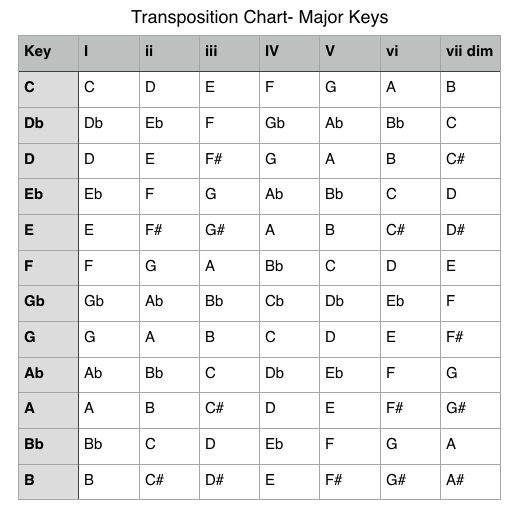
And here's a chart for minor keys:
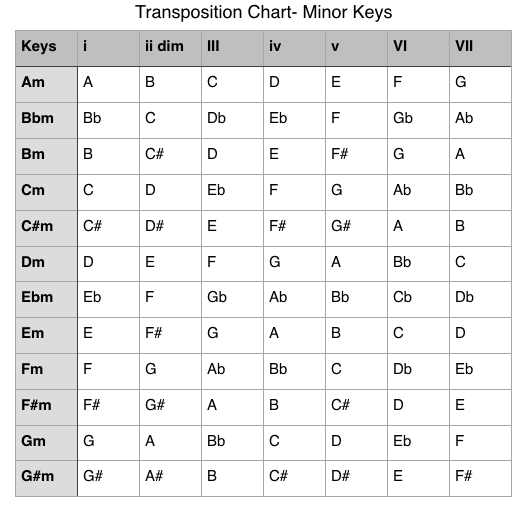
DWFII - Posted - 06/10/2022: 09:58:17
@ Old Hickory,
Well, I am beginning to get it. And the charts helped thanks. I have confirmed that the chords are transposed faithfully from the Utah Phillips version in C to the chord version in G...except for the first measure in the last seven, where the Utah Phillip's begins with F and the also begins with F.
I suspect I can just transpose the notes from Cmajor to Gmajor and carry over the chords in the Gmajor version. I like the sound of the chorded Gmaj. when I play it.
Old Hickory - Posted - 06/10/2022: 11:50:04
quote:
Originally posted by DWFIIWell, I am beginning to get it. . . . I suspect I can just transpose the notes from Cmajor to Gmajor and carry over the chords in the Gmajor version. I like the sound of the chorded Gmaj. when I play it.
Yes, you can!
If you like the sound of the G Major version that starts the last line of a verse on F before resolving to C (and I do, too) then play it that way. Joan Baez did. (Well, she played it that way in the key of C, but same type of flat VII to IV major chord change).
As I speculated in another message, Joan Baez's 1969 recording is probably the source of that chord choice.
Old Hickory - Posted - 06/10/2022: 13:41:14
quote:
Originally posted by DWFIIi asked ... in another thread ... could melody notes be extracted from chords. the answers I got were kind of all over the place but I came away thinking "yes you could but it would be laborious."
I have the chorded version...it has 4 measures and 8 notes all being played in a G chord. The melody note choices in a G chord seem to limit me to four notes--D, G, B, G.
The original melody, when transposed, suggests that there is an A in there and that the Ds are not played at all. . . . And where is that A when I'm brushing the G chord?
I've been meaning to answer this for a while but needed to gather my thoughts.
EVERY melody note is not necessarily in the current chord but the important or core melody notes almost always are.
What's the "core" melody? It's the melody that remains when you strip away the notes for all syllables or movement from one note or word to another. The remaining notes are typically going to be the ones that occur on the count of "1" in every measure and maybe the "3" (in 4/4 time) if there's a mid-measure chord change. In a 3/4 song like Rock Salt and Nails, the core melody pretty much occurs on the "1"s - the first beats of measures.
So, for example, RS&N starts on some pickup notes with the first downbeat or a 1 count being on the word "banks." The next 1 is the first syllable of "river." And so on. If you go through and play just the notes that occur on counts of 1, you'll hear the gist of the melody. You'll miss all the finer points. But the song will be recognizable. And I'm pretty sure that all of these notes will be in the chord that's happening at that moment.
As you've seen, one or more of the melody notes that we've stripped out don't appear in the current chord. They're just passing notes. I would expect 99+% of all songs have passing notes that are not in the current chord, but in between two notes of the chord. You mentioned a transposed G chord phrase having an A note. A is halfway between G and B which are both in the G chord. It is melodically ubiquitous for a song in G to have a melody note on A. Maybe the melody goes up to A and right back to G. Or it goes G-A-B or B-A-G ("three blind mice").
Don't worry if you can't hit all the passing notes or non-core melody in your two-finger index-lead. Trust your chord charts and keep your chord changes on the right beats and hit as much melody as you can. Three-finger style often displaces melody notes by a count one way or another to avoid fingering tie ups. Passing notes almost always happen on off-beats. They do not affect chord choice.
You also asked about notes in the chord that did not not appear in the melody at all. Of course they didn't. Melody is only one note at a time. Chords are two or more notes. Usually three or more. So not every chord note can be a melody note. The chords notes that aren't melody are harmony.
You asked if melody notes can be extracted from chords. Of course they can. Most of the time, anyway. As I've said so far, the core melody coincides with chord changes and resides within the chords. So you can almost always extract the core melody from the chord that's currently happening. Especially in simple songs. No need to deal with every possibility here.
Hope this helps.
DWFII - Posted - 06/11/2022: 16:15:38
quote:
Originally posted by Old HickoryYou asked if melody notes can be extracted from chords. Of course they can. Most of the time, anyway. As I've said so far, the core melody coincides with chord changes and resides within the chords. So you can almost always extract the core melody from the chord that's currently happening. Especially in simple songs. No need to deal with every possibility here.
Hope this helps.
Again I thank you. I have learned a lot from these two posts...although a good bit of tht is how much I don't know.
I am trying to come up with an arrangement for RS&N, that sounds good to me and that I can play. It is laborious but that too is a learning experience...especially for the ear. I am not sure I will even be able to play whatever I come up with when I am done. I am not very skilled at playing the banjo. But I have a recognizable melody line and am trying to figure what notes I can leave out and what notes and where I can add for ornamentation.
Probably the hardest part is figuring out wat to do with sustained and connected half notes... some of which take up two measures. Somehow i am not 'feeling' it when I break them down into sequences of quarter notes. I find myself resorting to pinches.
[sigh] ...not giving up.
banjoak - Posted - 06/12/2022: 16:36:42
quote:
Originally posted by DWFIIYes, being new has a lot to do with it. i asked something similar to what you're suggesting in another thread--ie. could melody notes be extracted from chords. the answers I got were kind of all over the place but I came away thinking "yes you could but it would be laborious."...
....I don't know. I thought I was getting somewhere but maybe I'm falling down a rabbit hole with this line of inquiry.
[sigh]
The answer is no, not only laborious, you really couldn't. For a lot of reasons, but importantly; a chord progression has such a vast number of different melodic possibilities, besides pitch, rhythm and rising/falling direction from one note to other.
Some seems basic confusion about what are melody vs chord/accompaniment relationship; and perhaps overthinking it; or perhaps looking for some over simple magic music theory formula or rules that can use? These are falling down bit of rabbit holes.
Might find easiest way to start understanding this is to just think of the relationship as separate; the melody as accompanied by chords (and rhythm).
...it has 4 measures and 8 notes all being played in a G chord. The melody note choices in a G chord seem to limit me to four notes--D, G, B, G.
The original melody, when transposed, suggests that there is an A in there and that the Ds are not played at all. . . . And where is that A when I'm brushing the G chord?
The D, G, B notes are the accompaniment, The melody is playing OVER a G chord, not in. Melodies are not limited to having only play pitches defined by the chord/accompaniment. The "Ds are not played at all."; melodies do not have to have to use ALL of the pitches that make up a particular chord.
-------------
Probably the hardest part is figuring out wat to do with sustained and connected half notes... some of which take up two measures. Somehow i am not 'feeling' it when I break them down into sequences of quarter notes. I find myself resorting to pinches.
Perhaps what you are looking at is the single line voice melody being held and sustained. Besides that banjos can't really do that sustain; typically the role isn't single line melody; but to incorporate an accompaniment (both rhythmic and harmonic); to which the melody sits on top of. An easier grasp in examples where the melody vs accompaniment are 2 separate instruments.
The idea 2FL, (and others)is to incorporate both into one. Play the melody notes a little stronger, emphasized... but then filling up those spaces with accompaniment, chord tones (and rhythm pattern)... often a little less pronounced.
--------
IMO, songs like this are pretty easy to do that "because" they have space, over multiple measures. Break it down, has pick up notes (on the); then melody of on picked One Two Three / One - then the next few measures is accompaniment fill (using the last melodic note of One to start the rhythm pattern). That can be just simple quarter note Bum tick tock (doesn't have to be pinches)... or can use more of eighth notes Bum a tick a tock a; or perhaps something in between or other... until get to next phrase with melodic pick up notes.
What might help this process though is start with the rhythmic feel you want to achieve. That is just as back up a separate instrument playing the melody, like in singing... find a good accompaniment for chords and rhythmic feel. Then suspend/replace the BU role, only on the parts where need to emphasize melody.
edit: as far as transposing, as other said, can just do the math; but I did notice in pdf, someone already started to pencil in note names for key G, which can just use that to do the rest.
Edited by - banjoak on 06/12/2022 16:40:03
mandobanjolibrarian - Posted - 06/12/2022: 21:45:44
I think banjoak does a nice job of distilling this down to the fundamental issue here: that melody and chordal accompaniment are separate and non-interdependent elements of music, but which work together to make a greater sum than their two parts.
I'm wondering if a little dab of music theory might help sort it out in your mind? Nothing too in-depth or time-consuming needed; just maybe Google basic music chord theory and skim some of the results. For example, I found this fairly succinct summary doing just exactly that:
Why Are Chords Important?
They’re important for developing the structure of a song and helping to define different sections of a song with the use of chord progressions.
A chord progression is a series of chords played in a sequence. Progressions are used to add harmonic content to a song. They are also used to create a sense of ‘movement’ within music. They can also be used to provide a melody with context and allow the characteristics of a melody to be clearly heard.
A melody is a linear sequence of musical notes that are heard as a single entity. Chords can also be used rhythmically to make a song more interesting and unique. This is particularly relevant to genres such as Reggae where the use of rhythm is a defining characteristic of the genre.
Just a suggestion to maybe get you over the hump on this one. I believe it's less complicated than you think!
Edited by - mandobanjolibrarian on 06/12/2022 21:51:25
DWFII - Posted - 06/13/2022: 07:19:12
quote:
Originally posted by mandobanjolibrarianJust a suggestion to maybe get you over the hump on this one. I believe it's less complicated than you think!
I thank you for your time and advice.
Truth to tell, I think it is actually more complicated than I had hoped it would be.
When I play a song using chords only...like RS&N... I hear the melody. I ask myself "how can i hear the melody if the melody notes (at least some of them) aren't in the chords?" How are those melody notes being generated? Or am I just imagining them?
mandobanjolibrarian - Posted - 06/13/2022: 08:33:47
It's entirely possible you're hearing the melody in your head while you accompany it strumming chords. This is an important skill to have when making music! But let's break down what's happening in that rocksalt and nails original version you shared early in this thread, ignoring the question of transposing for now and looking at the score as it is chorded and noted:
Now, arranging and playing a banjo tune isn't the same as just strumming a chord and singing/humming/hearing in your head the melody simultaneously. I'm just trying to respond to your point about "hearing" all the melody notes in the chords you're playing.
DWFII - Posted - 06/13/2022: 09:32:28
quote:
Originally posted by mandobanjolibrarianNow, arranging and playing a banjo tune isn't the same as just strumming a chord and singing/humming/hearing in your head the melody simultaneously. I'm just trying to respond to your point about "hearing" all the melody notes in the chords you're playing.
Yes, I see what you're saying. i guess it is possible that I'm just hearing the melody in my head.
I've gotten so fixated on RS&N it's dern near the only thing in my head most of the day. i think they call that an 'earwig', lol. That and I want a version--a melodic version--I can play (2FIL or even CH) so bad that I thought/hoped I could arrange one myself. I have certain passages that I have altered which I like very well. But even the simplest things stymie me.
The first measure, for instance, there appears to be an implied two beat rest and then a doublet of eighth notes, both very essential to the phrasing ...how the hellgramite does one arrange that for 2FIL? I've tried a sixteenth open 3 and 5 (in G) followed by an eighth note and that almost works but I'm not sure it's kosher.
And how does one handle a two measure sustain that doesn't lose the idea of a sustain?
Like I said ...probably more complicated than I had hoped when I was just desperate for a tab i could play ...and thus resolve the earwig bit.
But all that said, I have learned some things... and offer my thanks to all that have offered insights and advice (and might continue to do so)...nothing ventured, etc.. I guess that's one way, albeit painful, to learn.
Old Hickory - Posted - 06/13/2022: 11:29:56
quote:
Originally posted by DWFIIAnd how does one handle a two measure sustain that doesn't lose the idea of a sustain?
You fill with a measure of "G noise," "C noise," "E minor noise" or "noise" for whatever chord is playing over the two measures.
If you feel you lack experience to create something good, this is where listening to recordings and looking at your 2FIL lesson materials come into play. What do others do when they need to fill two measures of one chord after a melody note in a vocal song? What kind of picking pattern exercises are in your study materials? Can you apply the needed chord to one or more of those patterns? Can you modify the pattern (if needed) to emphasize the last melody note?
Pinches and quarter-note arpeggios through the chord are acceptable. Or, in this 3/4 tune where you're counting 1 & 2 & 3 &, consider playing single eighth notes "1 &" then quarter note pinches on "2 3."
All these are basic and are probably all you need. Even basic filler can be plenty musical. Slightly more sophisticated would be filler that has a sense of movement and transition -- or "voice leading" -- into the next melody note and chord. That can be something to aspire to.
johnedallas - Posted - 06/13/2022: 12:13:19
I can tell you how I transpose chords. It's easy - but I must confess to using exclusively Classic tuning, AKA DropC (gCGBD). I don't alter my tuning for different keys - I just play different notes and chords (using a capo, if the fingering gets too difficult!)
Your "problem song," in the version you posted, is in the key of C major (no sharps or flats in the key signature), and has 3 chords: C, F and Am. These are absolutely standard chords for key C - the tonic, the subdominant and the relative minor (in Roman numerals: I, IV and vi).
If I wanted to accompany the tune in the key of G major, I'd need the I, IV and vi chords for the key of G major. That's simple - the I chord is then G, the IV chord is C, and the vi chord is Em.
In cases that are not quite so simple, I take my trusty transposing wheel (like this one) and turn it so that G (the new key) is adjacent to C (the old key). It shows that C now comes where F used to be, and E (m) comes where A (m) used to be. Where's the problem? There's no problem with DropC, because C, F, G, Am and Em are all easy open-position chords in that tuning.
Try DropC - it might make things easier generally!
Cheers,
John
Dan Gellert - Posted - 06/13/2022: 14:50:07
Excuse me if I missed it in the comments, as I just skimmed real fast after looking at the original post and the original notation...
I think what has you confused is that the melody DOES NOT RESOLVE ON THE TONIC NOTE at the end. The tune, and the chords, all are in straight-ahead C major without accidentals. It ends on a G note, against a C chord on the notation, though it could just as easily be a G or G7.
mtnbiker55 - Posted - 06/17/2022: 08:21:06
quote:
Originally posted by DWFIIquote:
Originally posted by 250gibsonThe flat VII F is an F chord in the key of G. As you mentioned in the key of G the 7th is an F#. That is why an F natural chord is called a flat VII.
if you don't want to use the F chord, then forget entirely about the version you gave with chords in G. Just transpose the hand written notation to G and also transpose the chords from that version.
Ah! Thanks for that.
So how do you transpose the chords?
Key of C to key of G: C = G, Am = Em, F = C. If you want to use the flatted 7th chord (F# "flatted" or dropped 2 steps to F), you can. Your version of this in the Key of G chord chart is correct, it just has an extra chord that the key of C version does not show (but can be played).
If you transposed the key of G version to key of C, you would add a Bb where the F is in the key of G version.
sobill - Posted - 06/18/2022: 22:25:37
Chords............. l ii iii IV V vi vii (l, IV, V are major chords, ii,iii, vi are minor chords, vii is a diminished chord)
Key of C notes C D E F G A B C ( no sharps or flats)
Key of G Notes G A B C D E F# G ( 1 Sharp: F#)
Any note in the C scale transposes to the note below it in the G scale. The same exact melody will then be in G.
Any chord in the G scale transposes to the chord below it in the G scale. The B chord in C transposes to an F# chord in G.
The melody in the your first 9 measures are transposed correctly as you show them.
(G) On the banks of the river (C) where the willows hang (G) down
(G) And wild birds all (Em) warble with a low moaning (G)sound
(G) Down in the (Em) holler where the water runs (G) cold
(G) It was there I first (C) listened to lies that you (G) told.
Terms of Use | Privacy Policy | Privacy Consent (EU/GDPR Only)
Copyright 2026 Banjo Hangout. All Rights Reserved.


