
DVD-quality lessons (including tabs/sheet music) available for immediate viewing on any device.
Take your playing to the next level with the help of a local or online banjo teacher.
Weekly newsletter includes free lessons, favorite member content, banjo news and more.
Premier Sponsors


|
Please note this is an archived topic, so it is locked and unable to be replied to. You may, however, start a new topic and refer to this topic with a link: http://www.banjohangout.org/archive/381251
Page: 1 2
coolet5 - Posted - 02/11/2022: 21:32:11
Hi,
My Stelling Banjo needs some neck relief adjustment.
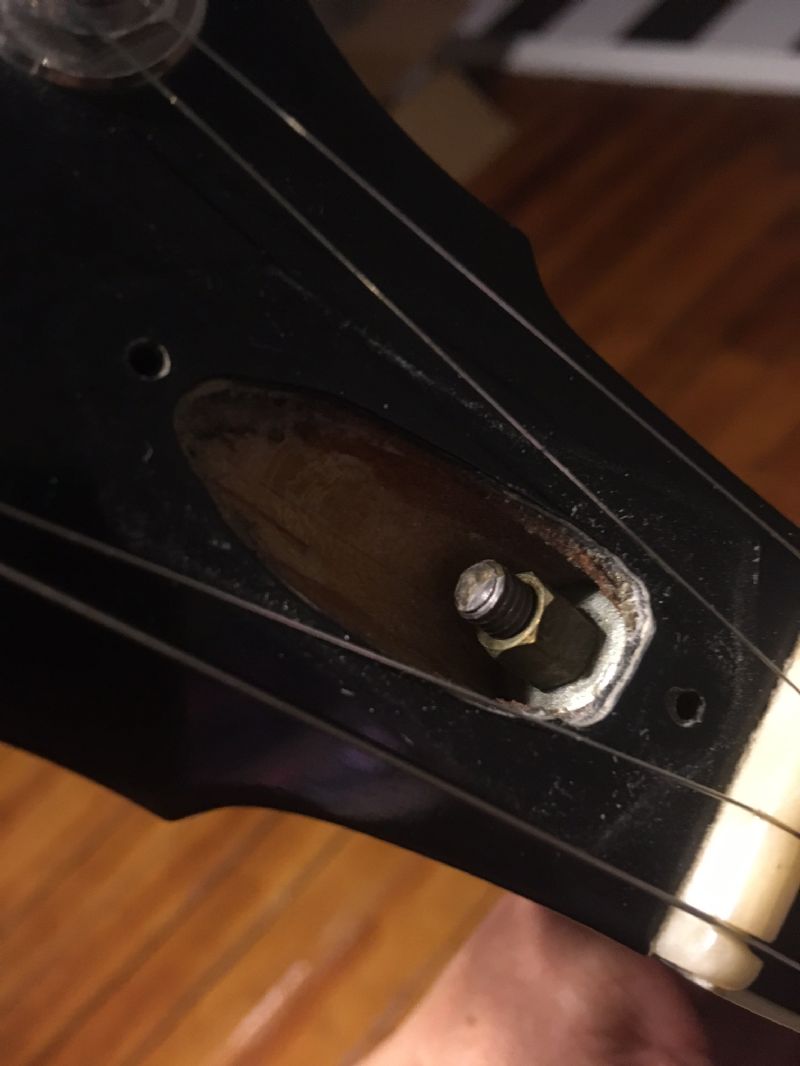
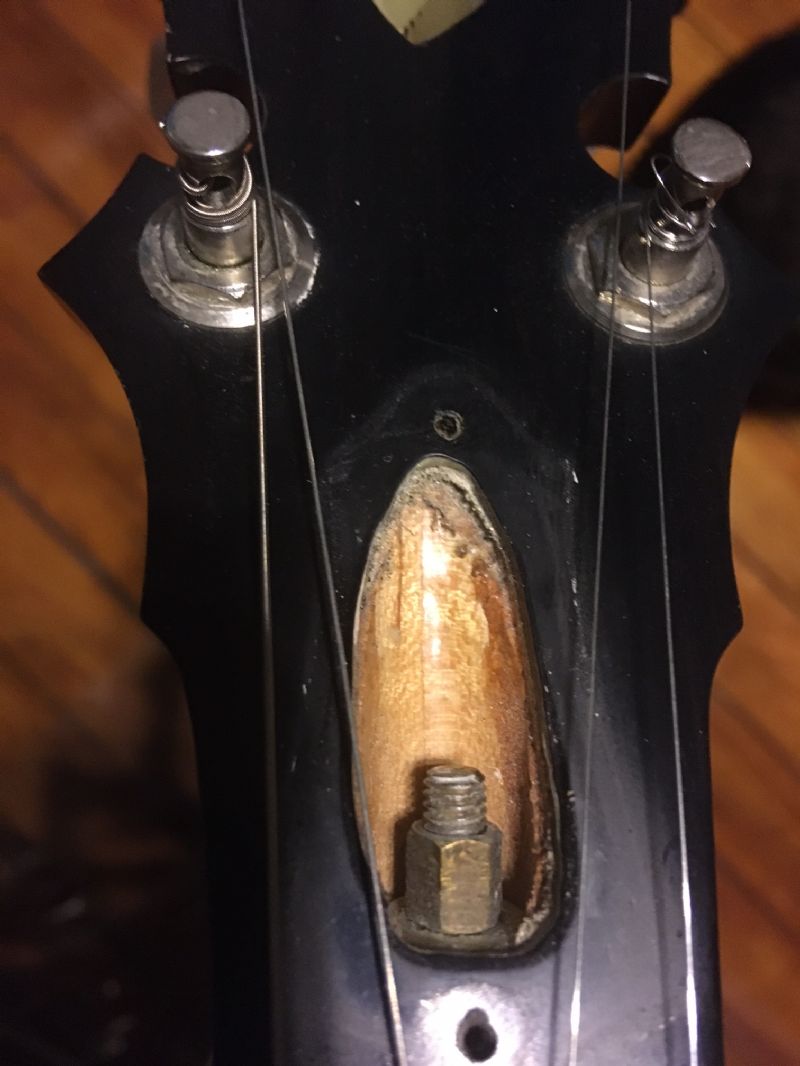
See photos, This is what I see on my Banjo when I opened the truss rod cover. Can you tell me if that's what it should be or is it broken? Also, I don't have any tools for that, what type of tool shall I get in order to adjust it?
I`ll probably bring it to a luthier but I`m trying to learn so I can do some basic setup myself,
Thanks!
HSmith - Posted - 02/11/2022: 23:52:30
Hi
Stelling banjos are supplied with a 0.25" nut driver wrench which is used both to adjust the truss rod (very carefully) and tighten/loosen the head. Very similar wrenches can be bought from here banjoteacher.com/banjo-supplie...cket.html
Do be very careful when adjusting the truss rod. Tiny changes are all that's required. Too much pressure can break the rod and leave you with a huge repair bill.
Regards
Harry
lightgauge - Posted - 02/12/2022: 04:16:06
You would tighten the brass nut to straighten the neck and take away relief. A one way rod is not capable of forcing relief. It only counteracts upward string pull.
beegee - Posted - 02/12/2022: 05:11:18
If I had to guess based on the picture, I would say the truss rod is too tight. If you loosen it, the neck relief will relax. You would have to put very mild pressure on the neck to relax it after loosening. If you have no clue about doing that refer it to a local banjo mechanic.
coolet5 - Posted - 02/12/2022: 07:47:04
Alright thanks for the feedback. I’ll bring to a luthier. I’m glad it’s not broken or anything like that.
Alex Z - Posted - 02/12/2022: 08:21:22
In the other thread, the poster described a neck that had too much relief -- was "bent" according to some repair person -- and the strings were too close to the frets from the 11th fret and higher.
Since the poster has never done any neck adjustments and is asking for basic information on how the geometry of the neck and the truss rod adjustments work, I'd advise not trying to fix the situation as one's first adjustment project.
Instead, take the banjo to a reputable banjo repair place or guitar repair place for the neck adjustment -- with an initial assessment of whether or not the truss rod can be further tightened. Can't go turning the truss rod nut and assuming all is going to work as expected. That's where experience of the repair person comes in. You have to feel the resistance in the nut and the movement.
If you go to a guitar repair, they'll be familiar with truss rod adjustments and will be able to tell if the truss rod is functioning the way it is supposed to be. You want .018-.022 at the 7th fret. Don't let a guitar repair person make any other adjustments at this time.
It is quite possible -- and I'm not diagnosing, because we don't have any evidence -- that if this banjo has severe neck bow (which apparently was unable to be fixed by the previous owner), it may not respond as anticipated when the truss rod nut is turned. Go slow.
Old Hickory - Posted - 02/12/2022: 13:35:42
quote:
Originally posted by coolet5Alright thanks for the feedback. I’ll bring to a luthier. I’m glad it’s not broken or anything like that.
No one said that.
It could well be broken. If your problem is too much relief with the nut already tightened as much as it appears to be, then that's not a good sign at all. The rod could be maxed out with the neck not responding.
If your problem is too little relief -- the neck is too flat or even approaching back-bow -- maybe it's not broken and loosening the truss rod should help. But no guarantee. That would require the tension of the strings being enough to pull the neck up into appropriate relief or up-bow.
You can diagnose for yourself quite easily if the relief is too much, too little or just right. Simply capo the strings at the 1st fret, depress the 4th string at the 22nd fret and see what kinf clearance there is of the 4th string over the 7th fret. For a precise measure, use a feeler gauge. For an approximation, use a business card or two. A business card is likely to be "10 point" stock, or 0.010-inch. As said in your previous discussion on this, Stelling spec calls for .020 or more.
Also as discussed in the previous message, I suggested Retrofret in Brooklyn as a probable banjo luthier. Guess you haven't called them yet.
You could use the Member Search function to find experienced Hangout members or teachers in Manhattan, write to them and ask who they take their banjos to for set up and repair.
Again: I think you have a potentially serious problem here. If your truss rod is already maxed out and you still have too much relief, one more turn could break the rod. Then you're looking at one of the most serious and expensive repairs possible. Major surgery to remove a broken, anchored truss rod. Your borderline being better off with a new neck. As recently reported in another discussion, Geoff Stelling isn't making them.
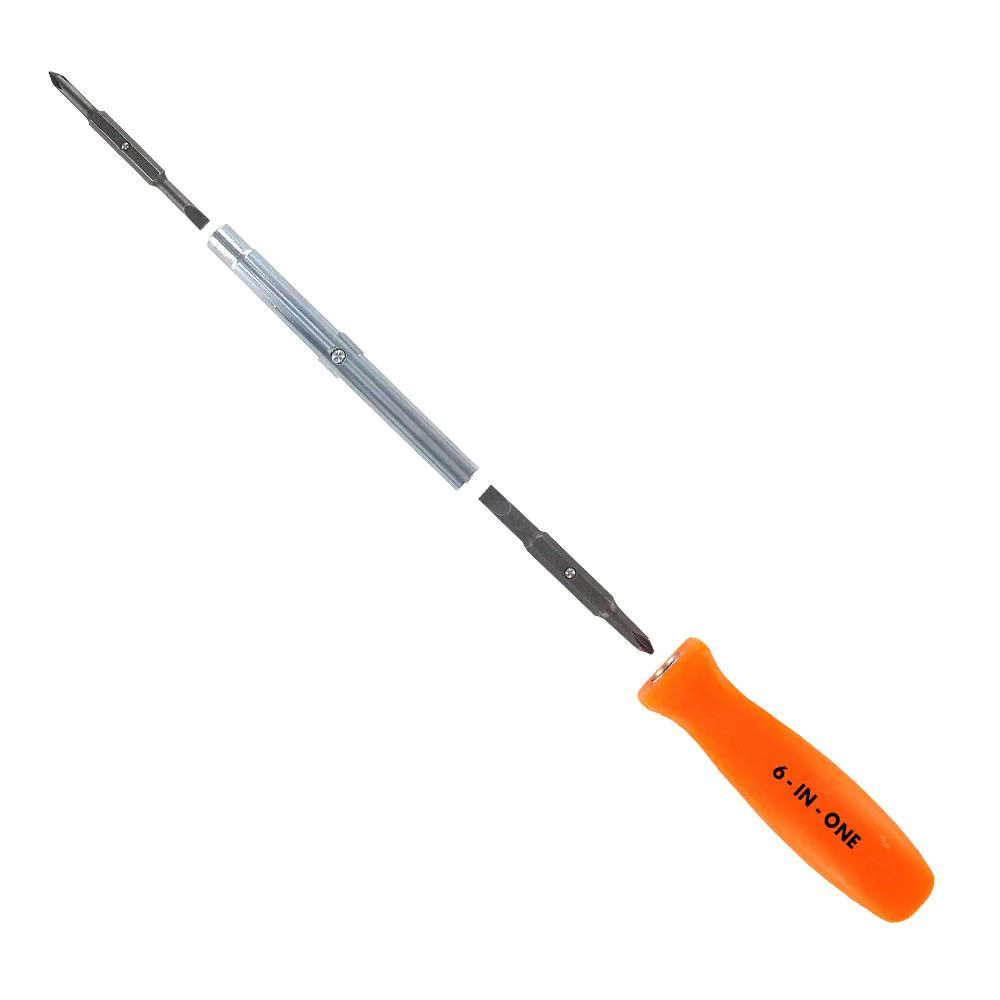
If you really want a tool for trying this yourself, a 6-in-1 screwdriver should work. It does for my 1970s RB. Besides the 4 different screwdriver blades, the ends of the shaft are two different size nut drivers: 1/4" and 5/16" Every local hardware store should have it. Here's one on eBay:
Edited by - Old Hickory on 02/12/2022 13:39:37
ban-joe - Posted - 02/12/2022: 13:52:09
I think something is missing in the above discussion, correct me if I’m wrong.
Stellings use a one-way truss rod, that can only be broken by tightening the nut too much in trying to remove excessive neck relief (strings too far away from the center of the fretboard). If the strings are too close to the middle of the fretboard (back bow?) one can loosen the truss rod nut, but over-loosening will simply result in the nut coming off.
Geoff Stelling has written about using heat and pressure overnight to correct a back bow, as the truss rod is useless for the purpose.
Generally the strings have enough tension to provide relief in that direction, but sometimes not. That’s why two-way truss rods were invented.
I’ll be happy to be corrected if I’m in error about any of the above.
coolet5 - Posted - 02/12/2022: 14:16:32
quote:
Originally posted by Old Hickory
Also as discussed in the previous message, I suggested Retrofret in Brooklyn as a probable banjo luthier. Guess you haven't called them yet.
I called Retrofret. Scheduled an appointment but they can only do it in May. I don't really want to do this but I might just send it to Stelling to do the setup. I usually like to do things myself but I kinda have the vibe it can be a bit complicated for a noob like me.
Edited by - coolet5 on 02/12/2022 14:18:35
Alex Z - Posted - 02/12/2022: 16:04:51
You can do some measurements, without hurting anything, and that might help in at least diagnosing what the symptoms are. (Diagnosing the underlying cause is a different issue.)
So far we know:
-- You have been told by a luthier that the neck needs a truss rod adjustment.
-- The strings are very close to the frets from the 11th fret and higher (toward the 22nd fret).
You can measure:
1. the height of the strings over the 12th fret (to the nearest 64th inch)
2. the height of the strings over the 22nd fret (to the nearest 64th inch)
3. the neck relief, as explained by Mr. Old Hickory, above. To the hearest .005 inch, or if no gauges are available, using some type of reference device such as a folded over dollar bill (2 folds, 3 folds, 5 folds, etc.). You can also use bits of banjo or guitar strings to measure, because the precise diameter is known, such as .010, .013, .022, .026, etc.)
These three measurements will reveal a lot about the current situation, about which we are speculating a lot right now. 
One step at a time.
Alex Z - Posted - 02/12/2022: 16:10:50
Here is what Mr. Geoff said back in 2014 on this forum:
"We use a one way truss rod on all models except the Crusader, at least for the time being. Models with the one way rod have a deliberate bow machined into the neck so that some constant tension is required all the time. With a two way rod, it is possible to have a neutral position at which point the neck is under no tension in either direction and it can flex up and down. The heat treatment is not just a temporary fix. With enough heat, it changes the wood cells in the neck permanently. In any case, a two way rod can not be fit into the one way rod channel. In fact, if a two way rod malfunctions and needs to be replaced, the fingerboard must be removed. Another plus for one way rods.
Geoff"
ban-joe - Posted - 02/12/2022: 16:37:09
Are the strings too close and buzzing at the middle frets, or too far away with excessively high action?
I can’t find the information that everyone else seems to be using.
And is this banjo in NYC?
There are plenty of good neck repair experts in this city without waiting months for a simple adjustment.
Loosening the truss rod nut a quarter turn every couple of days and examining the results won’t damage anything.
If it’s the back-bow situation that’s been suggested then that’s something I would send back to the Stelling shop for his heat treatment.
Pam W - Posted - 02/12/2022: 17:02:08
I would contact Stelling directly. They have an email address for instrument setup and maintenance. stellingbanjo.com
I read somewhere that Geoff had sold the banjo building business, but the sale fell through at the last minute. It said they were still going to build a limited number of banjo's this year. I have called in the past and Geoff answered the phone and when I bought my Master Flower, I dealt with his wife Sherry.
They are good people and have always been helpful and returned my emails or answered phone calls.
Edited by - Pam W on 02/12/2022 17:06:58
coolet5 - Posted - 02/12/2022: 17:26:15
quote:
Originally posted by Alex ZYou can do some measurements, without hurting anything, and that might help in at least diagnosing what the symptoms are. (Diagnosing the underlying cause is a different issue.)
So far we know:
-- You have been told by a luthier that the neck needs a truss rod adjustment.
-- The strings are very close to the frets from the 11th fret and higher (toward the 22nd fret).
You can measure:
1. the height of the strings over the 12th fret (to the nearest 64th inch)
2. the height of the strings over the 22nd fret (to the nearest 64th inch)
3. the neck relief, as explained by Mr. Old Hickory, above. To the hearest .005 inch, or if no gauges are available, using some type of reference device such as a folded over dollar bill (2 folds, 3 folds, 5 folds, etc.). You can also use bits of banjo or guitar strings to measure, because the precise diameter is known, such as .010, .013, .022, .026, etc.)
These three measurements will reveal a lot about the current situation, about which we are speculating a lot right now.
One step at a time.
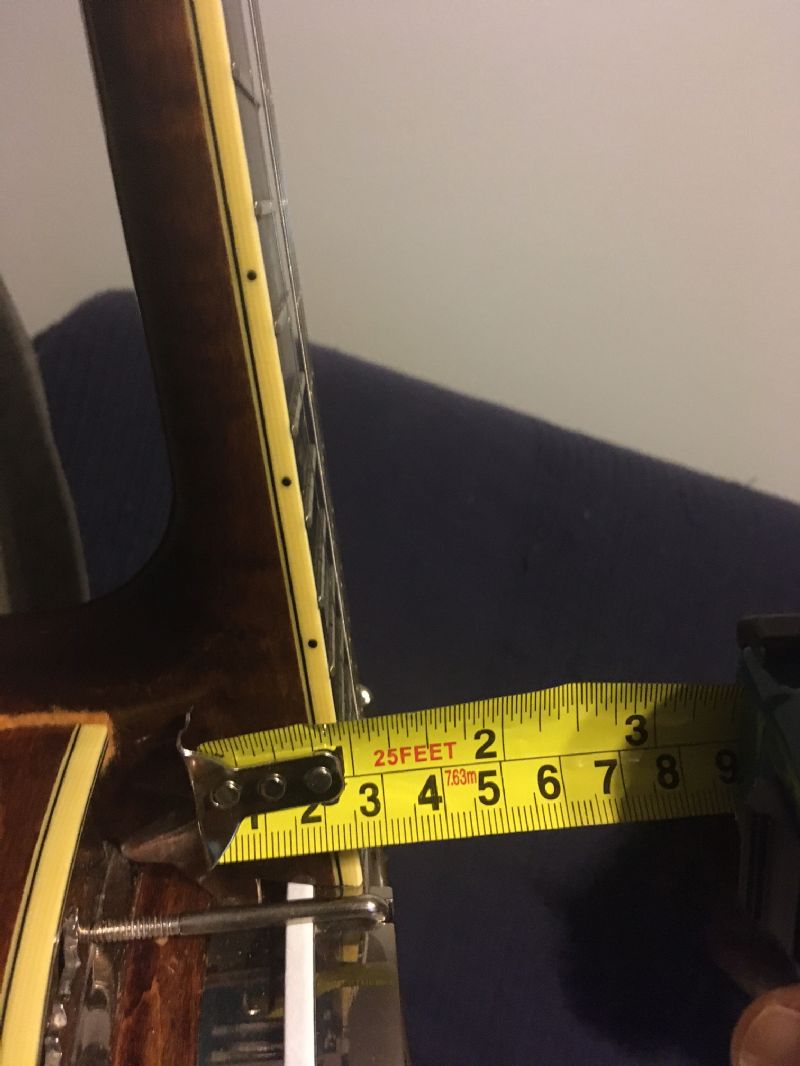
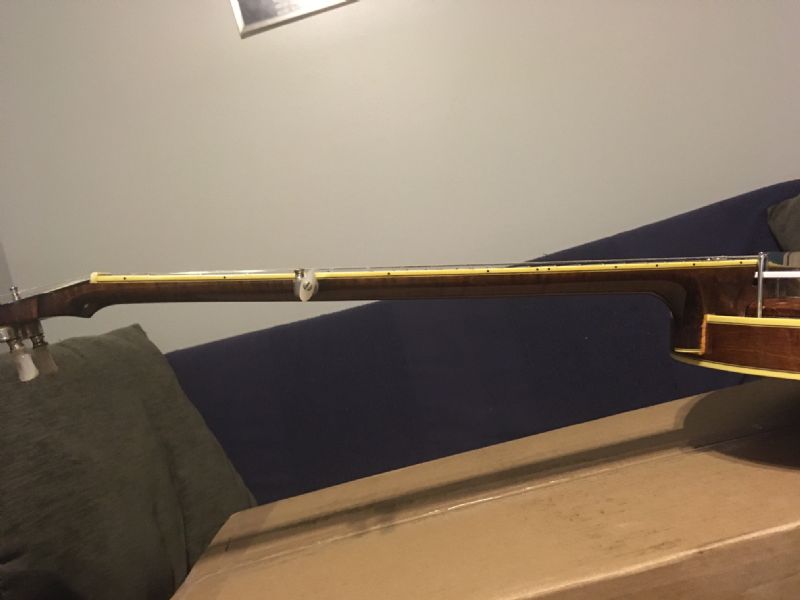
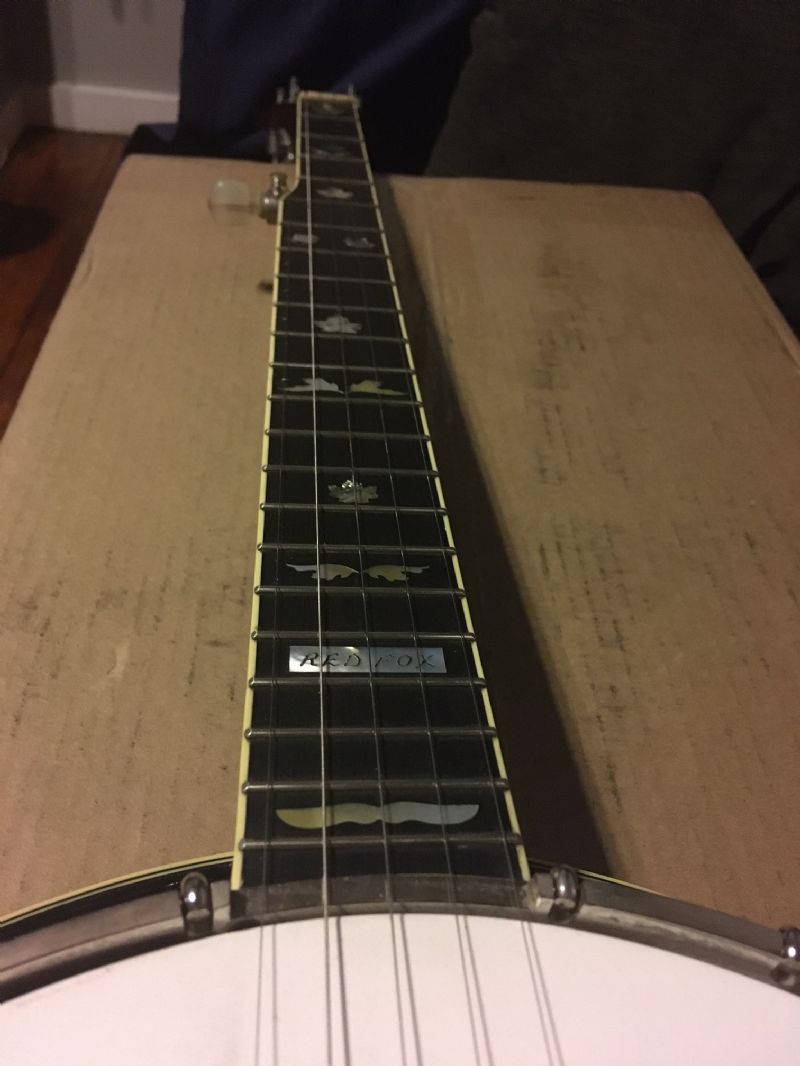
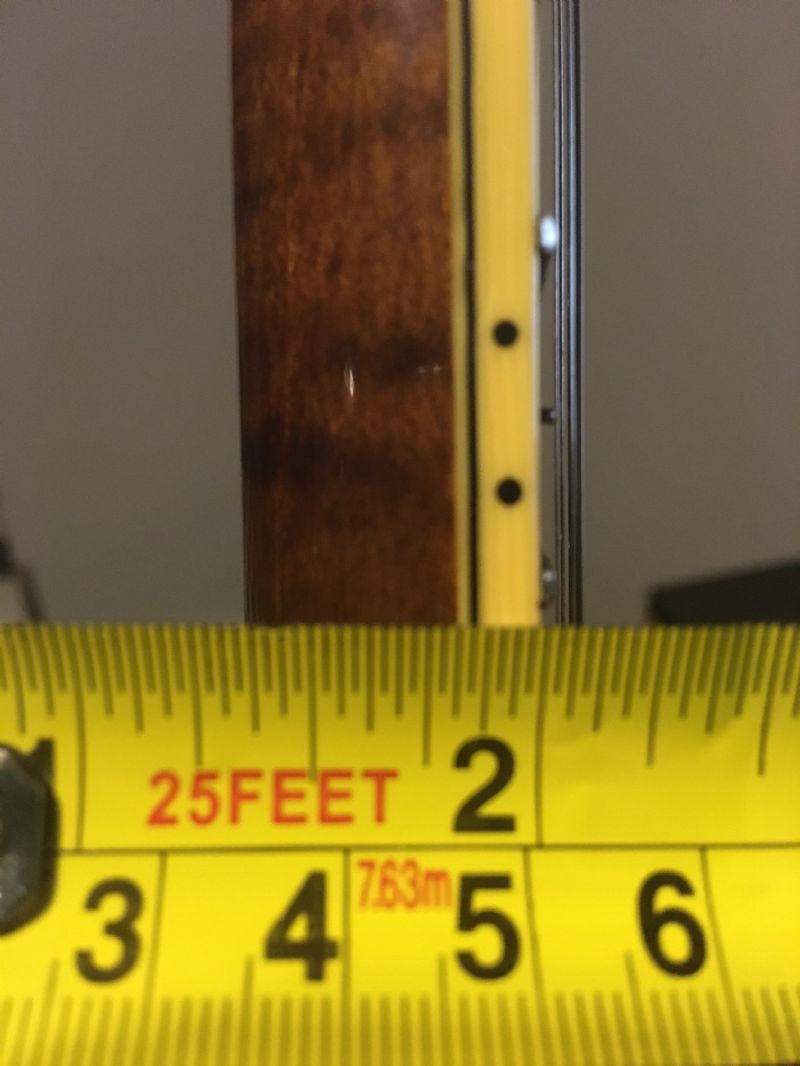
I attached a few photos, let me know if that helps to understand the situation in any way. Thanks!
coolet5 - Posted - 02/12/2022: 17:29:34
quote:
Originally posted by Pam WI would contact Stelling directly. They have an email address for instrument setup and maintenance. stellingbanjo.com
I read somewhere that Geoff had sold the banjo building business, but the sale fell through at the last minute. It said they were still going to build a limited number of banjo's this year. I have called in the past and Geoff answered the phone and when I bought my Master Flower, I dealt with his wife Sherry.
They are good people and have always been helpful and returned my emails or answered phone calls.
I talked to Sherry today. I might just send it to them. We`ll see.
Old Hickory - Posted - 02/12/2022: 20:44:33
quote:
Originally posted by coolet5
I attached a few photos, let me know if that helps to understand the situation in any way. Thanks!
Thanks for posting. Really difficult to tell.
PLEASE put a capo on 1st fret, depress the 4th string at 22nd fret and either measure the clearance at 7th fret with feeler gauge or business card or folded paper money and report findings back to us. Or don't measure and simply describe to us the relative positions of the string and fretboard. This test turns the string into a straight edge. If the neck is too flat or in back bow string will lay on many of the frets. If too much relief you'll see lots is space around 7-9.
Also: How tall is your current bridge?
Alex Z - Posted - 02/12/2022: 20:47:50
The photos are of some help, but are not precise enough to tell the story.
-- Distances should be measured from the top of the fret to the bottom of the string.
-- Use coins if there is no other gauge -- for example, "12th fret height is two dimes" or "22nd fret height is one nickel."
The difficulty in talking about this stuff without actually seeing the banjo or getting precise measurements is that the desired correct geometry varies with the string action height.
-- For example, if the string action height at the 22nd fret is 1/8" and the 12th fret is 1/64" higher, we can be pretty sure that there excessive bow in the neck. And the result can still be be "punchy tone from the 11th fret and higher."
-- However, if the string action height at the 22nd fret is 1/32" and the 12th fret is 1/64" higher, this may indicate the correct bow in the neck, even though the symptoms would still be "punchy tone from the 11th fret and higher."
All this stuff would take an experienced person about 5 minutes to figure out with banjo in hand, and another 60 seconds to determine if the truss rod is working as it is supposed to.
The neck relief measurement is critical. If that's OK, the rest is easy. If that's not OK, then it has to be corrected before anything else can be adjusted. On the Stelling site, the neck relief is the very first thing to be adjusted in the set-up process.
So: Capo 1, press down the string after the 22nd fret, and measure the clearance above the 7th fret using banjo or guitar strings. That number will allow you to make progress in figuring out what to do.
Other than that, send the banjo back to Mr. Geoff -- there were a few different faults that needed addressing, including excessive filing of the frets (possible refret needed), chips in the fingerboard, possible incorrect relief, possible stuck truss rod nut, and excessively low string height.
lightgauge - Posted - 02/12/2022: 21:13:54
"In fact, if a two way rod malfunctions and needs to be replaced, the fingerboard must be removed. Another plus for one way rods."
I would be interested to know how a one way rod can be replaced without removing the fingerboard? The ones I have seen had an imbedded anchor at the lower end and were installed in a bend.
Helix - Posted - 02/13/2022: 05:07:56
People wrench back and forth on these and then they come in my shop, so one doesn't know "where" the neck is.
There is no money in stopping and making necks when putting together complete banjos for sale.
Old Hickory- all the right info and people are here. Please explain to others how to adjust the one way. Do you press down lightly on the middle of the neck to relieve pressure on the nut? Then adjust? If the Stellings are mentioning ironing, then Bob Smakula should be consulted.
This person is off to the shop, but asked so they could at least learn more for themselves. It's possible to do this without killing the beautiful Stelling neck.
(I had a neck maker who installed a homemade oneway in a longneck, then he put silicone in the slot to "quiet" the rod. The silicone made the rod immoveable. A new problem. I ended up using the new shallow u-channel two way for a bass.)
Great thread, I'm learning as I vintage.
Alex Z - Posted - 02/13/2022: 08:25:33
Since the Stelling truss rod is one way, it exerts pressure only when straightening the neck. Therefore, pressing down the neck in the middle when straightening the neck adds more force against which then truss rod must push, in addition to the tension of the strings.
Some luthiers don't relieve the string pressure when straightening a truss rod, but advise to bend the neck back a little by putting something under the center of the neck and pushing down on the nut and heel when turning the truss rod. Others just turn it regardless. A few advise to relieve the pressure on the neck by loosening the strings -- make take a couple of tries to get the exact relief, loosening then tuning up, but this is the only thing that makes physical sense in avoiding undue strain on neck and truss rod. Besides, the neck can move a bit over the next couple of days anyway, after the adjustment, especially on a long thin banjo neck.
I know, I know -- "I've done 972 neck adjustments without loosening the strings and nothing has been damaged." That may be fine for an experienced person who has a sense of how hard to turn or not turn, but the newcomer can't yet tell between high pressure on the neck and a stuck truss rod. If the strings are loose and the truss rod won't turn, then you know something is wrong.
Still, the poster's neck bow may be perfectly OK now -- need the measurement! The first thing a repair person will check before adjusting a neck is how much relief there is already.
coolet5 - Posted - 02/13/2022: 08:37:05
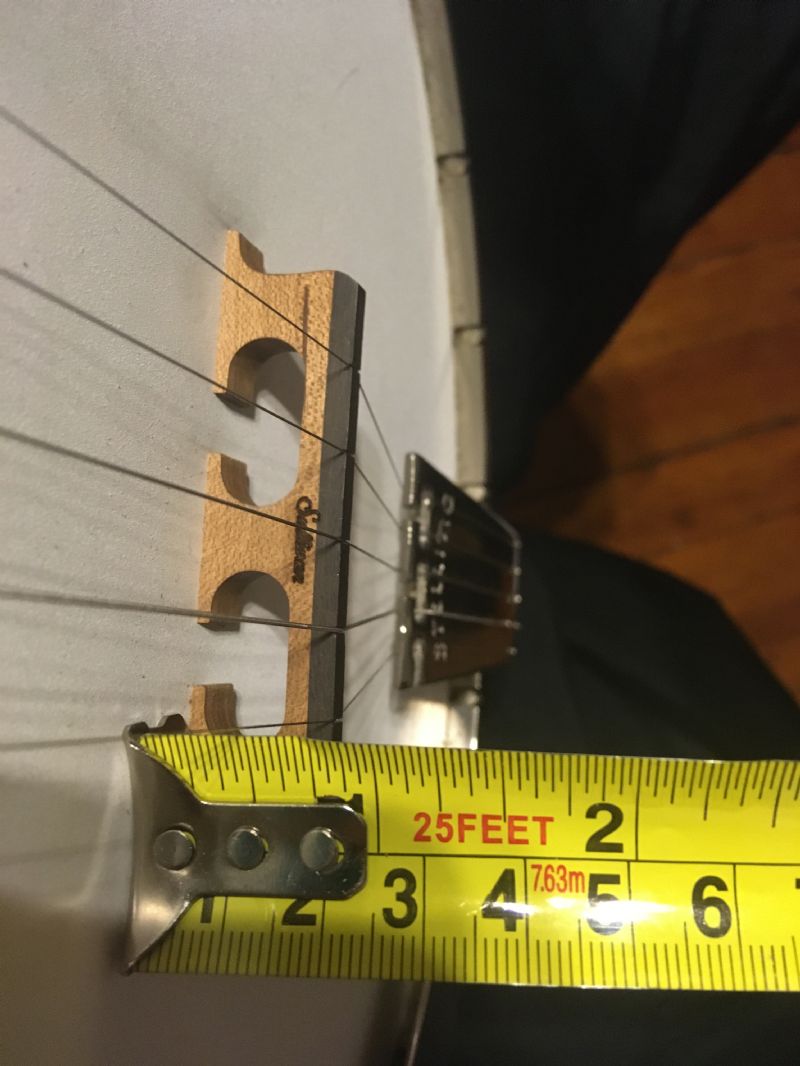
Is this helps to determine height of bridge?
Edited by - coolet5 on 02/13/2022 08:37:27
Old Hickory - Posted - 02/13/2022: 09:00:14
quote:
Originally posted by HelixOld Hickory- all the right info and people are here. Please explain to others how to adjust the one way. Do you press down lightly on the middle of the neck to relieve pressure on the nut? Then adjust? If the Stellings are mentioning ironing, then Bob Smakula should be consulted.
This person is off to the shop, but asked so they could at least learn more for themselves. It's possible to do this without killing the beautiful Stelling neck.
Larry:
This is the owner's second discussion on this same neck. The previous discussion was titled something like "What Bridge for My Stelling?" He/She had been told by a well-respected luthier in Brooklyn that the neck is bent and needs a truss rod adjustment or something to that effect. The owner used the non-standard unclear term "punchy" to describe the sound produced by the very low action up the neck -- low action that the owner is led to believe is caused by the bent neck. As far as I recall, the Brooklyn luthier was not going to do anything about the neck. We here on the Hangout have been trying to help, while dealing with the combined challenges of distance, lack of visual evidence, and incomplete descriptions provided by an apparently inexperience and unkowledgeable banjo owner.
That's all by way of background to bring you up to speed in case you hadn't seen the previous discussion or had forgotten.
Do I help out a one-way truss rod the way you suggest before adjusting it? Yes -- when tightening. If a neck is problematic I've even totally loosened the nut, clamped the neck (70s Gibson banjo, 70s Fender P-bass) into back-bow (with strings off or fully loosened) then tightened the nut. THEN, with instrument tuned to pitch, loosened the truss rod nut slightly to allow the strings to pull the neck into proper relief. Learned this from Dan Erlewine's "Guitar Player Repair Guide."
Clamping a neck with truss rod nut fully backed-off. Clamping board/beam as to be very resistant to bowing. I used a metal carpenter's level. wood blocks on frets, padded caul for back of neck.

I may have been remiss in not advising coolet5 to press on the neck before tightening the truss rod. But I was assuming the rod was already overtightened and needed loosening. And coolet5 seems inclined not to attempt this himself/herself.
Dan Erlewine Stew-Mac video on truss rod ajustment, single-action and double-action. No mention of pressing neck before tightening.
The Stellings have not mentioned ironing this neck as far as we know. Someone quoted Geoff Stelling describing his heating process. No one who has seen the neck in person has said it needs heat treatment. It seems that no one who has seen the neck in person has fully diagnosed the problem.
Old Hickory - Posted - 02/13/2022: 09:07:37
quote:
Originally posted by coolet5Is this helps to determine height of bridge?
Not really. This makes the bridge seem to be 13/16 or even 7/8-inch tall, which does not sound right to me or consistent with too-low action in the upper frets -- unless there's something seriously wrong with this banjo.
coolet5 - Posted - 02/13/2022: 09:21:09
quote:
Originally posted by Old Hickoryquote:
Originally posted by HelixOld Hickory- all the right info and people are here. Please explain to others how to adjust the one way. Do you press down lightly on the middle of the neck to relieve pressure on the nut? Then adjust? If the Stellings are mentioning ironing, then Bob Smakula should be consulted.
This person is off to the shop, but asked so they could at least learn more for themselves. It's possible to do this without killing the beautiful Stelling neck.Larry:
This is the owner's second discussion on this same neck. The previous discussion was titled something like "What Bridge for My Stelling?" He/She had been told by a well-respected luthier in Brooklyn that the neck is bent and needs a truss rod adjustment or something to that effect. The owner used the non-standard unclear term "punchy" to describe the sound produced by the very low action up the neck -- low action that the owner is led to believe is caused by the bent neck. As far as I recall, the Brooklyn luthier was not going to do anything about the neck. We here on the Hangout have been trying to help, while dealing with the combined challenges of distance, lack of visual evidence, and incomplete descriptions provided by an apparently inexperience and unkowledgeable banjo owner.
That's all by way of background to bring you up to speed in case you hadn't seen the previous discussion or had forgotten.
Do I help out a one-way truss rod the way you suggest before adjusting it? Yes -- when tightening. If a neck is problematic I've even totally loosened the nut, clamped the neck (70s Gibson banjo, 70s Fender P-bass) into back-bow (with strings off or fully loosened) then tightened the nut. THEN, with instrument tuned to pitch, loosened the truss rod nut slightly to allow the strings to pull the neck into proper relief. Learned this from Dan Erlewine's "Guitar Player Repair Guide."
Clamping a neck with truss rod nut fully backed-off. Clamping board/beam as to be very resistant to bowing. I used a metal carpenter's level. wood blocks on frets, padded caul for back of neck.
I may have been remiss in not advising coolet5 to press on the neck before tightening the truss rod. But I was assuming the rod was already overtightened and needed loosening. And coolet5 seems inclined not to attempt this himself/herself.
Dan Erlewine Stew-Mac video on truss rod ajustment, single-action and double-action. No mention of pressing neck before tightening.
The Stellings have not mentioned ironing this neck as far as we know. Someone quoted Geoff Stelling describing his heating process. No one who has seen the neck in person has said it needs heat treatment. It seems that no one who has seen the neck in person has fully diagnosed the problem.
Few clarifications: I`m a "He" born and will die that way.
I described the neck as bent. It`s not the proper term I`m aware of it now. English is my second language...
The Luthier which is a good one, at least for guitars, suggested a complete setup plus replacing the bridge with a higher one. I like my action low so I thought since I`m a bass player messed about with neck adjustment when needed, I would give it a try on the Banjo which I have no experience on hence all these questions that started with photos since I thought the truss rod would be different.
I`m in contact with a local forum member here in New York City, maybe we`ll meet and he can look at it. The wait for my appointment with another local luthier that was recommended here is until mid-May so, as I mentioned before, I might just send it to Geoff. Just rather avoid the shipping money risk etc.
Edited by - coolet5 on 02/13/2022 09:24:16
Old Hickory - Posted - 02/13/2022: 09:22:02
quote:
Originally posted by Alex ZThe difficulty in talking about this stuff without actually seeing the banjo or getting precise measurements is that the desired correct geometry varies with the string action height.
-- For example, if the string action height at the 22nd fret is 1/8" and the 12th fret is 1/64" higher, we can be pretty sure that there excessive bow in the neck. And the result can still be be "punchy tone from the 11th fret and higher."
-- However, if the string action height at the 22nd fret is 1/32" and the 12th fret is 1/64" higher, this may indicate the correct bow in the neck, even though the symptoms would still be "punchy tone from the 11th fret and higher."
In my experience, action on a well-adjusted neck is 1/64" to 1/32" higher at the 22nd fret than the 12th. My expectation that action at 22 will be the highest anywhere on the neck is why I prefer to measure action at 22 instead of 12. More meaningul to me.
So, if I get 1/8" at 22, I expect to find 7/64" - or close to it - at 12.
Old Hickory - Posted - 02/13/2022: 09:22:54
quote:
Originally posted by Old Hickoryquote:
Originally posted by coolet5Is this helps to determine height of bridge?
Thanks for trying, but this isn't clear. This makes the bridge seem to be 13/16 or even 7/8-inch tall, which does not sound right to me or consistent with too-low action in the upper frets -- unless there's something seriously wrong with this banjo.
coolet5 - Posted - 02/13/2022: 09:26:05
quote:
Originally posted by Old Hickoryquote:
Originally posted by Old Hickoryquote:
Originally posted by coolet5Is this helps to determine height of bridge?
Thanks for trying, but this isn't clear. This makes the bridge seem to be 13/16 or even 7/8-inch tall, which does not sound right to me or consistent with too-low action in the upper frets -- unless there's something seriously wrong with this banjo.
I might just bite the bullet and send it to Geoff. If it`s a simple problem then I`ll consider myself lucky again.
Old Hickory - Posted - 02/13/2022: 10:06:04
quote:
Originally posted by Alex Z. . . pressing down the neck in the middle when straightening the neck adds more force against which then truss rod must push, in addition to the tension of the strings.
Some luthiers don't relieve the string pressure when straightening a truss rod, but advise to bend the neck back a little by putting something under the center of the neck and pushing down on the nut and heel when turning the truss rod. . . .
Still, the poster's neck bow may be perfectly OK now -- need the measurement! The first thing a repair person will check before adjusting a neck is how much relief there is already.
Thanks for clarifying that. I know I replied to Helix that I relieve pressure the way he said, but I'm sure I never increase the work the nut has to do when I want to tighten it. If I were going to press the neck in the direction I want it to go, I would loosen the nut first, press the neck, then tighten the nut so that pressing it is working with it rather than against it.
Also . . . upon second look at Coolet5's overall photo of the banjo neck, it now appears to be up-bowed across much of its length. And the amount of truss rod protruding beyond the nut makes me agree with the previous comment that the rod is already tight. It's possible that the rod is extending the way it is because its anchorage has failed and the nut is pulling it out.
If this were my neck, I would definitely loosen the nut fully and then some, press or clamp the neck into flatness or beyond, then tighten the nut to try to hold that shape. But, with the possibility that the rod has failed, I'm not sure this would work.
Alex Z - Posted - 02/13/2022: 11:36:10
"I`m in contact with a local forum member here in New York City, maybe we`ll meet and he can look at it. "
That's a great idea. Shouldn't take long to figure out what to do. Actually doing it may take some expertise.
Your English is excellent. The technical terms for banjos only are new -- we have all been through that!
Old Hickory - Posted - 02/13/2022: 11:52:23
quote:
Originally posted by coolet5
Few clarifications: I`m a "He" born and will die that way. . . .I`m in contact with a local forum member here in New York City, maybe we`ll meet and he can look at it.
Thanks for clarification. You seemed to express happiness about the Brooklyn luthier being a woman, so I thought you might also be a woman. Typically, I just write "they" when I don't know. Rare for me to write He/She, him or her, or any of those forms.
I think getting together with a banjo player who might have some experience and skill in set-up is a good idea. But caution is the operative word here.
If you want to take yourself on a road trip, you could try to arrange a set-up session with Mike Munford in south-central Pennsylvania. But if your banjo needs repair work beyond set-up, I'm not sure he does that.
Good luck.
Old Hickory - Posted - 02/13/2022: 12:12:14
quote:
Originally posted by ban-joeAre the strings too close and buzzing at the middle frets, or too far away with excessively high action?
I can’t find the information that everyone else seems to be using.
The additional information came from this previous discussion.
Coolet5 said the acttion was too low and strings were hitting the frets up the neck, which would be consistent with back-bow. But to my eye, the full-length photo he provided in this discussion looks like the neck is in extensive up-bow. The bridge looks plenty tall.
Some of us don't like the look of the amount of truss rod protruding out beyond the adjusting nut.
This banjo definitely needs in-person hands-on examination by someone who knows what they're doing.
Are you the member who's going to be helping him out?
Who does reliable banjo repair and setup in NYC these days?
coolet5 - Posted - 02/13/2022: 13:50:34
quote:
Originally posted by Old Hickoryquote:
Originally posted by coolet5
Few clarifications: I`m a "He" born and will die that way. . . .I`m in contact with a local forum member here in New York City, maybe we`ll meet and he can look at it.
Thanks for clarification. You seemed to express happiness about the Brooklyn luthier being a woman, so I thought you might also be a woman. Typically, I just write "they" when I don't know. Rare for me to write He/She, him or her, or any of those forms.
I think getting together with a banjo player who might have some experience and skill in set-up is a good idea. But caution is the operative word here.
If you want to take yourself on a road trip, you could try to arrange a set-up session with Mike Munford in south-central Pennsylvania. But if your banjo needs repair work beyond set-up, I'm not sure he does that.
Good luck.
Haha no worries. I was just happy to see a woman doing Lutherie. Don't recall seeing it before.
ban-joe - Posted - 02/13/2022: 14:41:10
Yes, I’m going to have a look at Isaac’s banjo. He asked me if I would do so and I’m happy to help.
I’m not a trained luthier but I’ve taken my own banjos completely apart, swapped rims, rings, installed railroad spikes, repaired damage, etc. etc.
But I don’t plan on trying to adjust anything on this one though, just give whatever advice I think is appropriate.
I have a Stelling and some spare 11/16” bridges. I figured the first order of business is to make sure it’s not just an issue of wrong bridge height.
I would have recommended a trip to Staten Island to see the folks at Mandolin Bros. It’s really a shame they’re no longer around.
Alex Z - Posted - 02/13/2022: 15:46:23
"action was too low and strings were hitting the frets up the neck, which would be consistent with back-bow."
If the action is low and since only the 11th fret and higher frets were rattling, then the possibilities are that (a) the relief is OK and the action is really low at the 22nd fret (we don't have a measurement) or (b) the action is low at the 12th fret and the 22nd fret and there is excessive bow.
If we could get an accurate measurement of current neck relief, that would help a lot. It is very possible that all the poster needs is a higher bridge, which would fix (a) above.
Snip 2 inches off the end of a few banjo and guitar strings, and get a measurement !
O.D. - Posted - 02/14/2022: 06:21:58
Bridge height is relative to head tension
String buzz could be caused by a head that slacked.
A twist in the neck is also something to look for.
As stated, needs a hands/ eyes on evaluation
Good luck
Everett
ban-joe - Posted - 02/14/2022: 07:26:25
quote:
Originally posted by Old Hickoryquote:Who does reliable banjo repair and setup in NYC these days?
I traded emails with Jack Baker last night with this exact question. He recommended Matt Umanov's.
Some folks here might be familiar with Matt's store on Bleeker street, which opened in the 60s and closed recently. I wasn't aware that they still have the repair shop operating upstairs.
Bob Jones in Brooklyn is a legend as well, but I think he may have retired.
Old Hickory - Posted - 02/14/2022: 07:57:51
ban-joe:
I didn't know Umanov had a repair shop. Glad I visited the store duing my New York years -- 2013-16. THey had lots of banjos the day I was there. Several Omes. Maybe some Gold Tones. Forget what else.
Never heard of Bob during my time in Brooklyn. But I didn't need repairs, either.
coolet5 - Posted - 02/14/2022: 08:02:48
In New York, if you're lucky enough to find a Banjo in the stores it`s usually Goldtone, Recording King, and mostly Deering.
Old Hickory - Posted - 02/14/2022: 08:56:30
These days, for sure.
There were still some good places when I lived there. Though my last visit to Mandolin Brothers was 2012 on the way home (to Maryland) from a New England vacation.
I visited Retrofret maybe three times in my three years there. Walking distance! Their inventory of 5-string banjos skews to open backs and early 20th century -- at least back when I visited. But two great resonator banjos I played there were a 100% original 1940/41 RB-00 (no tone ring, entry level instrument) for which they were asking $4500, and a 1970s RB-250 in excellent condition priced at $2750 -- at the same time you could buy one for $1000 less here on the Hangout or eBay. Tht was July/August 2016. In today's seller's market, that banjo might go for close to that.
Jake's Main Street Music up the Hudson in Beacon sometimes has interesting stuff. My daughter's in-laws live there and so I visited that store once. Here's their inventory on Reverb.
Alex Z - Posted - 02/14/2022: 10:01:52
"action on a well-adjusted neck is . . . "
That's the key to the puzzle -- we don't know if the neck is well-adjusted. If we only had the measurements . . .
With a bow -- any bow -- in the neck, and the string height gradually being lowered, the first place that the strings will touch is the 22nd fret. Thus it is possible, if the strings are low enough, even with a proper bow, that the string height at the 22nd fret is the same or lower than the the 12th fret. We just don't know.
Anyway, Mr. ban-joe is going to take a look. Maybe he can report back on what he sees in this interesting situation.
Gee, we're all trying to do geometry with a picture of a plain sheet of paper!
J.Albert - Posted - 02/14/2022: 11:19:46
Here's a quick way to check the relative "straightness" of the neck.
Put a capo on the 1st fret.
Sit down, put the banjo in your lap.
Tilt it so that you're looking at the neck "sideways" (not "straight on").
Now, press down on the last fret (closest to the tension hoop).
OBSERVE the 4th string -- what happens when you do this...?
Is the 4th string down against many or all of the frets?
That could indicate "back bow". The banjo won't play right that way, strings will buzz in "the middle positions".
Is there a big gap between the 4th and around frets 5, 6, 7 ?
That would indicate the neck is "bowed up", making it harder to play in the mid-higher positions. Sometimes a truss rod adjustment can fix this.
The proper "set" for the neck is a VERY SMALL "space" between the bottom of the 4th string and the top of frets 5, 6, 7. Barely enough to get a thin sheet of paper under. You can see it if you touch the string above those frets. Does it move a little?
A two-way truss rod can compensate for back bow or forward bow, but apparently Stellings don't use one.
Instead, they have a traditional "one-way" truss rod that can correct for forward-bow only.
Old Hickory - Posted - 02/14/2022: 15:12:28
quote:
Originally posted by Alex ZWith a bow -- any bow -- in the neck, and the string height gradually being lowered, the first place that the strings will touch is the 22nd fret. Thus it is possible, if the strings are low enough, even with a proper bow, that the string height at the 22nd fret is the same or lower than the the 12th fret.
This did not occur to me, since I think the truss rod is anchored around the 15th to 17th frets and any higher is the heel which is thick and not likely to bow. But I haven't had a neck in that bad shape, so I've never experienced what you're describing.
Old Hickory - Posted - 02/14/2022: 17:16:23
quote:
Originally posted by J.AlbertThe proper "set" for the neck is a VERY SMALL "space" between the bottom of the 4th string and the top of frets 5, 6, 7. Barely enough to get a thin sheet of paper under.
That may be a rule of thumb for banjos in general. But the Stelling Set-up System specifically says 0.028-inch ± .006, which would be .022 - .034". That's in the table when you scroll down the page. In the text description of set-up, they say 1/64" to 1/32", which would be .016 to .031. That starts at more than the thickness of a business card.
Feeler guages come in handy.
Targets aside, I believe the right amount of relief is the smallest clearance that plays without fret buzz. Players who have harder attack may need more relief to give the strings more room to vibrate.
ban-joe - Posted - 02/14/2022: 17:47:31
I’ve located my set of General Hardware feeler gauges.
Stay tuned…
and I have an 11/16" bridge handy.
Edited by - ban-joe on 02/14/2022 17:48:45
coolet5 - Posted - 02/14/2022: 18:22:07
quote:
Originally posted by ban-joeI’ve located my set of General Hardware feeler gauges.
Stay tuned…and I have an 11/16" bridge handy.
Great I`ll touch base tomorrow!!
Alex Z - Posted - 02/14/2022: 18:27:43
Mr. Old Hickory: Since we set the relief by pressing a string down at the 1st fret and 22nd fret, then if the neck is even in the slightest bow the string will be the teeny tiniest bit above every fret in between.
I think there could be such a thing as an S shaped neck if something is not working well. Never have seen one. Sure hope Mr. coolet5's banjo doesn't have one.
Go, go, Mr. ban-joe! I hope the higher bridge takes care of the situation.
ban-joe - Posted - 02/14/2022: 19:18:59
Thanks all, for the encouragement.
I’ve been messing around with my own Stelling and feeler gauge this evening out of curiosity.
I had my banjo at the Stelling shop a while back (picked it up from Geoff on the way home from the Daytona 500.) I had sent it to him for a re-fret and setup, knowing I’d get to pick it up in person.
The neck relief is a little closer than I would have expected, .011” at the 7th fret. The truss rod nut is backed off completely, so that’s where it will stay.
No fret buzz or any other worries, but I’m used to seeing a little more relief.
Looking forward to checking out this other Stelling we’ve been discussing.
Stay tuned.
ban-joe - Posted - 02/14/2022: 19:29:46
quote:
Originally posted by Alex ZI think there could be such a thing as an S shaped neck if something is not working well. Never have seen one. Sure hope Mr. coolet5's banjo doesn't have one.
I have seen one. Not fun.
I had a neck made years ago that developed this condition several months after I received it. I didn't have the heart to return it to the maker so I fixed it myself, mostly through aggressive fret dressing. Not pretty, but it's now my favorite player because I turned it into an archtop and it sounds great.
I doubt an older Stelling would develop that way. Seems like a young wood problem.
Page: 1 2
Terms of Use | Privacy Policy | Privacy Consent (EU/GDPR Only)
Copyright 2026 Banjo Hangout. All Rights Reserved.


