
DVD-quality lessons (including tabs/sheet music) available for immediate viewing on any device.
Take your playing to the next level with the help of a local or online banjo teacher.
Weekly newsletter includes free lessons, favorite member content, banjo news and more.
Premier Sponsors


|
Please note this is an archived topic, so it is locked and unable to be replied to. You may, however, start a new topic and refer to this topic with a link: http://www.banjohangout.org/archive/380458
DWFII - Posted - 01/11/2022: 05:35:34
This is just curiousity coming out--I see classifieds talking about "long neck" banjos and others specifying certain neck lengths. What's that about?
And while I am at it, what is a "conversion?" Such as a "style 4 conversion?"
jduke - Posted - 01/11/2022: 06:52:15
There was a period of time during the Roaring Twenties when there were far more four-string banjos produce than five-string banjos. Some of those banjos from that era, however, are highly sought by current five string players, so many of them have had a new five string neck made to replace the original four string neck. They are referred to as conversion banjos.
As far as neck length, generally when we speak of a long neck banjo, we are talking about a banjo with three extra frets adding to the length of the neck. Pete Seeger is generally credited with that development. Short neck banjos are generally A-scale or C-scale banjos where the number of frets are fewer, shortening the neck length.
Don't confuse scale length with neck length. They are related, but not the same. The scale length is measured from the nut to the bridge. Different builders have had many different scale lengths, scale length and neck length contribute to the location of the bridge on the banjo head.
Hope this helps with the answers to you questions.
Edited by - jduke on 01/11/2022 06:57:52
DWFII - Posted - 01/11/2022: 07:16:48
Thank you. That's very helpful. Follow-up?
I am a rank beginner. I have not even begun to use the left hand.
I have a Deering Hartford that I just got. The neck seems pretty long for my frame. I am trying to learn clawhammer and as I said, I haven't got much beyond the basic right hand exercises. But I was wondering if the neck is 'standard' or considered a 'long neck'. It appears to be 20-1/8" from the nut to the steel ring around the head, it has 20 frets and a fretless space where a scoop might be.
I am sure it is fine. I have no comparison, is all. And wanted to know more.
GrahamHawker - Posted - 01/11/2022: 07:38:30
quote:
Originally posted by DWFII
It appears to be 20-1/8" from the nut to the steel ring around the head,
Scale length is the measurement you want. From nut to bridge. It says 26 1/4 inches in the specs. Around 26 inches is fairly typicalof standard scale 5 string banjos.
beegee - Posted - 01/11/2022: 07:59:09
Conversion also includes those banjos that most often are converted from arch-tops or ball-bearing banjos to flat heads or from wood rim non tone-ring banjos to tone ring banjos. Another level of conversion would include upgrading the neck of a lower-grade banjo with a higher-grade banjo's inlay patterns or re-skinning a resonator with a different material. Anytime a banjo is modified, a record should be kept of processes and materials. My 28 Granada was converted from a tenor and is all original except the replacement the brass j-hooks with steel, because the original brass hooks were breaking from metal fatigue of the originals. I still have all the original parts.
Neck length and a resulting change in scale length dictates where the bridge will eventually be positioned on the head, which in turn affects playability and tone and volume
Edited by - beegee on 01/11/2022 08:02:22
janolov - Posted - 01/11/2022: 08:50:27
Long neck banjos may also mean a banjo with extra long neck: usually three frets longer than an ordinary banjo, and they were tuned three steps lower than an ordinary 5-string (or it has 25 frets compared to an ordinary banjo with 22 frets) - or having a scale length of 28 - 29" compared to the common bajo with a scale length of about 26". Pete Seeger used to play long neck, and I think he also was the inventor of those banjos.

DWFII - Posted - 01/11/2022: 19:24:47
So banjos with a shorter neck, are A scale. But what does that mean? Does it mean the banjo is tuned to A? What does "scale" mean and why should we care?
I was looking at a Pisgah Possum 11" in the Classifieds (love at first sight) and it said it was A scale. ??
What are the advantages or disadvantages compared to a 'standard' (26"+/-) scale length?
Edited by - DWFII on 01/11/2022 19:27:10
Jim Yates - Posted - 01/11/2022: 21:51:18
D and A are common keys for fiddle tunes. This can be accomplished by using a capo, but since two very common tunings for old time banjo players seem to be open G (gDGBD) and double C (gCGCD) an A scale banjo is 2 frets shorter to enable open A (aEAC#E) or double D (aDADE) without a capo.
DWFII - Posted - 01/12/2022: 05:09:23
quote:
Originally posted by Jim YatesD and A are common keys for fiddle tunes. This can be accomplished by using a capo, but since two very common tunings for old time banjo players seem to be open G (gDGBD) and double C (gCGCD) an A scale banjo is 2 frets shorter to enable open A (aEAC#E) or double D (aDADE) without a capo.
Thank you for that. Interesting--kind of like the way clarinets or saxophones are tuned differently?
If I am understanding correctly, an A scale banjo is gonna always be tuned in A?
And if a person were thinking that they were always...or wanted to be...going to play with a fiddle, they would be best advised to choose the A scale instrument?
Jim Yates - Posted - 01/12/2022: 07:44:20
Thank you for that. Interesting--kind of like the way clarinets or saxophones are tuned differently?
Exactly. Good example.
If I am understanding correctly, an A scale banjo is gonna always be tuned in A?
No. If it's your banjo, you can tune it any way you want. Unlike bluegrass players, old time players use a variety of tunings, depending on the tune or song.
And if a person were thinking that they were always...or wanted to be...going to play with a fiddle, they would be best advised to choose the A scale instrument?
I have played a lot with fiddles but have never owned an A scale banjo. I use a capo. If I only had one banjo, It would be a regular scale.
DWFII - Posted - 01/12/2022: 09:27:47
Presumably, there is music that is written in A or D that when played on an A scale banjo would sound different than if played on a capoed G scale banjo?
But how much different?
Bottom line, I will never play in a band or need to project a loud brassy sound, so the softer and the more mellow the sound is--that's what I'm looking for. I have a Deering John Hartford and have taken off the resonator and may eventually replace the tail piece and bridge and switch of nylgut. And use a capo. Given that set-up, how much difference in sound will I get than if I were playing an openback A scale with nylgut?
DWFII - Posted - 01/12/2022: 13:59:10
Probably a silly question...does tablature written for G tuning have to be transposed somehow for A? (and vice versa?)
R.D. Lunceford - Posted - 01/12/2022: 17:17:23
No. Tab just tells you where to get the note on the instrument, there's really no pitch indication independent of the prescribed tuning. If you're in gDGBD and want to play the tune in A, tune up to aEAC#E, or apply the capo at the 2nd fret (which yields aEAC#A) and voila!, the tune comes out in A.
I never tune my A-scale to A. In fact when playing on my own I may tune as low as F or even E. It's all a function of scale length combined with string gauge. I find the strings I use can handle a range of pitches.
Edited by - R.D. Lunceford on 01/12/2022 17:18:00
DWFII - Posted - 01/12/2022: 17:44:13
Thanks i kind of figured that. So where ever you add the capo the fret below it effectively become #1...? Am I on the right track?
chip arnold - Posted - 01/12/2022: 17:54:04
DWFII
Have you begun practicing yet? Finding a teacher? Don't let all these details swamp you. You have a really good quality banjo ... Find a teacher and play it :-)
DWFII - Posted - 01/12/2022: 18:15:08
quote:
Originally posted by chip arnoldDWFII
Have you begun practicing yet? Finding a teacher? Don't let all these details swamp you. You have a really good quality banjo ... Find a teacher and play it :-)
I have been practicing, for about six weeks now, 1/2 - 3/4 hours a day... faithfully, I have been using Josh Turknett's (sp?) videos and am on lesson three (for the last two weeks).
I just had my second cataract surgery today and won't be fully operational until probably mid to end March.
That said, I have an in-person lesson on Monday the 17th. I am hoping to get some tips on refining my right-hand technique.
Late at night I wonder why someone my age would take up the banjo. I have absolutely no chance of ever getting really good. What's more, I have a lousy singing voice and have never been able to play with more than one person even when I was playing clarinet...and they had to sync with me not vice versa.
To top that off I am a melody person (probably as a result of the clarinet)--never heard of nor understood chords... so I am not sure I am even pursuing the right method.
But for some reason I am fascinated by the whole deal and don't get discouraged easily. I hope to be playing with the Nitty Gritty Dirt band by this time next year. xD
I tried
Edited by - DWFII on 01/12/2022 18:17:21
DWFII - Posted - 01/15/2022: 11:02:29
I read somewhere...that some short neck five string banjos can be tuned GDGBD. Is that true? Can anyone expand on that?
Jim Yates - Posted - 01/16/2022: 11:38:10
quote:
Originally posted by DWFIII read somewhere...that some short neck five string banjos can be tuned GDGBD. Is that true? Can anyone expand on that?
I would think it depends more on the string gauge than the banjo itself. Tuning a shorter banjo to open G would require heavier strings to maintain a playable tension.
KatB - Posted - 01/16/2022: 14:02:23
quote:
Originally posted by DWFIII read somewhere...that some short neck five string banjos can be tuned GDGBD. Is that true? Can anyone expand on that?
I can only tell you that my 22" scale is sitting in open G right now. I tried tuning it down with the strings that were on it, d'addario EJ61, and it sounds great. It sounds so good I've designated it my "G" banjo and left it like that for a couple months
Helix - Posted - 02/03/2022: 03:10:59
The Hartford is a different longneck than the others. It has 24 frets and the extension is at the heel part of the neck instead of 3 extra frets at the peghead end. Otherwise....it's pretty much the same.
Don't worry about scale length, you have a good one to start with.
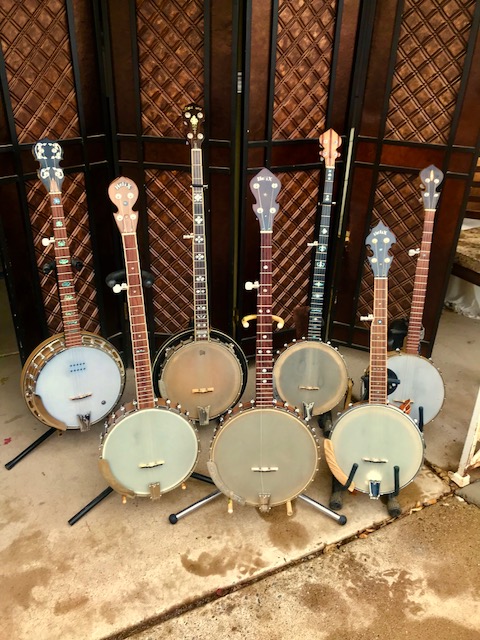
I did a project for a person of shorter stature. He got a 19 fret A Scale and tuned to G, no problem there. Here's a photo of Longneck, short and the A scale all together.
No sales, nor promotion intended, and as always, no wagering.
Terms of Use | Privacy Policy | Privacy Consent (EU/GDPR Only)
Copyright 2026 Banjo Hangout. All Rights Reserved.


