DVD-quality lessons (including tabs/sheet music) available for immediate viewing on any device.
Take your playing to the next level with the help of a local or online banjo teacher.
Weekly newsletter includes free lessons, favorite member content, banjo news and more.
Premier Sponsors


|
Please note this is an archived topic, so it is locked and unable to be replied to. You may, however, start a new topic and refer to this topic with a link: http://www.banjohangout.org/archive/379279
banjered - Posted - 11/22/2021: 08:46:54
I've been thinking about this question lately. Locally there have been a few more new-to-us fiddle players show up at the jam. Some of the more obscure tunes they play don't always sound like they are as banjo easy/friendly. Any tune that drops below the note of D can be problematic, or not. Seems like Possum Up A Gum Stump does OK when the tune drops below D while the banjo goes up to capture the right notes. What prompted this post is looking at Henry Reed's Reel which was played yesterday at a jam and today seeing Jimmy Sutton's comment post about HKR where he says, "I will probably be howled down but to me Henry King's Reel is an excellent FIDDLE tune. Transferring it to banjo kills the thing stone dead." Yet on another tune, Around The Horn, I had another banjo player say he thought it did not make a good fiddle tune whereas I came up with an arrangement that I like as one of my favorite fiddle tunes to play. All this sort of leaves me wondering whether it the question above is true or it's my failure to come up with a viable arrangement. Must be a reason that the old jam "chestnuts" are frequently played. Anyone else thinking about this too? Thoughts? banjered
R Buck - Posted - 11/22/2021: 15:01:14
It depends on how you approach the fiddle tune. It takes quite a bit of figuring on some tunes, but if you know your instrument, you can get most tunes. I still don't do many rags or jigs clawhammer, but then that is another story. You have to be into a very melodic place for those tunes with a lot of thinking outside of the box to pull those off IMHO.
tdennis - Posted - 11/22/2021: 15:14:01
When transposing a song from one instrument to another, I'm not sure if it has to be done as an exact transcription, but the song can be adapted & altered to accommodate the particular instrument of the player. I feel an artist has a license to make the song the best it can be on one's own instrument.
Dan Gellert - Posted - 11/22/2021: 16:06:35
Sometimes a tune is real good on the banjo, but not in the same key the fiddle plays it... or in the the commonest tuning for the key.
Bill H - Posted - 11/22/2021: 18:12:45
Some tunes may take a half hour to transpose and arrange, and others weeks. Some of my arrangements work better than others. Jumping into an unfamiliar and difficult tune in a jam is another thing entirely. If I like the tune I make it homework.
TomL - Posted - 11/22/2021: 18:19:02
A banjo can help a fiddle on most tunes, but clawhammer may not be the best style to use, depending on the tune. No reason for an old time player to be limited to one style
Don Borchelt - Posted - 11/22/2021: 19:35:53
Before you can play a fiddle tune on the banjo, you have to turn it into a banjo tune. I realize tdennis already said that. And as Bill said, some take a couple of hours, and some take a couple of weeks, and I've had a few take a couple of years. But I have been playing fiddle tunes on banjo for 50 years, and I can probably count on one hand the number I've given up on.
- Don B.
m06 - Posted - 11/23/2021: 00:51:42
Don’t forget that your own natural preference will influence your thinking. My instinct is that is a big part, rather than any particular fiddle tune presenting an insurmountable technical problem on banjo.
Jimmy Sutton - Posted - 11/23/2021: 02:25:07
A classic case in my experience is a the tune that a banjo player who I have played sessions with for many years, he insists on playing J P Fraley's Wild Rose of the Mountain. The lack of sustain just makes the tune plod especially when no fiddle is present. It really is painful.
Don Borchelt - Posted - 11/23/2021: 04:30:24
Originally posted by Jimmy Sutton: "A classic case in my experience is a the tune that a banjo player who I have played sessions with for many years, he insists on playing J P Fraley's Wild Rose of the Mountain. The lack of sustain just makes the tune plod especially when no fiddle is present. It really is painful."
I respectfully beg to differ.
- Don B
Edited by - Don Borchelt on 11/23/2021 04:31:03
Jimmy Sutton - Posted - 11/23/2021: 06:16:06
I respectfully suggest that you are playing at a different tempo than J P played it which changes the feel of the tune completely.
My friend who I refer to above plays it nearer to J P's timing and it doesn't work
m06 - Posted - 11/23/2021: 06:44:05
quote:
Originally posted by Jimmy SuttonA classic case in my experience is a the tune that a banjo player who I have played sessions with for many years, he insists on playing J P Fraley's Wild Rose of the Mountain. The lack of sustain just makes the tune plod especially when no fiddle is present. It really is painful.
Insistent and painful? Have you tried finding a different banjo player.
Don Borchelt - Posted - 11/23/2021: 11:06:30
quote:
Originally posted by Jimmy SuttonI respectfully suggest that you are playing at a different tempo than J P played it which changes the feel of the tune completely.
My friend who I refer to above plays it nearer to J P's timing and it doesn't work
You can suggest that I am playing at a different tempo, but you would be wrong.  I am playing it at the exact same tempo as Fraley on the recording I worked it up from, his 1974 Rounder album with his wife Annadeene on guitar. We are both at 95bpm. Listen to the two and see for yourself.
J.P. and Annadeene Fraley, 1974
The audio track from my video above
Now, you might think the "feel" is different, or something like that, but I've played it along with lots of fiddlers, and it always seems to complement them pretty well.
That's a great album of fiddling, all up on YouTube, for anyone who hasn't heard it. I learned six other tunes from that album, including Cluckin' Hen, Birdie, Sail Away Ladies, Goin' Down the River, and Denver Belle. One of these days I am going to work out The Roosian Rabbit.
- Don Borchelt
Jimmy Sutton - Posted - 11/23/2021: 12:50:18
OK DanI accept what you say about timing is correct but it just confirms for me that a good fiddle tune doesn't always make a good banjo tune. Short staccato banjo notes just cannot reproduce what J P does with his bow.
Incidentally I am well aware of J P's first album and bought it when it was first issued. I have several others too plus a number of recordings which I made of him over the years since I first met him in 1982. The recording of Wild Rose which he did for me did include an excellent banjo player as an accompanist.
Jimmy Sutton - Posted - 11/23/2021: 13:01:35
Mike in North Somerset.
One crap tune now and again I can accept. I didn't say he was a bad banjo player it's that one tune where he insists on playing lead that is irritating. We have been playing in the same sessions every week for around 30 years and even before that on odd occasions.
wrench13 - Posted - 11/23/2021: 13:07:55
Good players will always be able to adapt and find a way to cover the tune, albeit phrased a bit differently or add some ornaments. I wrote a tune years ago, Cape Horn Hornpipe; hornpipes are notoriously hard for banjo, but one of the guys at our jam sessions came up with a great version of it. Note for note, no, but he covered the prime phrases.
chip arnold - Posted - 11/25/2021: 04:15:47
Jimmy Sutton, who was the banjo player with J.P.?
If you still have it would you post your recording of them here?
Edited by - chip arnold on 11/25/2021 04:17:31
chip arnold - Posted - 11/25/2021: 04:27:32
Don Borchelt, first time I've heard you play that one. Beautiful and I think JP would hve loved it. He loved playing with Will and your playing very much has a lyrical feeling like Will.
Edited by - chip arnold on 11/25/2021 04:30:52
Jimmy Sutton - Posted - 11/25/2021: 12:28:53
Chip,
There were two banjo players present but the main one was Peter Gott, playing as accompanist, not trying to carry the melody. That in my humble opinion is the only use for a banjo with Wild Rose, but whatever floats your boat.
R.D. Lunceford - Posted - 11/25/2021: 16:33:23
quote:
Originally posted by Don BorcheltBefore you can play a fiddle tune on the banjo, you have to turn it into a banjo tune.
- Don B.
Exactly right.
Not all fiddle tunes are going to work out on the banjo. Fiddle tunes are typically composed on the fiddle and so naturally fit well on the instrument.
Unless you're playing melodic banjo, you typically need to boil the tune down to its basic, bare bones melody and then build it back up as a banjo tune by adding typical banjo technique to the basic melody.
Take a listen to the many different versions amd styles of the same tune. As different as they can be, it is this basic melody, the notes they have in common that makes them recognizable as the same tune. This is what you want to distill down to and then base a banjo version on.
jenorma1 - Posted - 11/26/2021: 08:44:30
Part of the issue with taking tunes to the banjo is that the banjo just doesn't have the range in the first position that a fiddle does; we're essentially missing the low G string and tunes that spend a lot of time down there (like Henry King's reel but also a lot of D tunes that go below the tonic note) become a bit more challenging to adapt. I think that the banjo's "proper" place is one octave below a fiddle, but this just isn't possible with some tunes on a 5 string in standard tuning.
There are several solutions here: jump octaves mid-phrase or between parts; leave out notes that get too low; stay in the same octave as the fiddle by learning to play up the neck. My favorite option is the 6-string (low bass) banjo for tunes that require it, thereby opening up the banjo's range in first position - I've got a post about this here:
jeffnormanbanjo.com/weekly-ban...ing-banjo
Henry King's Reel is one of my recent favorites too - I've played it with a fiddler and have chosen to just plunk around on the D string while he's on the low parts for now and then jump back to the melody when he goes higher - works well with a fiddle but sounds like nonsense on its own. I've been planning to get my 6 string out and tackle this one but just havent gotten around to it yet.
To Dan Gellert's point: Henry King's reel works well in double D (key shifted to D as well) because that tuning has the tonic as its lowest note (this will also be the case with a 6 string in G tunes with the low G added). I've also thought about playing this tune in double-D tuning capo-ed a the 5th fret; this will put me in the same octave as the fiddle but will allow me to get all the notes.
jenorma1 - Posted - 11/26/2021: 08:53:45
quote:
Originally posted by Don BorcheltOriginally posted by Jimmy Sutton: "A classic case in my experience is a the tune that a banjo player who I have played sessions with for many years, he insists on playing J P Fraley's Wild Rose of the Mountain. The lack of sustain just makes the tune plod especially when no fiddle is present. It really is painful."
I respectfully beg to differ.
- Don B
(also) - this is just SO good. You really make me want to try a bit more 3 finger playing, Don.
carlb - Posted - 11/26/2021: 09:54:33
quote:
Originally posted by banjeredAnyone else thinking about this too? Thoughts?
When playing with a fiddler, you can concoct a banjo setting that goes along with the fiddle tune. The setting might, or might not, make a good solo banjo tune, but often can make a really good fiddle-banjo duet.
R.D. Lunceford - Posted - 11/26/2021: 10:45:48
Right. The banjo's role is not necessarily to play a note for note version of the fiddle tune when playing with the fiddle.
Listen to some of Wade Ward's Banjo solos from the Uncle Wade recording. They are classic settings that are at quite a variance from
the fiddle tunes they are derived from.
janolov - Posted - 11/26/2021: 12:37:55
Also think about the Round Peak players, for example Tommy Jarrell and Fred Cockerham and others. They played both fiddle and banjo, but the banjo version differed from the fiddle version. The banjo gave a basic rhythm and at the same time supported the fiddle by playing the essential melody notes (often 2 - 3 notes per measure), and the rest was for rhythm and harmonies with drop thumbs, double thumbs and alternate string pull-offs and other techniques.
Don Borchelt - Posted - 11/28/2021: 16:18:12
R.D. Lunsford wrote: “Take a listen to the many different versions and styles of the same tune. As different as they can be, it is this basic melody, the notes they have in common that makes them recognizable as the same tune. This is what you want to distill down to and then base a banjo version on.”
it is just so. This is the way I have long stated that advice: hum along with the fiddle, and then find the melody you are humming on the banjo.
My thanks to Chip and Jeff for the nice compliments, it is quite an honor to get a nod from two truly superb players. I have a copy of Jeff’s recent CD, Stripey Cat, and it is wonderful. Among the tunes are some of my favorite tunes to play, including Texas, Five Miles From Town, Yew Piney Mountain, and Snake Chapman’s Tune; the last one I just recently learned a few months ago, and is still one of my current obsessions. Jeff, I’m just a few weeks away from seventy-one now, and my memory fails me sometimes, but I’m almost certain we have played some tunes together, maybe at Clifftop or Lake Genero. Chip I have played tunes with countless times; to my ear he does the best two finger up picking I have ever heard. Check out his YouTube channel. So praise from these two masters gives me the courage to keep tackling fiddle tunes that pickers like Jimmy warn cannot be done on banjo without dire consequences.
Now, I admit that it is with some trepidation that I continue to disagree with Jimmy, a picker who was destined for musical greatness from the day his mama named him after a fiddle tune. But I fear that his position is a very destructive one for old-time music. If players accept the idea that some tunes just cannot be played on banjo, they will be that much quicker to surrender when they are struggling to work out an unusual tune. Some wonderful contributions to old time music might be lost as a result. Of course, this leads to a bigger question- do we care? Is old time music best preserved by treating it as an artifact, something to be carefully protected, by always hugging closely to the techniques used when it was first recorded? Or is old time music a living thing, something that grows and expands, absorbing new ideas and approaches, while still staying true to its original spirit? In my opinion, if it is not the latter, it will eventually die.
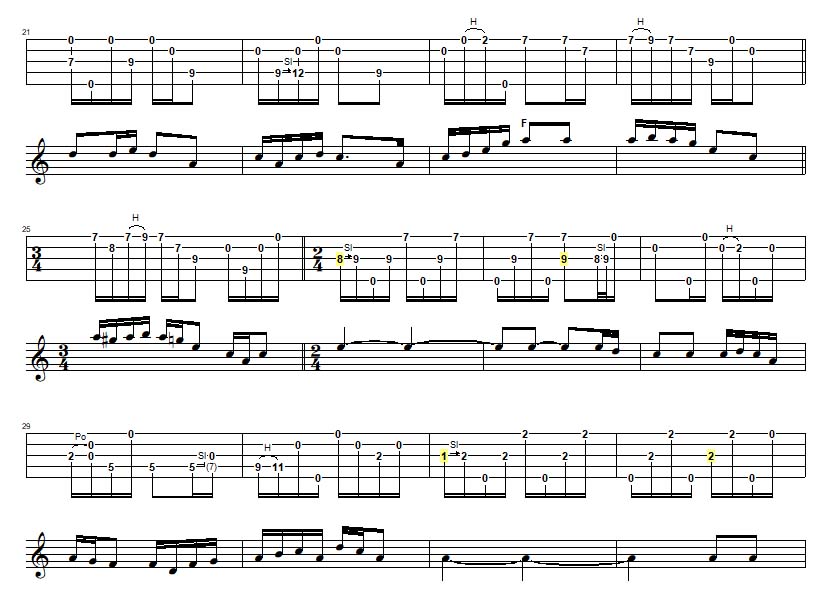
It was no accident- the thing Jimmy objected to- my use of an extended forward roll to try and capture some of the feeling of that long bow that Fraley puts at the end of each strain of Wild Rose of the Mountain. Jimmy stated adamantly that I had failed, but I don’t agree with him. Not only that, I recently applied the idea to another similar Fraley tune, Maysville. In both tunes, I repeat the long bow note multiple times over the course of the syncopated roll, but play it directly on the beat only on the first and the last beat. The object is to suggest the essense of a single, sustained note, even though the audible vibrations of the original note have long since decayed. In Maysville, those long bow notes occur in the second part. The tab below lays it out that second part the first time through, with the emphasized melody note highlighted in yellow in the banjo tab, and Fraley's fiddling, as I hear it, in standard notation underneath. Obviously, the fiddle notation cannot do justice to all of the subtleties of Fraley’s expressive bowing, but it does help illustrate the banjo concept. This is not something I invented, old-time three pickers have been doing this on the banjo since the days of Mack Woolbright and Snuffy Jenkins.
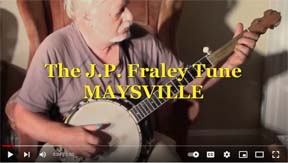
Yup, I've aged some from days of that first video.
- Don Borchelt
Edited by - Don Borchelt on 11/28/2021 16:20:12
chip arnold - Posted - 11/30/2021: 12:11:50
So one man's meat is another man's poison, I guess. I was fortunate to be around JP a bit and got to play in a few small jams with him. I know he was always happy to be accompanied on banjo by a good player. Will Keys was a picker he loved, and Will could do justice to a waltz. For my ears, Don Borchelt is a master at paying waltzes. I'm getting old and can't play up to speed anymore, so I'm thankful for the waltzes I've learned over the years. I can still play them and enjoy them. I agree that Jimmy's attitude is not helpful. My suggestion would be for him to just not listen :-)
R.D. Lunceford - Posted - 12/02/2021: 17:19:43
Astute observation by janolov.
I might add, that it depends on what the banjo version is going to be used for. If it is to back the fiddle, rhythm is paramount with some of the main points of the melody reinforced. The presence of backing guitar will also be a factor in determining how rhythmic the banjo will need to be.
If you're trying to come up with a banjo solo, you're going to need more of the melody, and depending on what style, the balance between typical rhythmic devices and pure melody will vary.
calicoplayer - Posted - 12/07/2021: 03:57:43
I believe there are two issues relating to whether or not a fiddle tune can (or should) be ported to the banjo. First, some slower tunes need the sustain that a fiddle or guitar can provide; the quicker decay of notes - which is an important element of the banjo - can make some tunes awkward on the banjo. For example, while "Ashokan Farewell" or "Da Slocket Light" can certainly be played on the banjo, I try to grab a guitar when those tunes come up (DADGAD guitar - much better for those Celtic items!)
The second issue is that some fiddle tunes are best played in keys that are less common or awkward on the banjo. For example, Democratic Rage Hornpipe is commonly played in F, and just doesn't work as well when transposed to some other key.
But all this aside, the reality is that ANY tune can be played on the banjo - there are just twelve tones to deal with - but sometimes a tune can benefit from some modification into a hybrid tune. I sometimes have fun doing what I call a "bluegrassification" of Celtic tunes, changing the timing, adding bluegrass rolls, doing closed chord walkups, etc., even though I sometimes get strange looks from the fiddlers when I do it.
chip arnold - Posted - 12/07/2021: 05:50:07
calicoplayer Since you mention this tune .......
Hearing only fiddle versions, I was never inspired to learn it, until I heard Don Borchelt's banjo rendition. I spent the rest of that day working it out in 2-finger style. Perhaps not enough sustain for you, but I love playing it with or without a fiddler :-)
banjohangout.org/myhangout/med...archived=
Don Borchelt - Posted - 12/08/2021: 17:29:22
Chip, (chip arnold), your rendition of Ashoken has always amazed me, it's just beautiful. Smooth and natural.
m06 - Posted - 12/09/2021: 02:47:34
quote:
Originally posted by Jimmy Sutton>Short staccato banjo notes just cannot reproduce what J P does with his bow.<
No, of course not. But we banjo players do have a range of options at our fingertips. Maybe wider than we give ourselves credit for? Note length is only one element. We can modulate volume and emphasis too and dial forward and back in relation to the fiddle lead. That has a big effect on our contribution to a group sound. When heard in unison with the fiddle (and other instruments) the banjo can play its role to enhance the overall sound in a variety of ways. The tonal fit (I mostly think of banjo and fiddle individually as two incomplete halves of a characteristic sound) is the beauty of their relationship.
The unique capability of the fiddle means that 'reproducing' what the fiddle bow does is never the aim. Everyone attempting to replicate each other note-for-note seldom makes for a pleasing sound. The aim is musicality and sensitivity to the tune.
In a session I was at last night we played Midnight On The Water a lovely 3/4 fiddle tune. I find I completely change how I play for that one tune, switching to 2-finger thumb lead and slurred triplets start appearing as well as very deliberate adjusting of volume and dynamics at different places in the tune. I guess that is just how the fiddle lead on that tune makes me respond on banjo. Vastly different to, say, my clawhammer approach with a driving and often playful rhythmic emphasis on fiddle tunes like Rock The Cradle Joe or Julianne Johnson.
BTW I'm not seeking to 'attack' your view. If you feel that way about a tune that's fine and your personal taste. I just happen to feel differently. Actually this is a really interesting thread and other posts wonderfully insightful and informative. A great example of why we keep reading BHO.
Edited by - m06 on 12/09/2021 03:02:16
Jimmy Sutton - Posted - 12/09/2021: 03:53:27
I thought that it was clear from my posting (perhaps not?) that the problem to which I refer is the banjo player believing that he could lead the tune, in other words replace the fiddle. There were/are often times when no fiddle was present and it just doesn't work.
Of course I am only speaking of my personal taste. I don't understand how my humble opinion could affect old time music.
Can I also add that I wasn't named after a fiddle tune but a banjo tune played by the Reedy/Ball family (Wade and Orna) accompanied by Walt Henderson's fiddle.
m06 - Posted - 12/09/2021: 07:01:30
Maybe my replies are influenced by not being familiar with the J P Frayley version? Without that comparison there’s no inherent reason for me to be disappointed. I’ve since googled J P Frayley’s version. Any banjo version is going to have to find a compromise for those long bow notes. If someone considers the long bow phrases are the essence of that tune then no banjo version is going to satisfy their rigid requirement. But to say a banjo cannot tackle the tune beautifully has been contradicted by Don’s video. Replication of J P Farley? Nope. It doesn’t need to be; it stands alone as a banjo piece and no way to my ears is it ‘plodding’.
The crux of the question seems to lie in comparison. Why automatically compare? We don't do that when different artists paint the same scene. We understand they are basing their individual version on the same information yet creating a picture that has its own form, colour and atmosphere. We can hold an opinion that we don't like a picture but not because it doesn't look like another artist's. We form that opinion by understanding whether the artist conveyed their vision.
What Jimmy appears to be doing is the equivalent of saying the picture is ' bad' because an element of the information/scene 'doesn't look as it should'. The old realism trap applied to music.
Edited by - m06 on 12/09/2021 07:16:41
Jimmy Sutton - Posted - 12/09/2021: 08:26:48
Mike,
I don't "appear to be doing" anything. What I am doing is stating a fact that for me, repeat FOR ME, it just doesn't work.
As for "the old realism trap", I quote the Solemn Old Judge "Keep it down to earth boys".
You indicate that you haven't heard J P Fraley's original. You can probably find it on You Tube.
m06 - Posted - 12/09/2021: 09:31:28
Yes I did google JP Fraley’s version.
I totally get that it’s your opinion that you don’t like the tune on banjo. None of us should comment on your opinion. That would be as daft and pointless (and rude) as criticising your favourite colour or holiday destination. My curiosity is with the suggestion/question in the OP that there are tunes that can’t/shouldn’t be played on banjo. As with anything, there's always going to be folks who like a particular result and those who don't (and folks who aren't bothered either way). To me that's inevitable and not the same as whether there are fiddle tunes that are in a category as 'undoable' on banjo and should not be attempted.
Edited by - m06 on 12/09/2021 09:41:15
maryzcox - Posted - 12/09/2021: 10:40:43
There are many reasons why fiddle tunes & banjo arrangements may not mesh & many reasons have been given here--but no one has mentioned a possibility that I have seen at informal jams.
Sometimes the fiddler has terrible timing & intonation & does not know the tune well and maybe plays it pretty crooked and references to someones historical playing--but hey--its difficult for banjoists who are in tune and in time to follow. :)
Best banjo wishes,
ps. If you play with a really good fiddler--he/she may play with you and weave the lead and harmonies with you so you aren't playing the exact same thing--which sounds really nice.
Mary Z. Cox
carlb - Posted - 12/17/2021: 07:09:16
quote:
Originally posted by Jimmy SuttonA classic case in my experience is a the tune that a banjo player who I have played sessions with for many years, he insists on playing J P Fraley's Wild Rose of the Mountain. The lack of sustain just makes the tune plod especially when no fiddle is present. It really is painful.
My take
janolov - Posted - 12/17/2021: 08:30:28
Regarding "Wild Rose Of The Mountain", I can admit it is a difficult, but not impossible, tune for the banjo. The difficulties are mainly the long sustained notes in the fiddle version, and that the melody is crooked so you have to emphasize the right notes on the right occasion. It is better to think this tune as built up by phrases, rather by measures. Otherwise I think the melody parts of this tune is very banjo friendly. And I think that Carl Baron really has caught the tune, as a banjo tune, in the version above.
Terms of Use | Privacy Policy | Privacy Consent (EU/GDPR Only)
Copyright 2026 Banjo Hangout. All Rights Reserved.