DVD-quality lessons (including tabs/sheet music) available for immediate viewing on any device.
Take your playing to the next level with the help of a local or online banjo teacher.
Weekly newsletter includes free lessons, favorite member content, banjo news and more.
Premier Sponsors


|
Please note this is an archived topic, so it is locked and unable to be replied to. You may, however, start a new topic and refer to this topic with a link: http://www.banjohangout.org/archive/373551
JudsonCarroll - Posted - 03/13/2021: 18:47:41
That is an old Joe Pass quote.... he was a master chord melody guitarist. It took years for that to sing in for me, and only did so while playing banjo. There are Major, minor and Dominant 7 chords. You can play most songs with them. The Major and minor pretty much stay the same... unless you raise or lower the 5th for an augmented or half diminished. The Dom 7 becomes a 6th just by lowering the flat 7, becomes a Major 7 by raising the flat 7 to natural 7, becomes a 9 by raising the 7 up to the 9/2..... etc, etc, etc. Once I got that, I realized that all I needed to do was find each chord with its root, 3, 5, and sometimes 7 on any string. WOW! That was like splitting the atom for my playing. Once I could do that, I could improvise freely, always having the arpeggios under my finger tips in any position and just filling in with scale or chromatic notes... or not! Honestly, I wasted 20+ years on tabs and transcriptions... why don't more books/teachers teach this?
rcc56 - Posted - 03/14/2021: 00:33:33
I also teach chord groups, but I use a couple more classifications:
Majors
minors
Dominant 7ths with no altered tones
"Juicy" chords-- includes dominant 7ths with altered tones, diminished and half diminished chords, and augmented triads
Suspensions and quartal and quintal chords
Indeed, most of the chords that we use in our "Western" system of tertian harmony can easily be constructed by learning what tones to alter or add to a major triad.
I also teach scales and modes using the major scale as a Rosetta stone reference-- again, what tones are altered, added, or subtracted. A chestnut of this system is that the majority of our scales can be considered to be either major or minor in nature, depending on whether they contain the major third or the minor third. If a scale contains both, or neither, that's another conversation.
Hindemith classified chords by the amount of tension created by the number of consonant or dissonant intervals contained in the chord.
Edited by - rcc56 on 03/14/2021 00:44:09
G Edward Porgie - Posted - 03/14/2021: 06:57:41
There are still a few chords which defy classification, such as the "tone clusters" used by Harry Partch, and some xhords which occur when "passing tones" feature in a melodic or contrapuntal progression. What can aslo be confusing is a sixth chord: for axample, an F6 th chord is F major with an added D, but looked at differently, it becomes a D minor 7.
For most harmonies, there may only be three chords, but that, to me, is a simplification of harmony which doesn't always apply. One might raise a fifth, but then it is no longer a simple major or minor chord that's been altered. In sound, shape, and behavior, it is not major, minor, or dominant, but something else entirely.
johnedallas - Posted - 03/14/2021: 09:58:40
Whether or not 3 chord types is an oversimplification depends to some extent on the context. I wouldn't want to do without my diminished chords, but even 4 chord types could be seen as an oversimplification.
In the context of me singing a song and accompanying myself with chords on the banjo, it may seem that I'm getting away with 3 or 4 chord types - but every time I sing a melody note that's not part of the accompanying chord, I'm creating a new chord, which may be augmented, diminished, or whatever.
In the context of me not singing, but playing the same melody with the same accompaniment on my banjo, I do have to form augmented, diminished, 6th, 9th etc. chords with the fingers of my left hand. As a singer by habit, even when I'm playing an instrumental, I usually think of what I'm doing with my left hand as fingering a melody note, and fingering a (simple) chord at the same time. But if you took a photo of my left hand at that moment, it would look as if I were holding down a more complex chord.
Cheers,
John
JudsonCarroll - Posted - 03/14/2021: 10:22:43
It is not that there are not more complex chords or more "colorful" chords than those three... not at all. It is a way of thinking. For instance a min 6/9 or something with a higher extension becomes very intuitive when one thinks about how those chords are built from the basics. Then, having memorized scales associated with numbers, the arpeggios become obvious and everything is right under your fingers, just a fret or two up or down, sometimes further. People often say about the greats, "________ knows every chord in every position." Well, anyone can if you can identify the root, 3, 5 and 7 of any chord on any string, or develop a sense for where the tones in relation to each other... and that sure beats memorizing chord encyclopedias!
johnedallas - Posted - 03/14/2021: 11:46:49
Judson,
When you say, " For instance a min 6/9 or something with a higher extension becomes very intuitive when one thinks about how those chords are built from the basics. Then, having memorized scales associated with numbers, the arpeggios become obvious" this may be how your mind works. For me, complex chords become intuitive when I know what note comes next in the melody, and feel what basic chord I need to underpin it. That's how my mind works.
Everybody's mind works differently. For instance, some may find it easiest to just memorize "chord encyclopedias."
Cheers,
John
G Edward Porgie - Posted - 03/14/2021: 14:00:27
Here's a chord from a piece (Morning Reveries," by William Albright) I am currently learning on the piano: F,F,A,D#, B.
Please tell me whether this is a major, minor, or diminished chord.
Or how about this one, from Chopin's Prelude No. 2 in A minor: D, A#, B, G, D. (I must qualify this one a little, though, These notes are split into two groups, although the sustain pedal does blend them into one.)
Although either of these could, with some effort, probably be classified as derivations of the basic maj., min,. dim. chords (the first could be an F7 with a enharmonic flat fifth (correct notation would be Cb) and an enharmonic spelling of the Eb (D#); the second could be a G major with an added sharp 9th) these "chords" and many like them can become so far removed from the so-called "three basic chords" it begins to seem like calling an automobile a "bicycle with an added motor, transmission, differential, two extra wheels, a backseat, doors, and a roof.
I will say, though, that if thinking in terms of only three basic chord types is helpful to a person, so be it, and I am happy it does help them.
Just don't foist that idea on me! 
Edited by - G Edward Porgie on 03/14/2021 14:04:34
JudsonCarroll - Posted - 03/14/2021: 14:40:31
How you name the chord depends on what key you are in and how you hear it with your mind/ear. obviously, for instance, you have all the same notes in CMaj and a min.... and it is especially true with enharmonics that the very intangible feeling of both the mood and how you anticipate the next note dictates. It is also true that on an 4 string instrument (5th rarely fretted) like the banjo, you can't play 6 note chords. You have to leave out a few, usually starting with the root. Knowing the relationship of where the key notes of root, 3, 5 and 7 fall on the next highest or lowest string allows you to play altered chords naturally. I doubt this is as relatable to piano, as you would have to play more than ten notes before running out of fingers..... and then you could use a foot!
Memorization is not my strong suit, whether chords or solos. I sight read and I improvise based on a melody... I'm not a modern jazz guy, so I do like to play the melody. Knowing 3/4 basic shapes for Major and minor chords and 4/5 basic shapes for Dom 7 lets me play all over the fretboard without having to think about the mechanics of playing. Then, I can fill in notes, substitute chords, etc, just as it sounds good to me. If classical music is your thing, then yeah, you will approach it differently. I mean, if you really sat down and tried to write out all the possible chords 5 or so notes could make, you'd end up with something more like math or trying to translate language without a solid key. For me, I say, this sounds like a D chord, the feeling is major or minor.... where is it leading? Is it pulling the ear somewhere... ? Or, if I have the music, I just hold down one or a few notes of the chord and play the melody with my other 1-3 fingers... next time through, maybe I add some runs and fills... maybe I try a substitution. Keeping things simple allows me to play the music in my head and go where my ear leads me. Being analytical doesn't, and memorization doesn't work for me, at all. I'm far more likely to get lost playing a solo I learned from a recording in a jam session than just improvising, based on the melody, over the chords. Sure, I enjoy hearing the greats play a solo and I'm always inspired by them. Actually transcribing a solo on my own, by ear, from a recording has given me some great insights into how those guy's thought and heard the music. But, I can only go so far with that before big chunks of music start dropping out of my head at, usually, the worst time!
But, that is me. Each to his own. But... I don't see many modern banjo books written for guys that learn like me. A lot of the old ones were. So heck, maybe I'll write a book for lunatics like me, who don't like memorizing other people's music. I'll figure out a way to give folks the basic tools to build their own style, their own way. People can always delve deeper into theory and and specific genres, and there are plenty of resources for that. If 5% of folks think/hear like I do, it will be worth it because that 5% won't get it any other way. I grew up following Doc Watson around. I learned from a lot of the legends and experienced a lot of frustration. Several said to me what I only came to understand later, "Don't try to play like me, son... I don't play the same way twice no-how. Play it your way!"
rcc56 - Posted - 03/14/2021: 20:41:50
George, the name and nature of the chords you cited depends on how they are voiced and their relationship to what precedes and follows them.
Although I don't have either musical example on hand, I will suggest that the Chopin example may carry a suggestion of bitonality, especially if the voicing you quoted is indeed in order from low to high. But when I play it on the piano in the order you gave, it simply sounds like a 2nd inversion G major chord with a dissonant note [A#] wanting to resolve to a B-- in short, G major with a dissonant appoggiatura. But again, its name and function depends upon its context.
By itself, the Albright example sounds like a mis-spelled F7 #11 [in jazz terminology] without the fifth, which is a pretty common way to voice such a chord.
Both chords carry a compelling suggestion of a need for resolution, and would fit as class III or class IV chords [I don't remember the details anymore and am too lazy to look them up right now] in Hindemith's system of harmonic analysis.
If my back wasn't hurting, I would look up both examples, but my time at the computer is over for the day.
G Edward Porgie - Posted - 03/15/2021: 08:22:54
I am not stupid, and know that a lot of chord naming has to do with where and how that chord is used.
My point is that some chords simply will not fit in a simple "three chord types" classification. Once a chord is modified, it becomes something different. Passing chords are such examples, in many cases. Although it is probably correct to say that the Chopin is, in fact a G major chord with the appogiatura A#, it is still, while it lasts, not a simple major chord, but something entirely different; a chord of tension that needs resolution.
Whether the Albright chord is a misspelled F7#11 as you've indicated, or a mispelled F7flat 5 is really neither here nor there; an argument could be made for either interpretation. But once again, I ask, is this really a dominant chord, a major chord, or a minor? The actual chord type could be different depending upon context and resolution, so calling it any of the three types could be debateable. In the case of the Chopin, due in part to its context within the piece and when it was composed, could be interpreted as a G major; the Albright chord, however, does not resolve as a normal dominant chord should.
In my opinion, there are so many questions of context, voicings, resolutions, and even the time periods when pieces were composed, that trying to fit everything into three categories is counterproductive. To me, sometimes a group of notes doesn't even constitute a chord, but would be better named as a group of "passing tones." (This might be particularly true of contrapuntal pieces, where linear melodic elements sometimes go past, or bump into each other on their routes toward resolution.)
Edited by - G Edward Porgie on 03/15/2021 08:23:54
mmuussiiccaall - Posted - 03/15/2021: 08:55:20
Seems to be a case of trying to find the exception which just proves the existence of the norm.
.
rcc56 - Posted - 03/15/2021: 09:36:34
I wasn't implying anything like that, George. I'm sorry you took it that way.
Well, the bottom line is that major, minor, and dominant will get one through an awful lot of music. But neither is it the whole universe. I have always taught six chord groups, plus chords that defy ordinary classification; but the first three are the most common until you get deep into jazz, or classical music of the late 19th century and onwards. I teach them first, and add the others later.
G Edward Porgie - Posted - 03/15/2021: 10:00:50
There are far too many exceptions, in my opinion, to "prove the...norm." Although the so-called norm may have existed at one time, modern harmonic structures do not always conform to three chord types, nor do they always resolve in the normal manner.
I will admit that my two examples were actually not particularly good ones, but I did not feel a need to get into too many examples of chords that are unclassifiable, such as Harry Partch's tone clusters or other oddities such as can be found in "wrong note" compositional techniques. I also wished to utilize some fairly traditional musical structures (Chopin is generally pretty "normal;" the Albright is basically "ragtime piano,' with that genre's basic "feel" and harmonic elements). I purposely left out context just to see if anyone could actually fit the chords into the three types, or if there would be any debate on what "type" they actually were.
For what it's worth, the Chopin can, indeed be looked at in context as a somewhat altered G major, but standing alone could not really be called anything. The Albright chord was identified out of context as a mis-spelled form of F7 chord, but in actuality, resolves to an E minor, which really makes it a B7flat5.
If there are only three chord types, and all others are an alteration of those types, one must ask how many alterations or additions are possible before the chord becomes something entirely different? After all, two of these chord types are extremely close to each other; a major chord, with one small half step alteration, becomes a minor chord. Should a major sixth chord be considered a major chord with an added note, or a minor chord with an added note? What about augmented chords, half diminished chords? Complete major triads with added sharp ninths? Chords formed over pedal tones? Passages with escape tones (non-chordal notes that don't resolve)?
Even some early harmonists didn't classify chords as three types. The augmented sixth chord would be an example. It sounds like a dominant seventh, but isn't written as such, and doesn't resolve as such, and if it did, classical harmony I'm sure would have called it a dominant seventh instead of an augmented sixth.
As I said earlier, if it helps someone to classify chords as being of three types only, so be it. I wish them success. But I will never subscribe to such a three- sizes-fit-all premise. That's all I'll say on this; feel free to disagree.
mmuussiiccaall - Posted - 03/15/2021: 10:32:00
Here's an analysis
teoria.com/en/articles/2019/ch...index.php
JudsonCarroll - Posted - 03/15/2021: 10:58:23
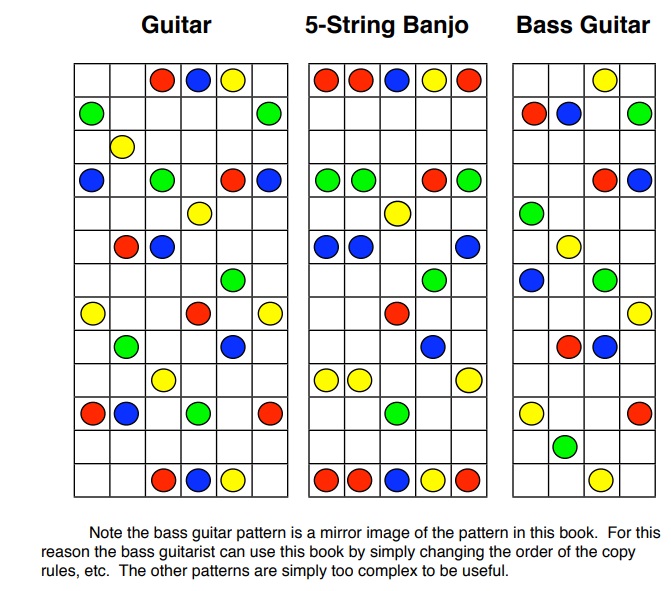
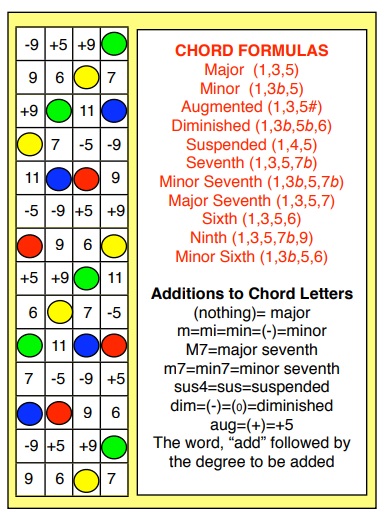
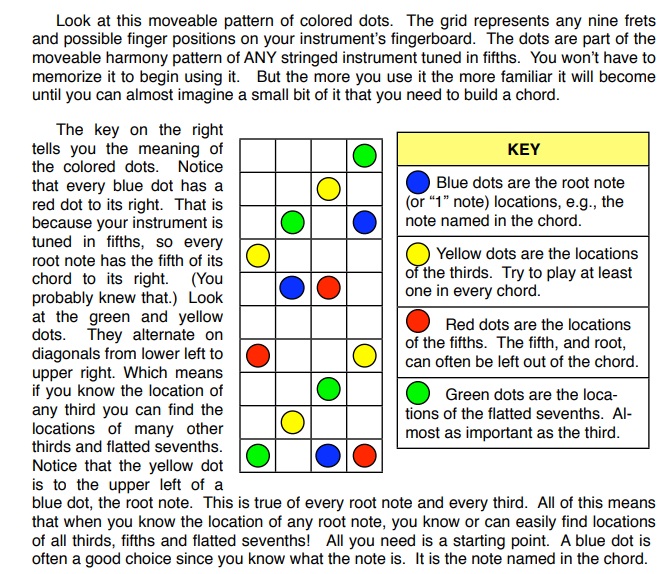
No one is classifying everything as "just 3 chords". That is an over-statement and being waaaaay too literal! It is a way of thinking about how to approach playing a fretted instrument with 6 or fewer strings.... a way of understanding the relationship between notes as opposed to memorized chord shapes. When you play chords by shapes, most folks are not really aware of what note is under each finger. We all have out favorite "grips" as the jazz guys say, but this is more like the CAGED system. It is not an attempt to call a m6flat5 add whatever a 7 chord. I think it would be good to listen to the guy responsible for that quote... then maybe it will make more sense. He was a master fingerstyle guitarist and a master of improvising chord melody. He could play hot single note solos better than most, too. I'll also post an image that should help visualize the concept.
youtube.com/watch?v=YJBJuH1CvcM
rcc56 - Posted - 03/15/2021: 11:28:30
Something was nagging at me about the Albright example, especially after its resolution was revealed. So I got out my music dictionary, went to the piano, and closed up the voicing.
It is a "French sixth," and as one my old theory teachers would have said, it is "more or less correctly resolved." But that's pretty deep stuff for a lot of folks who are seeking an early understanding of the nature of music.
Texasbanjo - Posted - 03/15/2021: 14:11:42
JudsonCarroll Your account is not locked. If it was locked, you couldn't post at all.
There are 3 pictures on your home page under media. Is that what you're talking about not being able to post? You should be able to scroll to the bottom of the page your text is on and find any pictures you have uploaded to your home page. Can you do that? If so, you should be able to click on the picture you want to add to your text, click on preview to be sure it's there and then click on post reply.
Note: you cannot edit or upload any picture 15 minutes after you have posted.
Edited by - Texasbanjo on 03/15/2021 14:12:23
JudsonCarroll - Posted - 03/15/2021: 14:15:02
quote:
Originally posted by TexasbanjoJudsonCarroll Your account is not locked. If it was locked, you couldn't post at all.
There are 3 pictures on your home page under media. Is that what you're talking about not being able to post? You should be able to scroll to the bottom of the page your text is on and find any pictures you have uploaded to your home page. Can you do that? If so, you should be able to click on the picture you want to add to your text, click on preview to be sure it's there and then click on post reply.
Note: you cannot edit or upload any picture 15 minutes after you have posted.
Oh, okay! Yeah, I was toatally confused... I had just posted, then it said, "your account is locked to prevent spam"!
JudsonCarroll - Posted - 03/15/2021: 15:27:24
Okay... it has been an hour since my last comment.... lets try this again. This is from Frank Geiger's How To Build Any CHord Anywhere, a great old book for tenor banjo. As you can see, once you knwo where the roots, 3, 5 and 7 are, in relation to neighboring strings, you can alter or make really cool chords just by moving a finger or two.... or paly arpeggios without losing the chord's "home".
Edited by - JudsonCarroll on 03/15/2021 15:30:49
Texasbanjo - Posted - 03/15/2021: 15:28:22
quote:
Originally posted by JudsonCarrollquote:
Originally posted by TexasbanjoJudsonCarroll Your account is not locked. If it was locked, you couldn't post at all.
There are 3 pictures on your home page under media. Is that what you're talking about not being able to post? You should be able to scroll to the bottom of the page your text is on and find any pictures you have uploaded to your home page. Can you do that? If so, you should be able to click on the picture you want to add to your text, click on preview to be sure it's there and then click on post reply.
Note: you cannot edit or upload any picture 15 minutes after you have posted.Oh, okay! Yeah, I was toatally confused... I had just posted, then it said, "your account is locked to prevent spam"!
I see that it worked for you this time. Glad I could unconfuse you (G)
Edited by - Texasbanjo on 03/15/2021 15:29:40
JudsonCarroll - Posted - 03/15/2021: 15:31:40
quote:
Originally posted by Texasbanjoquote:
Originally posted by JudsonCarrollquote:
Originally posted by TexasbanjoJudsonCarroll Your account is not locked. If it was locked, you couldn't post at all.
There are 3 pictures on your home page under media. Is that what you're talking about not being able to post? You should be able to scroll to the bottom of the page your text is on and find any pictures you have uploaded to your home page. Can you do that? If so, you should be able to click on the picture you want to add to your text, click on preview to be sure it's there and then click on post reply.
Note: you cannot edit or upload any picture 15 minutes after you have posted.Oh, okay! Yeah, I was toatally confused... I had just posted, then it said, "your account is locked to prevent spam"!
I see that it worked for you this time. Glad I could unconfuse you (G)
Much appreciated!
steve davis - Posted - 03/15/2021: 15:32:53
quote:
Originally posted by tdennisYou have experienced an epiphany !
Or in some cases an Epiphone.
I started by chording with a flatpick and thinking in terms of the 3 chord shapes for each kind of chord and altering their shapes to taste.I still use that way playing especially with melodic and fiddletunes.
Edited by - steve davis on 03/15/2021 15:37:20
banjoak - Posted - 03/15/2021: 20:29:38
Three types chords.
1. those that just sound right
2. those that just sound wrong
3. then those that sound perhaps not quite right, but with convincing attitude or BS that might be considered intentional as creative/art/jazzy thing.
Ira Gitlin - Posted - 03/16/2021: 06:56:42
quote:
Originally posted by banjoakThree types chords.
1. those that just sound right
2. those that just sound wrong
3. then those that sound perhaps not quite right, but with convincing attitude or BS that might be considered intentional as creative/art/jazzy thing.
"There are no wrong notes, but some right notes require more explanation than others."
;^)
G Edward Porgie - Posted - 03/16/2021: 07:23:18
Looking over some of this, I can believe that from a playing standpoint, a three chord classification system with all else considered as simple one note additions or alterations could be useful, and might be very useful to a person playing by ear.
However, from a theory standpoint or a compositional view, a more complex classification system would be in order, and even then, some "chords" or note groupings won't exactly fit. The French sixth chord (or other augmented sixths) is one that may sound like a dominant chord, but doesn't always look like one in standard notation, or resolve as one, and as such, might confound a person relying on a simple classification idea.
I also see Bob Chuckrow's logic in saving some of the weird chords for later.
(By the way, Bob, I was not really offended by your comment, and no apology was needed. My opening "I am not stupid," was ill-advised.)
Allstrings - Posted - 03/20/2021: 00:35:24
To the discussion of the "Albright" chord, it jumped out to me as B7flat 5; a jazz commonplace. But (as others have noted) context is all.
Far be it from me to gainsay Joe Pass, who was given to gnomic pronouncements, to the extent of denying knowing what was meant by a ii-V progression, but there are rudiments of harmony that are absent from this thread.
Chords are defined as four note entities. There are 5 chord qualities. Major 7th, minor 7th, dominant 7th (conventionally the x7 chord,) the half diminished, and the diminished.
With the exception of the diminished these can all be derived from the major scale. Every other note starting from I, VI, V, and VII, respectively. Anything else should be labeled a suspension. All your 13s and b9s and such. The three note entities to which we are accustomed are technically triads.
Also difficult for banjoists is that chord progressions are defined by the bass line, including inversions.
I suspect ol' Joe Pass was addressing jazz guitarists, who have busted their chops learning all those suspensions on 5 or 6 strings, in order to inculcate a sense of freedom. The major, minor and dominant 7 chords all have a perfect fifth. The two diminished qualities have a flat fifth. Again, context. If Joe was talking chord voicing for comping (as opposed to melodic soloing,) there is a tradition, dating at least to Teddy Green, of skipping the fifth. Banjos and mandolins who can go far with 3 note chords, can, if properly voiced substitute dom 7 and min 7 for dim and half-dim.
As to the original posters epiphany, I am reminded of the one (and only, alas) lesson I took with Rev. Gary Davis. "You got to learn to spell your chords."
G Edward Porgie - Posted - 03/20/2021: 06:51:15
First of all, a "chord" is defined as "three or more" notes. not always four. You have also left out the augmented chord(s).
I also hesitate to define 13th and flat9th chords as "suspensions," because in many cases they still contain the note that the suspenion resolves to. I believe most theorists would call these "added notes," and not suspensions. (A good example of a true suspension would be a Csus--C,F,G--without the usual E of the C major triad. It's called a suspenion because that F takes the place, momentarily, of the E, thus "suspending" the normal C triad sound until the F resolves downward.)
I, personally, have never defined banjo chord progressions by the bass line. To me, that would be counterproductive to learnimng what was actually going on, and would produce a monotony of first inversion chords. A person doing that might think that a first inversion E minor chord was a G major or worse yet, a G7. He might believe he had to move his hand way up the neck from a D major to an B7, then way back down to Eminor if he relies on just the bass note to form his chord progressions.
The truly interesting thing about the "Albright" chord is that harmonically, it serves two functions. The first part of the piece is in the key of C, which makes the chord an Augmented sixth (F-D# would be that augmented interval) which might resolve to the dominant or subdominant chor, keeping the song in in C. Instead, Albright uses it as a flat 5 dominant 7th (the B7flat5 you've noted) taking the piece to a new extended section in the key of E minor.
These kinds of chord usages are partly why I don't put them in three categories. The minute an altered interval comes into play, a chord may no longer behave the way one might expect.
Allstrings - Posted - 03/20/2021: 12:42:06
Thank you, George. Leave us observe that this is precisely the sort of arcane and systematic discussion that Judson (and Joe Pass) intended to circumvent for improvisers. And rightly so. If I had found this thread on the first page, I have some strategies in that regard.
Me, I like me a good arcane and systematic discussion.
So, if I have missed on the formal definition of "chord" and "suspension" I stand corrected. I generally prefer the term "color tones." The point being an overlay on the actual progression. You, being a pianist, face decisions about clashing (or replacing) color tones versus the basic chord note that rarely come up on banjo or guitar which favor open voicings. I do endorse Judson's original point on simplifying progressions and altering basic arpeggios (or scales) on the fly.
I, personally, have never defined banjo chord progressions by the bass line.
Well, we're not defining banjo chord progressions, but projecting the actual chord progressions onto an instrument, one with peculiar limitations. Play like a banjo, but think like a musician. A point pretty much every 5- string banjo book I've seen falls short on. My studies were that the progression is defined as a bass line (and the bass does not stick to the roots.) This conflates with the drawing of b5 chords.
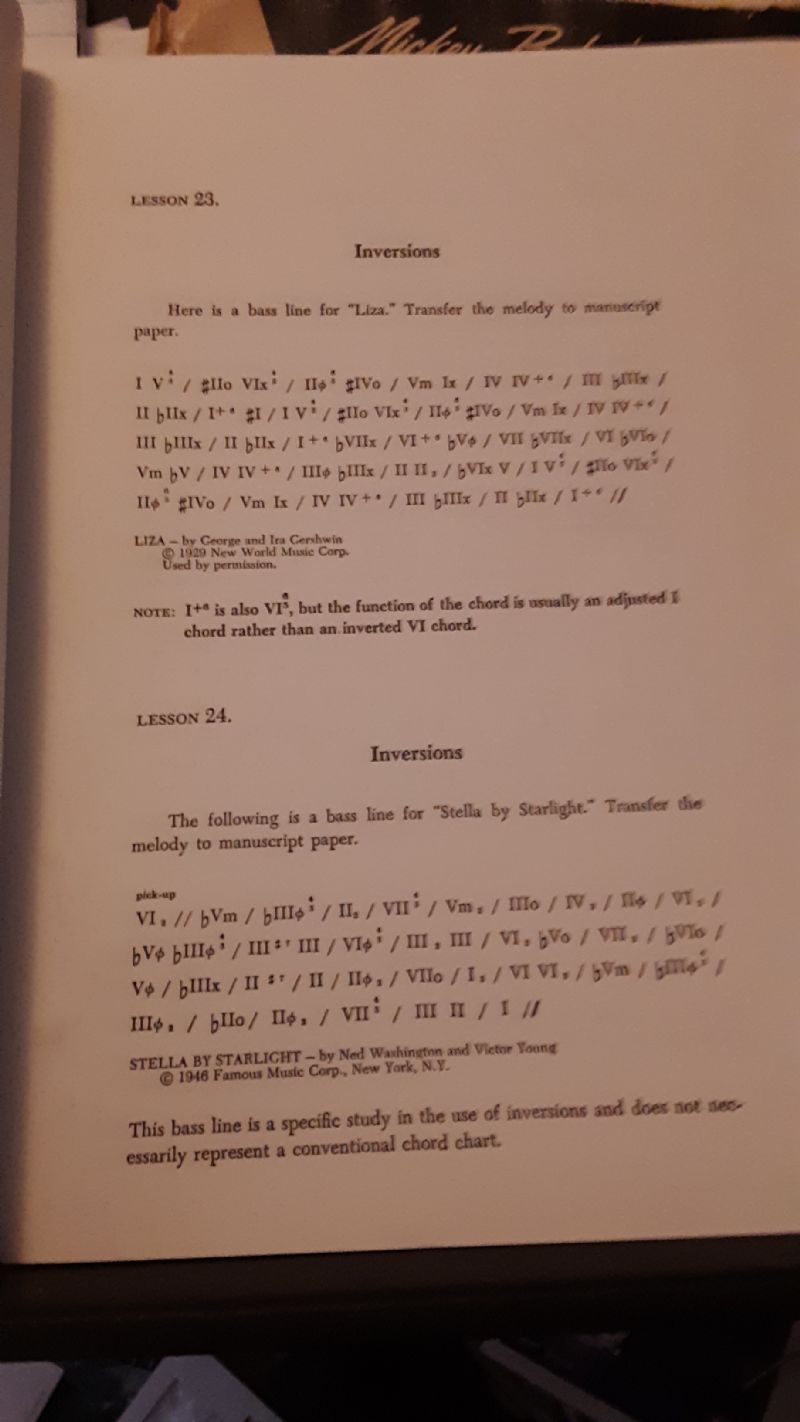
I call it "the Mickey Baker" problem. Back in 19 aught and 69, when I got my copy of Mickey Baker's "Modern Method in How-To-Play Jazz and Hot Guitar" I was confronted with the notorious Lesson One, being a page of 26 monster chord diagrams. The most monstrous being what he calls chord form 6, D 13 b5 b9. For the non guitarists the notes ascending are Ab, Eb, C, F#, B. At the time I pondered why isn't that chord Ab 7 #9 and wondered should the rule be "prefer the simplest chord name?" With a D root we go b5, b9, 7, 3, 6 (or 13 being voiced above dom. 7.) Counting from Ab; 1,5, 7 #9. So drawing from the bass, a simpler and to me more logical scheme. My inferred rule was any b5 chord can be considered with 2 roots, a tritone (that's a b5, y'all) apart. Rather than a whole thread on tritones, I shall quote myself.
Estersohn's Law: Flat Fives Flip Flop.
In either case, that chord resolves to G Maj7; down a fret to G, D, B, and holding the pinky on F# and B. (Mickey Baker chord form #7.) It becomes a question of preference or habit of thought whether one is leading to the G tonic with a D7 or and Ab7. Mehegan (below) teaches that there are 3 kinds of progressions: diatonic, chromatic, and circle of fifths. One of my inferred observations is that b5s tend to obscure those differences. It is also my observation that in jazz that diminshed chords and altered chords tend to progress in circle of fifths fashion.
I am only recently a serious student of the 5-string. But I have at least 2 jazz guitar books each by Mickey Baker, Joe Pass, Howard Roberts, and Bucky Pizzarelli. Won't start to count the one-offs, but they almost always say, "This is NOT a harmony course." The same received wisdom that gave me Mickey Baker as the bridge from the folk world to jazz led me to John Mehegan, Jazz Improvisation, a four volume piano and theory course out of Julliard. He starts with harmony, the five chord qualities (see 1st post) by 12 roots =sixty chords, by 4 = 240 inversions. For space and/or copyright considerations he does not print melodies but charts the harmony as a bass line. He draws a parallel to the "figured bass" in the et continuo classical compositions of old when the accompaniment was, not coincidentally, improvised. Having studied his system, I can assure you that each of those symbols denotes a specific chord quality and inversion (where applicable) attached to a given bass note for each chord.
Having quit piano lessons at age 8, I worked Mehegan laboriously on the guitar. Either not playing the bass called for (probably also a good or even necessary banjo strategy) or fishing around for open voicings that would do. (Closed voice means 1, 3, 5, 7 or in an inversion, say 5,7,1,3, in order; open voicing would shift at least one voice an octave.) After maybe 10 years, I'm slogging into book IV, Contemporary Piano Styles which charts the inner voicings of Oscar Peterson in an A scheme and a B scheme. I'm contiuing to try to find guitar chords that would get as much of that flavor as possible, jumping those octaves to find something that fits under my fingers and all of a sudden, "Holy #$@% ! That's Mickey Baker lesson one." Which is why those jazz guitar books are not a harmony course. Lacking, as a rule, bass in the root voicings, banjo books are worse, in that regard.
Back to Judson's original quest for simplification; when playing over a II minor to V dom. progression (or III-VII, etc.) it usually works to consider it all in the framework of the dominant arpeggio, adding the scale and "outside" notes to taste.
Allstrings - Posted - 03/20/2021: 12:44:02
Lost the illustration somehow.
banjohangout.org/forum/attachm...ID=272649
JudsonCarroll - Posted - 03/20/2021: 14:34:13
It really just comes down to the difference in the way people's brains work, especially musicians. Some delight in intricate detail. Others just naturally "make the complex simple" by more intuitive thinking. Honestly, my two favorite guitarists were Ted Green and Merle Travis. Definitely opposite sides of that spectrum. I suppose, music is as simple as the chromatic scale, or as complicated as every mathematical equation you can make from 12 notes and octaves. You can be academic or intuitive... or a combination of both.. it just depends on your brain, nature and ear. I play a several instruments, but banjo is the probably the most fun. I want to keep it that way.
G Edward Porgie - Posted - 03/20/2021: 15:17:16
Your arguments about chord progressions being defined by the bass notes is not correct in most cases. This idea has some merit with figured bass, but only in the fact that the figures above the bass note are really what determines the actual chord. A G bass note with I 6/4 beneath it judged by the bass alone might be, without the "figures" initially thought to be a dominant chord in C major, but in actuality, is a second inversion tonic chord. That's just one example.
Figured bass is, in fact, improvised, even though, like improvisation in other genres, does have some rules. It may not be as flexible as jazz, but it's still improvistion, and two ensembles will play the figures differenly, utilizing differing passing notes and countermelodies to the main melody. The melody, chords, and bass are set; what lies between the bass and melody are up to the performers. An analogy might be a sonnet; it's a poem with a set number of lines (14) and a set rhyme scheme, but there have been probably thousands of totally different ones written over the years.
One problem you have inadvertently exposed is that sometimes, if the root is missing, the chord can easily be misnamed as something else. The same can happen with any other missing interval. Although in some cases, this may not affect the resolution, in others, adding or subtracting an interval can. Also, an enharmonic spelling of a chord may also cause confusion if it's been spelled incorrectly for the key it is in or the chord it is going to. You mention this Ab,Eb,C, F# ,B chord as resolving to a Gmaj7. However, it also could move just as nicely to C maj9. (although perhaps not so easily on a guitar). There are other possibilities depending on context.
Also, perhaps you intended that "a tritone (that's a b5, y'all) " for someone else, but I thought it rather insulting, as if I, and perhaps others reading, didn't know basic theory.
I will say that jazz harmony sometimes utilizes terminology that differs from classical harmony, and I find nothing wrong with that (other than sometimes it makes for difficulties in communication), just as I've stated before I don't object when a person thinks in terms of "only three chord types" if it helps them.
One other thing--you seem to think I am a piano player. But I also play tenor and plectrum banjo, so I do know a bit about the need for some incomplete chords.
Edited by - G Edward Porgie on 03/20/2021 15:31:17
JudsonCarroll - Posted - 03/20/2021: 15:45:57
I don't think I'm really part of this conversation anymore... it has gone down roads I don't care to journey. That's totally fine with me... y'all have fun! I just found a great old Dukes of Dixieland album - original Assunto family... Poppa Jack absolutely tearing it up on banjo and trombone! Few bands played with more energy and spirit than the original Dukes... LOVE those guys! Time for a cocktail or three.... supper ont he stove.. "happy on my shelf"... as the old guys used to say, "groove, baby, groove!"
Edited by - JudsonCarroll on 03/20/2021 15:47:12
USAF PJ - Posted - 03/20/2021: 18:56:42
quote:
Originally posted by JudsonCarrollIt really just comes down to the difference in the way people's brains work, especially musicians. Some delight in intricate detail. Others just naturally "make the complex simple" by more intuitive thinking. Honestly, my two favorite guitarists were Ted Green and Merle Travis. Definitely opposite sides of that spectrum. I suppose, music is as simple as the chromatic scale, or as complicated as every mathematical equation you can make from 12 notes and octaves. You can be academic or intuitive... or a combination of both.. it just depends on your brain, nature and ear. I play a several instruments, but banjo is the probably the most fun. I want to keep it that way.
Hi Judson,
Appreciated the graphic you posted. Can you help me understand it a little more. Would you be kind enough to include an example. I have been working through some theory and feel as if I am getting closer and much more comfortable improvising w/ different notes. Still need more time though.
JudsonCarroll - Posted - 03/21/2021: 06:03:14
I'm gradually coming up with a plan in which I may do just that! I am an Herbalist by trade, and I'm trying to finish up a book I'm co-writing with a lady in Austria before the garden really gets into full swing. I grow and wild harvest hundreds of herbs, do a weekly podcast, teach herb classes... etc, etc... so things are busy now but about to get into the part of the year where I make most of my income. But, I am giving thought to writing a book and doing some instructional videos to go along with it. It wouldn't be "how to play the tenor banjo"; it would be on how I approach it. So, I'll probably be a project for later in the year. In the meantime, here is the link to the book those pages were from: storage.googleapis.com/wzukuse...0copy.pdf
USAF PJ - Posted - 03/21/2021: 07:55:02
banjohangout.org/my/JudsonCarroll
Judson, way off topic....What are your thoughts on inflammation and best herbs to counter and perhaps reduce?
aintbrokejustbadlybent - Posted - 03/21/2021: 08:30:16
USAF PJ
It’s not off topic if you qualify it “so I can play the banjo”, or my arthritis is keeping me from playing my banjo. A condition that effects many of us I suspect given the average age of the group.
JudsonCarroll - Posted - 03/21/2021: 09:57:02
quote:
Originally posted by USAF PJbanjohangout.org/my/JudsonCarroll
Judson, way off topic....What are your thoughts on inflammation and best herbs to counter and perhaps reduce?
No problem! I'm always glad to answer questions, and I even offer free herb classes on the same Rumble site where I posted my banjo videos - southernappalachianherbs.blogspot.com is where everything is listed. There are lots of herbs that help with inflammation. And, lots that are particularly good for arthritis. So, these are just off the top of my head. Turmeric combined with black pepper and fish oil is good - you have to have the pepper and oil so the liver can process the turmeric. Linden flowers and young leaves work even better for most caucasian folks. Fern root and willow can be used as a compress or poultice. Elderberry and meadowsweet tea are good. Tulsi, so called "holy basil" is very effective, and a lot of the culinary herbs are very anti-inflammatory when they are fresh and full of volatile oils. Cat's claw herb helps. Swedish Bitters can help. One of the best treatments for arthritis, sciatica, etc is one few folks will ever mention - a soak or hot bath just a few pinches of natural tobacco will help dramatically with both pain and inflammation... very good if you don't have tobacco addiction issues, because you will absorb nicotine through the skin. Oils infused with St. John's Wort, cayenne pepper, arnica, juniper, pine or camphor are good to rub in externally, Poke is also excellent for arthritis; fresh spring greens, or a tincture of the root - it is toxic in large amounts though, so be careful and use just a few drops of tincture. Tobacco, poke, plantain, lemon balm and arnica are great for sprains, bruises, bug bites, etc as a poultice. Even just covering an area with fresh, cool cabbage leaves is useful for many folks.
Edited by - JudsonCarroll on 03/21/2021 09:58:14
USAF PJ - Posted - 03/21/2021: 13:06:37
quote:
Originally posted by JudsonCarrollquote:
Originally posted by USAF PJbanjohangout.org/my/JudsonCarroll
Judson, way off topic....What are your thoughts on inflammation and best herbs to counter and perhaps reduce?No problem! I'm always glad to answer questions, and I even offer free herb classes on the same Rumble site where I posted my banjo videos - southernappalachianherbs.blogspot.com is where everything is listed. There are lots of herbs that help with inflammation. And, lots that are particularly good for arthritis. So, these are just off the top of my head. Turmeric combined with black pepper and fish oil is good - you have to have the pepper and oil so the liver can process the turmeric. Linden flowers and young leaves work even better for most caucasian folks. Fern root and willow can be used as a compress or poultice. Elderberry and meadowsweet tea are good. Tulsi, so called "holy basil" is very effective, and a lot of the culinary herbs are very anti-inflammatory when they are fresh and full of volatile oils. Cat's claw herb helps. Swedish Bitters can help. One of the best treatments for arthritis, sciatica, etc is one few folks will ever mention - a soak or hot bath just a few pinches of natural tobacco will help dramatically with both pain and inflammation... very good if you don't have tobacco addiction issues, because you will absorb nicotine through the skin. Oils infused with St. John's Wort, cayenne pepper, arnica, juniper, pine or camphor are good to rub in externally, Poke is also excellent for arthritis; fresh spring greens, or a tincture of the root - it is toxic in large amounts though, so be careful and use just a few drops of tincture. Tobacco, poke, plantain, lemon balm and arnica are great for sprains, bruises, bug bites, etc as a poultice. Even just covering an area with fresh, cool cabbage leaves is useful for many folks.
I will PM you. This has got my attention. I currently use epsom. Also thanks for what you posted. Looking forward to looking through it.
JudsonCarroll - Posted - 03/21/2021: 14:16:11
quote:
Originally posted by USAF PJquote:
Originally posted by JudsonCarrollquote:
Originally posted by USAF PJbanjohangout.org/my/JudsonCarroll
Judson, way off topic....What are your thoughts on inflammation and best herbs to counter and perhaps reduce?No problem! I'm always glad to answer questions, and I even offer free herb classes on the same Rumble site where I posted my banjo videos - southernappalachianherbs.blogspot.com is where everything is listed. There are lots of herbs that help with inflammation. And, lots that are particularly good for arthritis. So, these are just off the top of my head. Turmeric combined with black pepper and fish oil is good - you have to have the pepper and oil so the liver can process the turmeric. Linden flowers and young leaves work even better for most caucasian folks. Fern root and willow can be used as a compress or poultice. Elderberry and meadowsweet tea are good. Tulsi, so called "holy basil" is very effective, and a lot of the culinary herbs are very anti-inflammatory when they are fresh and full of volatile oils. Cat's claw herb helps. Swedish Bitters can help. One of the best treatments for arthritis, sciatica, etc is one few folks will ever mention - a soak or hot bath just a few pinches of natural tobacco will help dramatically with both pain and inflammation... very good if you don't have tobacco addiction issues, because you will absorb nicotine through the skin. Oils infused with St. John's Wort, cayenne pepper, arnica, juniper, pine or camphor are good to rub in externally, Poke is also excellent for arthritis; fresh spring greens, or a tincture of the root - it is toxic in large amounts though, so be careful and use just a few drops of tincture. Tobacco, poke, plantain, lemon balm and arnica are great for sprains, bruises, bug bites, etc as a poultice. Even just covering an area with fresh, cool cabbage leaves is useful for many folks.
I will PM you. This has got my attention. I currently use epsom. Also thanks for what you posted. Looking forward to looking through it.
I replied to the email... not sure how PMs work on here yet.... if you don't get a reply, let me know.
Texasbanjo - Posted - 03/21/2021: 14:45:40
JudsonCarroll To PM a member, go to his home page (click on his username and that will take you there) and then click on send private message. That goes directly to the member. If the member is on the Hangout, he will receive a message at the top of the page (usually a green box saying "you have a private message"). If the member is not on the Hangout, the PM will go to his e-mail. You can reply to the e-mail that you get and the member should receive it.
JudsonCarroll - Posted - 03/21/2021: 15:20:15
quote:
Originally posted by TexasbanjoJudsonCarroll To PM a member, go to his home page (click on his username and that will take you there) and then click on send private message. That goes directly to the member. If the member is on the Hangout, he will receive a message at the top of the page (usually a green box saying "you have a private message"). If the member is not on the Hangout, the PM will go to his e-mail. You can reply to the e-mail that you get and the member should receive it.
I'm not getting the green box. The last two I've received just went straight to my email.
Texasbanjo - Posted - 03/22/2021: 04:35:54
quote:
Originally posted by JudsonCarrollquote:
Originally posted by TexasbanjoJudsonCarroll To PM a member, go to his home page (click on his username and that will take you there) and then click on send private message. That goes directly to the member. If the member is on the Hangout, he will receive a message at the top of the page (usually a green box saying "you have a private message"). If the member is not on the Hangout, the PM will go to his e-mail. You can reply to the e-mail that you get and the member should receive it.
I'm not getting the green box. The last two I've received just went straight to my email.
You have to be on the Hangout when the PM is sent to see the green box notification at the top of the page. The notification is only up for about 10 minutes, then it goes to your e-mail.
banjoy - Posted - 03/22/2021: 04:53:53
Judson Carroll -- I pretty much agree, and had similar epiphanies when I was in my late teens and early 20s.
For me, the main ah-ha was realizing that since the 5-string banjo is tuned to an open chord, that by definition, any triad would have three distinct shapes on the fingerboard. From there, identifying the 1st, 3rd and 5th degrees of any chord (and where they are within the three main shapes) and how they correspond to (are derived from) scales is key to knowing what to do with them and how to use them. Then, modifications to the triad, and add-ons or extensions. Bingo. You're off and running.
So for 99.9% of bluegrass, folk, rock and blues, knowing the three chord types (major, minor, and the various 7ths) gets you pretty far down the road.
Anyway, I codified my ah-ha moments pretty much what you're describing, made a teaching booklet and last year gave it away for free here on BHO. You may find this BHO sticky topic of interest: Fingerboard Studies for the 5-String Banjo which mirrors a lot of what you are describing here.
I believe you are on the right track with this kind of thinking, but that's just me, there are many ways to view these things, and this is a valid approach IMHO.
Edited by - banjoy on 03/22/2021 04:57:00
MurrayYvonne - Posted - 03/23/2021: 03:04:55
Great thread!! answered so many questions, thx for sharing))))
Old Hickory - Posted - 03/28/2021: 12:16:43
quote:
Originally posted by banjoySo for 99.9% of bluegrass, folk, rock and blues, knowing the three chord types (major, minor, and the various 7ths) gets you pretty far down the road.
With apologies to Hillel: That is all of it. Everything else is commentary.
Terms of Use | Privacy Policy | Privacy Consent (EU/GDPR Only)
Copyright 2026 Banjo Hangout. All Rights Reserved.