DVD-quality lessons (including tabs/sheet music) available for immediate viewing on any device.
Take your playing to the next level with the help of a local or online banjo teacher.
Weekly newsletter includes free lessons, favorite member content, banjo news and more.
Premier Sponsors


|
Please note this is an archived topic, so it is locked and unable to be replied to. You may, however, start a new topic and refer to this topic with a link: http://www.banjohangout.org/archive/356558
2hittim - Posted - 08/30/2019: 09:16:46
Hi folks..
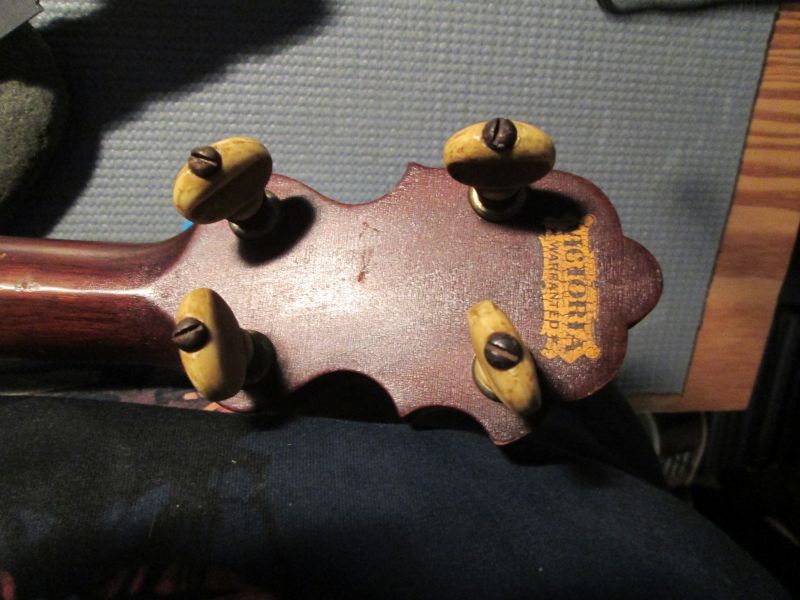
I recently obtained an old banjo with no labels (with the exception of "Victoria Warranted", anybody know what that means?) and am hoping to fix it up to at least playable condition. The head is skin of some sort and in decent condition. I intend this banjo to be played old style, claw hammer and such. My question is about strings: would steel strings be too much for this type of banjo? I'm thinking I might want steel as nylon might be too mellow.
At some point I'm going to post some pics, as maybe somebody has some insight as to the maker.
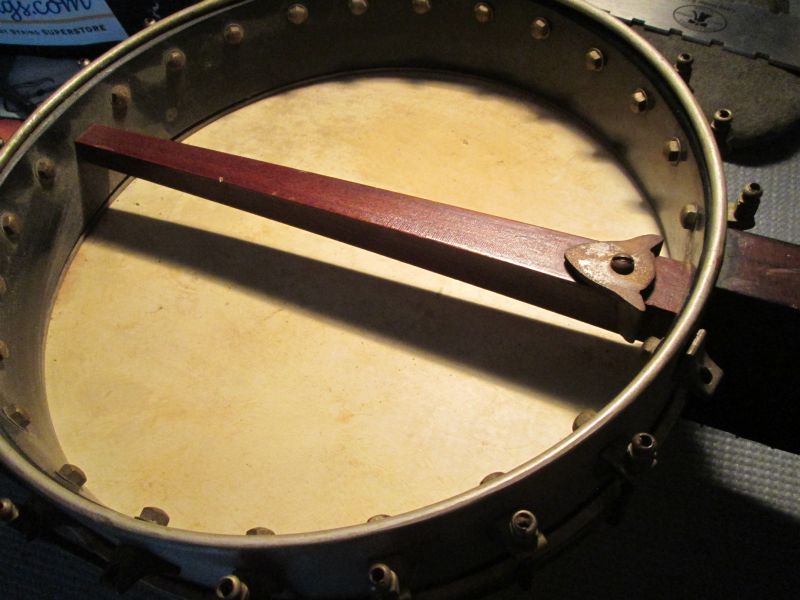
Also its missing some brackets; recommendations for (old) parts will be needed too.
Thanks; looking forward to further discussions
G Edward Porgie - Posted - 08/30/2019: 09:25:31
Welcome to the Hangout.
Most of the choice between string types (nylon or steel) depends on the construction of the entire banjo. Therefore it's very important that pictures be posted.
Also, nylon or other synthetic strings can be just as loud and ceisp as steel. It really depends upon how the banjo is set-up.
AndrewD - Posted - 08/30/2019: 19:04:15
All my banjos are skinheads. I prefer the tone (and the older ones mostly have the skin they were born with) . The newer ones have steel strings - the older have nylgut. The head material has absolutely no bearing on this. If the neck is strong enough for steel and the tailpiece was designed for steel you will be ok with steel. If the banjo was built after about 1930 it almost certainly came with steel strings. If before 1920 could have been either. But gut was preferred and steel was only used on cheaper banjos that probably were not expected to be around 100 years later.
Uncle Freddy - Posted - 09/01/2019: 16:31:54
Typically, the string tension on a banjo is fairly light, and only the most lightly built instruments would be negatively effected by use of steel strings of a reasonable gauge. The main area of concern would be the neck, and I don't think I've encountered a commercially built banjo built in the last 100 years that wouldn't be fine with light gauge steel strings. Of course, that doesn't mean that such things don't exist, or that age and use hasn't compromised the instrument in some way that gives it greater fragility. Having a professional look at the instrument might help ease your worries. Or, you can just go ahead and try it with a lower tension choice of string, of which there are quite a variety available. Real gut strings can sound wonderful (but can be temperamental), Aquila Nylgut strings are popular as a kind of gut-like sound in a nylon string, there are many types of classical guitar strings that can work nicely (I sometimes use the first 4 strings, E, B, G,and D) of a classical/nylon guitar set, with an extra nylon guitar E string as the banjo 5th. That works well, as the intended pitches are close to a standard banjo G tuning. My current favorite strings for most skin head, old-time banjos are Thomastik/Infeld Classic S Rope-Core guitar strings. These have an unusual construction and are in between steel and gut/nylon in sound, with a lower tension than comparable steel strings. When I use those, I use a steel .010" string for the 5th. As a guitar and banjo builder, over the years I've tried those Thomastiks on guitars and never liked them, but discovered that they sound great (to me) on just about every skin-head instrument I put them on. Yes, it does all depend on what sounds best to you, and what use you're putting the instrument to. I love the plunky sound of nylon and gut, but the clarity and ring of steel can be delightful as well. Have fun!
Half Barbaric Twanger - Posted - 09/04/2019: 12:08:16
Whether the head of the banjo is skin or mylar doesn't really affect the type of strings. The things that do affect it are the tailpiece, the tuners, the neck and the sort of tone you want.
1) Steel strings have a tendency to cut through softer material like ivory. If the tail piece is made of ivory, celluloid, wood, or anything else besides metal, steel strings will destroy it. That is the reason old ivory tailpieces are so rare (and cost so much). You can get a no-knot tailpiece for $10-$15, that will work fine and be a reasonable style for an older banjo.
2) Steel strings also have a tendency to cut through softer material like ivory or celluloid in the posts of a tuner. I have seen a number of old ivory/celluloid tuners with deep grooves (up to 1/4") in the posts due to steel strings. I am sure you will find recommendations and discussions of modern tuners with metal posts elsewhere on the forum.
3) Sometime between WWI and WWII, banjo makers started putting metal truss rods in the necks of their banjos. If your banjo has a truss rod (metal or the more recent graphite), it will certainly stand up to the additional tension of steel strings. If not, things are little more complicated. Deering makes their banjos without a truss rod, and I have never heard a complaint about bowing of their necks; good material, good design and good workmanship (made in America) still work. I have had two pre-WWI banjos (a Dobson and a Fairbanks Electric) that have had steel strings for over 50 years, and are still easy to play. Nowadays I put the lightest steel strings I can find on them (09 11 13 15 20 09), but before the internet occasionally my local music store would have no light strings and one dark day they only had heavy weight strings with a WOUND THIRD (wound with durel yet, that sounded dead right out of the package). S S Stewart was proud of the light weight of his "thoroughbred" banjos, and they have a reputation for not standing up to steel. If you don't know what you have, I would recommend keeping a sharp eye on the neck if you use steel. Periodically measuring the distance from the fourth string to the twelfth fret (or maybe the 17th), would be a good way to keep track of this. A little bow in the neck is actually necessary, but too much is not good.
4) Finally (maybe I should have put it first) is the kind of tone you want. Different strings have different sounds. Bluegrass seems to require steel, clawhammer and other old-time styles can accommodate either. Beyond that it's all a matter of your personal taste. As you might guess, my taste goes toward steel, but it's your banjo.
Happy picking,
Bill
2hittim - Posted - 09/12/2019: 11:49:57
Thanks for the info!
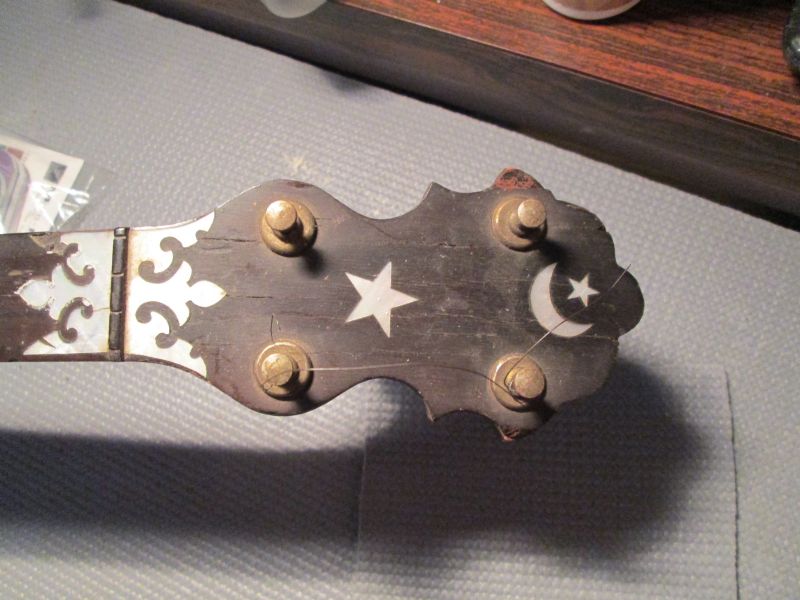
I uploaded some photos. Anyone have any idea on the make?
No truss rod, and it has a "No Knot" tail piece.
It may not be worth fixing up, but what the hell... I might learn something
Edited by - 2hittim on 09/12/2019 11:55:49
G Edward Porgie - Posted - 09/12/2019: 12:55:49
There should be two wooden wedges between the metal bracket that's screwed to the dowelstick, and the rim. Don't string this banjo with anything until that issue is resolved.
This banjo was quite obviously made for gut strings and I would not use steel on it.
I don't know what company made this, and I suspect that the "Victoria" label was a dealer's name, and not the actual maker's name.
Ken LeVan - Posted - 09/12/2019: 13:16:12
It's a beautiful instrument! It looks like an SS Stewart, or maybe the maker had seen a couple of SS Stewarts.
Anyway, in answer to your question, Steel strings would probably be too much for it, although you could try. The sound is very different. In terms of nylon strings, there are the heavy "Nylgut" kind and lighter rectified nylon strings as supplied by LaBella as "early instrument" strings. These are brighter and more aggressive, and are favored by classic banjo players. I prefer them to the Nylgut ones and would recommend a silver plated copper wound nylon string for the 4th string instead of the heavy nylon kind (just my personal preference).
As part of a project I did a while ago where I made a banjo where you could switch off between steel and nylon, I made comparative sound samples of the two.
For what it's worth, here's the same banjo with steel and nylon strings.
AND, a comparison of LaBella early instrument nylon vs Nylgut.
I also have a comparison between a 2-footed bridge and a 3-footed one, but that's for another day.
2hittim - Posted - 09/20/2019: 05:33:08
Thanks!
I did notice that; I'll have to make my own wedges. Does the material matter? I was going to use maple.
quote:
Originally posted by G Edward PorgieThere should be two wooden wedges between the metal bracket that's screwed to the dowelstick, and the rim. Don't string this banjo with anything until that issue is resolved.
This banjo was quite obviously made for gut strings and I would not use steel on it.
I don't know what company made this, and I suspect that the "Victoria" label was a dealer's name, and not the actual maker's name.
2hittim - Posted - 09/20/2019: 05:40:22
quote:Originally posted by Ken LeVanIt's a beautiful instrument! It looks like an SS Stewart, or maybe the maker had seen a couple of SS Stewarts.
Anyway, in answer to your question, Steel strings would probably be too much for it, although you could try. The sound is very different. In terms of nylon strings, there are the heavy "Nylgut" kind and lighter rectified nylon strings as supplied by LaBella as "early instrument" strings. These are brighter and more aggressive, and are favored by classic banjo players. I prefer them to the Nylgut ones and would recommend a silver plated copper wound nylon string for the 4th string instead of the heavy nylon kind (just my personal preference).
As part of a project I did a while ago where I made a banjo where you could switch off between steel and nylon, I made comparative sound samples of the two.
For what it's worth, here's the same banjo with steel and nylon strings.
AND, a comparison of LaBella early instrument nylon vs Nylgut.
I also have a comparison between a 2-footed bridge and a 3-footed one, but that's for another day.
Thanks Ken LeVan.
I thought it was someone project, but I didn't know. The sound clips of the string comparison is helpful! Thankquote:Originally posted by Ken LeVanIt's a beautiful instrument! It looks like an SS Stewart, or maybe the maker had seen a couple of SS Stewarts
2hittim - Posted - 09/20/2019: 05:42:16
Thanks Ken LeVan.
I thought it was someone project, but I didn't know. The sound clips of the string comparison is helpful!
Terms of Use | Privacy Policy | Privacy Consent (EU/GDPR Only)
Copyright 2026 Banjo Hangout. All Rights Reserved.