DVD-quality lessons (including tabs/sheet music) available for immediate viewing on any device.
Take your playing to the next level with the help of a local or online banjo teacher.
Weekly newsletter includes free lessons, favorite member content, banjo news and more.
Premier Sponsors


|
Please note this is an archived topic, so it is locked and unable to be replied to. You may, however, start a new topic and refer to this topic with a link: http://www.banjohangout.org/archive/336936
rudy - Posted - 11/23/2017: 09:42:42
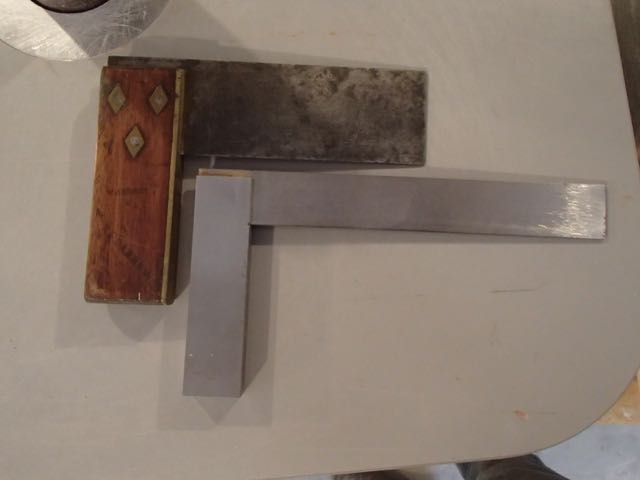
Seeing the "old" version of a square in Dan's recent "FLAT" topic made me reflect on some of the tools that I own, and indeed, on this day to be thankful for.
They don't do the job any differently than their new counterparts, but boy do they put a smile on your face when you think about the amount of pride that a craftsman took in developing, making, and using these products from a bygone era.
Hopefully a few of you will post a photo or two of tools that you own and appreciate for their usefulness as well as their style.
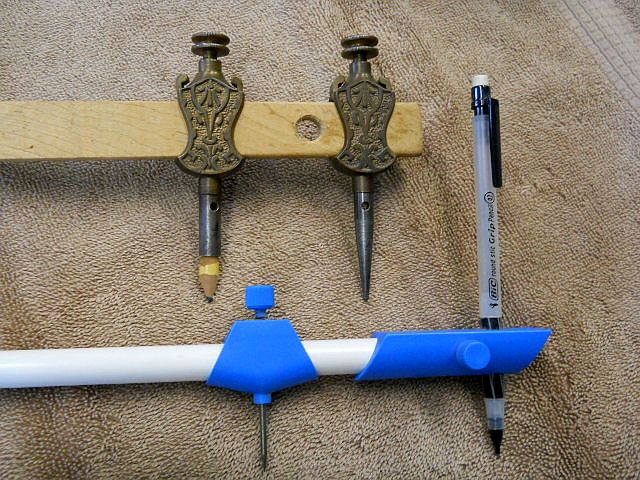
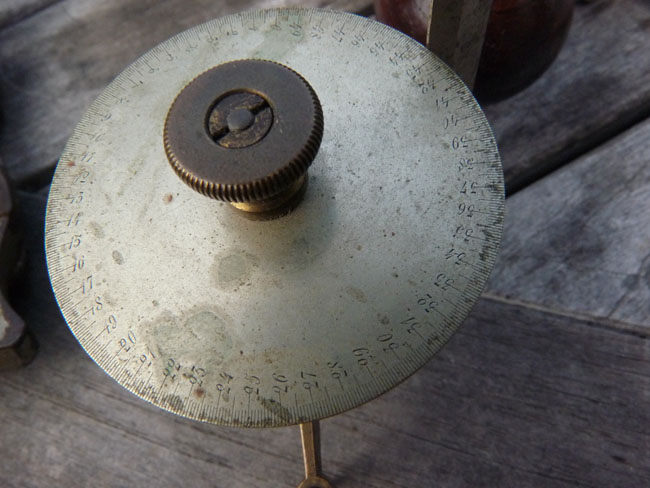
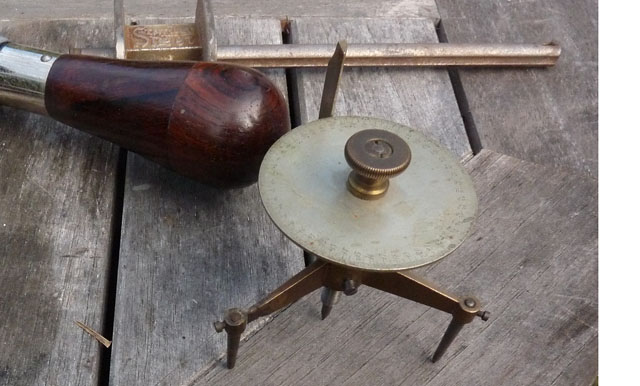
My version of "Tools to be thankful for" comes in the form of my two beam compasses, one old and one new. I don't think I'll have to point out which is which.
rickhayes - Posted - 11/23/2017: 10:11:12
I just bought one of those "new" ones to use in starting my first banjo (a mountain style). It worked great and I'm thankful for it. I didn't see any of the "old" ones in the big box home store. 
Zachary Hoyt - Posted - 11/23/2017: 10:25:42
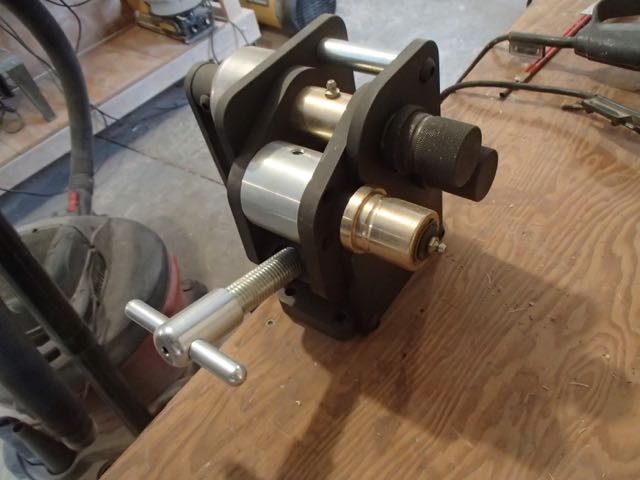
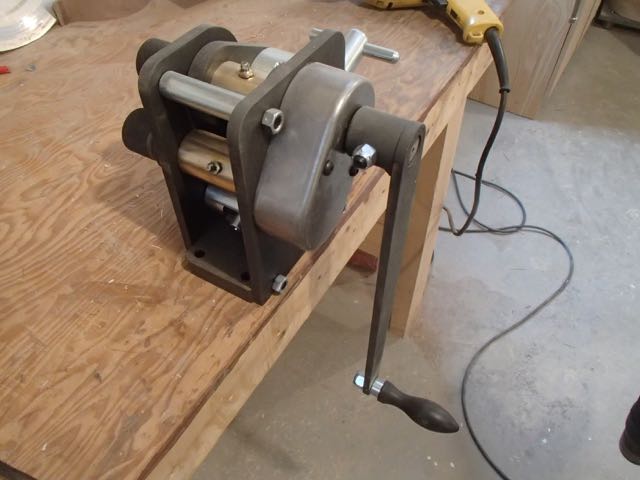
I am thankful to you for suggesting the Shop Outfitters #1415 ring roller. I like how easy it is to turn, even with 3/16" thick brass. It makes very nice circles, and they come out dead flat with no adjusting needed. It was more expensive than any tool I have ever bought, but it seems like it should last for the rest of my foreseeable life and save a lot of time and aggravation, as well as making it possible to experiment with tone rings and such. I haven't had time to set it up on a base yet, but once I get done with the current flurry of jobs I will bolt it to a piece of something so that I can clamp it to the workbench when wanted or put it away at other times.
I was also reflecting on old and new tools today, but in another way. The new square was given to me by a kind person in the spring, and I ended up with the old square in a box of odd hand tools at an auction. The old one is very pretty but it is not square, so unless I can find a job for which it's particular angle is suited I fear its usefulness will be very limited. The new one is very plain but works how it should, and that's what I like best.
Zach
pickin_fool - Posted - 11/23/2017: 11:22:01
rudy..I had a set of trammel points exactly like the brass ones you have in the top photo
Dan Drabek - Posted - 11/23/2017: 11:22:04
I'm not a tool collector, but a lot of them go through my hands. Here are a few of my "users". I found most of them at our local flea market over the years. I paid on average about 1/10th of the price I would pay for a modern high-quality tool. Note that most of the handles are made of Brazilian rosewood, so you wouldn't want to cross the border with them. The handles on the set of gouges are made of lignum vitae.

There are three more attached photos below.
The one on the right is an interesting tool. Hand made-mid 19th century. Let's see if anyone here can identify it. The photo next to it is a closeup of the same tool.
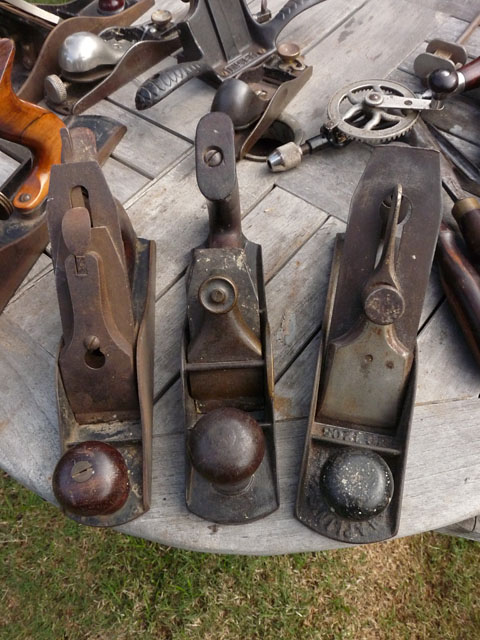
The photo on the bottom shows three smoothing planes, all are of late 19th century make. The first one is a Stanley. They all do the same job, but each is of a unique design.
DD
rmcdow - Posted - 11/23/2017: 12:01:33
Dan, I think that is a very well made round tuit. They come in pretty handy at the end of a project.
Ken LeVan - Posted - 11/23/2017: 13:23:21
For years, I restored historic buildings going back to the mid 1700s, and I have a bunch of old tools you need for that kind of work, including scrub planes, scrapers, molding cutters, a beautiful square with a rosewood handle, stone cutting hammers and chisels, etc. Unfortunately, none of them come in very handy for making banjos.
Based on my experience in design model-making and pattern-making, there are a "circle of tools" that are critical to my banjo making process.
Possibly, the most useful one is my old wood lathe. I got this from a used machinery dealer in Jersey City NJ 40 years ago, and it was already old at that time - I can't remember what I paid for it. I know it came from the Navy, possibly the Brooklyn Navy Yard, and was painted battleship gray when I got it.
It weighs upwards of 800 pounds and has an infinite variable speed control. The spindle is 1 1/8 - 8, which is tough to get faceplates for, but I have found a supplier.
I use it as a lathe to turn rims and dowel sticks, a buffing polishing device, a tool sharpening device, a tone ring and tension hoop truing device, a threader, a horizontal drill press, an indexing machine, and other things I can't even remember.

I could figure out ways to do things some other way, but I just love this old tool. I reminds me of the old Pennsylvania Railroad GG1 locomotive, and I have painted it in one of their color schemes.
Dan Drabek - Posted - 11/23/2017: 14:47:42
Those old lathes are easy to fall in love with. But I think it might weigh more than my entire shop. :->
Dave1climber - Posted - 11/23/2017: 20:48:45
I have a large number of old Stanley hand planes, none of which I have photos of, at one point of time someone asked me if I was a collector and I said no. When I got each one I could envision using it for a particular job. Every time I use one I think that there is no modern tool that can do the same job better.
At the same time I would admit that if you are making a large number of something, it could be worth the set up time to use a powered machine make your parts.
Having said that, there is a great deal of satisfaction in producing a hand made object.
Winged Words - Posted - 11/24/2017: 03:45:34
My grandfather and father (born 1923) were both skilled craftsmen. My grandfather was a cabinet maker and antiques restorer and in his latter years worked for what was then the Ministry of Works as part of a team who worked on furniture and fittings in Buckingham Palace and was responsible for the refitting of a Royal railway coach now in the National Railway Museum, York. So when he died in 1958 my father inherited a substantial collection of tools which I spent many childhood hours watching him use. And in a small way I've used them myself and I'll try to load some photos of a few long familiar favourites that I kept when I had to dispose of my dad's workshop a few years ago. First off is a hammer and a screwdriver that were my grandfather's, but which I've used and abused for nearly 60 years.
Winged Words - Posted - 11/24/2017: 04:03:19
I used to use the block plane as an 8 year old nearly 60 years ago. The Tyzack smoothing plane and the Norris shoulder plane I wasn't allowed anywhere near.
I was really happy that the bulk of my dad's/grandfather's woodworking tools including a work bench probably 100 years old went to my great-nephew who shows distinct signs of inheriting the craft skills that sadly passed me by. (I can just about use the hammer and screwdriver.) I was also very pleased to pass a set of wooden spokeshaves to a banjo builder in the USA.
J.Albert - Posted - 11/25/2017: 15:21:40
Ken wrote:
"it reminds me of the old Pennsylvania Railroad GG1 locomotive, and I have painted it in one of their color schemes."
I used to run those GG-1's, hostling them around the enginehouse at New Haven. Including the famous "4935", which Amtrak had painted up in the old colors and pinstripes.
They definitely qualified as "old tools"...
Terms of Use | Privacy Policy | Privacy Consent (EU/GDPR Only)
Copyright 2026 Banjo Hangout. All Rights Reserved.