DVD-quality lessons (including tabs/sheet music) available for immediate viewing on any device.
Take your playing to the next level with the help of a local or online banjo teacher.
Weekly newsletter includes free lessons, favorite member content, banjo news and more.
Premier Sponsors


|
Please note this is an archived topic, so it is locked and unable to be replied to. You may, however, start a new topic and refer to this topic with a link: http://www.banjohangout.org/archive/336879
mike gregory - Posted - 11/21/2017: 16:26:39
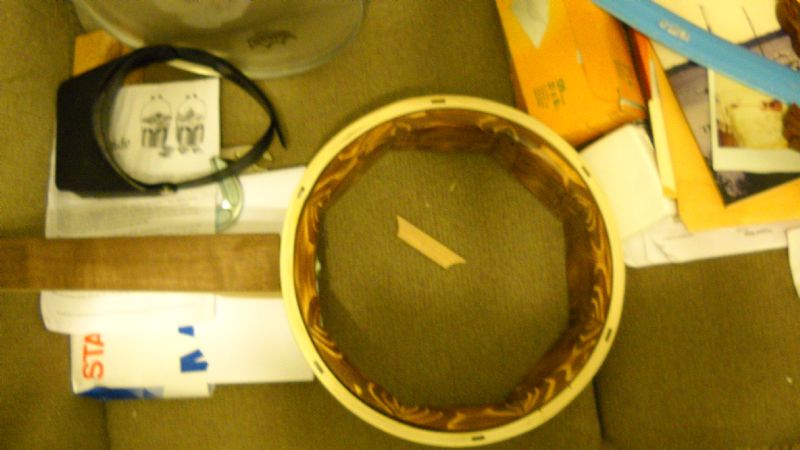
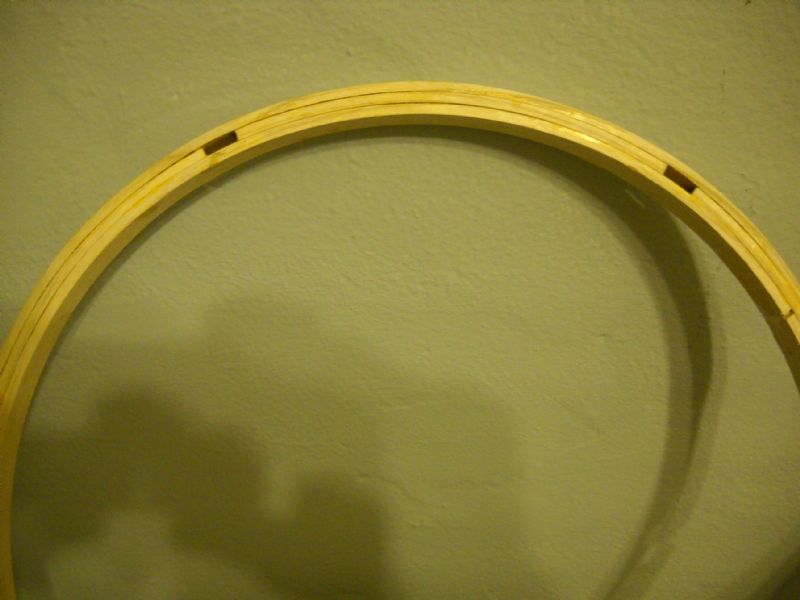
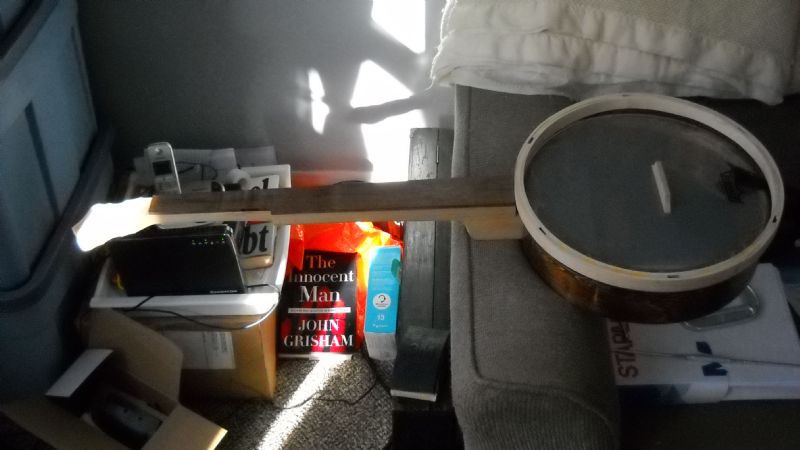
I'm attaching a factory-made tenor neck to a piece of 10 inch PVC pipe, using the two hangar bolts already in the neck.
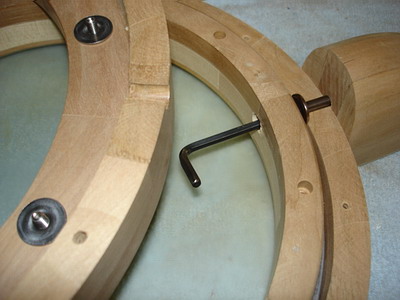
I'm just wondering what good it would do, to put a rod from the hanger bolt through the other side of the rim.
Might it help keep the rim from flexing, when the strings are under tension?
rudy - Posted - 11/21/2017: 16:33:51
It just depends on how rigid your rim is...
Schedule 40 or 80?
A single bolt or attaching to only one side of the rim can work if there's enough rigidity.
mike gregory - Posted - 11/21/2017: 17:08:15
Geez, now I'm sorry I removed most of the markings.
There is a bit that says PVC 1245
Might have been a longer number, but that's the edge of the slice.
roydsjr - Posted - 11/21/2017: 17:18:15
I've use what we call c-900 pipe which is water line and it's close to 1'' thick. It's a bit heavy though. You may be right about using a hanger bolt to the other side if your pipe is thin.
Helix - Posted - 11/21/2017: 17:47:18
I was going to ask how thick it is, Mike. If a rim is strong enough, I really like the
'nut only' neck mount, so a rod would stabilize even the best Gibsons, why not yours?
mike gregory - Posted - 11/21/2017: 18:36:34
OK, I'll run a rod.
It's only 1/4 inch thick.
Thanks all, for the replies.
Fathand - Posted - 11/22/2017: 12:48:28
I picked up some 10.5" and 6" pipe as scrap at a local road construction site for this purpose. It is much stronger than a gourd so I am believing a conventional dowel stick or a Rudy Rod should be adequate to keep the rim in shape.
mike gregory - Posted - 11/22/2017: 14:01:47
Will visit the RUDY page, brush up on the details of that rod.
sort of remember, first time I saw it, I was impressed that such a genius thing was being freely shared.
mike gregory - Posted - 11/22/2017: 16:02:46
Oh, [expletive deleted]!
Can't find any instructions on how to make a Rudy Rod.
So, I'm going to improvise.
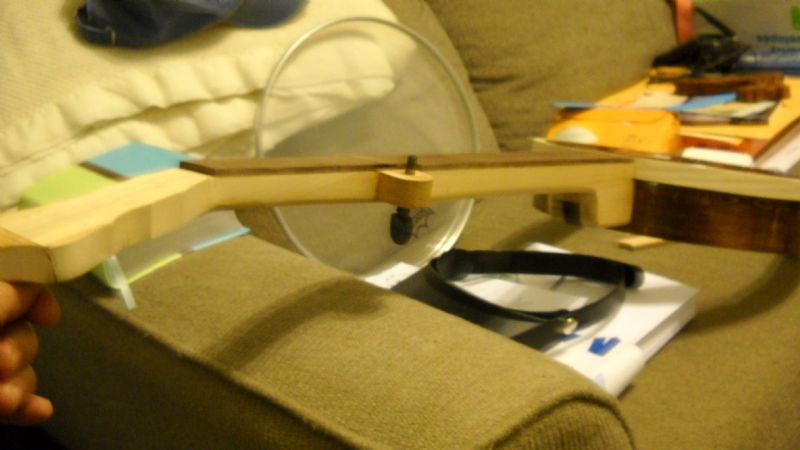
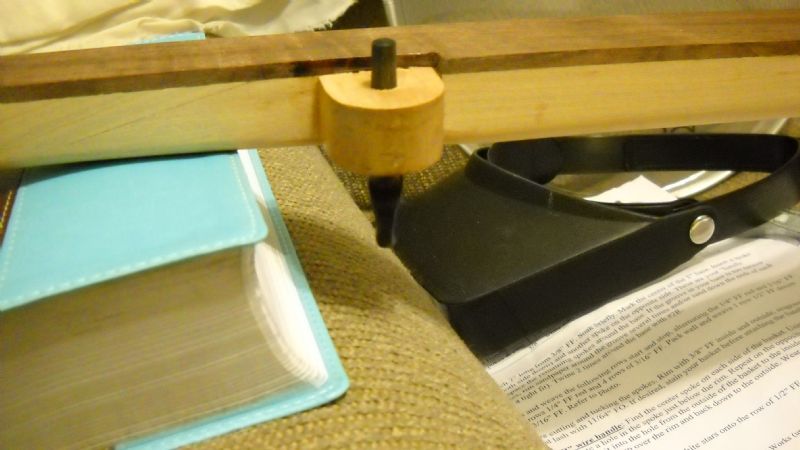
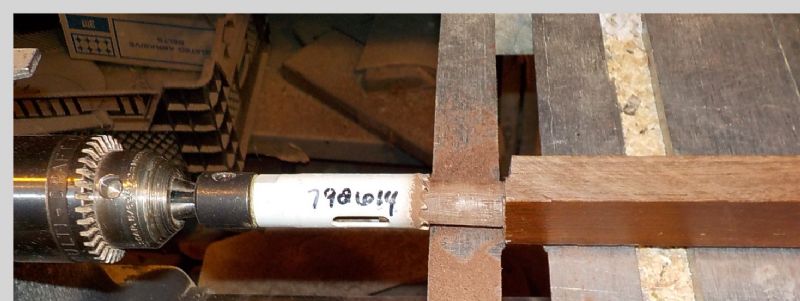
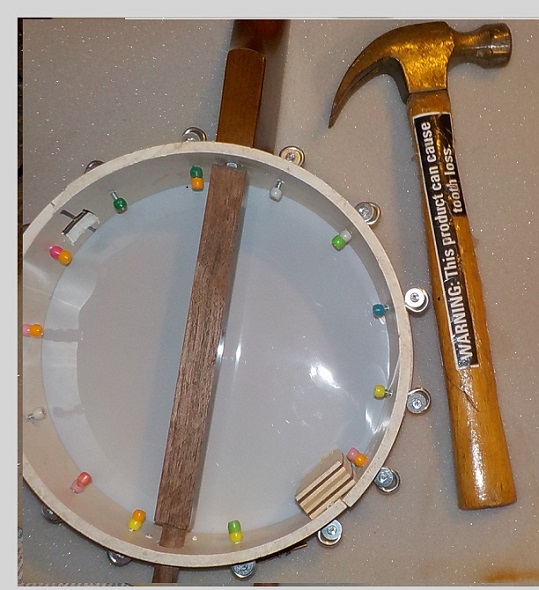
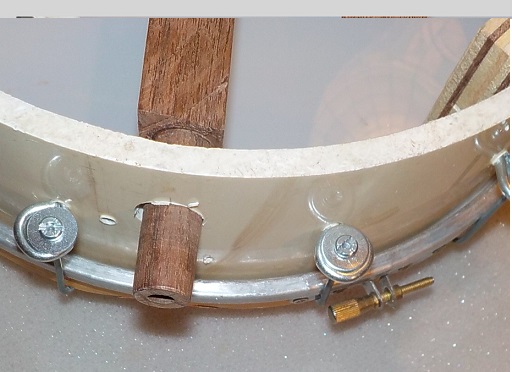
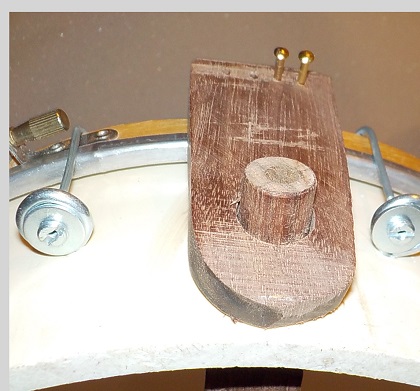
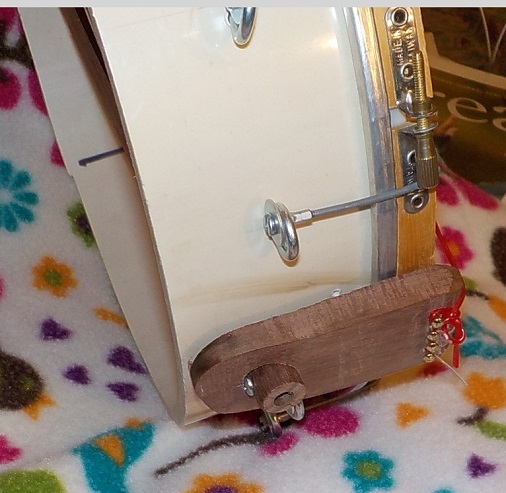
Got a long hunk of walnut, rounded one end so it can TURN in a hole near the tailpiece,
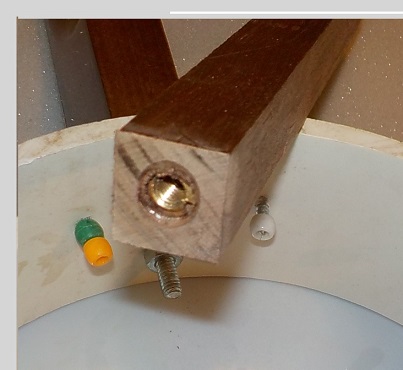
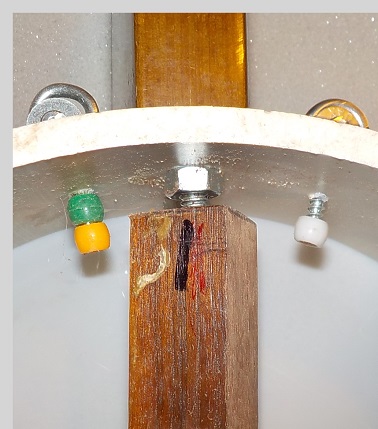
and a brass insert

(Much like this)
in the other end.
And THAT will screw onto the hanger bolt.
If it fails, I'll try something else.
Like my childhood hero, Red Schoendienst once said:

"If at first you don't succeed, play 2nd!"
mike gregory - Posted - 11/23/2017: 16:39:09
I do believe that's what they call 'em.
Rod pictures later.
Big lunch.
Nap time.
RIP, turkey!
Jonnycake White - Posted - 11/24/2017: 13:52:34
I'm currently making four banjo ukes out of 8" PVC drain/sewer pipe. It's about 1/4" thick (wall thickness). I'm using Rudy's "backstep" neck extension method rather than coord or dowel rods. In fact, I'm just about committed to that for all but my most traditional expensive serious banjos. I say why take a chance on your rim distorting. The first banjo I made was a wood head glued on a 3/4" thick block built pot. I figured the pot would be rigid enough to not distort under string pressure. I figured wrong. Within a few years the pot was distorted, the action up to about a half inch near the 12th fret, and I had to retrofit a coordinating rod made from threaded rod and steel tube. It pulled the action back down and taught me a lesson all at the same time.
I also scrounged a piece of 10" PVC sewer pipe (used - but for a storm sewer, not to worry). It has close to 3/4" wall thickness and 11 1/8" O.D. Do those approximate dimensions sound familiar?
Edited by - Jonnycake White on 11/24/2017 13:53:23
mike gregory - Posted - 11/24/2017: 15:45:36
Well, mine must be DRAIN pipe, not actual SEWER pipe, since it's a quarter inch thick.
If the factory built neck did not already HAVE two bolts, I would have done it MUCH differently, closer to Rudy's backstep.
And, since I enjoy cobbling crap together, if and WHEN it distorts, I'll build another, not using that neck, or modifying it vigorously so as to be highly similar to Rudy's.
wizofos - Posted - 11/24/2017: 17:41:40
Mike, I have used threaded inserts like this in the past and have found that screwing them into end grain can be iffy. I am assuming that the neck has end grain. I would drill a hole either from the fret board or from the bottom of the neck. Take a piece of square stock, drill holes the same distance apart as the bolt holes and tap them to the same thread as your rod, then you have a good strong base to screw into. Not sure is this makes sense but it is similar to what Rudy shows. If you drill from the fret board side it would be easy to fill the hole and finish off with some black or matching color filler. The biggest problem is aligning the holes screw in the rods.
mike gregory - Posted - 11/24/2017: 19:51:43
Appreciate the advice, but it's SORT OF confusing.
Considering the bolts are 1& 5/8 inches apart, allowing some wood beyond the edges of the holes APPEARS to mean the stock, if square ( not rectangular, but SQUARE), would need to be two and a quarter inches each way.
Sounds like a massive hunk of wood in there.
The entire depth of the body is only 3 inches.
Can you draw me a picture of what you mean?
Are you talking about square stock to which to connect this factory neck? Square stock across the inside of the pot, connecting to the existing neck?
Or are you talking about making a whole new neck?
For if and when I re-do the whole thing.
For now, I'm calling it "Done".
Jonnycake White - Posted - 11/24/2017: 22:59:32
A simple way of avoiding end grain pull out of lag screws, inserts, etc. is to put in a cross dowel so that the threads have something to bite into. If they are wood screw threads, a round wooden dowel works. If they are machine screw threads, you should use a metal cross dowel. I think this is what Glen (Wizofos) is saying. It can be round bar or square bar, long enough to get both screws in - you say they are 1 5/8" apart so you would need a dowel close to 2 inches long (at least 1 7/8). Square bar would probably be easier to drill and tap but round bar would be easier to insert as you would only have to drill a round hole, not a square one. So it's a trade-off and probably depends on your tools and skills. You can go up through the heel cap or down through the fret board, however you want, to put the hole for the cross dowel.
Jonnycake White - Posted - 11/24/2017: 23:06:54
Another thought - I did this recently with a canjo. I got a bunch of old necks where the previous luthier (a very well respected banjo restorer/builder) had cut the heel off the neck, presumably because he wanted to salvage just the dowel sticks for some reason or other. I took one and ran it through a thickness sander jig on an oscillating spindle sander to make the cut off heel area a parallel plane with the fret board. Then I attached a "backstep" style neck extension in the usual fashion.
mike gregory - Posted - 11/25/2017: 03:04:39
Oh!
VERTICAL!! in the HEEL.
I thunk he was talking about a square piece of lumber, running sort of like a huge wooden co-ordinator rod, across the inside of the body.
Makes more sense now.
Mental image adjusted.
Thank you both.
wizofos - Posted - 11/25/2017: 06:15:08
Sorry if I was confusing. I could not remember the name for the cross dowels. If you look at Rudy's Banjo Building 101 post you can see it, but I lost all my book marks to his stuff when he shut down his web site. I did find a picture. You can get these at Menard's for about fifty cents apiece in the area where they have all the odd ball fasteners in the little plastic drawers.
Lots of information at this site. woodpeck.com/crossdoweljig.html
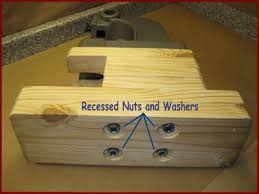
The only problem I see is that if you need 2 bolts close together it might be easier to make a cross dowel out of a piece of square stock and tap them. If the bolts are far enough apart then use 2 of the short cross dowels.
That cross dowel drilling jig at Woodpecker is cool but you could make one out of a block of wood.

Edited by - wizofos on 11/25/2017 06:19:22
Jonnycake White - Posted - 11/25/2017: 07:55:53
A somewhat easy way to do a double hole cross dowel out of round stock is to bore the heel for the dowel, insert it, and then use the bolt holes as guides to drill the two cross holes. Leave the dowel long enough you can grab it and pull it out to tap the threads.
wizofos - Posted - 11/26/2017: 05:58:27
Mike, Just thought about this, should have mentioned it earlier in the thread but turkey has this affect on me. I use the threaded inserts into end grain when I make walking sticks, but I glue them in with 2 part epoxy which helps keep them from pulling out. JB Weld, Devcon, etc......
mike gregory - Posted - 11/26/2017: 06:25:27
No majo problem, Mr. Wiz.
It's all experimental, and I dang well know I can remember not to make any mistakes if I have to rebuild it.
Come to stink of it, since it's NOT fully assembled, I may as well remove the insert, dab on some epoxy, and do it your way the FIRST time.
Like the punch line from a VERY old joke:
"It couldn't hurt!"
wizofos - Posted - 11/26/2017: 06:29:10
Mike, I found the link I was looking for and book marked it. If you scroll down to the topic index and click on the 'neck to pot mounting' you will see how Rudy does the cross dowels and then a few pages farther there is detail about how to build Rudy Rods.
mike gregory - Posted - 11/26/2017: 14:53:51
So, how do I look for something YOU bookmarked?
Just because I'm so goshdarned GOOD LOOKING, doesn't mean I know all about computer stuff.
wizofos - Posted - 11/26/2017: 15:12:04
Ok ya caught me, and here I thought you could read my mind. Can I blame it on all the turkey I ate? or the wine that was with it?
bluestemstrings.com/pageBanjoD...n.html#25">web.archive.org/web/20160328213135/bluestemstrings.com/pageBanjoD...n.html#25
mike gregory - Posted - 11/27/2017: 18:18:40
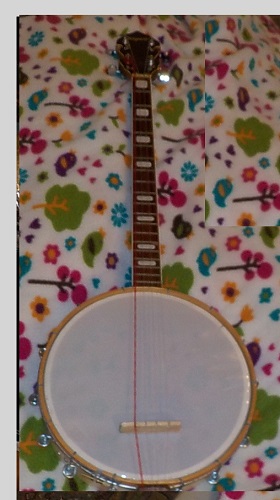
And here it is, al done.
EXCEPT for the strings.
No steel available in this small town, so, nylon fishing line for the first 3, and weed trimer line (0.065) for the 4th
mike gregory - Posted - 11/27/2017: 21:04:37
Turns out that her name, in Irish, is "Maire", not Marie, so I had to do a few edits hither and thither.
mike gregory - Posted - 11/28/2017: 21:04:32
Since adding J-hooks is a fairly simple process, I've doubled them up.
Ran out of spokes, so need 5 more, but the few I put on DID take a lot of wrinkles out of the head.
MUCH more "punch" to it.
Going to do the rest, tomorrow.
Can hardly wait to get it strung properly.
mike gregory - Posted - 11/29/2017: 07:46:35
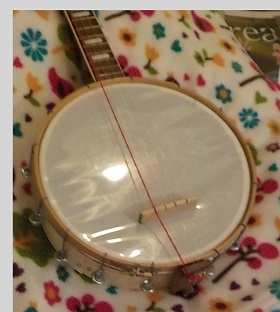
And here she is, with twice as many bicycle spoke J hooks, and a MUCH tighter head:
mike gregory - Posted - 11/29/2017: 07:52:07
And a HUGE note of thanks to Lorna (Vintagewells on the HangOut), for being the person who first posted the idea of using bicycle spokes for J hooks.
mike gregory - Posted - 11/29/2017: 20:55:37
Client played it, with steel strings.
Loves it.
So, we're both happy.
Terms of Use | Privacy Policy | Privacy Consent (EU/GDPR Only)
Copyright 2026 Banjo Hangout. All Rights Reserved.