
DVD-quality lessons (including tabs/sheet music) available for immediate viewing on any device.
Take your playing to the next level with the help of a local or online banjo teacher.
Weekly newsletter includes free lessons, favorite member content, banjo news and more.
Premier Sponsors


|
Please note this is an archived topic, so it is locked and unable to be replied to. You may, however, start a new topic and refer to this topic with a link: http://www.banjohangout.org/archive/335703
Zachary Hoyt - Posted - 10/15/2017: 14:22:05
I have been using an old blade that is too dull for wood to cut aluminum and brass on my bandsaw. It's an 18" Jet woodworking bandsaw with a 1.5 hp motor. It does pretty well, but the cut is rather rough since I'm using a 3 TPI 1/2" blade. Also the aluminum gets pretty hot sometimes, and the brass to some extent. Thicknesses I'm cutting are between 1/8" and 3/4" so far. I'm thinking of getting a ring roller this fall which would enable me to experiment more with tone rings and such, and I'm already making tension hoops and dowel stick yokes. I'm wondering if anyone has a recommendation for what sort of bandsaw blade would be most suitable for what I'm doing. I don't have to make long cuts now, but I'm thinking about scalloping a Whyte Laydie style ring, for instance, and how I would best go about that with the saw I have. Thank you very much for reading this and for any advice you may have.
Zach
Dan Drabek - Posted - 10/15/2017: 15:18:42
IMO 3 TPI is way too coarse for cutting 1/8" stock. Even with 3/4" stock, it's probably not going to give you the cleanest cut. The 1/2" blade should be fine if you're making mostly straight cuts. But I would go more like 10 TPI. A bi-metal blade would probably hold up better in the long run, but they are pretty spendy. I've had good luck with the flex-back carbon steel blades from Sawblade.com. And their prices are fair.
sawblade.com/bandsaw-blades-fo...tting.cfm
I also bought a pulley set from Jet that reduces the speed of my saw. It helps keep the blade cooler and it seems to cut better on non-ferrous metals. But I still can't bring it down slow enough to cut steel.
DD
pickin_fool - Posted - 10/15/2017: 15:53:46
the rule of thumb for cutting aluminum is to have 3 teeth in contact with the work piece...so 24 tpi is about right..brass is a "sticky" metal and most cutting operations require what is called a negative rake on the cutting edge...in any event you will need two blades..one for brassm one for aluminum...unless you are cutting trees..take the 3 tpi blade off and trash it..
go to a machine shop supply place and tell them your needs
rudy - Posted - 10/15/2017: 16:25:27
quote:
Originally posted by Zachary HoytI have been using an old blade that is too dull for wood to cut aluminum and brass on my bandsaw. It's an 18" Jet woodworking bandsaw with a 1.5 hp motor. It does pretty well, but the cut is rather rough since I'm using a 3 TPI 1/2" blade. Also the aluminum gets pretty hot sometimes, and the brass to some extent. Thicknesses I'm cutting are between 1/8" and 3/4" so far. I'm thinking of getting a ring roller this fall which would enable me to experiment more with tone rings and such, and I'm already making tension hoops and dowel stick yokes. I'm wondering if anyone has a recommendation for what sort of bandsaw blade would be most suitable for what I'm doing. I don't have to make long cuts now, but I'm thinking about scalloping a Whyte Laydie style ring, for instance, and how I would best go about that with the saw I have. Thank you very much for reading this and for any advice you may have.
Zach
You need to re-think your use of a dull blade to cut metal. If it's too dull to use on wood then it's going to be REALLY ineffective for metal. The single piece of advice I can give you for band saw use is to keep a sharp and good quality blade on it and discard a blade that starts falling off in performance; it just isn't worth it to use a worn blade.
I have a blade welder and purchase stock in bulk rolls, so it ends up being about 5 bucks to put a new blade on. I usually buy Starrett or Morse blade stock and they both work well for me.
I keep a reasonably sharp 3 tpi 1/2" skip tooth hard back blade on my band saw and it does all my wood tasks and also metal cutting without the need to change anything. I cut 3/8" 2024-T4 aluminum bar and 3/8" brass stock with no problem. It ain't happening with a dull blade, though.
If the blades is SHARP it will cut 1/4" and 3/8" aluminum and brass without much heat being generated. If the blade is not sharp then it's going to generate heat and not cut very well.
I'm going against the grain of conventional wisdom, but I can say I've been doing this for 30 years with no problem. The standard rules are to reduce blade speed and to use a blade that is sized to have 3 teeth bearing against the stock at all times. I'm not following those guidelines and have no problem with switching between metal and wood using the same setup. As long as my results are good I have no desire to switch blades and/or speeds when switching materials.
Do check your blade speed, as some smaller saws are WAY too fast.
Edited by - rudy on 10/15/2017 16:26:50
banjobart - Posted - 10/15/2017: 16:48:56
I once cut a lot of 3/8" thick brass with no trouble. I used the same blade as I use for banjo wood, the 6 TPI 1/4" width Timber Wolf from SuffolfkMachinery.com
Dan Drabek - Posted - 10/15/2017: 19:11:06
The big boys use friction cut blades for metal--including steel. The teeth on a friction blade are rounded, and the blade actually melts its way through the metal--which it cuts like butter. Interestingly, while a friction blade can slice through steel beams, it can't cut through a wood 2x4. I've heard of people who have converted their wood cutting saws to friction cut, but I don't know the details. I think it would be easy to end up owning a half dozen bandsaws, each for a special task. I hate changing blades, and will occasionally pull out a hacksaw, rather than change one.
DD
jhko - Posted - 10/15/2017: 20:43:32
Go to msc or mcmaster-carr (mscdirect.com, or mcmaster.com) and get yourself a real metal cutting bandsaw blade of the right length and thickness for your saw. Those companies are real metalworking companies. Something like 10-14 TPI. Bi-metal if you can afford it. A good, sharp, real metal cutting blade will allow you to cut brass or aluminum like butter in a decent wood band saw. Don't use a wood blade or a friction cut in a wood bandsaw. And whatever you do, DON'T try to cut steel. The blade speed is too fast on a wood band saw and it is really not rigid enough for steel. And, as other's have mentioned, DON'T use a dull blade. It will give you problems and is dangerous.
pickin_fool - Posted - 10/15/2017: 20:46:20
off topic a bit..
I used to work in a sign shop..lots of plexiglass and lexan to cut..i saw one of the other guys about to use the band saw..i had noticed the blade getting dull so I called out to him to change the blade first..which he did..i continued with what I was doing..a few minutes later I detected smoke pouring off the band saw..went over to see what the problem was...the freakin teeth were pointing up!!..shook my head..told him to throw that blade out and install a new one but this time make the teeth point down..
back to what I was doing..a minute later he calls me over and says..."the teeth on this one are pointing up too..i think the blade store made a booboo"...I grab the blade from him..gave it a quick flip and said try it now..he seemed mystified that I was able to change the way the teeth were pointing..i never did tell him how I did it nor did I mention it to the shop owner
Zachary Hoyt - Posted - 10/16/2017: 03:39:31
Thank you all very much, you've given me lots to think about. My experience has been that after I have used a blade for cutting brass and aluminum it doesn't cut as well in wood anymore, which is why I have been using an older duller blade. I will try a purpose-made metal cutting blade and see what happens, and if I don't find that it works well I can always fall back on using a regular wood cutting blade.
Zach
rmcdow - Posted - 10/16/2017: 04:21:51
I just bought a Rikon 10" band saw to replace my desktop bandsaw, and am pretty happy with it so far. The price was right. I was looking at other blades for it, and see the variable set teeth blades on McMaster that look interesting for cutting metal. The saw is a direct drive, 1720 rpm, and I've used metal cutting bandsaws before that operated at a much, much slower speed than that. I've installed shunt wound motors on my lathes, which give full power at any speed, and have one, a 1/4 horse rather than the 1/3 horse that is on the Rikon now, which I was considering installing on the Rikon to be able to slow down the speed when cutting brass, aluminum, or cupronickel. Is this necessary to do? From what I read here people are using wood cutting bandsaws at full speed, which is likely around 3000 to 4000 feet per minute. That seems a bit high to me for metal, but I'd like to hear if this is working fine for people here, and if so, I'll try that first. I guess the worst that can happen, hopefully, is that I burn a blade.
banjobart - Posted - 10/16/2017: 05:23:08
It is interesting to note that Stew-Mac used a router in a fixture to cut the scallops in their #0815 Whyte Laydie tone ring rings. I made several WL rings in various diameters and just used the end roller of the belt sander to grind the scallops.
Stew-Mac cut the scallops when the brass stock was still straight, then rolled the ring. If using the belt sander the scallops can be ground after the ring is rolled and soldered.
Edited by - banjobart on 10/16/2017 05:25:19
Zachary Hoyt - Posted - 10/16/2017: 10:15:02
That's very interesting about Stew-Mac using a router. I have never tried to rout metal, I am not sure if I would be brave enough to attempt it. Using the end of the belt sander makes a lot of sense. I am thinking of cutting close to shape on the bandsaw and then cleaning up the cuts using the 3" drum on the spindle sander. It will be slow but at least I'll have all of those nice curved bits of brass to sell at the scrap yard, which may eventually pay back enough for another bandsaw blade, possibly.
Zach
rudy - Posted - 10/16/2017: 11:24:40
quote:
Originally posted by Zachary HoytThat's very interesting about Stew-Mac using a router. I have never tried to rout metal, I am not sure if I would be brave enough to attempt it. Using the end of the belt sander makes a lot of sense. I am thinking of cutting close to shape on the bandsaw and then cleaning up the cuts using the 3" drum on the spindle sander. It will be slow but at least I'll have all of those nice curved bits of brass to sell at the scrap yard, which may eventually pay back enough for another bandsaw blade, possibly.
Zach
Brass routes easily with carbide tooling provided you slow the speed down considerably. As long as you are using PPE and staying out of the path of a broken tool in the event of failure. I've done it a few times with no problem using both aluminum and brass, but it's nothing I really have a need to do.
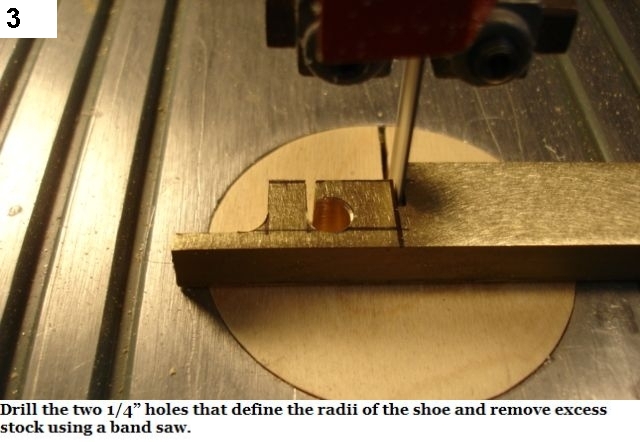
Here's a shot of 3 tpi 1/2" skip tooth blade cutting 3/8" brass bar stock. It also cuts curves easily, but you have to do relief cuts if the radius is greater than what the blade will define as an arc. It cuts like butter with no problem, but it will dull the blade faster than wood, obviously.
Edited by - rudy on 10/16/2017 11:27:03
rmcdow - Posted - 10/17/2017: 11:15:34
I have routed metal before also, and I slowed down the speed as Rudy mentioned. In the Machinist handbook there are cutting speeds (surface speeds at feet per minute) listed for pretty much every metal, and I have used this as a reference for cutting metals for years. It has saved me many times from having difficulty, as the surface speed varies with the tool radius (or work radius on a lathe), and every metal has a different speed that works best for it. I first learned about this in the 80's, when learning to machine titanium. I found that that metal has a very narrow range of surface speeds that work, but when you are in that range, titanium is a great metal to machine. When I was outside of the range, or let the tool ride on the surface without cutting, I pretty much had to throw that piece of titanium away due to the work hardening.
Rudy, I saw you cutting brass before like this in your building instructions, but was not so keen to try this on someone else's bandsaw. Is this cutting with your bandsaw running full speed, my guess is about 3000 fpm blade speed? HSS tools on brass are recommended to be used at between 300 and 350 fpm, carbide at around 800 - 1500. This is what always put me off about cutting brass or aluminum on a wood cutting bandsaw. I know what happens on my lathe and milling machine when I try to cut metal at too high a surface speed, and this is with small tools or work. The bandsaw blade is a different animal. Do you ever have issues, or do I have the speed of your bandsaw wrong?
rudy - Posted - 10/17/2017: 12:54:14
quote:
Originally posted by rmcdowI have routed metal before also, and I slowed down the speed as Rudy mentioned. In the Machinist handbook there are cutting speeds (surface speeds at feet per minute) listed for pretty much every metal, and I have used this as a reference for cutting metals for years. It has saved me many times from having difficulty, as the surface speed varies with the tool radius (or work radius on a lathe), and every metal has a different speed that works best for it. I first learned about this in the 80's, when learning to machine titanium. I found that that metal has a very narrow range of surface speeds that work, but when you are in that range, titanium is a great metal to machine. When I was outside of the range, or let the tool ride on the surface without cutting, I pretty much had to throw that piece of titanium away due to the work hardening.
Rudy, I saw you cutting brass before like this in your building instructions, but was not so keen to try this on someone else's bandsaw. Is this cutting with your bandsaw running full speed, my guess is about 3000 fpm blade speed? HSS tools on brass are recommended to be used at between 300 and 350 fpm, carbide at around 800 - 1500. This is what always put me off about cutting brass or aluminum on a wood cutting bandsaw. I know what happens on my lathe and milling machine when I try to cut metal at too high a surface speed, and this is with small tools or work. The bandsaw blade is a different animal. Do you ever have issues, or do I have the speed of your bandsaw wrong?
Hi Rives,
Your question piqued my interest so I looked at the motor nameplate synchronous speed, checked the reduction ratio for the drive pulleys, and did a quick calculation in my head and arrived at 2700 fpm or thereabouts.
I thought I'd double-check the owner's manual and the listed specification was indeed 2700 fpm so my ciphering was right on.
Interestingly enough, there's a blade selection chart on the inner face for the wheel cover and it says "Use 1/2" 3 TPI premium hard tooth flex back blade for cutting all kinds of wood and aluminum, magnesium, and other non-ferrous metals up to 1/4" thickness".
I've always used the 1/2" 3 TPI skip tooth blade and I don't ever remember checking that label for Delta's recommendations. It's a matter of coincidence that what was recommended to me years ago matched the label. Delta states 1/4" thickness, but I think that has more to do with the motor's horsepower than what it will cut. The 3/8" thickness certainly doesn't seem to bother it any.
I also put a 3" riser block on this saw so I could re-saw 9" thick for the occasional guitar top or back, and it handles that just fine as long as I don't push the cut time.
Ideally the 2700 fpm is a bit too high for metal and slowing it down 25 to 50% would be more in line with accepted standards, but since it cuts as well as it does I didn't bother doing any further reduction in speed. Not having that ability to lower the speed hasn't effected my work methods in any way and not swapping speeds and/or blades makes it all that much easier for me. (I'm ALL about being lazy...) 
No issues with doing this on my 12" saw other than dulling the blade more rapidly than if it's only cutting wood, but since blade changes end up being about $5 it's no big deal.
I accidentally got 6 tpi blade stock once and found that I dulled the teeth much more rapidly when using the higher tooth count. It logically didn't make any sense, as it seemed that twice as many teeth sould last twice as long. Not so...
I sold that roll stock off with a couple of other rolls on eBay and was glad to not see it again.
Edited by - rudy on 10/17/2017 13:04:38
rmcdow - Posted - 10/17/2017: 18:15:35
Thanks for that overview Rudy. It gives me confidence to try this out on my bandsaw, as you don't report any issues.
rudy - Posted - 10/17/2017: 19:25:12
quote:
Originally posted by rmcdowThanks for that overview Rudy. It gives me confidence to try this out on my bandsaw, as you don't report any issues.
Hi Rives,
If your Rikon is 1750 rpm and direct drive doesn't that put you way higher for fpm?
rmcdow - Posted - 10/17/2017: 19:31:45
The Rikon manual lists the speed at 2780 fpm. I don't see a lot of harm in trying it out based on what you have experienced. If I have a problem, I'll mount a shunt wound motor on it and could then adjust the speed to what works best.
Terms of Use | Privacy Policy | Privacy Consent (EU/GDPR Only)
Copyright 2026 Banjo Hangout. All Rights Reserved.


