DVD-quality lessons (including tabs/sheet music) available for immediate viewing on any device.
Take your playing to the next level with the help of a local or online banjo teacher.
Weekly newsletter includes free lessons, favorite member content, banjo news and more.
Premier Sponsors


|
Please note this is an archived topic, so it is locked and unable to be replied to. You may, however, start a new topic and refer to this topic with a link: http://www.banjohangout.org/archive/327661
timacn - Posted - 02/12/2017: 15:40:30
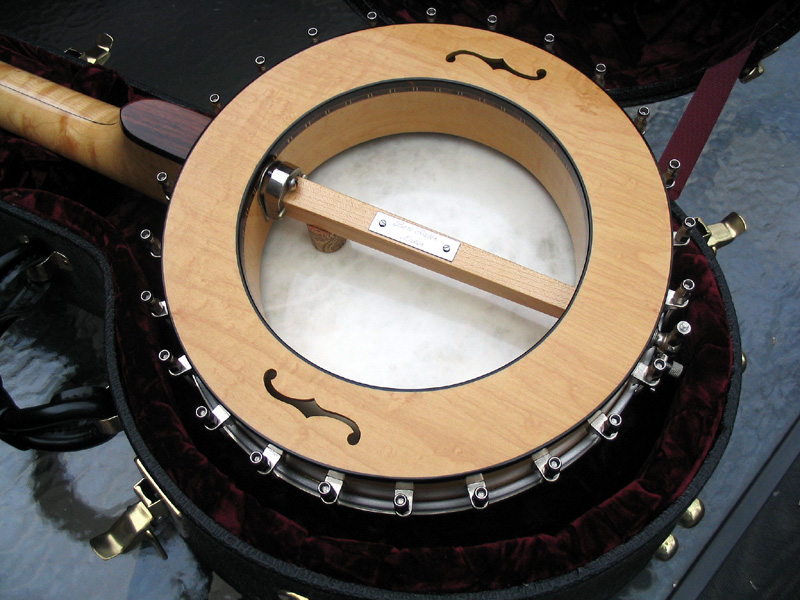
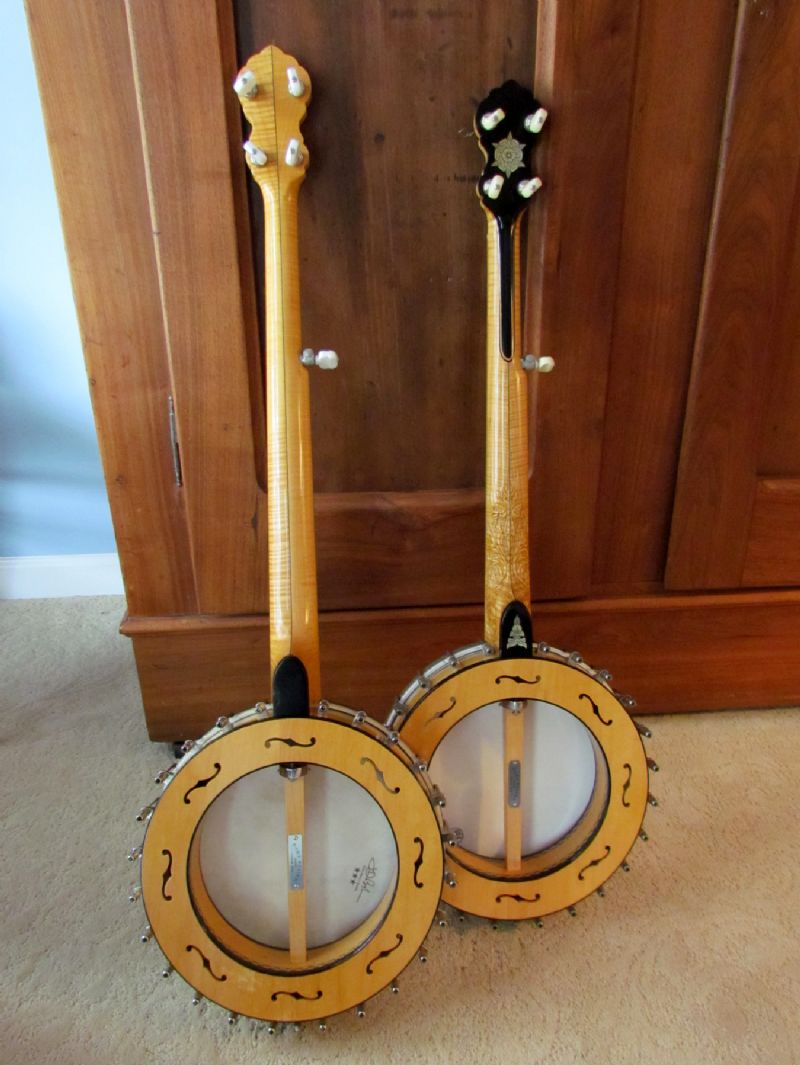
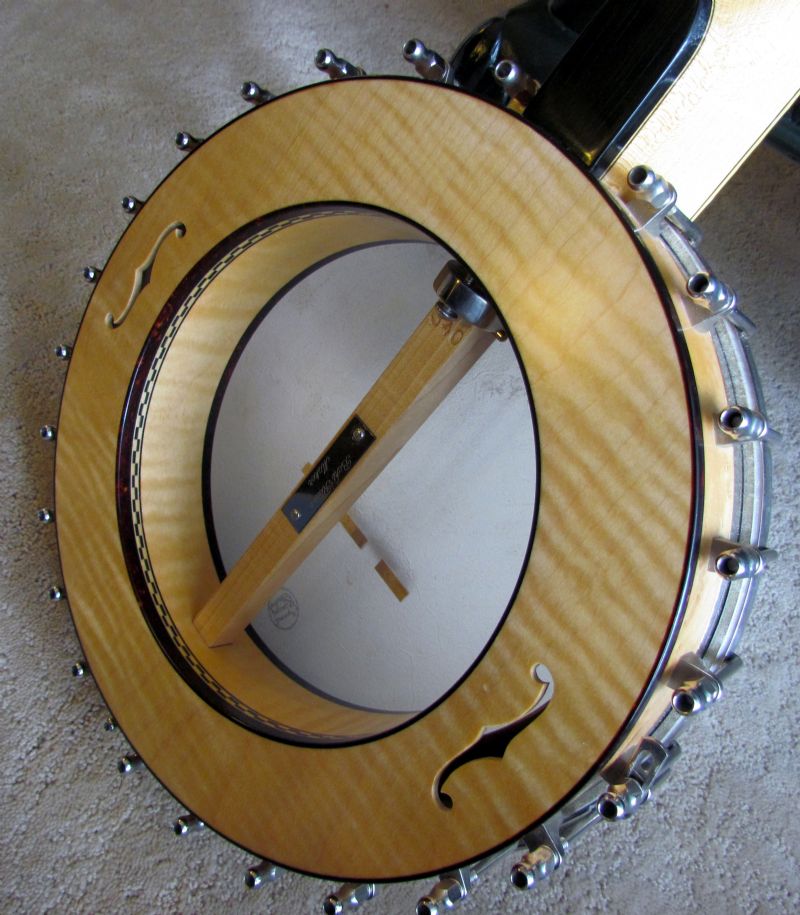
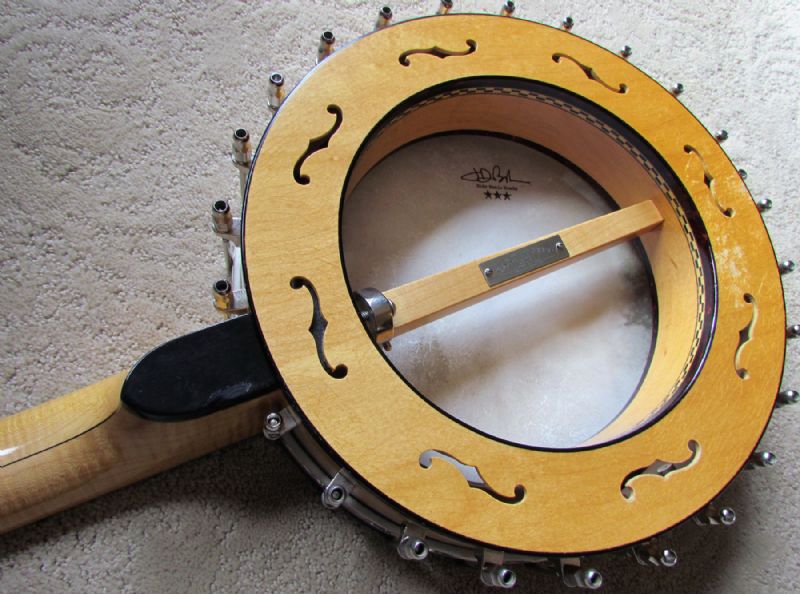
Hello. I'm wondering what effect, if any, the number of F holes on internal resonator banjos has on the sound.
Is one design considered "better" sonically than the other?
Thanks for your help.
Bill Rogers - Posted - 02/12/2017: 22:51:28
Well, if you hold the banjo against your body, I can't see it makes any difference. That's opinion based on nothing but visual observation.
desert rose - Posted - 02/13/2017: 01:42:33
In string instrument design theory, the number of holes are far less important than the total square inches of the combined openings. In other words if the total square inches of four holes equals the same as an instrument with eight holes, you would be in the ball park so to speak, of course the " color " of tone might not be exact...
Scott
flailing - Posted - 02/13/2017: 04:04:33
I remembered reading an article here about IR banjos and Dave Ball commenting that he thought 2-holed IRs echoed slightly more than multi-holed ones. Here is the link to that archived topic.
banjohangout.org/archive/142382
jbalch - Posted - 02/13/2017: 04:46:55
Over the years, I have had more than a dozen various Bart Reiter Internal Resonator banjos. Some have had two holes, most have had eight.
I have not noticed a predictable difference that I could attribute specifically to the number of f-holes. I've heard great sounding examples of both.
I am not an acoustic engineer (or an expert on such things). But I think the Bacon-style Internal Resonator serves to create an air chamber behind the spun donut tone ring. I think the function is to "resonate" and maybe amplify or strengthen certain characteristics of the tone. The best sounding examples have enhanced bass tones and project sound in a way that is big & wide. I have said that they: "fill the room without being too much in-your-face." I like IR banjos for solo playing & accompanying another instrument in a duet (or maybe trio). But ... I prefer a more focused sound for playing in a full string band and/or some recording applications.
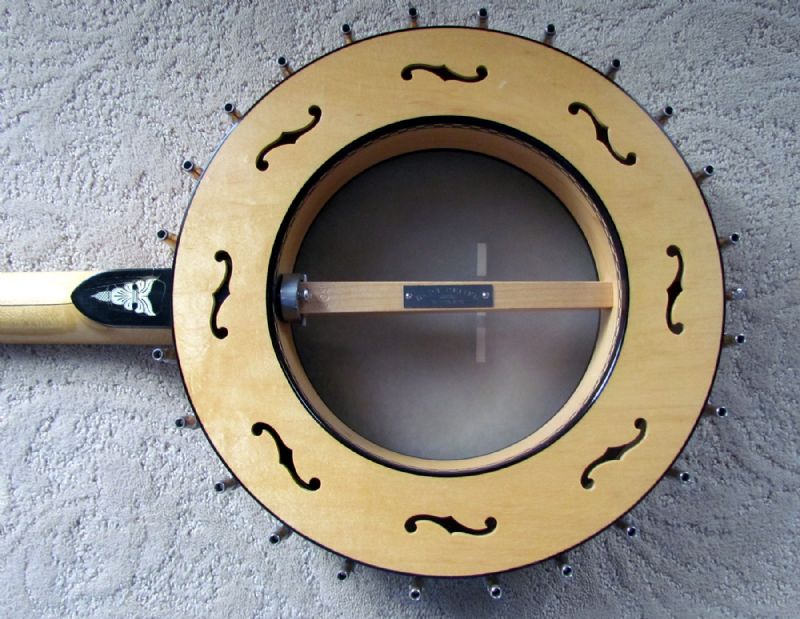
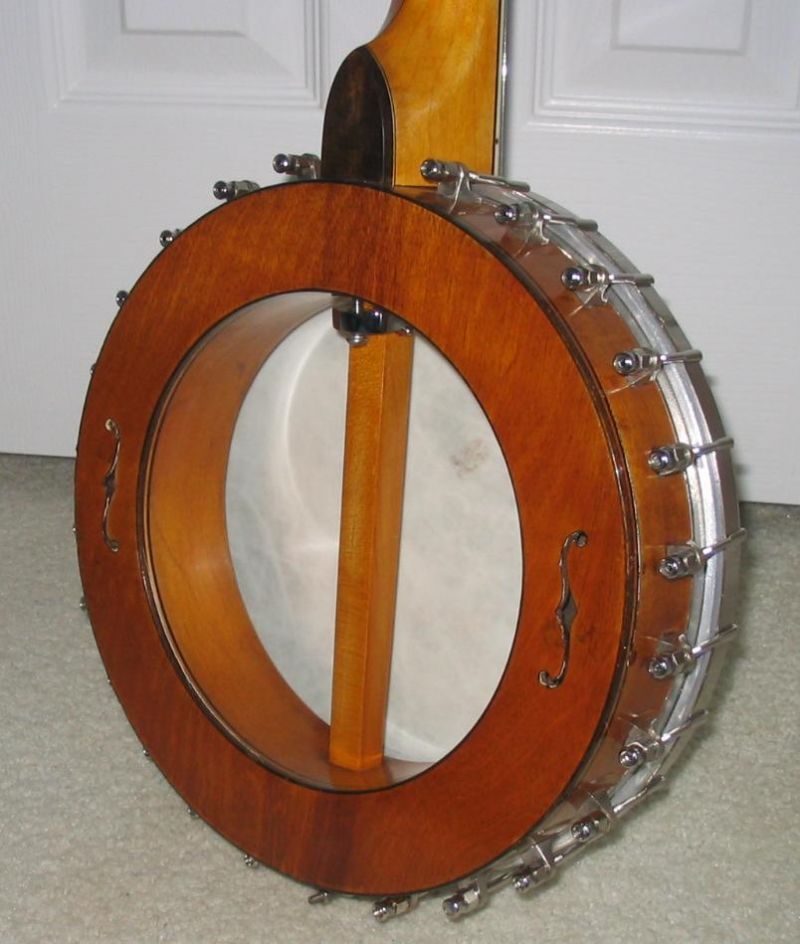
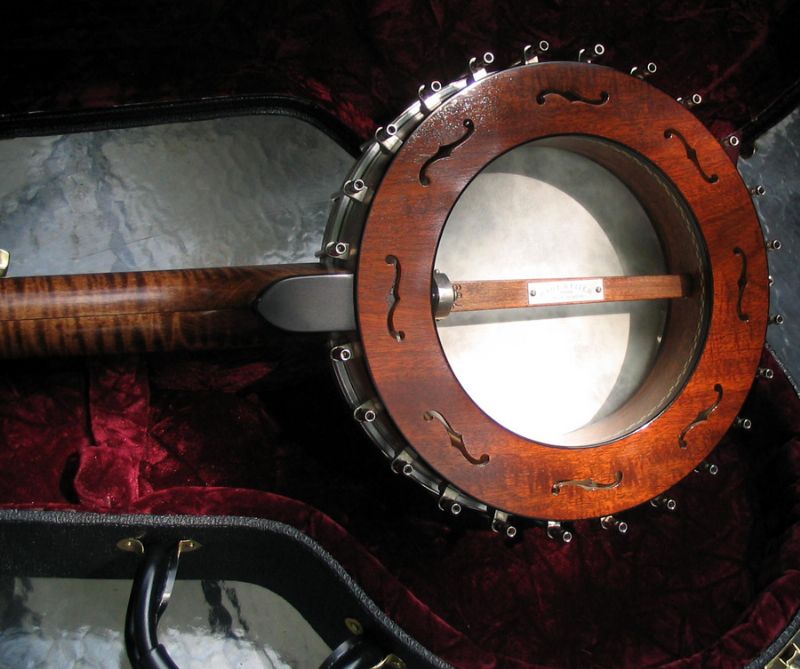
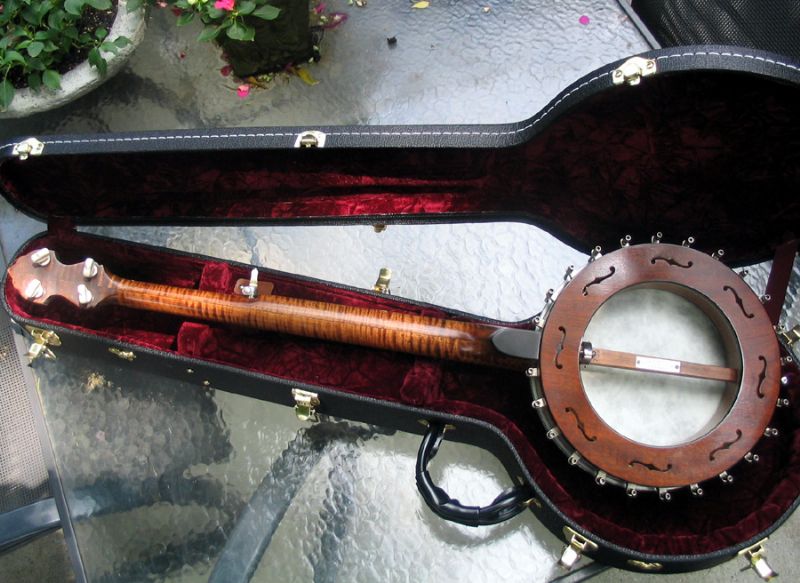
I like the sound of these banjos. All of them that I've had were really great. But a few of them really stood out as exceptional. One of the very best (IMHO) was an early two-hole model (sn#340 - pictured below). That specific banjo has "the" sound that exemplifies the best of what these banjos are capable of.
In 1993, Bart made a small batch of 12" rim banjos (before that size was offered on a standard production model). Some of them were Internal Resonator banjos. I've never heard Bart say for sure how many 12" rim IR banjos there were. But one thing is for sure - there were not many of them. I have been lucky to find three from that batch. Those large rim IR banjos are very special!
Best wishes!
Edited by - jbalch on 02/13/2017 04:58:09
carlb - Posted - 02/13/2017: 04:53:02
I'll recommend you read the following article: "Physics of the Bacon Internal Resonator Banjo". From the site
its.caltech.edu/~politzer/
you'll find a link to the article, or here is the link
its.caltech.edu/~politzer/baco...l-res.pdf
Also, the location of the Bacon Internal Resonator banjo data base is no longer at the links in the archived article but is at
sugarinthegourd.com/BaconProfe...alBanjos/
richard baskowski - Posted - 02/13/2017: 06:11:27
not sure about the amount of holes making a difference. Those guys were busy experimenting with all sorts of ways to make them look, and sound different. two holes are cool eight holes certainly has that visual wow factor! from experience (bacon #3 pro,#10712) these banjos respond well to the other sound variable changes that you can make. Bridges,head strings etc,they always seem to have a "true" tone, since I don't know how to put it in words. Mine is currently set up with nylon strings, homemade bridge,for use with clawhammer, and classic style. Will make a difference if you hold it away from your body as stated before, (volume), might make a diff.,(tone). probably need a very good ear to hear it though! love my bacon!
maneckep - Posted - 02/13/2017: 07:47:53
Not sure if the number of holes makes a difference because there is a much larger gap at the inside top of the resonator where the sound escapes.
I even think with no F holes it would probably sound about the same with the gap as big as it is.
trapdoor2 - Posted - 02/13/2017: 10:02:58
I'm another IR fan. Both of mine have multiple holes.
Last time I talked to Dave Ball, he was playing one of his with no holes at all...and it sounded great. I suspect the way one plays trumps sound-hole number/size.
jbalch - Posted - 02/15/2017: 07:08:19
One more comment: In conversations with Bart Reiter I learned that - in the early days of his making IR banjos he cut the F-holes by hand. Because of the labor involved, two (2) holes were standard. Eight (8) was a custom upgrade (with higher cost). Later, he set-up a jig to make cutting them easier - so eight (8) became the standard.
maneckep - Posted - 02/17/2017: 11:42:51
John - nice to now that. Now whenever I look at my Reiter Professional I'll think of Bart cutting those two holes by hand.
davidppp - Posted - 03/15/2017: 21:01:55
quote:
Originally posted by maneckep
Not sure if the number of holes makes a difference because there is a much larger gap at the inside top of the resonator where the sound escapes.
I even think with no F holes it would probably sound about the same with the gap as big as it is.
Sorry I didn't catch this thread as it first came by. I'm with Emil (as quoted above).
Terms of Use | Privacy Policy | Privacy Consent (EU/GDPR Only)
Copyright 2026 Banjo Hangout. All Rights Reserved.