DVD-quality lessons (including tabs/sheet music) available for immediate viewing on any device.
Take your playing to the next level with the help of a local or online banjo teacher.
Weekly newsletter includes free lessons, favorite member content, banjo news and more.
Premier Sponsors


|
Please note this is an archived topic, so it is locked and unable to be replied to. You may, however, start a new topic and refer to this topic with a link: http://www.banjohangout.org/archive/326821
Don Borchelt - Posted - 01/19/2017: 22:19:53
He probably didn't play the his fiddle all that often. It was said that he only knew about thirty or forty tunes on it, in contrast to the hundreds if not thousands of songs he wrote and performed over the span of his life. But when he walked into the studio of Moses Asch, the head of Folkways Records, in April, 1944, Woody Guthrie brought it with him. Over some ten sessions in 1944 and later in 1945, in between his renditions of traditional folk and country songs like Worried Man Blues, The Roving Gambler, and Foggy Mountain Top, and his own topical songs like One Big Union, Union Maid, and the Sinking of the Ruben James, he would occasionally pull out the fiddle, and saw his way through one or another of the old standards, like Sally Goodin, Rye Straw, Cacklin' Hen, and an old Texas tune Woody called the Cowboy's Waltz. Recorded in January, 1945, Woody was accompanied on the waltz by Bess Lomax Hawes on the mandolin, and an unidentified bass player. Hawes was Alan Lomax's sister, who would four years later write the song Charlie on the MTA. In 1977, she became the first director of the Folk and Traditional Arts Program at the National Endowment for the Arts. But on this day she was Woody's accompaniest, and hoping to become one of the Almanac Singers.
In 1940, when he first came East, Alan Lomax would record several hours of music and conversation with Woody for the Library of Congress. Early in the session, Guthrie describes the square dances he would attend as a teenager in Okemah, Oklahoma.
I was out on a farm there about seventeen miles north of town, and stayed out there for a long time with a family of people, and that's where I first got acquainted with square dances. They always had their fiddle and their old guitar, and everybody from all over the whole countryside'd come, and they called 'em ice-cream freezings, or house parties. They'd all come out there, and usually the boys would come in and tie all their horses up to the hitchin' post outside and come in, and usually before the square dance was complete, why, there'd be anywhere from two gang fights on up, and 'bout fifteen or twenty good, fast singles, just fist fights, you know. Down in that country, they had Prohibition in them days, and so there was lots of moonshine whiskey and there was lots of bootleg liquor stills all over the whole country, and pretty near every family made their own wry whiskey, you know.
This is not your genteel, well-supervised square dance from the eastern Appalachians. You can hear the spry, anarchic spirit of those dances in Woody's raucus playing on the old waltz, which is actually an old European waltz called the Cavalier Waltz, likely brought by German immigrants to Central Texas during their great migration in the 1840s. When Woody kicks off the opening notes, you can hear echos of the wailing opening syllables of the song The Cattle Call, written and recorded by cowboy singer Tex Owens in 1934 for Decca Records. They are the same notes as the opening phrase of the Cavalier Waltz, but when Woody puts in that plaintive cry, they're not the same, either.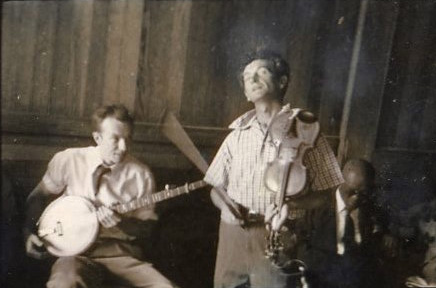
Woody playing his fiddle with Pete Seeger at the first concert at the
Music Inn in Lenox, MA, July, 1950, hosted by Alan Lomax.
Guthrie probably learned to play the fiddle from Jeff Guthrie, his father's half brother, after he moved to Pampa, Texas when he was eighteen years old. He learned to play the guitar, Maybelle Carter style, backing up his uncle at local square dances. "Old champ fiddlers," he once said, "want the guitar to stay purely down at the bottom of the stack, and they make you pluck or pick it their way so as to ride in and out and down around on their fiddle bow (without) your banjo or your guitar ruining their fiddle piece." There is a fiddle that belonged to Guthrie on display at the Woody Guthrie Center in Tulsa, Oklahoma. Carved into the top is an inscription, "This Machine Kills Fascists," identical to the declaration that graced his old flattop guitar. 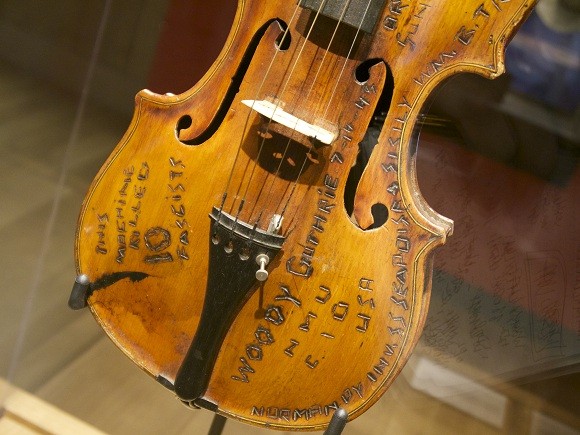
The Cowboy Waltz snuck through the back door into the old-time repertoire when it was recorded by the New Lost City Ramblers for Folkways Records in 1964, for an album called String Band Instrumentals. The archtypal old-timey revival group followed the original Guthrie recording pretty closely, with John Cohen reprising Bess Hawes laconic mandolin introduction, Tom Paley providing the guitar, and Mike Seeger playing fiddle with the same Guthrie gusto, though perhaps with a bit more precision than the original.
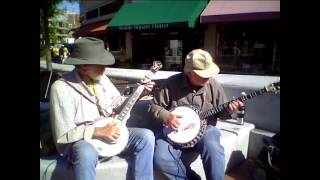
I've posted two videos of my own setting for The Cowboy Waltz, in open D tuning (aDF#AD). The video directly below is a solo performance at my computer, picking on my semi-fretless 1928 Tubaphone, from July, 2013. The second, attached below, is a street performance in Harvard Square with my friend and busking partner Ed Britt, recorded a month later. In that video, I'm picking my 1964 Ode Model 42, which has a Shatten pickup installed, to make amplification much simpler. I try to get Woody's mournful wail in those opening notes with a pair of luxurious string bends.
There are two other renditions of the Cowboy Waltz posted here on the Banjo Hangout, by Janet Burton and Steve Parker, and both are excellent, proving that you can clawhammer a waltz, with fine results!
Janet Burton playing The Cowboy's waltz, with Kit on mandolin
Steve Parker playing The Cowboy's Waltz
So ease your troubled mind today, and take some time to work up this fine country waltz. Make it sound just like a poor, lonely cowboy singing a sweet love song to his heffers.
- Don Borchelt
Edited by - Don Borchelt on 01/19/2017 22:26:02
banjered - Posted - 01/20/2017: 05:33:16
Thanks. I enjoy playing this tune CH style. First heard it at our local jam when a mandolin player whipped it out. We don't play it often enough at our jams so I have to play it on my own to keep it current. One area that gives me trouble is measure #13. According to written material,Woody begins that measure with the note "A." Tater Joe and Parker "E," Kenny Hall "C#." I usually play it "B" as C# sounds harsh in this tune at this spot, as least to me. All these versions, I tell you it is a wonder that old time musicians can play anything together (ha!). Banjered
chip arnold - Posted - 01/20/2017: 05:38:08
Wonderful tune, Don. Cattle Call has been a favorite of mine since hearing it on the radio, sung by Eddie Arnold, when I was a kid. The second part is very much like Gum Tree Canoe. I'm gonna see what I can do with it in D/D, today. Thanks for posting :-)
vrteach - Posted - 01/20/2017: 08:45:56
Thanks Don. What a soothing tune for the week; and I wish I had an instrument in reach!
JanetB - Posted - 01/20/2017: 14:22:49
Thanks for covering Cowboy Waltz, Don, and sharing your more plaintive but lovely take on it. The comparison to Cattle Call gives me a different perspective. The comparison to Gum Tree Canoe is something I'd never thought about before.
My Plinky and Plunky duet with Kit was actually picked. I was in aDGBD tuning. So here I've tuned to double C and made tab to go along with this new take. I even changed a few notes to match Woody's. Kit and I first heard Heidi Claire, formerly of the Reel Time Travelers, play it at a Grass Valley music camp one year. She said it was a traditional last waltz at dances. It was sure pretty.
Zischkale - Posted - 01/20/2017: 14:42:41
Great choice, Don, lots of fascinating new info for me here! Hadn't heard the waltz, didn't realize Woody played (really ragged, stabby) fiddle. Excellent that it's a Texas tune. Great background and thrilling banjo arrangement with those rubbery bends. Should never be under appreciated that you provide detailed tablature on at least a hundred of your arrangements. Great resource and great playing!
robmac07 - Posted - 01/20/2017: 21:22:28
Thanks for the tune background Don. That's our favorite waltz at the Adelaide Old Time String Band Jam. I learnt it on the fiddle way back in the 60s from the Rambler's recording. One day an older classically trained violinist walked into the Jam heard the tune and proceeded to play an almost identical more 'formal' version with a a fancy name which escapes me at the moment :)
jack_beuthin - Posted - 01/22/2017: 12:05:29
While perusing the LOC collection today, I stumbled across Alan Jabbour's recording of Henry Reed playing "Cowboy Waltz." It is significantly different than the tune most of think of when we hear the name "Cowboy Waltz" but you can still hear strains of that familiar tune. Alan Jabbour noted:
"Henry Reed gave no name to this waltz, but it is usually known as the "Cowboy Waltz" and has been a standard in folk and popular song and dance repertory throughout the twentieth century. Like the waltz in C he performed twice in this collection (AFS 13033b12, AFS 13037a07), Henry Reed learned this tune from recordings of Henry Ford's Orchestra."
I didn't know about Woody's connection to this tune either. Thanks for that Don!
Edited by - jack_beuthin on 01/22/2017 12:06:06
g3zdm - Posted - 01/22/2017: 14:59:54
This tune brings back happy memories of the Sunday night Skellig OT jam in Waltham MA where I first heard it and so learnt it (in D out of open G tuning).
Enjoyed Don's and Janet's renditions and it was great to hear the history and background to the tune.
I actually sneaked this tune in towards the end of the evening at my regular Irish tunes session last Monday here in Manchester, UK after a fellow musician played Shepherd's Wife Waltz.
Chris Muriel, Manchester, UK
bhniko - Posted - 01/23/2017: 12:02:26
One of 'purty' ones. Nice choice Don. Thanks to all for their beautiful renditions.
John Gribble - Posted - 01/23/2017: 16:41:10
That's a good one! It's funny in a good way how Guthrie played fiddle a lot like how he sang. Thanks.
imapicker2 - Posted - 01/24/2017: 11:39:48
youtube.com/watch?v=ffDkhRzKJm0 Granddad liked to play "Wednesday Night Waltz" on the fiddle. Is this just the A part of Cowboy Waltz? Did Guthrie borrow from that tune? No connection?
Edited by - imapicker2 on 01/24/2017 11:42:25
Don Borchelt - Posted - 01/26/2017: 12:09:57
Janet, very nicely played as always. Dwight, according to the Fiddler's Companion, The Cavalier's Waltz, which is virtually identical to The Cowboy Waltz, is of European origin, although I could find no other confirmation of that. But if that is correct, then I think it is more likely that the Wednesday Night Waltz, which as you point out is remarkably similar to the A part of The Cowboy/Cavalier Waltz, probably was injspired by the latter, rather than the other way around. Again according to The Fiddler's Companion, the Wednesday Night Waltz we all heard when we started out came originally from a 1927 recording by the Leake County Revelers, whose fiddler, Will Gilmer, said he picked it up "out in Texas somewhere." Here is the only version of The Cavalier Waltz I could find, by a group of Civil War re-enactors who call themselves the 2nd South Carolina String Band.
I went to the Boston Common with my daughter and granddaughter last Saturday for some sort of gathering or another, and saw this banjo picker channeling Woody. I wonder how many got the connection? By the way, I made an error in my original post- Woody's fiddle is carved with the inscription "This Machine killed 10 fascists."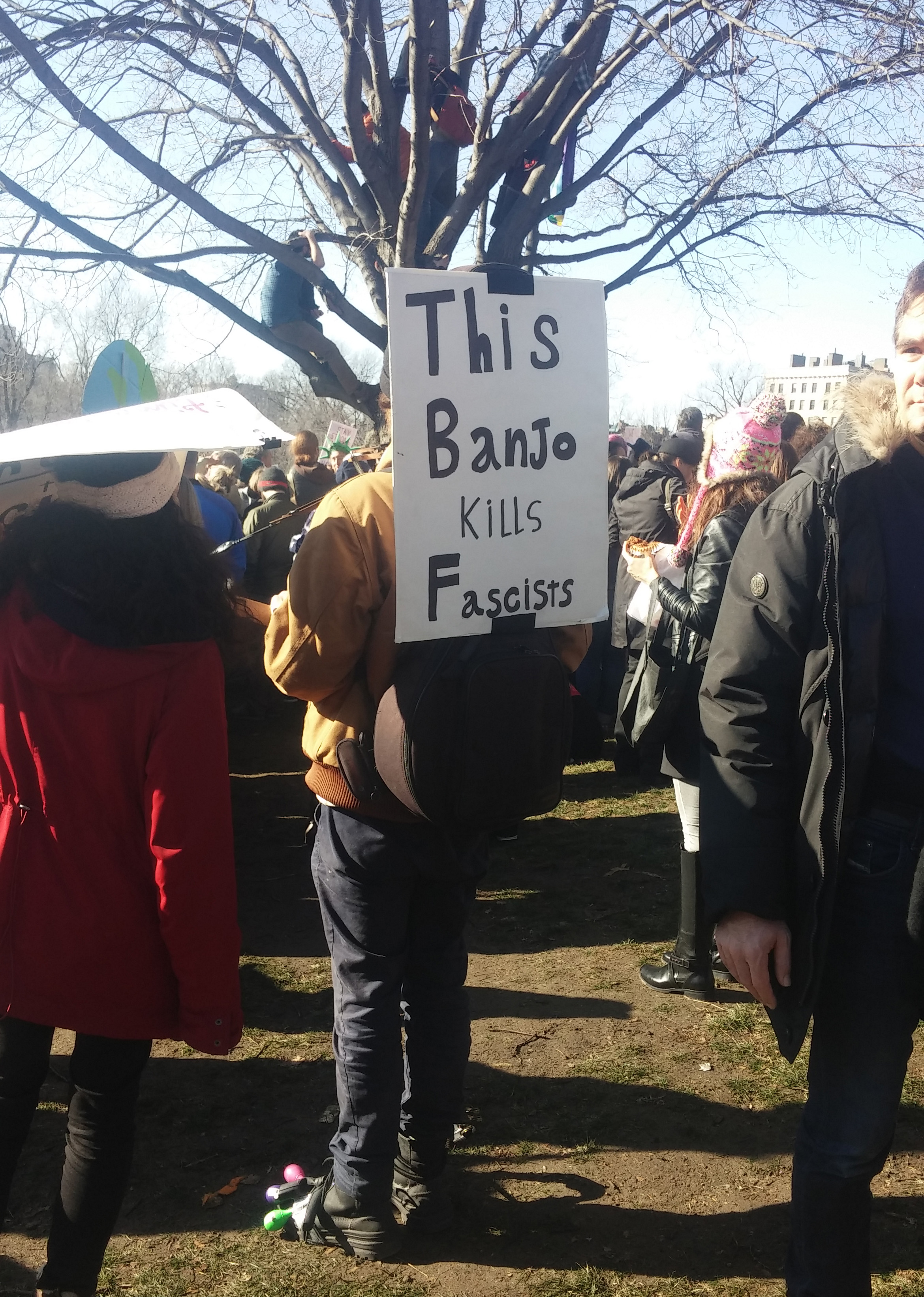
Edited by - Don Borchelt on 01/26/2017 12:20:05
imapicker2 - Posted - 01/26/2017: 18:27:29
Very interesting! Thanks for the insight into this tune,Don. I appreciate you and everyone that contributes to make this such a great forum.
mswzebo - Posted - 04/05/2017: 20:09:10
I learned this waltz from my former teacher, a wonderful man, Kurt Hippen. He taught it to me as having three parts (A,B,C) and said that if you just do the A&B parts its called Log Cabin Home in the Sky. I see that others have posted this on Janet's original recording. This is the first waltz I've learned clawhammering and I look forward to others. Any suggestions?
Don Huber - Posted - 04/06/2017: 00:46:46
Thanks for the interesting connection of the Bess Hawes/Cohen mandolin arrangements. Another OT mystery solved!
John Cohen played mandolin only on occasion with the NLCR, and as with their final recording of Colored Aristocracy, it was apparently a tip of the hat to an earlier, very special recording.
Don Borchelt - Posted - 04/06/2017: 12:21:03
Mark (mswzebo) wrote: "This is the first waltz I've learned clawhammering and I look forward to others. Any suggestions?"
Mark , I play a few waltzes on the banjo, and would like to learn more myself. Maybe my favorite among the few I play now is an obscure tune called Roscoe Parish's Waltz. Parish was an old time fiddler and banjo player from Coal Creek, Virginia, who played a lot of unique and unusual tunes. He was recorded by Alice Gerard and Andy Cahan back in the '80s, and you can here him playing his waltz here, on the Slippery Hill website. Janet Burton has a lovely version she posted back in 2013, you can listen to that here on the BHO. According to the Fiddler's Companion, it is a waltz time version of an old Scottish jig called The Muckin' o' Geordie's Byre, which Samuel Bayard collected from a half dozen Pennsylvania fiddlers and fifers under the title Lassie, Art Thou Sleeping Yet. His transcriptions are in his collection Dance to the Fiddle, March to the Fife. Here is the field recording of one of those fifers, Hiram Clinton Horner of Westmoreland County, recorded in 1960. You can decide if you think it is the same tune. Kind of sounds like it to me.
Hiram Horner playing Lassie, Art Thou Sleeping Yet
I won the BHO Waltz on the Banjo contest with this tune back in January, 2014. About four months ago, Roscoe Parish's granddaughter posted a thank you on my YouTube page, saying that she was "glad to hear his beautiful music lives on." She went on to comment that:
He was extremely talented in so many things, yet so humble. He made my brother and fiddle, and me a banjo. They are priceless to us. Music was such a big part of his life.
That is an epitaph few of us could live up to.
Edited by - Don Borchelt on 04/06/2017 12:21:58
Winged Words - Posted - 04/22/2017: 04:05:48
I'm just catching up with this one. But bearing in mind that I come from a middle class suburban South East London old time banjo free 1950's background, I had to mark the occasion: it's the very first tune of the week that I already knew from way back.
Well, not from that long ago. It took me back to happy times in my late teens as a passionate Incredible String Band fan. Mike Heron used the A part of the tune for Log Cabin Home in the Sky, one of my favourites at the time and the first tune in E I learnt on my new guitar in 1969. I just dug out my CD of Wee Tam and the Big Huge and had a happy reunion with some old friends. Joe Boyd's notes to the 2009 reissue say that Mike Heron learnt the tune at the 1967 Newport Folk Festival from Texan Eck Robertson. The words at the time always made me think of Bob Dylan hiding away in Woodstock after his motorcycle accident.
And the B part of Cowboy's Waltz has definite echoes for me of Roy Rogers and his Four Legged Friend. Cowboys were a big part of my childhood!
So thanks for waking up a few memories Don.
BrendanD - Posted - 04/23/2017: 03:15:10
Don, your playing of Roscoe Parish's Waltz just knocks my socks off! Gorgeous tone, beautiful phrasing and timing, and just a lovely arrangement. I'm quite familiar with this tune, having heard it played by Bruce Molsky (who I think may have recorded it as well), probably by Paul Brown, and maybe by Alice Gerrard. I know that Paul and Alice knew and played with Roscoe personally, and possibly Bruce did as well. I didn't get to meet Roscoe Parish myself, but in 1979 and 1982 I did visit Roscoe's contemporary, the great southern Virginia fiddler Luther Davis, and so I have a special love for that stately old style and repertoire.
Everything I've heard you play here on the BHO is consistently beautiful, tasteful, top notch playing, and certainly at the level of any currently "famous" banjo player. As they say, it don't get no better than this! Thanks for posting this.
Chris Berry - Posted - 04/23/2017: 14:38:03
Lovely version of Roscoe Parrish's Waltz, Don. Bob Walters recorded the jig version on fiddle a couple of times as "Marching Quadrille," as well.
slippery-hill.com/recording/ma...quadrille
Edited by - Chris Berry on 04/23/2017 14:38:46
g3zdm - Posted - 04/23/2017: 16:05:08
I play the original Scots jig (Muckin' o' Geordie's Byre) occasionally; I knew it as song long before I came across the instrumental thanks to growing up hearing Andy Stewart sing it.
If you hang on in until about 1:40 in the following rendition, Andy does 1 verse in Queen's English in lieu of broader Scots 
youtube.com/watch?v=7XgMxKP_Jcs
I found, being familiar with the jig, it was pretty easy to play along with Don's Parish's Waltz.
Chris Muriel, Manchester, UK
Lester M - Posted - 04/27/2017: 15:08:49
quote:Thanks for the great, clear Tab!!
Originally posted by JanetB
Thanks for covering Cowboy Waltz, Don, and sharing your more plaintive but lovely take on it. The comparison to Cattle Call gives me a different perspective. The comparison to Gum Tree Canoe is something I'd never thought about before.
My Plinky and Plunky duet with Kit was actually picked. I was in aDGBD tuning. So here I've tuned to double C and made tab to go along with this new take. I even changed a few notes to match Woody's. Kit and I first heard Heidi Claire, formerly of the Reel Time Travelers, play it at a Grass Valley music camp one year. She said it was a traditional last waltz at dances. It was sure pretty.
Don Borchelt - Posted - 05/02/2017: 07:13:00
Chris, YouTube tells me that your video is blocked here in the states, due to copyright issues. Wow, them Scots are sure getting feisty over there!
Very nicely played, Aaron (ackeim), a lovely rendition. It sounds to me like you have your uke tuned like a tenor guitar, rather than something similar to the standard reentrant tuning used for a soprano ukelele. I gather that it is customary that the dog does not have fleas once you leave the standard uke aside.
Thanks, Geoff, Brendan and Chris for the nice comments. Chris, you don't hear too many jigs in the Appalachian fiddle repertoire. Are they common in Missouri?
- Don Borchelt
Terms of Use | Privacy Policy | Privacy Consent (EU/GDPR Only)
Copyright 2026 Banjo Hangout. All Rights Reserved.