DVD-quality lessons (including tabs/sheet music) available for immediate viewing on any device.
Take your playing to the next level with the help of a local or online banjo teacher.
Weekly newsletter includes free lessons, favorite member content, banjo news and more.
Premier Sponsors


|
Please note this is an archived topic, so it is locked and unable to be replied to. You may, however, start a new topic and refer to this topic with a link: http://www.banjohangout.org/archive/326669
OK-4 - Posted - 01/15/2017: 23:09:30
For standard tuning on a banjo with regular scale. (I'd like to avoid widening some narrow nut slots.)
Helix - Posted - 01/16/2017: 03:18:02
I was bragging the other day about this ingenious guy on the hangout who used mylar to make a banjo head.
Fishing line.
OldPappy - Posted - 01/16/2017: 03:52:54
I was at a festival last Fall and met another banjo builder who had several of his banjos, but also had an old Stewart he let me play.
After playing it, I joked that he would void the warranty by having steel strings on a Stewart. They weren't steel, they were synthetic gut strings that were so thin, and so loud, I only thought they were steel. It escapes my mind what brand he said they were, but they were the thinnest synthetic strings I have ever seen, and I am sure someone out there will know what they might have been.
rudy - Posted - 01/16/2017: 06:47:16
You most likely won't appreciate standard fishing line due to its excessive stretching and lack of tone.
If you want to do the "fishing line" route you should purchase fluorocarbon leader line which comes in slightly heavier guages, resists excessive stretching, and sounds much better. Suggested weights should fit in nut slots with no need to re-size. The majority of leader line users prefer 20 / 30 / 40 / 50 / 20 pound fluorocarbon leader line, available from many finer sports fishing shops.
The difficulty is finding it is the short lenghs needed for an instrument. I've heard that some shops that do bulk sales will sell it by the foot, but it's probably unlikely that its available where you live unless you live somewhere on the coast. You can purchase smaller "rolls" of material; I think mine was purchased in 25 yard packages.
Joel Hooks - Posted - 01/16/2017: 06:53:33
Fishing line is great for catching fish. It is strong, elastic, and pliable. It is designed to go from completely slack to the load of a fish struggling against it without breaking while being able to cast and spool up countless times.
Strong is good. Elastic and pliable, not so much.
Musical strings are extruded from a different nylon than fishing line. It is also extruded using a different process. The goal is to have a perfectly uniform thickness and density across the entire string. Fishing line is almost always "false" or uneven in thickness. Even a little variance can cause the intonation to be off.
I have also found fishing line to not be perfectly round. This can cause it to sound out of tune and feel funny.
From about the 1880s up until gut fell out of favor in the late 1920, the strings used were much thinner than the common "light" nylon or polyester strings sold in sets today.
When La Bella started selling nylon banjo strings they used a set based on the early sizes. They called them "No. 17" from the sizes-- .017", .019", .023", .024" wound.
Fred Van Eps used thinner strings on the banjo he played and built, .016, .018, .022, .024w. His banjos had 28.5" scales.
I have been using the "17s" on all my banjos except "tubs" (aka "early" banjos) and really like them. These are not offered for sale in sets and you have to buy singles and build them. LaBella has made their No. 17s thicker and the firsts are no .019".
I have been getting Rectified Lute Singles from Strings by Mail but they are often out of stock on them and they get backordered. I have gotten good service from them but I recently noticed that La Bella is now selling direct and I will likely buy from them in the future.
labella.com/strings/category/r...truments/
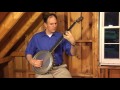
In the video below I am using the 17s.
Banjo Lefty - Posted - 01/16/2017: 07:39:51
I love the sound you are getting out of those strings. Your picking is pretty good, too. All in all, fun!
csacwp - Posted - 01/16/2017: 07:57:20
The thinnest strings on the market are the Savarez Alliance (KF) carbons, which have a similar density to gut (roughly 25% denser than standard nylon). These go down to really tiny diameters, even smaller than the LaBella lute strings. The Van Eps string gauges Joel provided are correct as far as nylon strings go (Van Eps was one of the pioneering users of nylon), but back when he used gut his strings were even thinner, likely using a .014 first and fifth.
Texican65 - Posted - 01/16/2017: 10:35:24
I've used fishing line on my gut string banjos over the years, just to try it out, and to echo Joel...i wasn't very pleased with their performance. They were "ok" at best, something to use in a pinch or if you couldn't find gut or nylon, took forever to finally stretch out and hold proper pitch, feel very elastic-y, dull and flat tone. Chris Sand nylons are AWESOME! And the LaBella 17s are amazing aswell, LaBella is an American made string and has been around for a couple hundred years...they know what they're doing.
OLDPAPPY, might be talking about the Thomastik Infeld synthetic strings. They look like steel, sound like steel, feel like steel, but they're NOT. I tried a set on one of my Jerry Reed gut string guitars, sounded great...but I didn't like the way they felt, so I took them off.
Dow
mikehalloran - Posted - 01/16/2017: 12:51:27
The thinnest nylon strings are found at your local sewing center or fabric store. You will find thread as thin as metal strings. Install them—they will sound terrible.
Moving on... you don't want to cut a nut to accept synthetic strings. You are worrying over nothing. A large number of us play vintage banjos from the 1930s and earlier with steel in nuts cut for gut strings. It's not a problem—really, it isn't. The u-channel accommodates the thinner string easily. Yes, gut was thin but it's still not an issue.
If you need to cut the nut, have it done with properly gauged nut files. You can have it filled and recut if you go back to steel but you probably won't feel the need.
Fluorocarbon strings are visibly thinner (typically 17%) than Nylon or Nylgut of the same tension and are available from a number of makers. Savarez Alliance is the brand most likely to be in stock somewhere but there are others. There are a number of other modern plastics in use—some are thicker or thinner but none approach metal at the dame tension.
>Musical strings are extruded from a different nylon than fishing line. <
Absolute nonsense. If the string says Nylon, it's the same stuff. Standard nylon guitar strings are Perlon, Dupont's registered name for gauged Nylon used in musical instrument strings. Nylon may be a generic name in the US but not through much of the world where Dupont protects their trademarks.
Rectified or Trued nylon is extruded twice, the second time through a machine that removes the imperfections making the string smaller but more even from one end to the other. Savarez uses grind wheels that leave the surface rough. D'Addario uses a different process that leaves the string clear — Liona Boyd worked with them on it so that her guitars play in tune better.
D'Addario Composites use a nylon type compound that goes through their rectification process but their standard strings are plain old nylon. The gauges are about the same.
A great 4th string for use with synthetic strings is the D'Addario EXP. Besides being coated, it has 4 strands of wire in the core making it thinner. You may not have to widen the nut for it at .028". The coating keeps them bright even after you wear through the wrap—which you will because they stay bright. EXP classicals were my gigging string for years—not because they sounded superior but because the basses lasted so long.
juststrings.com/dad-exp4504.ht...d-exp4504
So, if you like the sound of Nylon, go for it. Fluorocarbon or one of the other synthetics may sound better to you—or not. I like NylGuts with that EXP 4th on banjos. All require widening nut slots a little.
If you decide to fill the nut slots again, CA (superglue) works well. I use clear on narrow fills or white if the clear fill will be visible. Others like to mix in baking soda or bone dust as a coloring agent (it does not strengthen the fill, however).
Edited by - mikehalloran on 01/16/2017 13:00:14
Joel Hooks - Posted - 01/16/2017: 13:31:29
There was an article written for the 5-Stringer by an engineer from DuPont explaining the difference in both the process and the material. I'll dig out the article and reread it, but since it is nonsense I keep it to myself.
mikehalloran - Posted - 01/16/2017: 15:37:48
quote:
Originally posted by Joel Hooks
There was an article written for the 5-Stringer by an engineer from DuPont explaining the difference in both the process and the material. I'll dig out the article and reread it, but since it is nonsense I keep it to myself.
Please do. Most of the world's monofilament nylon is Nylon 6, a trade name for polycaprolactam and is made by many companies, the patent having expired decades ago. It stretches less than the original Nylon 6.6 which is rarely used anymore. It was invented in 1938.
Nylon 6.6 was used as the multi-strand core in bass strings since the 1920s.
Helix - Posted - 01/17/2017: 06:31:59
I thought you were in a boat, ok then no fishing line.
I learned a lot, thanks everyone.
OK-4 - Posted - 01/17/2017: 14:01:04
Thank you for all the responses.
I had to read Mike Halloran's comment several times before I could figure what he was talking about ("... you don't want to cut a nut to accept synthetic strings. You are worrying over nothing. A large number of us play vintage banjos from the 1930s and earlier with steel in nuts cut for gut strings. It's not a problem—really, it isn't."). Mike, my problem is that I WANT nylon strings, not steel. And I also prefer not to widen the slots. It is a modern repro neck with slots cut neatly for steel, too narrow to receive my nylon strings.
I found that it actually plays OK with the nylon strings sitting on top of the nut (and draped around the fifth string pip instead of on top of it where it won't sit). But it is sometimes awkward, looks sloppy, and it probably doesn't do any favors for the tone.
G Edward Porgie - Posted - 01/17/2017: 16:23:36
quote:
Originally posted by mikehalloran
quote:
Originally posted by Joel Hooks
There was an article written for the 5-Stringer by an engineer from DuPont explaining the difference in both the process and the material. I'll dig out the article and reread it, but since it is nonsense I keep it to myself.
Please do. Most of the world's monofilament nylon is Nylon 6, a trade name for polycaprolactam and is made by many companies, the patent having expired decades ago. It stretches less than the original Nylon 6.6 which is rarely used anymore. It was invented in 1938.
Nylon 6.6 was used as the multi-strand core in bass strings since the 1920s.
The first sample of Nylon 6.6 was produced in the DuPont labs on Feb. 28, 1935. Therefore It could not have been used as stranded bass string core since the 1920's.
Joel Hooks - Posted - 01/17/2017: 17:01:06
I suppose I could add that like all plastics, hardness and softness are added to give it the properties needed for the application. Fishing line is formulated for catching fish.
dculgan - Posted - 01/18/2017: 04:43:43
quote:
Originally posted by G Edward Porgie
The first sample of Nylon 6.6 was produced in the DuPont labs on Feb. 28, 1935. Therefore It could not have been used as stranded bass string core since the 1920's.
Here I sit, reading the forum over a cup of morning coffee right at the location where nylon and mylar (and a bunch of other stuff) was invented. I can't believe they don't have a big sign out front so all the people driving by know where nylon banjo strings and mylar heads were born. Different priorities I guess. Maybe a kevlar banjo head could be marketed in this day and age, oh wait...I see someone has, but is it bullet proof?
Joel Hooks - Posted - 01/18/2017: 05:53:56
quote:
Originally posted by Joel Hooks
I suppose I could add that like all plastics, hardness and softness are added to give it the properties needed for the application. Fishing line is formulated for catching fish.
This post was the victim of auto correct.
** Hardeners and softeners**
Terms of Use | Privacy Policy | Privacy Consent (EU/GDPR Only)
Copyright 2026 Banjo Hangout. All Rights Reserved.