DVD-quality lessons (including tabs/sheet music) available for immediate viewing on any device.
Take your playing to the next level with the help of a local or online banjo teacher.
Weekly newsletter includes free lessons, favorite member content, banjo news and more.
Premier Sponsors


|
Please note this is an archived topic, so it is locked and unable to be replied to. You may, however, start a new topic and refer to this topic with a link: http://www.banjohangout.org/archive/323134
hansirowe - Posted - 09/26/2016: 07:13:22
Hi
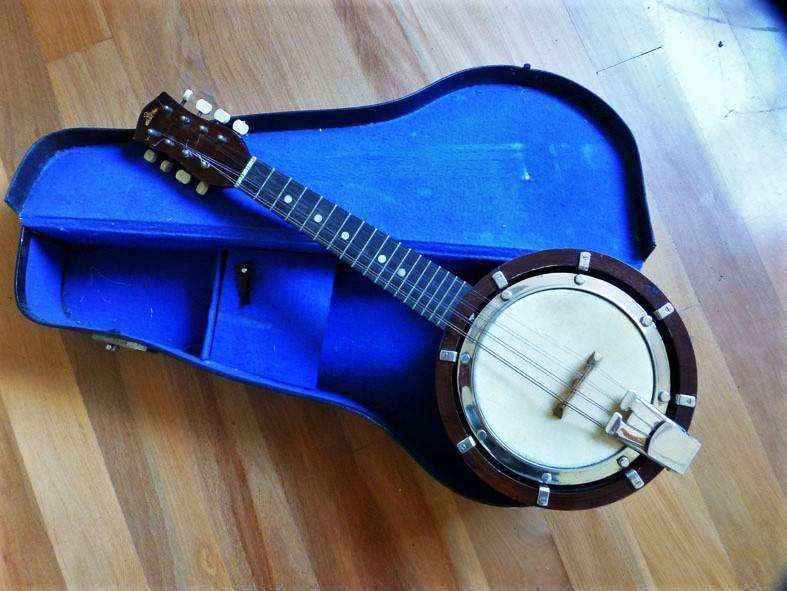
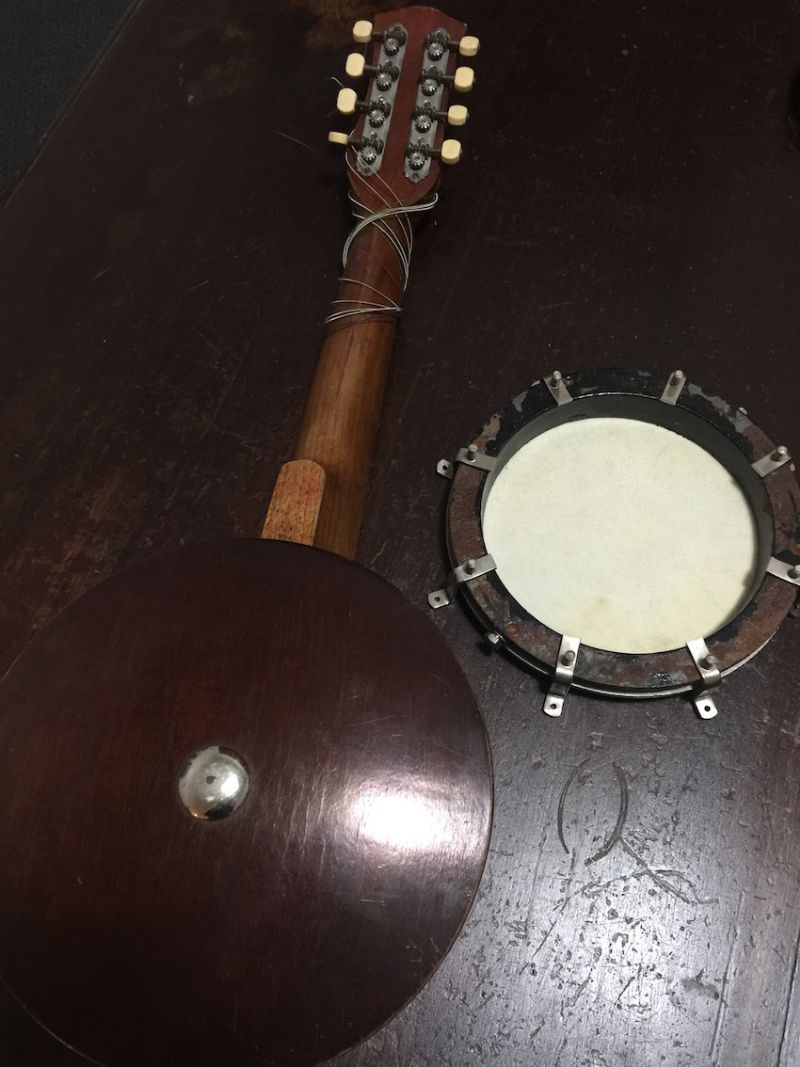
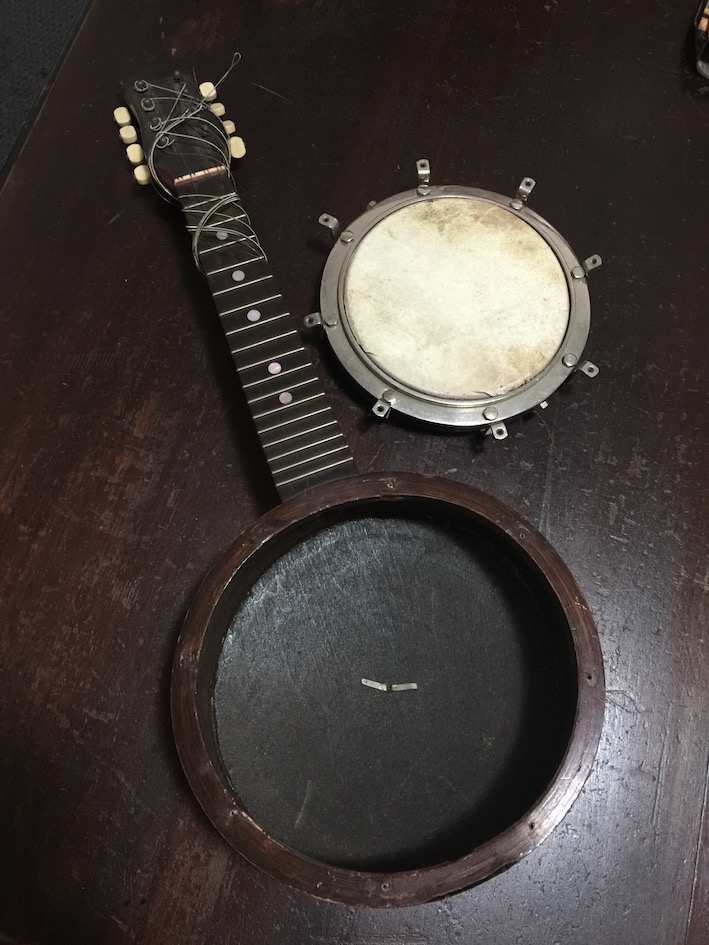
I've just bought this old banjo mandolin in need of some TLC for $50. I can't see any maker's stamp or numbers anywhere but I found a photo of a restored model that looks exactly the same as mine, except the restored model is for sale at $550!. The restored model is apparently British c. 1920 and made by George Houghton & Sons. Do you think that my old one is of the same pedigree? The other thing that I wanted to ask is related to the missing tail piece and bridge... I'm toying with the idea to repair and restore it but keep it as a small sized 4 string banjo, or possibly a banjo ukulele, in any case not set up as a banjo mandolin. Is there anyone on the forum who might have a suitable, period (the fancier and older the better) 4 string tail piece and a suitable bridge for sale? Or maybe know of a place that might have? Any help or info would be much appreciated. Many thanks, cheers, John
AndrewD - Posted - 09/26/2016: 08:08:03
Asking $550 and getting $550 are 2 completely different things. At $50 it wasn't a bargain. These low end "zither style" British mando-banjos crop up on UK ebay all the time. If they do sell it's for well under £100 for fancier ones than this.
G Edward Porgie - Posted - 09/26/2016: 08:37:30
Andrew makes it sound as if you've been cheated, but I don't think so. Markets are different around the world. I don't know if he's calculated just how much 100 British punds comes out to in Australian dollars.
You can find a four-string bridge almost anywhere. As far as a period correct tailpiece, you may have to check Ebay or other online sources. The re-production ones I've seen have all been for five string banjos. (However, one of those would work if you just use leave the middle string attachment blank.) Just don't put one on that resembles the one on that "restored" unit. It's not correct for one of these, and is most likely too long. I'd also guess that installing it required some modifications to it or the banjo itself.
You might just try a standard mandolin tailpiece, so that if you ever decide to go with the original configuration, all you'd need to do would be to add the four missing strings. Just because a mandolin tailpiece has eight places to attach the strings doesn't mean you must use all of them.
banjonz - Posted - 09/26/2016: 12:22:31
Hi John and welcome. Unless the instrument has a makers marque on it (Like G H & S) it is extremely difficult to know who made it. They were churned out in large numbers during the time period when they were popular in the UK. I see a lot of them here in NZ and folk still put ridiculously high prices on them because they are old and therefore 'vintage'. Honestly speaking, they are not worth much. As stated, the TP in not original on the Houghton. TP's on these come in a variety of styles. Sometimes they are built into the tension band as studs. As for locating the items, it is as George has said. Ebay is probably the best bet!
AndrewD - Posted - 09/26/2016: 13:57:52
quote:
Originally posted by G Edward Porgie
Andrew makes it sound as if you've been cheated, but I don't think so. Markets are different around the world. I don't know if he's calculated just how much 100 British punds comes out to in Australian dollars.
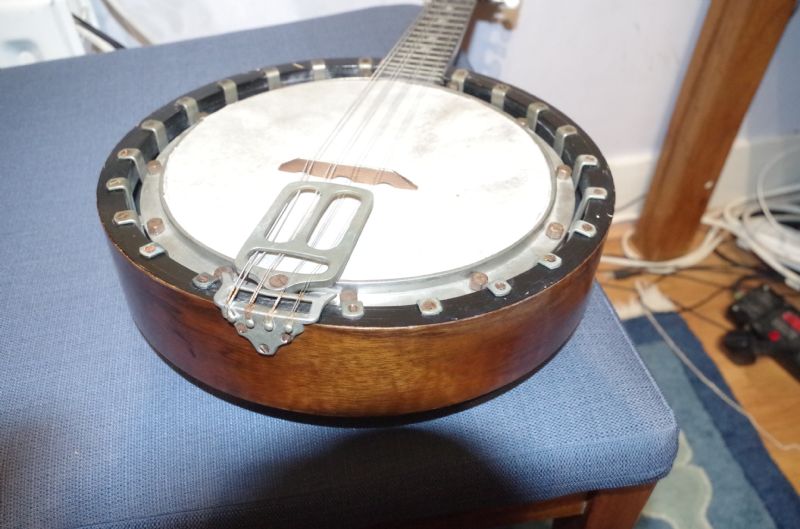
"Not a bargain" doesn't mean cheated. It means just what it says. If somebody actually pays $550 for the one pictured then they would have been cheated. The original tailepiece would have looked something like the picture below from my no-name English mando banjo. Note that it only has 4 studs so the paired strings go 2 to a stud. This is normal in this style of mando-banjo.
Edited by - AndrewD on 09/26/2016 14:03:28
hansirowe - Posted - 09/26/2016: 17:34:21
Thanks very much Andrew, Wayne, and George for your help and advice! Yes, $50 Australian dollars doesn't amount to very much these days so I feel that it was a fair price, especially also that there's really not much on offer here in west Australia. Buying from overseas eBay sites works out really expensive with the high price of shipping, etc. How I often wish I was back in the UK for buying used instruments!! Small items are not too bad, even though I often pay twice as much in the end for shipping than the actual item costs, but instruments cost a small fortune to send. So, all in all, I'm happy with my purchase and I'll enjoy restoring it. Yes, it appears from the indentation and screw holes from the missing TP that it would have had the same small plate attached to the pot as shown in your photo Andrew, I'll have a search around and see what I can find. I've noticed, looking at banjo bridges, that they vary in height... would it be a matter of buying a few different heights and deciding then which one gives the lowest action without the strings buzzing on the frets, or is there a specific height for these old instruments? Or would a mandolin bridge be a better option? Anyway, thanks again for your help guys... cheers, John
banjonz - Posted - 09/26/2016: 18:25:10
John, I have worked on a lot of these over the years. Most I find with abominably high actions. What I do is shim the necks where they attach to the pot. It is easy to do as the neck is attached via 2 woodscrews from the inside. It is a bit of a fiddle ( no pun intended) but I have devised a technique which works for me. I have found that to bet the action right for playability it is a combination of neck angle and bridge height. I play around with those till I have got it right.
hansirowe - Posted - 09/26/2016: 18:44:58
Thanks Wayne, yes I noticed those two wood screws and wondered if somebody had carried out a repair job as they look a bit primitive... good to hear that they're 'normal'! That's a good idea anyway, and I might try that if after purchasing a bridge I find the action very high and the angle of the neck needs a bit of fine tuning (no pun intended.. ha ha!). Thanks for that, that helps a lot, cheers, John
deke46 - Posted - 09/27/2016: 23:14:41
Hi John,
Most of what has been said about these b/mandolins is quite correct but don`t let that stop you from having a bit of fun with it!
You can see the two set bolts screwed into the iron frame, these should be in line with the neck when installed. They serve to adjust the neck and action height. Screwing them out forces the rim to expand at the top, thus lowering the action. Choosing the appropriate bridge height should complete the set-up.
I wouldn`t worry about finding a period t.p. for it, they were pretty primitive and cheap anyway, a short mandolin t.p. should fit the bill.
PM me if you want any further hints, I`m in Brisbane.
Cheers,
Deke.
hansirowe - Posted - 09/28/2016: 05:08:07
Hi Derrick... thanks very much for your message and the info about those two bolts, I was wondering what they do! I thought they secured the skin in some way, so good to know that they change the action height and that they should be in line with the neck. As for the tailpiece, I have in fact ordered a nickel, scalloped mandolin tailpiece that should look very nice. It was only cheap but should be perfectly adequate for the job and has a period look. I have to admit that I did look at some sites that sell authentic period pieces but most of the tailpieces were in the $150 - $180 price range! Would you have any idea as to the height of the bridge used on these instruments... I'm presuming that I would have to buy a banjo bridge and they seem to come in a few different heights? Cheers, John
deke46 - Posted - 09/28/2016: 06:10:33
G`day John,
These b/m`s generally had a fairly low bridge, about 1/2" or less. often the originals were a maple base with piece of fretwire let into the top edge,
if you can find one of those floating around somewhere you can replace the fretwire and cut new retaining slots to suit the number of strings you install.
I`ve done a few of these and it`s worked quite well, although the instrument does retain the stridency which tends towards their unpopularity.
Tomorrow I`ll have a shufti and see if I can find a possible bridge in the useful box.
Cheers,
Deke.
AndrewD - Posted - 09/28/2016: 07:52:35
quote:
Originally posted by josh95843
That old presto is worth more than the banjo.
Possibly not an old presto as it's almost certainly not original to the instrument. May have been added last year. And that's in the photo of the example that the OP says is going for $550, not the OP's actual banjo. It can happen though. I bought an old Slingerland 5 string earlier in the year that turned up with a pre-war presto 5 string tailepiece and a set of good condition pre-war grover geared tuners.
hansirowe - Posted - 09/28/2016: 17:49:11
The banjo mandolin that was selling for $550 has either sold or been removed now from the Australian Gumtree site, but there's another one, a Windsor Pixie Banjo Mandolin Model 3 selling for $599...! Thanks Derrick for the info about the bridge... I've ordered a $2 maple & ebony 4 string banjo bridge which has a height of 1/2", which I thought I would try and see what sort of distance this gives me and take it from there. By the way, those 2 height adjusting bolts, I'm presuming have to be set before the strings are put on, as the TP covers one end and the strings would make things awkward at the other... is this correct? Cheers, John
AndrewD - Posted - 09/29/2016: 01:00:00
gumtree.com.au/s-ad/morley/gui...117274602
If this style of banjo mando really fetched over AUD500 then it would be wirth somebody's while to collect up a few here to finance a vacation in Australia.
I wonder what this one will go for ?
ebay.com/itm/Fine-quality-Banj...125646311
deke46 - Posted - 09/29/2016: 01:10:51
Hi John,
Re the bridge, sounds like the way to go, you can always shave it down if necessary, and you are right about adjusting the set bolts before putting the strings and t/p on. A straight-edge along the frets and over the skin should give you some idea if you`ve gone far enough to accommodate your bridge.
Cheers,
Deke.
hansirowe - Posted - 09/29/2016: 06:25:59
Thanks Derrick, that's a very handy tip about using the straight edge, I'll try that. Just one last question concerning strings. As I'm converting this banjo mandolin into a 4 string banjo I'm seriously thinking about using nylon banjo strings... the tailpiece that I've ordered has hooks for looped strings, so I just wanted to ask if looped nylon strings exist? If not, can nylon strings be tied around the hooks as in the old days with gut? Would nylon tie securely without constantly slipping? Cheers, John
G Edward Porgie - Posted - 09/29/2016: 08:08:00
Nylon strings can be tied (it's done regularly on classical guitars) but a lot of what will happen depends on the tailpiece. There can be no sharp edges at all, or the nylon strings will be cut. Some of the new tailpieces may not work without some smoothing or modification.
G Edward Porgie - Posted - 09/29/2016: 08:15:15
quote:
Originally posted by AndrewD
quote:
Originally posted by josh95843
That old presto is worth more than the banjo.
Possibly not an old presto as it's almost certainly not original to the instrument. May have been added last year. And that's in the photo of the example that the OP says is going for $550, not the OP's actual banjo. It can happen though. I bought an old Slingerland 5 string earlier in the year that turned up with a pre-war presto 5 string tailepiece and a set of good condition pre-war grover geared tuners.
That's not a surprise on a Slingerland; some of them were sold with Prestos. In fact, I bought an old Slingerland parts banjo (badly broken neck) which still had its Presto tailpiece. Of course, with my usual bad luck, it was cracked at the bend, just like numerous other old Prestos.
I haven't encountered one with the good tuners, though, even though I know that some of the higher-grade Slingerlands used them.
hansirowe - Posted - 09/30/2016: 03:30:07
quote:
Originally posted by G Edward Porgie
Nylon strings can be tied (it's done regularly on classical guitars) but a lot of what will happen depends on the tailpiece. There can be no sharp edges at all, or the nylon strings will be cut. Some of the new tailpieces may not work without some smoothing or modification.
Thanks for the info, yes I can imagine a cheap t/p will have sharp edges to the hooks, I'll make sure that I smooth them all off before stringing! Cheers, John
Hawgfiddle65 - Posted - 09/30/2016: 04:36:02
Hi
That looks identical to the one I inherited from my Mum. Definitely a George Houghton and Sons instrument .Identical apart from the tailpiece. My tailpiece which I'm sure is original to instrument looks like this one on ebay .half inch or so.
ebay.co.uk/itm/Leader-Banjo-Co...wVupTlwxV
Jim
hansirowe - Posted - 09/30/2016: 07:49:41
Hi Jim
I know that these little banjo mandolins are pretty common, cheaply made, not worth very much, and were churned out but they still have something...apart from the instrument itself I like to think of all the people who have played them over the years and all the enjoyment they had, etc. That's a nice little t/p for just a few dollars... as mentioned above I have just ordered something similar but in a scalloped design for my project. Do you ever play yours..?
Cheers, John
Terms of Use | Privacy Policy | Privacy Consent (EU/GDPR Only)
Copyright 2026 Banjo Hangout. All Rights Reserved.