
DVD-quality lessons (including tabs/sheet music) available for immediate viewing on any device.
Take your playing to the next level with the help of a local or online banjo teacher.
Weekly newsletter includes free lessons, favorite member content, banjo news and more.
Premier Sponsors


|
Please note this is an archived topic, so it is locked and unable to be replied to. You may, however, start a new topic and refer to this topic with a link: http://www.banjohangout.org/archive/319924
Page: 1 2
1qwik70cuda - Posted - 06/26/2016: 11:31:55
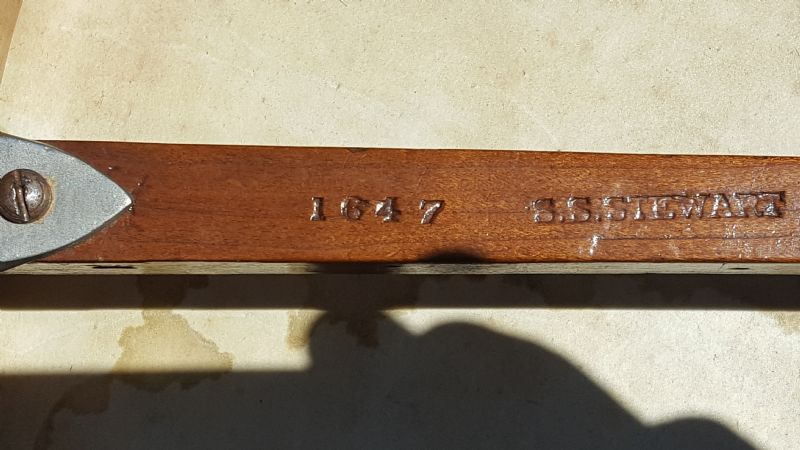
hello i have a SS Stewart banjo made in 1886 serial # 1647 ....i am not a banjo player (play and collect guitars ) but do know some upper level players and builders so i know a little about them . from what i know the fifth string on the lower tuning peg at 5th fret is a drone string and a 6 string banjo is usually like a guitar with all strings going to the headstock and i know there are variations out there but i think thats basically correct ....now about my banjo
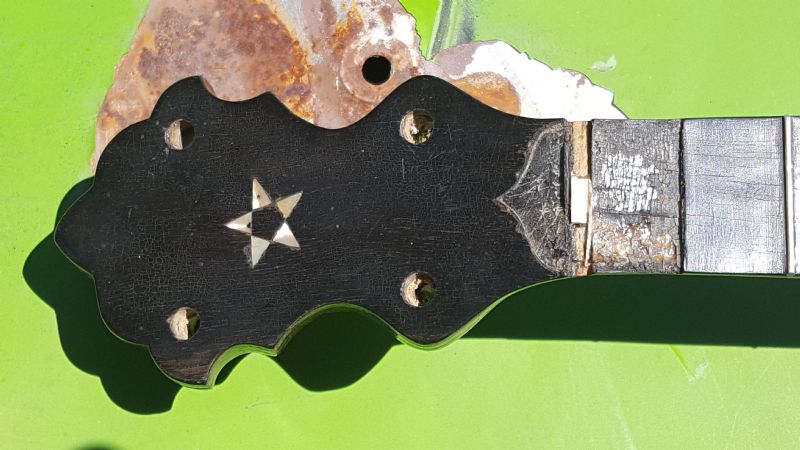
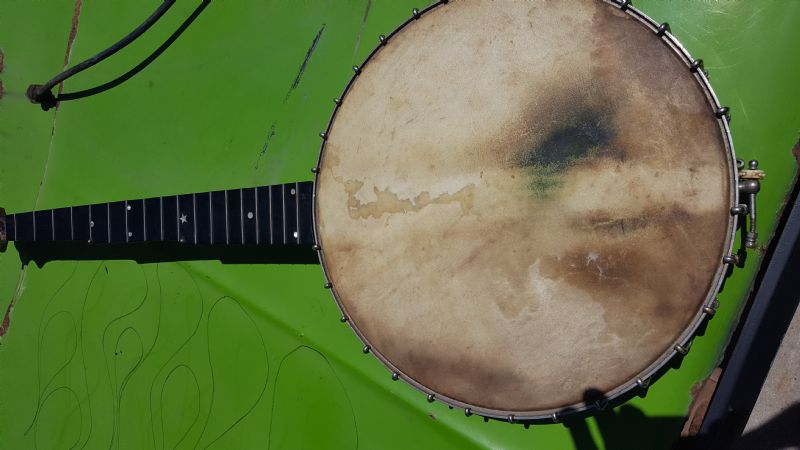
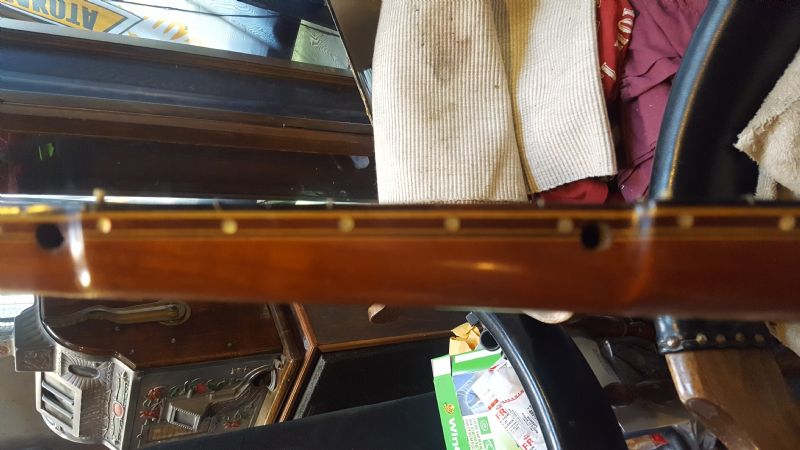
what i have is a SS Stewart with the serial # 1647 on the neck which has 20 frets and the basket thats 13 1/2 in" and has 30 hooks on it ....the thing is it has a double stepped neck with tuning pegs at the 6th fret and the 11th fret ...i have had many people look at this banjo including a local expert who said in 50 years he has never seen anything like it i have sent pics to a contact at Elderly and am still waiting on their findings but being impatient as i am i started my own quest and after looking at literally thousands of pics of banjos and a week of web searching i decided to come ask you all ....
so there you have it in a nutshell what have i got ??? its got 6 strings but its not a 6 string banjo by definition nor is it a 5 string is it a 4 string with 2 drone strings and if so why are the on the 6th and 11th fret instead of the 5th and 10th or something ...i have heard SS Stewart was good for making custom and one off stuff ...is this one ?? .. im going to upload some pics but they are not great quality i will be taking some better photos and will get them posted later today ........Thank You all for your time in helping me solve this mystery in advance
 |  |  |  |
 |  |
tdennis - Posted - 06/26/2016: 11:58:13
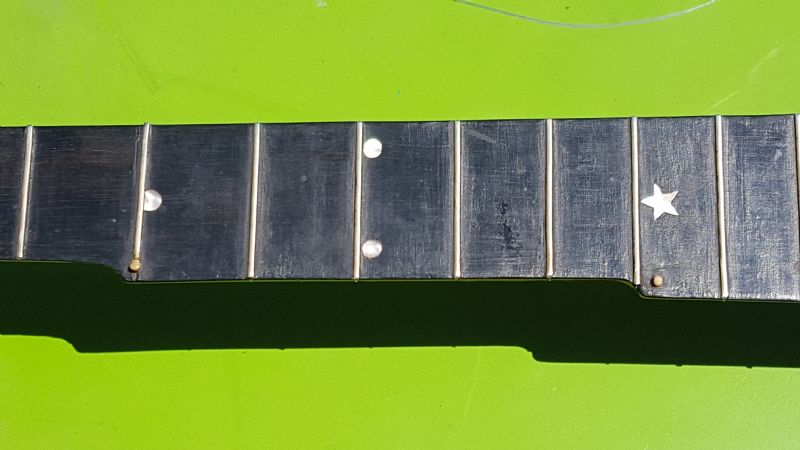
This seems to be a folk project that started out as an S S Stewart banjo. The neck & fret board have been radically altered, & the dowel rod looks to have some kind of splicing. The pot may be original, but I'm not sure the neck is original. The frets & fret markers don't fit correctly. (This is not a Stewart custom job)
1qwik70cuda - Posted - 06/26/2016: 12:11:12
quote:ok i can see that but the inlay work on sides of neck are perfect so as the 3 layers of wood and inlays are unaltered and ive had a local expert banjo builder check it out and that neck is not spliced or altered one bit from how it was made so the fret board may be different or altered but not the neck ....ive been offered a obscene amount for it already so folk project maybe but i doubt it when im offered that kind of bank for it but its not about the money until i figure out what it is the money can wait history cant
Originally posted by tdennis
This seems to be a folk project that started out as an S S Stewart banjo. The neck & fret board have been radically altered, & the dowel rod looks to have some kind of splicing. The pot may be original, but I'm not sure the neck is original. The frets & fret markers don't fit correctly. (This is not a Stewart custom job)
joe28675 - Posted - 06/26/2016: 12:17:37
Very unusual banjo. As a collector of early S.S.Stewart banjo, it's got my interest.
I believe it is original. I have seen a few, a very few, double drone banjos but neve a Stewart with two drone strings. The side dots (Stewart called them professional frets) indicate that it was originally a fretless banjo. A very interesting banjo.
jonredmond - Posted - 06/26/2016: 13:03:49
Some better photos of the sides and back of the neck would be nice. Also more photos of the pot and sides.
jbalch - Posted - 06/26/2016: 13:58:23
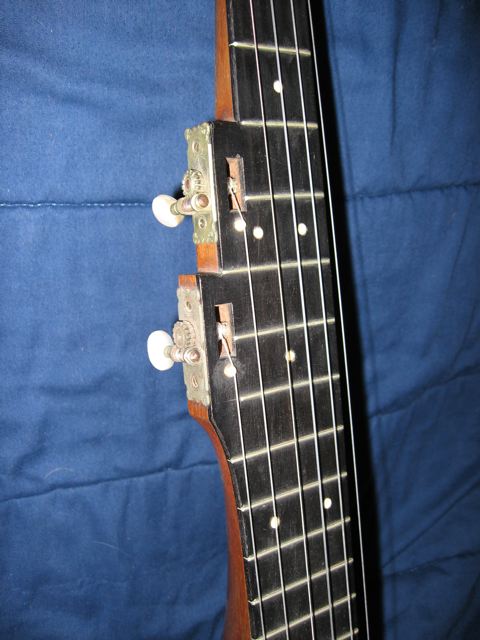
For comparison: Attached are some images of an H. C. Dobson banjo with two short strings. I think these photos were posted several years ago by David Ball.
 |  |  |
Andy FitzGibbon - Posted - 06/26/2016: 16:05:23
quote:
Originally posted by joe28675
Very unusual banjo. As a collector of early S.S.Stewart banjo, it's got my interest.
I believe it is original. I have seen a few, a very few, double drone banjos but neve a Stewart with two drone strings. The side dots (Stewart called them professional frets) indicate that it was originally a fretless banjo. A very interesting banjo.
The neck looks original to me as well, though the frets and perhaps some of the fingerboard inlays are a modification. I have also seen a few double-drone banjos- most or all probably the same ones that Joe has seen. They are not common.
Very interesting instrument.
Andy
Joel Hooks - Posted - 06/26/2016: 16:28:26
Agreed, the neck looks like it was made that way without the raised frets. Very cool. And collectible to the few who are into that. If it were mine, I'd sell it and buy one I could play. Thanks for sharing.
jonredmond - Posted - 06/26/2016: 17:14:00
So was there special music written for these?
I assume it was some type of classic finger style playing. You can see where the previous owner anchored their hand on the head.
Joel Hooks - Posted - 06/26/2016: 18:20:06
None that I know of. And I have (and have played through) over two thirds of his sheet music and book output. SSS would make you anything that you wanted to pay for. Banjos like these are rare for a good reason. Nothing like this shows up in his catalogs (well, not in the dozen or so I've studied). I'm only missing a little over 15 issues of the Journal~~ nothing like this in those either. I'm thinking this is a one off or close to it.
joe28675 - Posted - 06/26/2016: 21:16:27
Rob,
A few observations while we are all waiting for more photos. A banjo type instrument with six equal length strings is a banjo guitar, the word banjo is the adjective but it is a guitar and is played like a guitar. A six string banjo normally refers to a banjo with five equal length strings and one shorter string.
I don't know the proper term for the banjo that you have. Perhaps it doesn't have a proper name since it is so rare. I just call it a double drone.
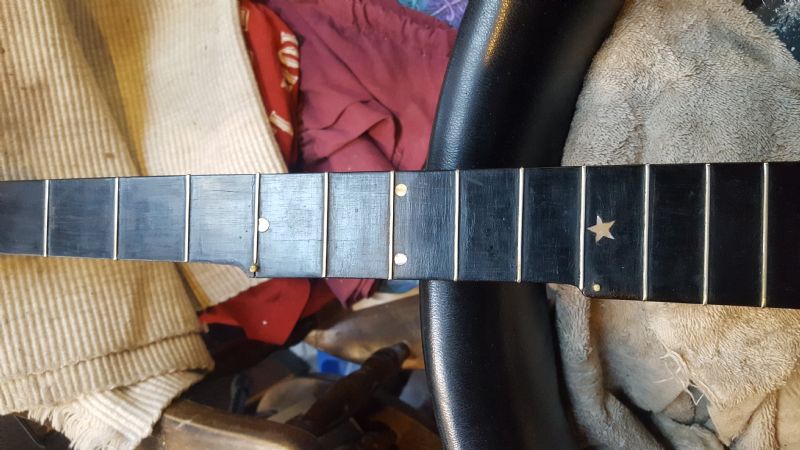
You stated that the drone strings are placed at the six and eleventh frets. Not sure without seeing more photos but I suspect they were originally at the fifth and tenth frets. The side dots were the original scale, count them down. Appears as though the scale length was changed when the frets were added. Also, the spacing from the nut to the first fret and the spacing from the first fret to the second fret doesn't compute, unless it had a very thin nut.
Does this banjo have the serial number stamped on the inside diameter of the rim?
G Edward Porgie - Posted - 06/27/2016: 06:35:24
Distance to the first fret is too short in comparison with the rest. I also note that those side markers are evenly spaced and therefore would be totally inaccurate for marking the original scale.
While this may have been an original Stewart banjo (and I have doubts about that), whoever added those frets didn't seem to quite know what he was doing.
Andy FitzGibbon - Posted - 06/27/2016: 08:37:27
Everyone is assuming that the cut across the fingerboard (shown in the first photo) was a fret slot. I think it's more likely that there was some sort of inlay there that is now missing, and that the fretwire visible above it is the first fret.
That would place the two drone pegs at the 5th and 10th frets, which makes more sense.
Andy
Edited by - Andy FitzGibbon on 06/27/2016 08:40:41
G Edward Porgie - Posted - 06/27/2016: 10:37:09
quote:
Originally posted by Andy FitzGibbon
Everyone is assuming that the cut across the fingerboard (shown in the first photo) was a fret slot. I think it's more likely that there was some sort of inlay there that is now missing, and that the fretwire visible above it is the first fret.
That would place the two drone pegs at the 5th and 10th frets, which makes more sense.
Andy
That is, indeed, a possibility, most likely even a probability. Personally, I wasn't assuming the slot was for a fret, because some of the wood is obviously missing anyway. I don't, however, see any real room for a nut, unless it may have covered a small portion of what certainly was an inlay in the headstock. Precise measurements would help to figure things out, perhaps.
In looking at this again, it does seem to me the scale length was altered when frets were added, as someone else has suggested. What one could assume is the fifth "fret" indicator is almost directly beneath the added fret, but the seventh is somewhat further up the neck than the fret, and the tenth is even further from its fret. This would indicate that the owner preferred a a slightly shorter scale than the original fretless one.
joe28675 - Posted - 06/27/2016: 11:30:10
quote:
Originally posted by Andy FitzGibbon
Everyone is assuming that the cut across the fingerboard (shown in the first photo) was a fret slot. I think it's more likely that there was some sort of inlay there that is now missing, and that the fretwire visible above it is the first fret.
That would place the two drone pegs at the 5th and 10th frets, which makes more sense.
Andy
I concur.......
jonredmond - Posted - 06/27/2016: 11:39:19
quote:
Originally posted by G Edward Porgie
Distance to the first fret is too short in comparison with the rest. I also note that those side markers are evenly spaced and therefore would be totally inaccurate for marking the original scale.
While this may have been an original Stewart banjo (and I have doubts about that), whoever added those frets didn't seem to quite know what he was doing.
Good observation about the side markers. They actually seem randomly spaced (and not lined up very well) and may just be divots drilled into the neck where someone thought the frets might be. But this is all guesswork until some better photos show up. I do love a good banjo mystery.
Andy FitzGibbon - Posted - 06/27/2016: 12:13:25
quote:
Originally posted by G Edward Porgiequote:
Originally posted by Andy FitzGibbon
Everyone is assuming that the cut across the fingerboard (shown in the first photo) was a fret slot. I think it's more likely that there was some sort of inlay there that is now missing, and that the fretwire visible above it is the first fret.
That would place the two drone pegs at the 5th and 10th frets, which makes more sense.
Andy
That is, indeed, a possibility, most likely even a probability. Personally, I wasn't assuming the slot was for a fret, because some of the wood is obviously missing anyway. I don't, however, see any real room for a nut, unless it may have covered a small portion of what certainly was an inlay in the headstock. Precise measurements would help to figure things out, perhaps.
In looking at this again, it does seem to me the scale length was altered when frets were added, as someone else has suggested. What one could assume is the fifth "fret" indicator is almost directly beneath the added fret, but the seventh is somewhat further up the neck than the fret, and the tenth is even further from its fret. This would indicate that the owner preferred a a slightly shorter scale than the original fretless one.
Edited by - Andy FitzGibbon on 06/27/2016 12:16:55
joe28675 - Posted - 06/27/2016: 12:32:14
quote:
Originally posted by Andy FitzGibbon
quote:
Originally posted by G Edward Porgie
quote:
Originally posted by Andy FitzGibbon
Everyone is assuming that the cut across the fingerboard (shown in the first photo) was a fret slot. I think it's more likely that there was some sort of inlay there that is now missing, and that the fretwire visible above it is the first fret.
That would place the two drone pegs at the 5th and 10th frets, which makes more sense.
Andy
That is, indeed, a possibility, most likely even a probability. Personally, I wasn't assuming the slot was for a fret, because some of the wood is obviously missing anyway. I don't, however, see any real room for a nut, unless it may have covered a small portion of what certainly was an inlay in the headstock. Precise measurements would help to figure things out, perhaps.
In looking at this again, it does seem to me the scale length was altered when frets were added, as someone else has suggested. What one could assume is the fifth "fret" indicator is almost directly beneath the added fret, but the seventh is somewhat further up the neck than the fret, and the tenth is even further from its fret. This would indicate that the owner preferred a a slightly shorter scale than the original fretless one.
The first photo shows a nut slot, with what looks like a piece of a bone nut still in place.
The side dots are consistent with those I have seen on other Stewart fretless banjos, ie. not spaced very accurately. I think they were meant to serve as a general guide, and you were to rely on your ear for precise finger placement.
Andy
Andy is correct about the position of the side dots. I currently own 13 fretless S.S.Stewart banjos with professional frets and whereas the location of the side dots might not be exact, they are normally very close. Upon close examination of the banjo, I suspect the place of these indicators will be found to be correct.
G Edward Porgie - Posted - 06/28/2016: 09:54:07
quote:
Originally posted by Andy FitzGibbon
quote:
Originally posted by G Edward Porgie
quote:
Originally posted by Andy FitzGibbon
Everyone is assuming that the cut across the fingerboard (shown in the first photo) was a fret slot. I think it's more likely that there was some sort of inlay there that is now missing, and that the fretwire visible above it is the first fret.
That would place the two drone pegs at the 5th and 10th frets, which makes more sense.
Andy
That is, indeed, a possibility, most likely even a probability. Personally, I wasn't assuming the slot was for a fret, because some of the wood is obviously missing anyway. I don't, however, see any real room for a nut, unless it may have covered a small portion of what certainly was an inlay in the headstock. Precise measurements would help to figure things out, perhaps.
In looking at this again, it does seem to me the scale length was altered when frets were added, as someone else has suggested. What one could assume is the fifth "fret" indicator is almost directly beneath the added fret, but the seventh is somewhat further up the neck than the fret, and the tenth is even further from its fret. This would indicate that the owner preferred a a slightly shorter scale than the original fretless one.
The first photo shows a nut slot, with what looks like a piece of a bone nut still in place.
The side dots are consistent with those I have seen on other Stewart fretless banjos, ie. not spaced very accurately. I think they were meant to serve as a general guide, and you were to rely on your ear for precise finger placement.
Andy
If that is indeed a nut slot and the white thing a piece of the original nut, then in my opinion, it's too close to the first fret for accurate intonation.
Once again, I say that accurate measurements are probably in order. Photos can distort the way spacing appears.
Interesting about the "fretless markers." I would have thought Stewart would have been a little more accurate. Of course, a really experienced and good player wouldn't need them at all.
Andy FitzGibbon - Posted - 06/28/2016: 10:59:55
quote:
Originally posted by G Edward Porgie
If that is indeed a nut slot and the white thing a piece of the original nut, then in my opinion, it's too close to the first fret for accurate intonation.
trapdoor2 - Posted - 06/28/2016: 12:31:16
My $0.02: it is no wonder that the OP is agog at an obscene offer or two...this bit of fluff has everything a collector wants in a unique instrument. Well, except pristine NIB condition. 
To my eyes, it looks authentic. Yah, sure it once was smooth and has been fretted...and perhaps poorly so. Yah, it has some missing bits and some inlay oddities. It is getting very close to 140yrs old...we should expect oddities and alterations.
What it is, is a very cool and possibly significant (to the right collector) bit of SSS history. This is like finding a prototype car in a barn that nobody knew existed. It begs documentation...good measurements, high-quality studio pix, etc., etc.
For me, well...every time I think that ol SSS would do anything for a buck...I see another example that pushes that envelope broader and deeper.
Edited by - trapdoor2 on 06/28/2016 12:32:09
jonredmond - Posted - 06/28/2016: 13:49:30
Andy's statement about the nut is correct I think. The first fret IS in scale with the rest of the frets. The photo is very confusing because a missing inlay that took up half of the area between the nut and the first fret wire is being mistaken for the entire first fret
In other words from left to right in the photo we have: headstock with missing fancy inlay, then the nut slot (with bit of bone left) , then a missing square inlay (which only took up half of the first fret area), then a square bit of black fingerboard, and THEN the first fret wire. I myself was confused into thinking that the missing fretboard inlay was the entire first fret. It is only half of it.
Just goes to show you how misleading photos can be if they are seen out of context to the whole.
Edited by - jonredmond on 06/28/2016 14:02:42
1qwik70cuda - Posted - 06/28/2016: 19:13:30
I have added 40 more pics to my photo album of my SSS thank you all for the input so far ,i am learning a great deal about banjos also
trapdoor2 - Posted - 06/29/2016: 06:41:55
quote:
Originally posted by 1qwik70cuda
I have added 40 more pics to my photo album of my SSS thank you all for the input so far ,i am learning a great deal about banjos also
Winner winner, chicken dinner!
Take this to the ABF rally in October (or the Banjo Collector's Gathering in November)...and watch the Stewart guys dehydrate (from drooling). This is a very, very cool piece of history.
Glad you said the pot diameter is 13-1/2"...cause the pix make it look like 15~!
Joel Hooks - Posted - 06/29/2016: 06:42:33
Okay, I've looked at the added photos closely. One sees the metal heel cap on early SSS banjos. One also sees the slot screws on early SSS' as well. That is about where the similarities end.
I think that this is a British counterfeit. SSS complained about this a lot and I've seen some before. There are things about this that don't look correct. The peg head is one. The rim also looks crude as does all the stampings, SSS' offerings were of better quality. The fingerboard laminations also look British.
I doubt SSS would have changed his formula for export banjos (Including the way he made necks). He could have made a double short string banjo, but the way this one is built does not look like his work. Even the way the short string pegs are carved in and set look wrong.
A little background history. SSS had struck a deal with J. E. Brewster for Brewster to be the exclusive dealer of SSS banjos to England. The deal was going well for a while and Brewster was doing a pretty good business until... Stewart began to get letters from people in England claiming to have seen counterfeit SSS banjos for sale. An example was even shipped to SSS. It turned out that Brewster was behind it (in the beginning, I've seen more than a few obviously British SSS knock offs). SSS outed Brewster and publicly cut ties with him.
I'm open to arguments, esp. with photo examples showing SSS work that looks like this one. It is interesting as a period counterfeit.
Edited by - Joel Hooks on 06/29/2016 06:44:01
trapdoor2 - Posted - 06/29/2016: 06:58:23
Joel, I did think the dowelstick stampings were 'odd'...but the photos of those are not very clear, I would like to see a nice, clear, close-up of the dowelstick. The pix are great but, of course, they're not big enough or detailed enough.
And...I'd like to see example photos of known Brit. copies. I've read about Stewart's issues with the Brits but I've never actually seen a Brewster-built Stewart. Most of the copies I've seen were obviously made from European woods...this looks like standard Stewart 'PA Cherry' to me.
Stephen John Prior - Posted - 06/29/2016: 08:30:19
I think Joel's Brewster suggestion is very interesting. I have a Brewster Grand Concert here at present and it does have certain similarities with the banjo in question. For example the neck lamination's, bracket bolt heads, heel shape and metal cap. I was assuming the Brewster had been made by Dallas. I will post some photos later.
Andy FitzGibbon - Posted - 06/29/2016: 11:46:07
The peghead (shape and inlay) and rim construction both look the same as other early Stewarts that I've worked on or examined. So do the fingerboard laminations and the stamps on the rim and dowel. The photos are nowhere near large enough for me to draw a definite conclusion, though I probably wouldn't anyway, unless I had the opportunity to examine the banjo in person.
Yes, Stewart complained of imitators. Stewart said a lot of things that, while they reinforced his assertion that he was the best banjo maker around, did not necessarily have facts backing them up.
I have seen a few British banjos that were definitely copies of Stewart's work, but they were not counterfeits (ie. they were marked with the maker's name). I've never seen one marked S. S. Stewart that I felt was not made in Stewart's factory.
Andy
jonredmond - Posted - 06/29/2016: 11:57:44
Also, why would someone counterfeit a banjo that S.S. Stewart didn't sell? Counterfeiters cash in on what is popular and easy to sell. Not double drone string banjos.
Joel Hooks - Posted - 06/29/2016: 13:33:22
quote:
Originally posted by Andy FitzGibbon
The peghead (shape and inlay) and rim construction both look the same as other early Stewarts that I've worked on or examined. So do the fingerboard laminations and the stamps on the rim and dowel. The photos are nowhere near large enough for me to draw a definite conclusion, though I probably wouldn't anyway, unless I had the opportunity to examine the banjo in person.
Yes, Stewart complained of imitators. Stewart said a lot of things that, while they reinforced his assertion that he was the best banjo maker around, did not necessarily have facts backing them up.
I have seen a few British banjos that were definitely copies of Stewart's work, but they were not counterfeits (ie. they were marked with the maker's name). I've never seen one marked S. S. Stewart that I felt was not made in Stewart's factory.
Andy
I may be wrong about this being a knock off, but I will disagree with you re SSS being a liar. If one reads all of the things he wrote and cross checks his claims and facts with dates and other sources where available, it can be seen that he was surprisingly accurate with high accountability as others would call him out on any falsities. He also printed retractions when he was wrong. "Meaningful research" is much better than recycling the misinterpreted information that has been written about him in "histories of the banjo."
I have no doubt that you have a vast knowledge about the banjos that he built as your craftsmanship speaks for itself, so I will defer to your expert on the authenticity of this banjo.
csacwp - Posted - 06/29/2016: 13:50:21
Stewart had such a problem with counterfeiters that he had to resort to using multiple trademarks in addition to his name stamp and serial number system. To me this banjo looks suspect. While I can't say anything for certain without handling it, the neck wood, rim metal, and thickness of the fingerboard all look suspect.
Edited by - csacwp on 06/29/2016 13:52:04
Andy FitzGibbon - Posted - 06/29/2016: 18:27:31
banjohangout.org/global/ckedit.../icon.png) center no-repeat #ff0000;cursor:pointer;top:-8px;-moz-border-radius:2px;border-radius:2px" title="Insert paragraph here">↵
quote
:
Originally posted by Joel Hooks
quote:
Originally posted by Andy FitzGibbon
The peghead (shape and inlay) and rim construction both look the same as other early Stewarts that I've worked on or examined. So do the fingerboard laminations and the stamps on the rim and dowel. The photos are nowhere near large enough for me to draw a definite conclusion, though I probably wouldn't anyway, unless I had the opportunity to examine the banjo in person.
Yes, Stewart complained of imitators. Stewart said a lot of things that, while they reinforced his assertion that he was the best banjo maker around, did not necessarily have facts backing them up.
I have seen a few British banjos that were definitely copies of Stewart's work, but they were not counterfeits (ie. they were marked with the maker's name). I've never seen one marked S. S. Stewart that I felt was not made in Stewart's factory.
Andy
I may be wrong about this being a knock off, but I will disagree with you re SSS being a liar. If one reads all of the things he wrote and cross checks his claims and facts with dates and other sources where available, it can be seen that he was surprisingly accurate with high accountability as others would call him out on any falsities. He also printed retractions when he was wrong. "Meaningful research" is much better than recycling the misinterpreted information that has been written about him in "histories of the banjo."
I have no doubt that you have a vast knowledge about the banjos that he built as your craftsmanship speaks for itself, so I will defer to your expert on the authenticity of this banjo.
I don't call Stewart a liar, but he does not seem to have been above "massaging" the truth when it suited his needs. His descriptions of his own instruments, and their construction methods (which is the writing of his that I am most familiar with) are sometimes a bit fanciful, and sometimes are not entirely accurate.
Telling the buying public that you have a huge problem with counterfeiting because your banjos are so popular and well regarded is a great way to sell more banjos. I'm sure he did have a problem with counterfeiting. But I also think he probably wasn't above talking the problem up as a sales tool, and that's not a bad thing- it's just good salesmanship. Advertising of the time was awash in hyperbole, and Stewart was no worse than just about anyone else who was selling a product.
I'd have to look at the banjo in person to say any more about it than I already have.
Andy
Tim Mullins - Posted - 06/29/2016: 19:07:12
I know next to nothing about Stewarts or fretless banjo styles from this era, but if this were in C tuning with the first drone a G and the second a C it might make a lot of sense.
Stephen John Prior - Posted - 06/30/2016: 04:12:41
Early Brewster Fretless.
 Brewster | 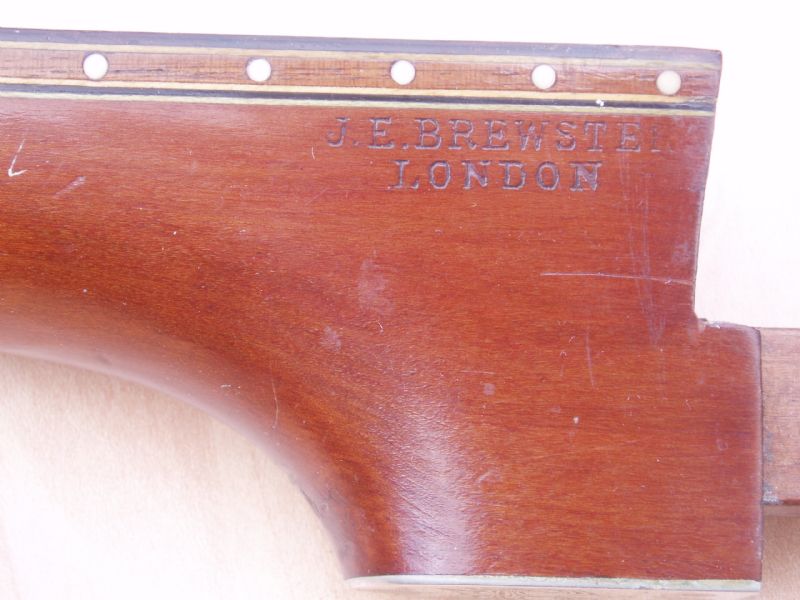 Brewster | 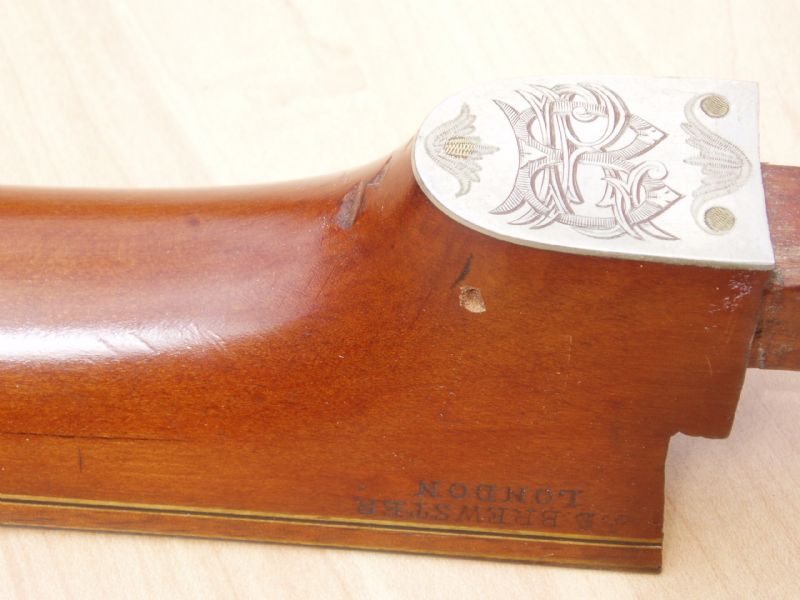 Brewster | 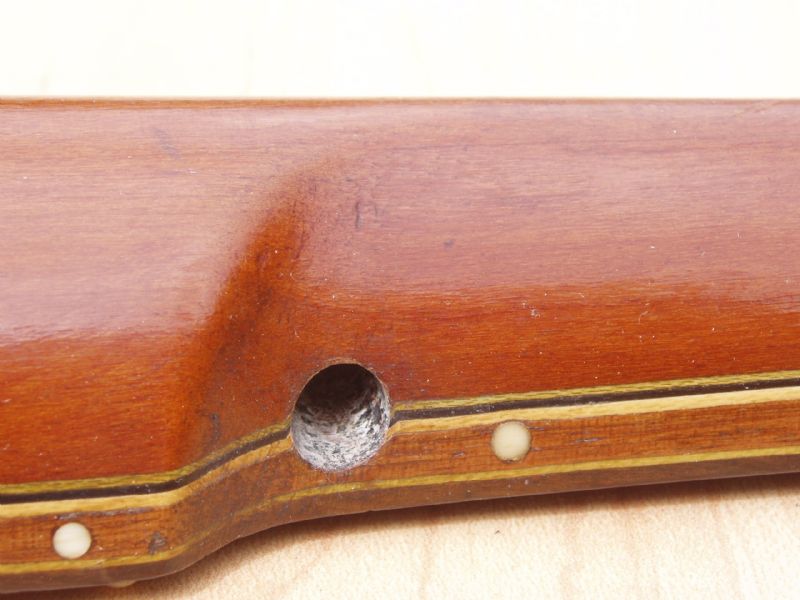 Brewster |
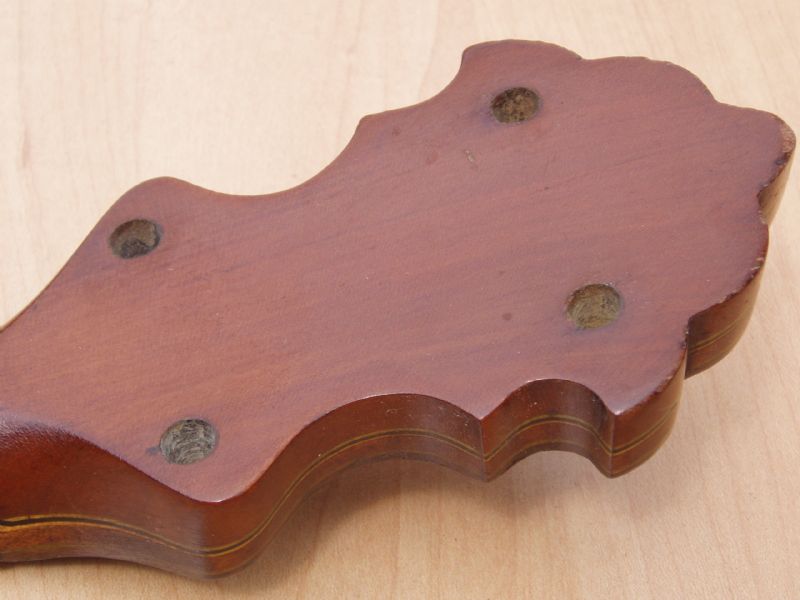 Brewster |
trapdoor2 - Posted - 06/30/2016: 07:21:16
Oh my. The Brewster's headstock shape, laminations and side dots look like a damn close match to the OPs banjo.
Thank you for those pix!
joe28675 - Posted - 06/30/2016: 09:04:26
quote:
Originally posted by trapdoor2
Oh my. The Brewster's headstock shape, laminations and side dots look like a damn close match to the OPs banjo.
Thank you for those pix!
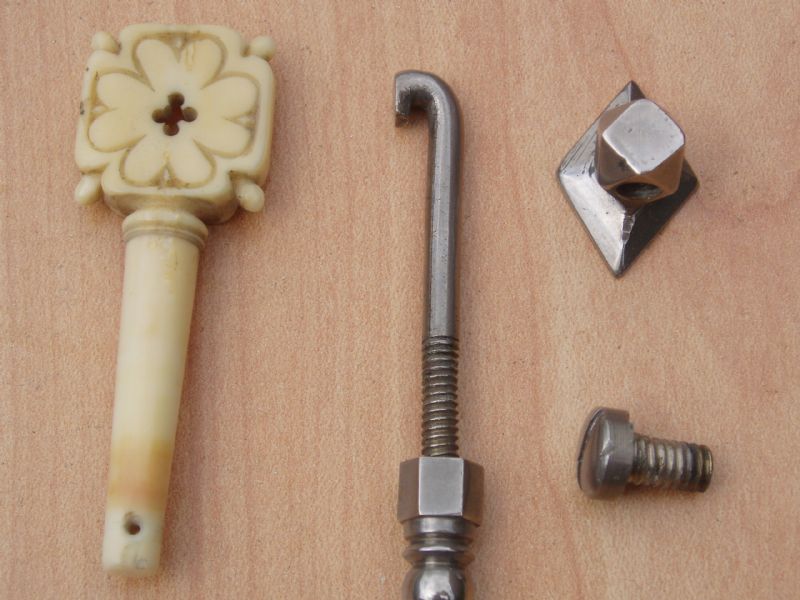
Stewart also used a similar bracket on a few banjos, which were attached via stud & nut.
 Studs&Hexnuts | 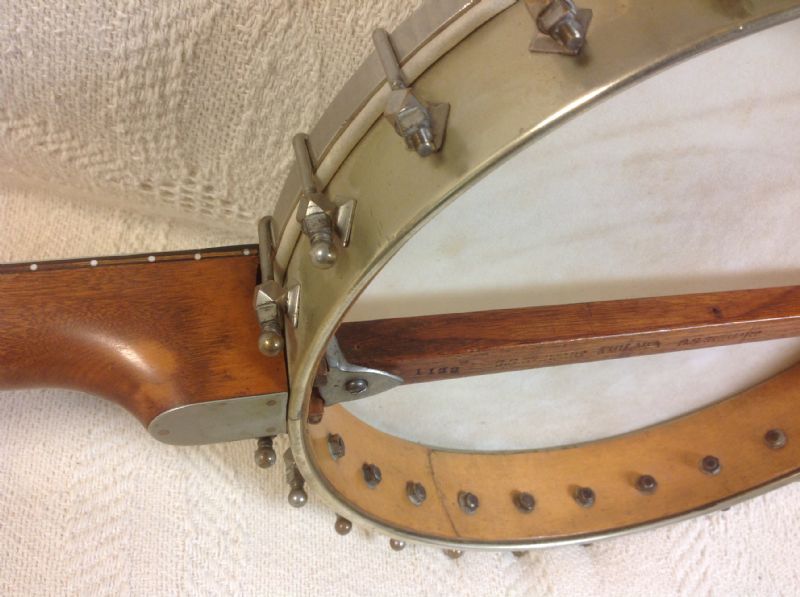 Schall type brackets |
Andy FitzGibbon - Posted - 06/30/2016: 09:22:35
I wonder if the Brewster was made by Stewart, for Brewster to stamp with his own name?
Andy
Stephen John Prior - Posted - 06/30/2016: 09:42:18
As i said previously i had assumed it was made for Brewster by J E Dallas. But, the neck looks like Cherry to my eye which would be rare for an English maker from that period. Dallas made instruments are mostly Walnut. I would be grateful for any information regarding Stewart's dealings with Brewster.
Joel Hooks - Posted - 06/30/2016: 12:03:04
SJP, Thanks for posting the photos, it looks like a good banjo! Could we see more? If you can wait until this weekend then I'll post all the articles I have on Brewster.
Andy, that is an interesting thought. I can't think of a single incident where SSS had done contract work under another name. That is not to say that he did not as I do not know for sure. I do know that he sold low end banjos that he bought from another manufacturer (advertised as such), I'm not sure how they were stamped. He insinuated that they were a closeout or special buy. As he was operating a music store on the first floor of his factory and at one time added a second store, he sold just about everything you would find in a typical music store for all pricepoints.
S&R Acme banjos were actually made by Stewart and Bauer -- Swaim was dead and Fred was managing the factory for less than one year of production under the Acme name. George Bauer had his way with the company, selling it off piece by piece until he could force bankruptcy and take control. Banjos were sold to S&R by SSS but under the Stewart name (and advertised in the catalogs as such) before the Acme trademark. Sears did sell Acme stamped banjos by other firms (including J. B. Schall) before SSS started making them. I wish we could put the "Stewart contract with S&R to build Acme Banjos" myth to bed as it actually happed about 1900 and no earlier than 1899, yet it still persists despite my documenting the actual story many times on BHO.
 S&R No 107 |
G Edward Porgie - Posted - 06/30/2016: 12:41:54
quote:
Originally posted by jonredmond
Andy's statement about the nut is correct I think. The first fret IS in scale with the rest of the frets. The photo is very confusing because a missing inlay that took up half of the area between the nut and the first fret wire is being mistaken for the entire first fret
In other words from left to right in the photo we have: headstock with missing fancy inlay, then the nut slot (with bit of bone left) , then a missing square inlay (which only took up half of the first fret area), then a square bit of black fingerboard, and THEN the first fret wire. I myself was confused into thinking that the missing fretboard inlay was the entire first fret. It is only half of it.
Just goes to show you how misleading photos can be if they are seen out of context to the whole.
I never assumed that the wood was the entire 1st fret. I always assumed something was missing there, and based my opinion of it being less than the optimal length on the overall distance between the bit of bone and the fret. (And I might add that I never felt it a "surprise," but was only pointing out what I felt was an issue.)
I agree with you that photos are sometimes inaccurate and misleading. I've mentioned more than once that measurements would help.
As far as whether this is a Stewart or not, I am ill-qualified to say. I have merely been pointing out a few things that may have gone unnoticed by others (but maybe not!). Sometimes a disinterested observer's ideas can help when others may have already formed contradictory opinions.
Andy FitzGibbon - Posted - 07/01/2016: 05:10:15
quote:
Originally posted by Joel HooksSJP, Thanks for posting the photos, it looks like a good banjo! Could we see more? If you can wait until this weekend then I'll post all the articles I have on Brewster.
Andy, that is an interesting thought. I can't think of a single incident where SSS had done contract work under another name. That is not to say that he did not as I do not know for sure. I do know that he sold low end banjos that he bought from another manufacturer (advertised as such), I'm not sure how they were stamped. He insinuated that they were a closeout or special buy. As he was operating a music store on the first floor of his factory and at one time added a second store, he sold just about everything you would find in a typical music store for all pricepoints.
S&R Acme banjos were actually made by Stewart and Bauer -- Swaim was dead and Fred was managing the factory for less than one year of production under the Acme name. George Bauer had his way with the company, selling it off piece by piece until he could force bankruptcy and take control. Banjos were sold to S&R by SSS but under the Stewart name (and advertised in the catalogs as such) before the Acme trademark. Sears did sell Acme stamped banjos by other firms (including J. B. Schall) before SSS started making them. I wish we could put the "Stewart contract with S&R to build Acme Banjos" myth to bed as it actually happed about 1900 and no earlier than 1899, yet it still persists despite my documenting the actual story many times on BHO.
Joel Hooks - Posted - 07/01/2016: 05:52:26
L&H/ Washburn was one of the companies he accused of making copies. In one issue of the Journal he wrote an article about someone bringing into the factory a L&H banjo that was exactly like his in every way "except the tone." I've also seen (and even owned for a while) a L&H that was pretty much a Cole banjo-- even the inlays were fooling people at the one collectors gathering I went to in Nashville (Carl Anderson owned it at the time-- and does now). It was marked Elise Howe (music jobber- not sewing machine). Still-- it was not a Cole but a knock off of the design. Excellent banjo.
Seems SSS copies (not marked SSS) by L&H have been posted here in the past. I'll see if I can search and find some discussions on them.
Andy FitzGibbon - Posted - 07/01/2016: 07:59:47
quote:
Originally posted by Joel HooksL&H/ Washburn was one of the companies he accused of making copies. In one issue of the Journal he wrote an article about someone bringing into the factory a L&H banjo that was exactly like his in every way "except the tone." I've also seen (and even owned for a while) a L&H that was pretty much a Cole banjo-- even the inlays were fooling people at the one collectors gathering I went to in Nashville (Carl Anderson owned it at the time-- and does now). It was marked Elise Howe (music jobber- not sewing machine). Still-- it was not a Cole but a knock off of the design. Excellent banjo.
Seems SSS copies (not marked SSS) by L&H have been posted here in the past. I'll see if I can search and find some discussions on them.
Stephen John Prior - Posted - 07/03/2016: 09:15:07
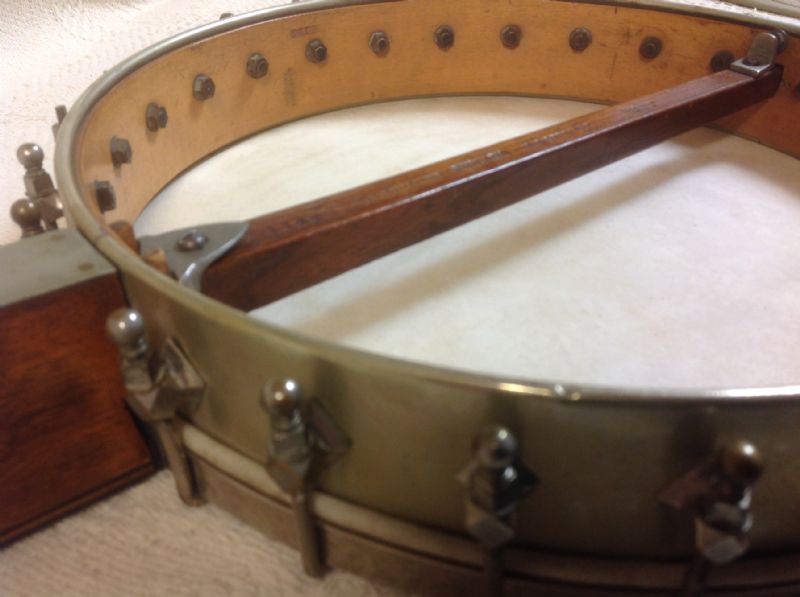
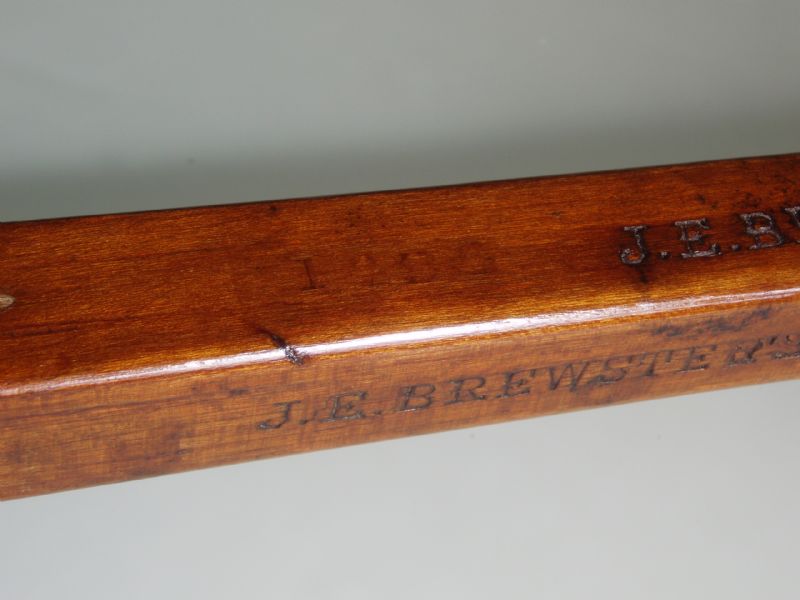
Further information on the Brewster. On cleaning up the pot i noticed the ghostly remains of two S S Stewart stamps on the inside of the rim either side of the liner join. Plus you can just make out a 4 figure number on the dowel which appears to have been refinished and stamped Brewster.
 Stamps | 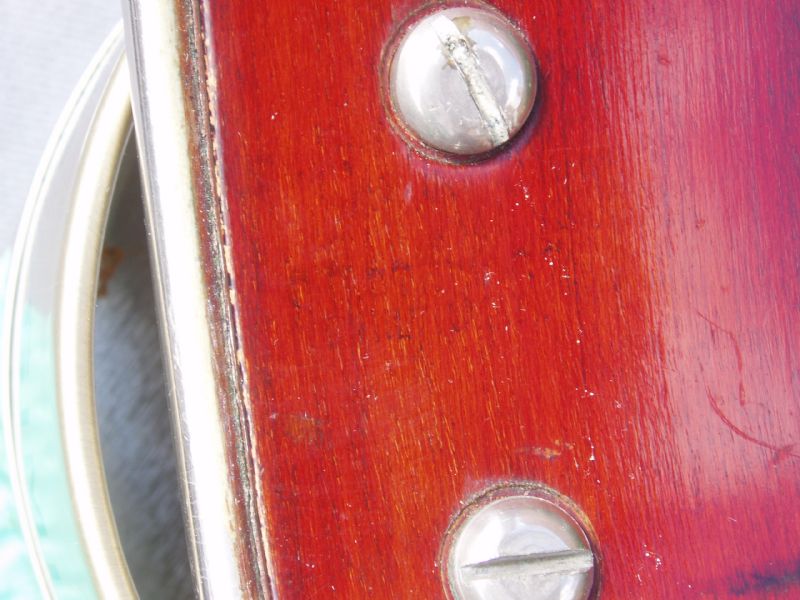 Stamps ? |
esmic - Posted - 07/03/2016: 16:35:33
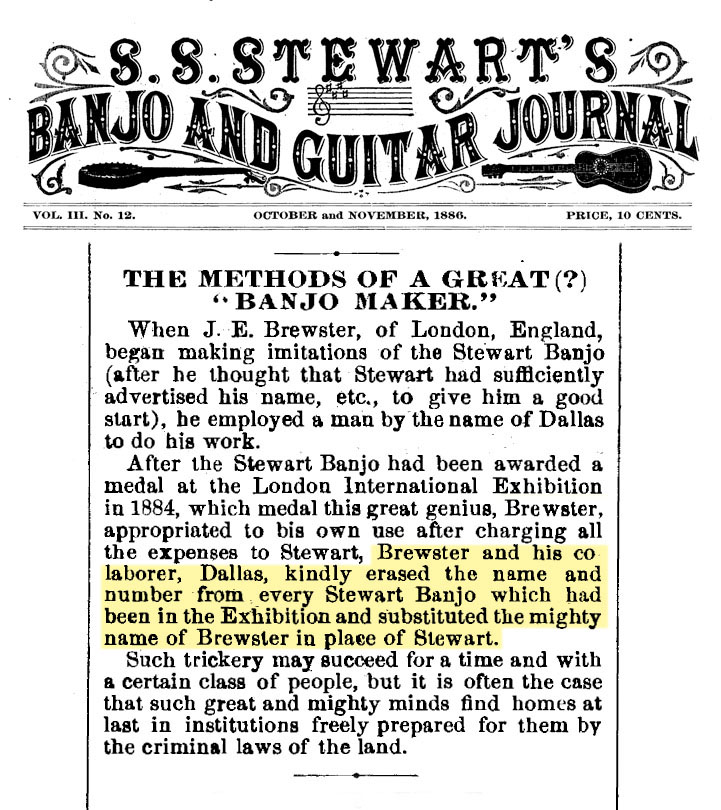
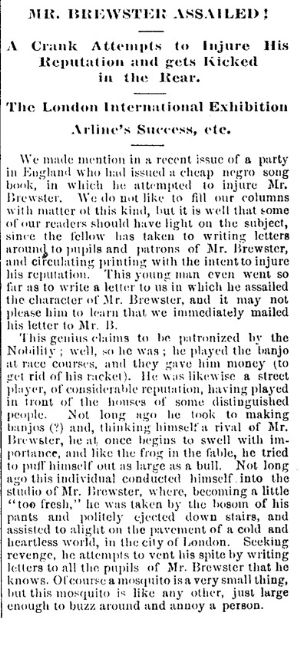
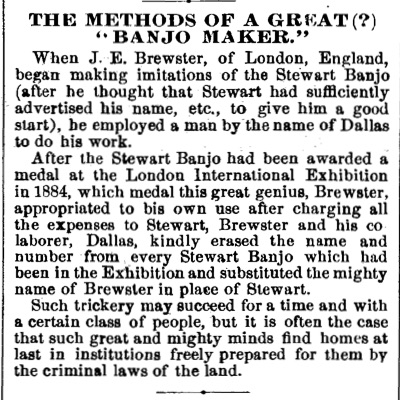
Brewster was a Stewart agent, authorized to sell Stewart banjos but not to rebrand them. In 1886 Stewart wrote a piece on Brewster's fraudulent rebranding, using Dallas as his accomplice. (see below)
The above "Brewstered" Stewart banjo may have been from the batch Stewart referred to, originally displayed at the 1884 London International Exhibition.
As for the oddity with double drone, I agree with Andy and Joe; based on the available (low-res) photos, it appears to be a Stewart original. Also, keep in mind, SSS was no stranger to novelty instruments, having made and promoted the equally awkward giraffe banjo.
 |
joe28675 - Posted - 07/03/2016: 18:12:14
Steven, looks as though you have quite a piece of history in that Brewster fretless.
The earliest Stewart banjo that I have seen with the later peghead shape is serial # 1605. The latest Stewart banjo that I have seen with the earlier shape peghead is serial # 1783. Quite an overlap. Would be nice to determine the number on your Brewster.
Dose your Stewart/Brewster have it's original end pin? If so, does it screw onto the end of the stick (perch pole) and fit into a square hole in the pot?
Stephen John Prior - Posted - 07/04/2016: 03:50:42
Thanks Shawn fascinating stuff. I vaguely remember reading something about the Brewster/Dallas relationship not lasting long either.
Joe. On closer inspection the serial number reads 1494. Unfortunately the dowel end has been altered slightly and the original bolt hole plugged and re-drilled.
However it does have the square hole in the rim that the dowel end fits into. It would be really helpful to me if you have photos of an original.
Joel Hooks - Posted - 07/04/2016: 08:05:33
It took me longer than I thought it would but I think it is fitting that I make this post on American Independence day.
I was incorrect-- mostly my not paying close enough attention to this drama when I first read all the journals. SSS did not ever claim that a English banjo maker was counterfeiting his banjos, only making copies of his designs. What he did claim was that English music publishers were plagiarizing his music. He was correct on both accounts.
SSS' relationship with J. E. Brewster started about or before 1882 when letters start showing up in the SSS Banjo and Guitar Journal. I do not know exactly when this happened because I am missing 6 issues of volume 1.
In 1882 SSS published two music numbers "Brewster's Favorite Polka" (#75) and "Brewster's Favorite Waltz" (#116). The waltz is typical for the time, put the polka is very musical and fun to play. both numbers are attached below as PDFs.
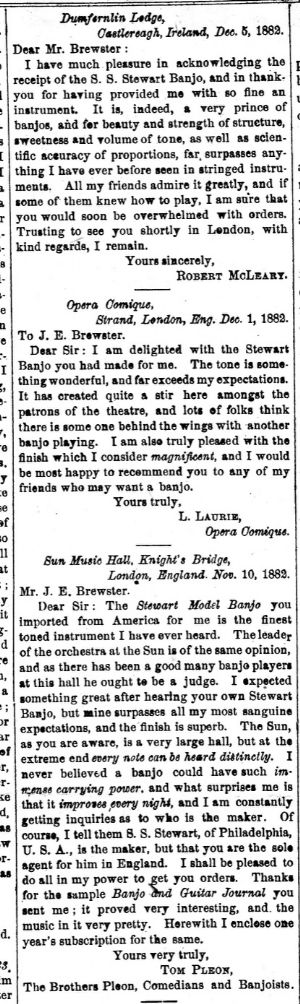
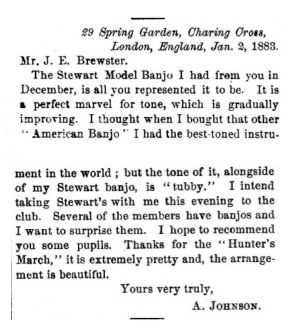
SSS has been in business for 3/4 years, Brewster is selling banjos for him in England and all is great.
In 1883 SSS starts to run ads for Brewster as a banjo teacher in and representative.

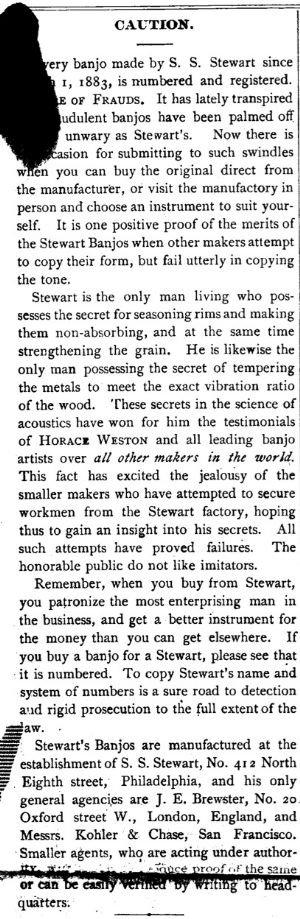
In July of 1883 SSS publishes this unrelated notice, repeating a previous notice that all SSS banjos made since March 1, 1883 have a serial number stamped on them and registered.
 Brewster's Favorite Waltz | Brewster's Favorite Polka |
Joel Hooks - Posted - 07/04/2016: 08:16:51
Things were going so well that J. E. Brewster sails for the US, stays at SSS' house and then leaves with a load of banjos.
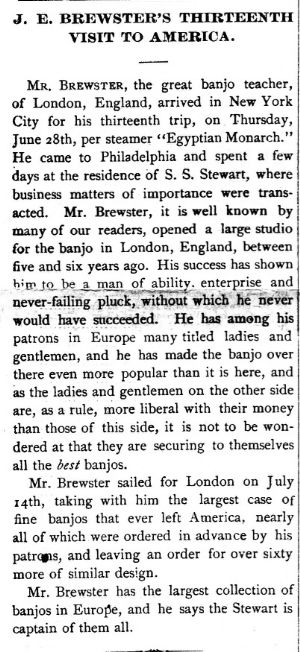
SSS and Brewster were on such good terms that SSS was protecting JEB's reputation in print.
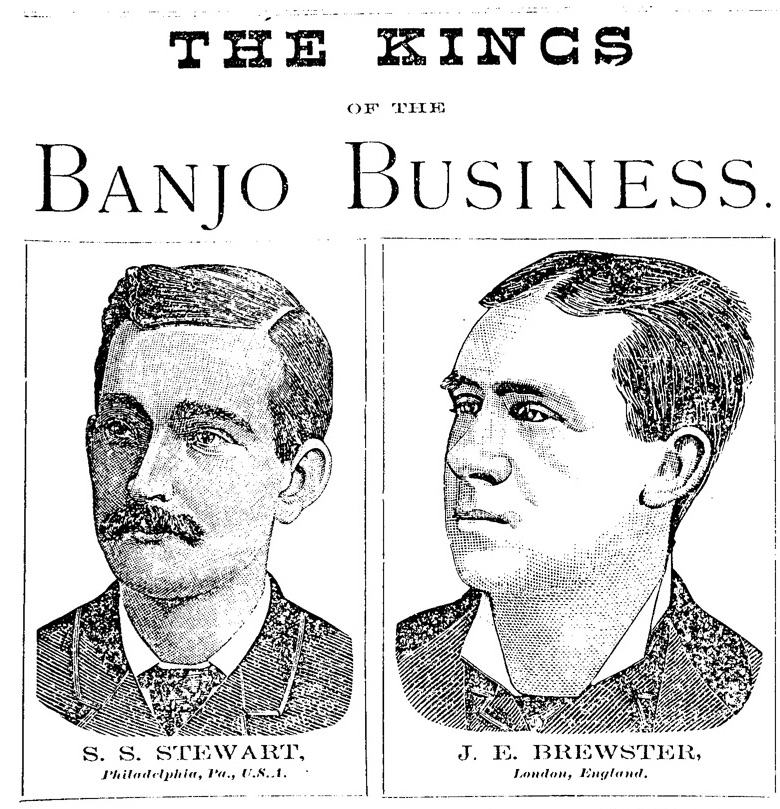
That same year SSS proclaims them both...
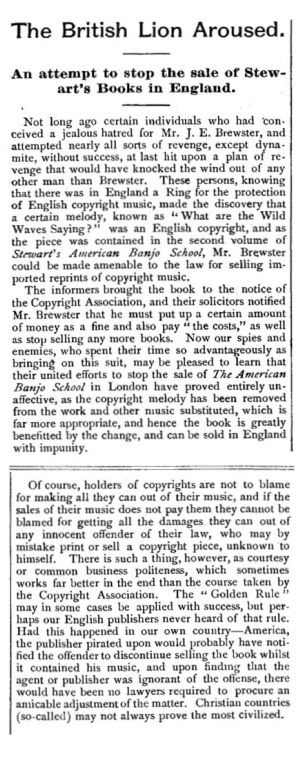
JEB even ran into some copyright trouble selling a SSS instruction book. Funny that the English were so concerned with copyright protection when Herbert J. Ellis (another English banjoist) would end up plagiarizing over 300 of SSS' publications.
Joel Hooks - Posted - 07/04/2016: 08:42:46
All good things come to an end and in February of 1886 this notice is published.
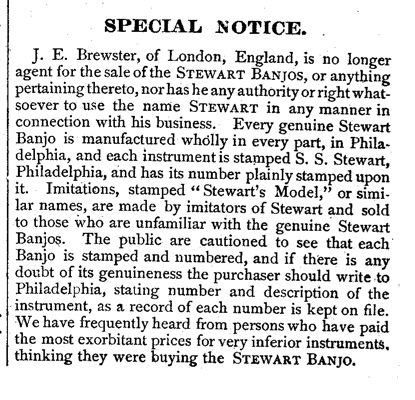
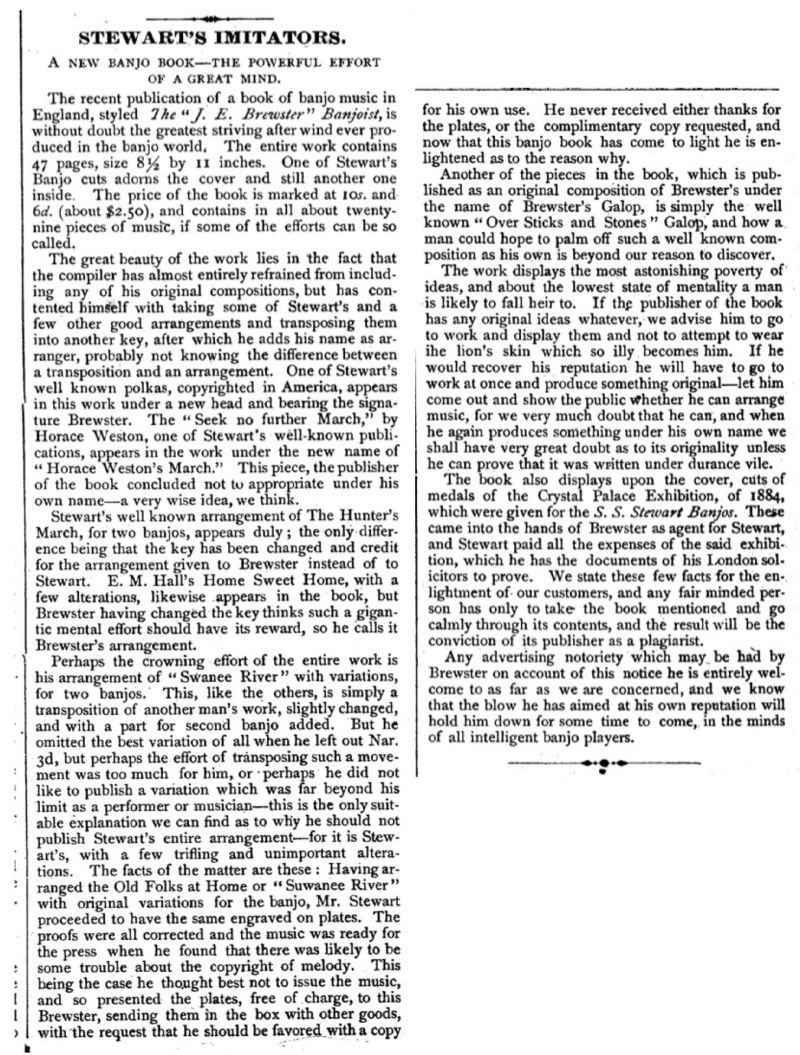
In April of 1886 SSS run this article. The subject book article may be found on the Classic Banjo Ning site complete with metals and SSS banjo on the cover.
And in October of 1886 SSS published that following accusation and as Shawn pointed out is consistent with SJP's example.
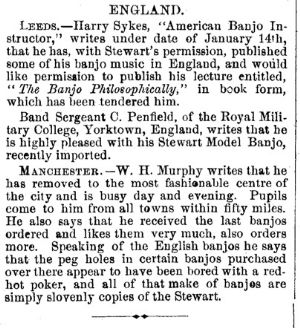
Stewart continues to claim that the English are copying his designs-- and they were. A little background. SSS started building banjos in 1878-1879. His early banjos were experimental and often he tried different things. Most banjos to be had at that time were "trade" banjos of "minstrel stage" style, large with smooth fingerboards or cheap copies of the New York School banjos made by Wilson & Farnham or Jimmy Clarke. W&F (and later Clarke) were making "Silver Rim" (clad/spun/whatever you want to call it) banjos as early as 1855. These were being used by professional banjoist on stage and were very limited in production. SSS took that design (about the time that Clarke was suffering from the effects TB) and refined it to be stronger, more refined and player friendly. SSS should be credited for putting the banjo in the basic formula that is still being made today (because he did).
Page: 1 2
Terms of Use | Privacy Policy | Privacy Consent (EU/GDPR Only)
Copyright 2026 Banjo Hangout. All Rights Reserved.


