
DVD-quality lessons (including tabs/sheet music) available for immediate viewing on any device.
Take your playing to the next level with the help of a local or online banjo teacher.
Weekly newsletter includes free lessons, favorite member content, banjo news and more.
Premier Sponsors


|
Please note this is an archived topic, so it is locked and unable to be replied to. You may, however, start a new topic and refer to this topic with a link: http://www.banjohangout.org/archive/319511
robobanjo - Posted - 06/15/2016: 06:20:30
Hey all - I just ordered a 4-Star goat skin head from John Balch. It's coming pre-mounted and sealed (better contends with humidity), for my 11 13/16" Vega Little Wonder banjo. I'm really excited about slapping it on and virtually convinced it will be a profound improvement in tone, and much to my enjoyment. I know that Balch's heads (click here for his price list) are very popular in 5-string clawhammer old-time music circles. Also, a whole slew of banjo makers like Jason Romero (any many others) seem to be making most if not all of their banjos with goat/calf skin heads these days. The skin heads are really taking on in popularity in 5-string; to lesser extent in 4-string jazz; but virtually not at all in 4-string Irish Trad. My question is "why do you think the interest is slower to emerge in 4-string irish Trad?" Thoughts? Opinions? If you have a good/modern skin head it is not plunky at at all, and can really improve the tone. I know there's the concern about having to contend with humidity, but that concern seems to be a thing of the past as well, and much overstated. My sense is that the industry began promoting plastic heads and everyone jumped on board and lost touch with the greatness of tone that comes from a skin head ... thoughts? Opinions?
Incidentally, here are 2 Youtube videos of folks playing Irish Trad on open-back banjos with skin heads. These are what convinced me to give it a try myself. The 1st video is one where the fella has a John Balch skin head. I like his sound more more than the 2nd. Of course the banjo, set up, and player influence the sound as well!
Rob
Edited by - robobanjo on 06/15/2016 18:15:02
grober83 - Posted - 06/15/2016: 08:11:19
Sounds great! Be sure to share your video when you git er did.
prooftheory - Posted - 06/15/2016: 11:36:38
I may be wrong here but I suspect that most of the 5-string use of skin heads is by old-time players rather than bluegrass. In old-time the deep plunky tone is much more important that note separation, whereas bluegrass has a strong emphasis on being able to hear each note being plucked. It seems to me that ITM is closer to bluegrass in this respect. Jazz playing is an interesting case depending on the person playing. I imagine that players who emphasize chords might be more amenable to skin heads than players who emphasize lines. In the end, it all depends on the player and their preferences in terms of tone. It does seem to me that there has been a drift away from really super bright tone in both ITM and Jazz recently.
Mark Cox - Posted - 06/15/2016: 17:09:40
The skinheads were most definitely a problem for pickers back in the old days. There were no plastic banjo heads before 1959. So all that old flatt and Scruggs and Stanley brother stuff that we all love so much was all recorded with skinheads. Skinheads were a lot of trouble but they were mostly trouble for the traveling musicians because they were all over the United States in different environments all the time. They definitely had to tweak their banjos a lot. If you buy a skinhead nowadays it's definitely going to be better quality than you could've gotten back then, And once you get it on and get it set up correctly you shouldn't have much trouble with it because it will always be in the same environment. Instead of traveling around from state to state every day. There's a video on YouTube of Jim Mills interviewing JD Crowe. And he talks about it in that interview. Look it up. Very interesting interview. Good stuff.
mikeyes - Posted - 06/16/2016: 09:48:35
There were some very high quality skin heads back in the day, the Joseph Rogers high end skins are still sought after. I had a three star Rogers on a Vega Little Wonder that sounded terrific. The trick, especially in the winter, was to tune the head about 80% of optimal and let my body heat bring up the rest during the session. This meant that you were tuning and retuning during the first part of the session, but it eventually adjusted. I would slacken the head a little at the end before going home.
Skin heads are the best and the worst of all worlds depending on the humidity and the state of the head tuner (meaning you, of course) and the reason that mylar heads became so popular. Good head quality is essential and a well made head is strong and consistent. It takes a lot to destroy a skin head but if you dry it out and tighten it up for a few years, it will break. Mostly it is a different mind set that is needed to have one and you will have bad days every so often. In the winter I still have to tune and retune my plastic heads due to temperature changes from cold to warm, but it is not as radical as a skin head, mostly because plastic is affected by temperature and skin both temperature and humidity which go hand in hand in the winter months or the summer in the south.
I still have one banjo with a skin head and I love the sound when it is on. It outperforms all my other heads, but it is a PITA to keep at optimal sound and you have to plan ahead. I think I read somewhere that fully half the banjo patents were designed to keep the heads tight or more easily controllable.
Mike Keyes
Tom Hanway - Posted - 06/18/2016: 00:30:57
quote:
Originally posted by mikeyes
There were some very high quality skin heads back in the day, the Joseph Rogers high end skins are still sought after. I had a three star Rogers on a Vega Little Wonder that sounded terrific. The trick, especially in the winter, was to tune the head about 80% of optimal and let my body heat bring up the rest during the session. This meant that you were tuning and retuning during the first part of the session, but it eventually adjusted. I would slacken the head a little at the end before going home.
Skin heads are the best and the worst of all worlds depending on the humidity and the state of the head tuner (meaning you, of course) and the reason that mylar heads became so popular. Good head quality is essential and a well made head is strong and consistent. It takes a lot to destroy a skin head but if you dry it out and tighten it up for a few years, it will break. Mostly it is a different mind set that is needed to have one and you will have bad days every so often. In the winter I still have to tune and retune my plastic heads due to temperature changes from cold to warm, but it is not as radical as a skin head, mostly because plastic is affected by temperature and skin both temperature and humidity which go hand in hand in the winter months or the summer in the south.
I still have one banjo with a skin head and I love the sound when it is on. It outperforms all my other heads, but it is a PITA to keep at optimal sound and you have to plan ahead. I think I read somewhere that fully half the banjo patents were designed to keep the heads tight or more easily controllable.
Mike Keyes
It takes a lot to destroy a skin head but if you dry it out and tighten it up for a few years, it will break.

bartmcneil - Posted - 06/18/2016: 14:22:22
The breaking of a skin head is rare enough that I would not consider it a detriment. I have seven skin head banjos and have not broken a head in seven years of playing.
AllanJ - Posted - 06/19/2016: 03:54:45
Very timely thread - I put a new head on my Clifford Essex yesterday evening (which I'm going to have to re-do as it's got a bit creased around the flesh hoop :-/ ).

I've never had too much trouble with vellums but I live in an area with fairly consistent temperature / humidity. The only time I ever broke one was carelessly tightening an old zither banjo. I suspect the volume might be slightly less than with a plastic head - but I've never heard any one at a session complaining that they can't hear the tenor banjo..
Look forward to heading the results!
Allan
Joel Hooks - Posted - 06/19/2016: 06:17:29
quote:
Originally posted by AllanJ
Very timely thread - I put a new head on my Clifford Essex yesterday evening (which I'm going to have to re-do as it's got a bit creased around the flesh hoop :-/ ).
I've never had too much trouble with vellums but I live in an area with fairly consistent temperature / humidity. The only time I ever broke one was carelessly tightening an old zither banjo. I suspect the volume might be slightly less than with a plastic head - but I've never heard any one at a session complaining that they can't hear the tenor banjo..
Look forward to heading the results!
Allan
A little tip. After it is fully dried, take it off and use scissors to trim off the excess. It prevents cutting a line in the inside of the hoop with a knife.
robobanjo - Posted - 06/26/2016: 14:12:35
It seems like a lot of folks are applying waterproof-like sealants on their new skin heads these days. I'm told that these do not undermine the sound/tone (which is so admired) and are very good at repelling water; hence keeping humidity problems at bay. There's no such thing at 100% assurance, but it seems to me that this may resolve much of the humidity concern that many have traditionally had ...
Tom Hanway - Posted - 06/26/2016: 18:04:04
I have a Van Eps tenor with a steel resonator, and it's gone through several vellum heads because its design includes a sound hole in the middle which always rips when conditions change too quickly from high humidity to low humidity.
It belonged to my grandfather, John Hanway, who bought it in his freshman year (Class of 1922), probably in 1917, playing it in the Yale Mandolin and Banjo Club and Orchestra. It has been restored twice by Tom Cussen (Clareen Banjos) of Clarinbridge, Co. Galway.
I need to re-design the size and/or position of the sound hole (or sound holes). It's been an ongoing problem and I keep restoring the banjo to its original glory, but the vellum keeps ripping at the sound hole.
I will take it to Tom (who has also re-glued the binding and made other immaculate repairs), and see if we can devise a lasting solution. I'm almost at my wit's end. I'd like to keep the original design, with a fairly wide sound hole in the middle (approx. 3 inches in diameter), but the Irish weather is my nemesis. (I'm thinking that a smaller circular sound hole that is off center might do the trick, so I'm open to any design ideas.)
Any thoughts, anyone? I'd appreciate it. I really want to play this banjo again. 
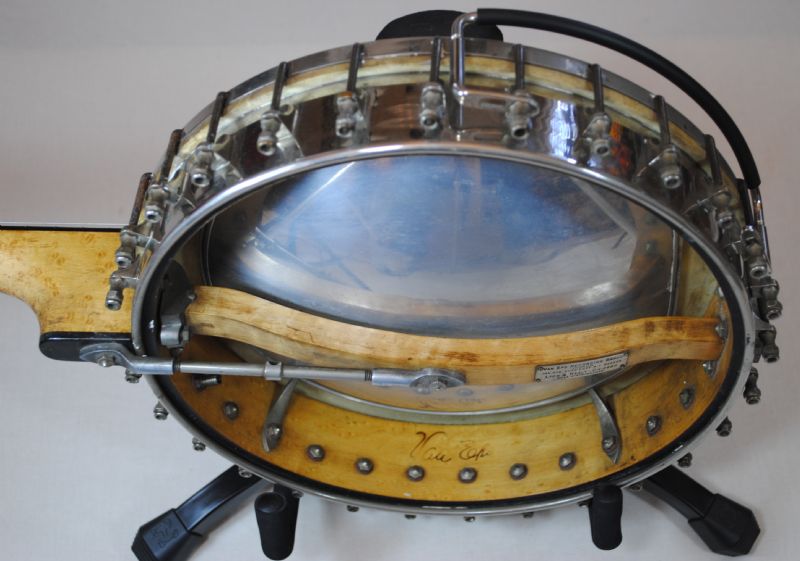
All the best ~ Tom
Edited by - Tom Hanway on 06/26/2016 18:21:34
Rawhide Creek - Posted - 06/26/2016: 21:50:09
The title of this thread still gives me a double-take every time I scroll past it . . .

Tom Berghan - Posted - 06/28/2016: 07:16:11
If anyone thinks that all hide heads sound deep and plunky then they have never actually played a hide head, or, they were afraid of it and did not bring it to a proper tension. They can be just as tight as any Mylar head. I know JD Crowe said he was changing heads every week in the Jim Mills interview, but that is BS. (C'mon JD!) He was exaggerating - a gross exaggeration. I have had a few rip but it is always due to a natural flaw. When you get a good head with no weak thin spots they last forever. And you can tension them to get that same "crack" you can get with Mylar. Just listen to any recording prior to about 1960 (give or take). All hide heads.
Why don't more players try them? Just fear of the unknown. But it is true that they need a lot more adjustment than Mylar. And that is exactly why top tension flanges were invented ... So you could adjust the tension quickly on the spot. Enjoy your new John Balch hide head. Write me off line if you have any questions. I'm sure your going to love it. But you will get good at tensioning a banjo head!
prooftheory - Posted - 06/28/2016: 08:45:55
quote:
Originally posted by Rawhide Creek
The title of this thread still gives me a double-take every time I scroll past it . . .
Me too. This stuff used to happen. I hope it isn't happening any more.
Cottonmouth - Posted - 07/01/2016: 07:53:19
My experience with a moisture-treated goat skin head from John Balch, has been a good one. He mounted one of his 3-star heads on my 1910 Fairbanks-Vega Tu-ba-phone rim (10-1/8") and it has withstood the brutal heat and humidity of the Mobile Bay area for a few years now. I am speaking mainly of outdoor jamming at the water's edge in the early evening and I have made no adjustments to the head at all. The instrument is a melody banjo (4-string mandolin banjo). Click on the photo below for a closer look.
captbanjo - Posted - 07/01/2016: 09:31:47
I am having a goat skin head put on a custom Irish bodhran I ordered from Ace Bodhran. These are made by master Irish drummer and bodhran builder, Mance Grady.
One cool thing is he sends you photographs of the skin heads so you can choose the one you prefer. One of the issues that I had to answer was whether I wanted my goatskin treated or 'raw'. Mance explained to me that he preferred the raw ones, as they retain some of the natural oil in the skin. So that is what I went with but when I think about it, it does sound a little gross...
Wayne
Paul Roberts - Posted - 07/01/2016: 10:11:02
quote:
Originally posted by Tom Hanway
I have a Van Eps tenor with a steel resonator, and it's gone through several vellum heads because its design includes a sound hole in the middle which always rips when conditions change too quickly from high humidity to low humidity.
It belonged to my grandfather, John Hanway, who bought it in his freshman year (Class of 1922), probably in 1917, playing it in the Yale Mandolin and Banjo Club and Orchestra. It has been restored twice by Tom Cussen (Clareen Banjos) of Clarinbridge, Co. Galway.
I need to re-design the size and/or position of the sound hole (or sound holes). It's been an ongoing problem and I keep restoring the banjo to its original glory, but the vellum keeps ripping at the sound hole.
I will take it to Tom (who has also re-glued the binding and made other immaculate repairs), and see if we can devise a lasting solution. I'm almost at my wit's end. I'd like to keep the original design, with a fairly wide sound hole in the middle (approx. 3 inches in diameter), but the Irish weather is my nemesis. (I'm thinking that a smaller circular sound hole that is off center might do the trick, so I'm open to any design ideas.)
Any thoughts, anyone? I'd appreciate it. I really want to play this banjo again.
All the best ~ Tom
Hey Tom, I need a setup like that like I need a hole in the head! 
Mirek Patek - Posted - 07/01/2016: 15:44:52
quote:
Originally posted by Tom Hanway
I have a Van Eps tenor with a steel resonator, and it's gone through several vellum heads because its design includes a sound hole in the middle which always rips when conditions change too quickly from high humidity to low humidity.
...Any thoughts, anyone? I'd appreciate it. I really want to play this banjo again.
Here is related discussion from 2002 with some ideas how to protect the edge of the hole:
Tom Hanway - Posted - 07/02/2016: 19:25:13
quote:
Originally posted by Mirek Patek
quote:
Originally posted by Tom Hanway
I have a Van Eps tenor with a steel resonator, and it's gone through several vellum heads because its design includes a sound hole in the middle which always rips when conditions change too quickly from high humidity to low humidity.
...Any thoughts, anyone? I'd appreciate it. I really want to play this banjo again.
Here is related discussion from 2002 with some ideas how to protect the edge of the hole:
groups.google.com/forum/#!topi...7x2_BZgC0
Thank you Mirek, I read that and found this useful bit of information:
Yes - both Van Eps and Farland used skin heads. The Van Eps "Recording" banjo
made by Lyon and Healy in the teens - had a metal "bowl" reflector mounted
under the head, and used a round hole cut in the head.
The pictures I've seen, of the Van Eps do not show any specific reinforcement to
the edge of the hole. If it's a CLEAN-cut edge - there are no "notches" to
propagate tears.
<A HREF="mailto:banj...@webtv.net">banj...@webtv.net </A> (banjorman)
wrote:
<<Stanger and Ed, Just a note- the article said" I work in construction as
a carpenter. I got a Teflon "O" ring that is used to stop leaks when
joining two pipes together and installed it on the head." Would it be
possible to modify a head like this with hardware supplies? >>
Sure. But you are ALSO adding WEIGHT - which will affect tone (mostly adding
some sustain).
<<Ed, could you look at the head and give us an idea on how it is made to not
tear? >>
See above. With a skin head you could also just run a small bead of
cyanacrylate (super glue) around the edge of the hole, to prevent any tears
from propagating. Just gluing a simple, flat fiberboard or plastic ring around
the hole would also prevent propagation of tears.
<<...Before I read this article I did not think that this would be possible
because of the force on the head...>>
It's NOT as big a problem as you think - IF the hole is CLEANLY cut.
Especially on mylar heads. If there are no nicks in the edge - a hole towards
the middle really doesn't see the strain that the edge of the head, or the
flesh-hoop sees.
<<...It said "the head is a fibrous type of material over plastic." Would this
resist tearing better? ...>>
Better than a skin head - yes. Sounds like it's a typical fiberskyn head. It
would give more of the "skin head" sound - without the "worries" that a skin
head cause.
But I think it's much less of a problem than imagined. Try it!
Best - Ed Britt
+++++++++++++++++++++++++++++++++++++++
Thanks a million!
Best ~ Tomás
Terms of Use | Privacy Policy | Privacy Consent (EU/GDPR Only)
Copyright 2026 Banjo Hangout. All Rights Reserved.


