DVD-quality lessons (including tabs/sheet music) available for immediate viewing on any device.
Take your playing to the next level with the help of a local or online banjo teacher.
Weekly newsletter includes free lessons, favorite member content, banjo news and more.
Premier Sponsors


|
Please note this is an archived topic, so it is locked and unable to be replied to. You may, however, start a new topic and refer to this topic with a link: http://www.banjohangout.org/archive/318376
alexoryan - Posted - 05/13/2016: 17:53:21
Hi All,
I'm just learning Banjo and curious about other's experience in terms of whether learning to play in the12 different keys is useful in practice. Some of the more exotic keys seem to be not very well suited to open G tuning or maybe it's just that I'm not great at playing lower in the fretboard.
Is it more common just tune the banjo to another key so you can still get at the more twangy notes on top of the fretboard?
Thanks!
Texasbanjo - Posted - 05/13/2016: 19:09:24
Edited by - Texasbanjo on 05/13/2016 19:10:34
Fathand - Posted - 05/14/2016: 06:00:20
If you can play in the following keys, you should be able to capo to the rest, G, C, D. Learning these 3 keys up the neck also helps a lot in playing other keys by moving your hand position to the appropriate place. Don't forget you might want to do some minor key work too, I would start with Am and Em and capoing from there.
After learning G, C, D I find these keys not too bad to expand your skill base with, E, F, Bb.
banjoak - Posted - 05/14/2016: 16:07:37
Whether something is useful to learn, depends on whether you will have a use for it. Much depends on what context you want to play your banjo in.
Playing in these other keys, often has to do with playing with others... a lot of the odd keys just has to do with accommodating singer (if the singer insists on Ab, you play in Ab). Sometimes an instrument like a fiddler, that can't just capo, and it's that tunes are designed to for the mechanics of a certain key on that instrument. (for fiddle tunes, the common bulk is just a few keys, but depends on the fiddler, but probably never encounter some keys like Ab or Db) -
So if you think you will be doing banjo with any of those... then it's highly useful to learn how to do that.
The two approaches... One is more on using open strings, melodic or as part of chords. As mentioned...using a capo. The other is in using closed, essentially ignoring open strings, just frets, or closed chord shapes... which is moveable anywhere on the fretboard... so can transpose to any key. of course you still probably want or need to change the drone, fifth string to accommodate the key. The closed, fret and chord shape, is useful to learn, and often used even if using open strings and capo.
BTW - For more just banjo oriented tunes - designed with banjo in mind - there are not in a lot of odd keys (other than might be just capoed)
Edited by - banjoak on 05/14/2016 16:18:09
alexoryan - Posted - 05/16/2016: 03:35:36
Thanks for the advice, that's really helpful!
I've been learning G-C-D and their relative minors, I'll pick up a capo next time I'm out and give that a try as well as tuning the drone string. I've been a bit hesitant to try totally different tunings since I'm still learning standard shapes and don't want to confuse myself too much lol.
Old Hickory - Posted - 05/16/2016: 08:40:19
I think it's perfectly acceptable to hold off attacking different tunings until you're comfortable with your skills in different keys in G tuning. I also think it's perfectly acceptable not to learn other tunings at all. Just another angle on Banjoak's view that something is useful to learn if you have a use for it. Of course, learning multiple tunings makes you a more well-rounded player.
My first teacher introduced me to D tuning the summer I took lessons 40+ years ago. Learned a basic version of Reuben. That's it. I've maybe tried D tuning a few times over the years. Decided I've had no use for it in jams and chose never to explore it on my own.
The extent of retuning I do consists of occasionally spiking the 5th string 2 frets higher than the rest of the G-tuned banjo (to A for playing in D, or to B for playing capoed 2 to E) and occasional drop-C tuning, as when my previous Celtic-Americana band did a medley of Mursheen Durkin and Soldier's Joy. In my previous bluegrass band, I used drop C for our version of Red Clay Halo.
Back in the late 70s I figured out a tune that used an unusual C-minor tuning capoed up 2 to D minor. Played it a few times then never played it again for 35 years.
- - - - - - - - - - - - -
Back to your original question: Some of the oddball keys will come up so rarely that the only reason to learn them is for the possible applicability of their closed positions to keys that you actually would come across. Banjoak also addressed this.
F and B-flat are good keys to learn without capo. B-flat is related to G-minor, which gives it a connection to G: the B-flat pentatonic scale has B-flat and F notes which you use in the G blues scale. So that's really worth becoming familiar with. Main thing to be aware of when playing in F or B-fat in G tuning is that the open 2nd string is a really bad note. One way to avoid it when playing down the neck is to plant your index finger at 2nd string 1st fret, since the C note is needed in both those keys. That leaves other fingers free for hitting the notes at 3rd fret on 4th, 3rd and 1st strings that you'll need. This is also a good way for discovering bluesy sounding licks in G.
Banjophobic - Posted - 05/17/2016: 09:12:26
quote:
Originally posted by alexoryan
Hi All,
I'm just learning Banjo and curious about other's experience in terms of whether learning to play in the12 different keys is useful in practice. Some of the more exotic keys seem to be not very well suited to open G tuning or maybe it's just that I'm not great at playing lower in the fretboard.
Is it more common just tune the banjo to another key so you can still get at the more twangy notes on top of the fretboard?
Thanks!
As a beginner, how often are you going to be playing in 'all 12 major keys'. realistically? The chances are extremely small this will happen. This is akin to just starting to learning to write and then asking "should I be writing a novel right now?"  . I would just stay focused on the 'beginner' keys like G, C,D,A and get prificient at them first. Once you understand how those keys operate, you'll already know how to play in the other ones..whether you understand what that means right now or not.
Edited by - Banjophobic on 05/17/2016 09:12:55
monstertone - Posted - 05/24/2016: 15:32:35
"Just learning to play banjo" encompasses quite a wide spectrum including any number of disciplines. For the sake of discussion, let's narrow it down to bluegrass. And since you're at beginner level, you need a plan. Focus on banjo instrumentals, in the key of G, then working into C & then D, By doing so, you will become familiar with these keys while building up a vocabulary of licks & techniques. You will then be able to explore instrumentals, such as fiddle tunes, in other keys, while still in G tuning, with or without the use of a capo.
G tuning key of G, fifth string plays the root note of the scale. Key of D, fifth string plays the 3rd. Key of C, fifth string plays the 5th. Pay attention to the relationship of the fifth string to the scale of the key & the effect it has on what you are trying to do.
Along the way, you will no doubt play around with turnings such as drop C, & D, which are associated with specific songs. These might include such standards as Home Sweet Home, Solders Joy, & Reuben's Train. Just don't get too hung up on them as you'll find it a royal pita if you have to re-turn very often.
FWIW: the bulk of fiddle (& to lesser extent mandolin) tunes will be in the keys of A & D, although there are some to be found in G & C. Bill Monroe was known to write songs in other keys strictly for the effect the of the various instruments which would, or would not, be capoed.  For the most part, use of capo is optional.
Edited by - monstertone on 05/24/2016 15:47:48
Old Hickory - Posted - 05/24/2016: 17:14:15
quote:
Originally posted by monstertone
G tuning ... Key of D, fifth string plays the 3rd.
Make that 4th
monstertone - Posted - 05/25/2016: 09:23:28
Oops, G tuning, key of D, fifth string plays the 4th note of the D scale.
overhere - Posted - 05/26/2016: 03:56:43
capos are ok to a certain extent. I find beyond the forth fret (B) banjo starts to thin out. so its probably a good idea to learn keys of C D F shapes at least. You can get some really good sounds in C and D E. also by staying low you get to use all important open strings as drone strings when needed.
steve davis - Posted - 06/18/2016: 11:27:03
When you get used to how the chord patterns work in the key of G you then know how all the other keys are constructed.
overhere - Posted - 06/21/2016: 15:56:38
A simple way to convert keys is too learn simple major scale, E F G A B C D E F. want key of A…A is root. count two up D and then 2 back from A = E…so basic is A D E. / Key of E two up A, 2 back B, basic E A B /….key of D=D…G…A. / and so on… not everything you have to learn but puts you in the running
jojo25 - Posted - 06/22/2016: 13:45:07
I feel like I am kinda a strange egg...as I like to play in many keys...but then I hear/see folks in the Old Time world who play in many keys. Here is something I do as an exercise...sometimes in clawhammer style...sometimes fingerpicking...I play Bye Bye Blues...starting in the key of C...then march around the circle of 5ths (clockwise)...and keep going around until I get back to C. This takes me through all the major keys. Two things I like about this study...this tune has the flatted 6th chord in it...that would be A flat major in the key of C...and it is only a half step down from that chord to the next step around the Circle of 5ths...so I end with a C/A flat/C cadence...then A flat/G...and I am at the next stop on my circumnavigation. Second...the tune has that little stop/run...that goes where the lyrics go "...from now on its only good times" ...this little run challenges me to find those notes in each key.
I was inspired to try this by two things...one...the story I heard that Don Reno once got on stage and played Wildwood Flower in all 12 keys...don't know if he walked around the circle or not.
Two...at a festival...years ago....I was in a session where a wonderful guitar player was leading us...doing all these good old tunes in C...singing tunes...none of which I knew...but I had fun following along...then he called for Bye Bye Blues... finally!...a tune I knew!...but he wanted to do it in the key of F...and I had learned it in C:(...but I dove in and got an enthusiastic "yes!" from the guitar player when I managed to hit that flatted 6th chord at the correct time (that would be D flat major in the key of F).
So I went home...thought about that Don Reno story...and said to myself..."self...why not try taking that tune all the way around the circle of 5ths.?"
Tangent: to properly study the circle of 5ths: go to a liquor store...buy 12 5ths of booze (your choice)...take those home...arrange them on the floor in a circle...sit on your fav chair in the middle of said cirlce...commence to practice/play...sample from the bottles as needed:)
steve davis - Posted - 06/24/2016: 13:06:41
I can play any key as itself.It's just fun to play as if it were G.Pretending that all keys are G is the same as playing by the Nashville Number System.
Do you only play in G,Russ?
Edited by - steve davis on 06/24/2016 13:08:23
Jack Baker - Posted - 06/24/2016: 14:07:42
Excellent and to the point advice Sherry...
Originally posted by Texasbanjo
overhere - Posted - 07/01/2016: 15:47:25
learning to play in different keys opens up a wide door. Some songs or tunes lend themselves better to certain melodies in different keys. Just as an example I ‘ll play Did She Mention My Name (Gordon Lightfoot) in C as opposed to G because it allows the lower notes needed. And also voice range will put you into different keys as needed for comfort while singing or playing with others singing. As you go along the banjo journey you will learn all these things and they will become second nature.
steve davis - Posted - 07/02/2016: 06:39:11
Being able to play any key without capoing offers great freedom in improvisation.
steve davis - Posted - 07/04/2016: 06:45:30
I love it when someone surprises me at a jam with a key of C# and I'm right there at the kick-off with no pause for capoing.
Rawhide Creek - Posted - 07/04/2016: 15:08:13
quote:
Originally posted by steve davis
I love it when someone surprises me at a jam with a key of C# and I'm right there at the kick-off with no pause for capoing.
Yep, C-sharp major is definitely one of the easiest to do without a capo!
steve davis - Posted - 07/04/2016: 15:39:41
They're all of similar "difficulty" since all keys are built identically,Russ.
That's why it's so simple to just pretend all keys are G.
Rawhide Creek - Posted - 07/04/2016: 15:40:19
A good exercise to work through the major keys is to start in any key of your choice, play I-IV-V, then back to IV. Let IV become the V of the next key and repeat, ad infinitum, around the Circle of Fifths. See the pattern and the example:
I - IV - V - IV
              V - I - IV - V - IV
                                V - I - IV - V
                                             etc.


G - C - D - C
            C - F - G - F
                        F - Bb - C - Bb
                                     etc.
I don't have to pretend!
Edited by - Rawhide Creek on 07/04/2016 15:46:48
steve davis - Posted - 07/04/2016: 16:23:41
I just like using that word.
Shut your eyes and play positionally is such a long description.
Rawhide Creek - Posted - 07/04/2016: 20:20:18
Yes, shutting your eyes enables your pretense. I'm sure it enhances your fantasies, too.
Edited by - Rawhide Creek on 07/04/2016 20:26:08
steve davis - Posted - 07/05/2016: 07:29:16
Saying pretending its all G can speed things up greatly for a beginner,Russ.
I'm talking about slick tricks to playing by ear and am not surprised that this is over your head.
Rawhide Creek - Posted - 07/05/2016: 19:45:00
quote:
Originally posted by steve davis
They're all of similar "difficulty" since all keys are built identically,Russ.
. . .
G major and G minor would be the first to disagree with that absurdity.
steve davis - Posted - 07/06/2016: 07:20:44
You really don't get the simplicity of this,do you Russ.
Banjophobic - Posted - 07/06/2016: 08:16:25
Russ
What Steve is referring to is what I call "positional playing" which basically means that when playing out of closed positions on your banjo, in G tuning, every key "looks" the same, physically speaking. Classically speaking we know that no two keys are "the same".
But since this is the theory forum it's better to recognize the classic views and recognize the keys signatures as being different from each other, as you pointed out.
steve davis - Posted - 07/06/2016: 08:23:12
The ability to overlay the workings of a key to a new fretboard (fret) location for a new key is rife with theory.
Banjophobic - Posted - 07/06/2016: 11:25:07
Yes, but on a "theory" forum most posters are used to the proper nomenclature,that's all.
Helix - Posted - 07/06/2016: 17:25:15
Alex, find a good jam and sit in or just watch them at first. We all joke about our friend Shelba Mullins, I use a spike at the 8th because she sings in Bb, a spike just for her.
Too much theory and not enough weary from playing.
mmuussiiccaall - Posted - 07/06/2016: 19:26:17
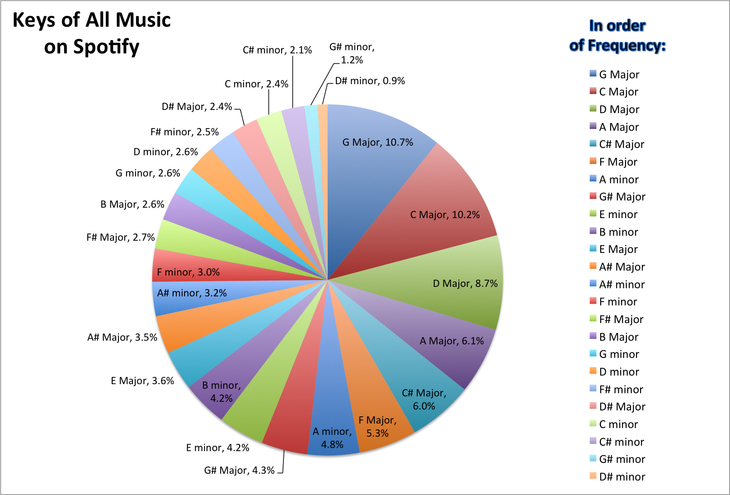
of 30 million songs on spotify
my count looks like 35% can easily be done without a capo on a banjo
Rawhide Creek - Posted - 07/06/2016: 21:22:13
quote:
Originally posted by mmuussiiccaall
of 30 million songs on spotify
my count looks like 35% can easily be done without a capo on a banjo
That's a great chart, Rick! (I'm going to save it.)
My count is 56%, but our definitions of "easily" may be different.
Edited by - Rawhide Creek on 07/06/2016 21:23:01
Rawhide Creek - Posted - 07/06/2016: 22:44:14
quote:
Originally posted by Banjophobic
What Steve is referring to is what I call "positional playing" which basically means that when playing out of closed positions on your banjo, in G tuning, every key "looks" the same, physically speaking. Classically speaking we know that no two keys are "the same".But since this is the theory forum it's better to recognize the classic views and recognize the keys signatures as being different from each other, as you pointed out.
I know precisely what it is, although "positional" play is something I associate with chess, and "positional playing" has been the subject of some controversy, off and on, in the world of piano pedagogy.
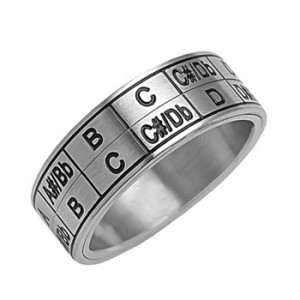
It is simply mechanical transposition, nothing more. Steve would have us believe that doing this is, in his words, "rife with theory", but it is not, any more so than the "transposing ring" shown below--which bears an amazing resemblance to Little Orphan Annie's secret decoder ring. Just move the magic ring and presto! all the new notes line up in the new and different key. No theory (and scant musical knowledge) needed.
I can pull the same stunt reading violin music but playing the viola in fifth position. It's entirely mechanical, no theory involved. Or I can read as playing the violin but in fact play on the viola. The result will sound a fifth lower. Again, mechanical, no theory involved. I can use thumb position on the cello (think of the thumb as a fleshy capo) and play viola music that will sound as written. Mechanical.
And then there's scordatura. This is the trick of tuning the violin's (or other bowed instrument's) strings to various of several different tunings, but reading and playing the music as if the instrument is tuned normally--the notes correspond to locations on the fingerboard but do not sound as written. (Biber's Rosary Sonatas are an exceptionally fine example. Each movement uses a different tuning, including one "cross tuning" where the two middle strings are crossed between the tailpiece and the bridge.) Entirely mechanical, no theory involved.
There are special stops on many pipe organs that accomplish like mechanical functions.
Many musicians can identify the key of a piece of music simply by hearing it (I'm one). Good ear training helps in this, and in any case is important to good musicianship. We do a beginner a serious disservice if we tell him (or her), "Close your eyes and pretend you're in G." That is not good ear training. Major is major and not minor; the key of G is G and not C.
Edited by - Rawhide Creek on 07/06/2016 23:02:55
pearcemusic - Posted - 07/07/2016: 06:44:17
If what you do is play tunes with fairly simple harmony (chords),then the "positional" approach is great. I've been doing that since I was a teenager. But, when you are asked to use a broader skill set it falls apart quickly. I am asked to read music every week in keys like Db Eb Ab ... Etc. The process of reading more complex harmony in keys that aren't G is difficult if you don't KNOW those keys melodically and chordally. I.e. Abmaj7/C to Db to Eb/G to Fm9/Ab is hard to take in if you don't understand basic diatonic theory in Ab major, but if you DO know it, it's very simple. When a chart is in front of me, either in a recording studio or on stage, I need a skill set that helps me succeed when the downbeat starts.
Banjophobic - Posted - 07/07/2016: 07:44:59
quote:
Originally posted by Rawhide Creek
quote:
Originally posted by Banjophobic
What Steve is referring to is what I call "positional playing" which basically means that when playing out of closed positions on your banjo, in G tuning, every key "looks" the same, physically speaking. Classically speaking we know that no two keys are "the same".But since this is the theory forum it's better to recognize the classic views and recognize the keys signatures as being different from each other, as you pointed out.
I know precisely what it is, although "positional" play is something I associate with chess, and "positional playing" has been the subject of some controversy, off and on, in the world of piano pedagogy.
It is simply mechanical transposition, nothing more. Steve would have us believe that doing this is, in his words, "rife with theory", but it is not, any more so than the "transposing ring" shown below--which bears an amazing resemblance to Little Orphan Annie's secret decoder ring. Just move the magic ring and presto! all the new notes line up in the new and different key. No theory (and scant musical knowledge) needed.
I can pull the same stunt reading violin music but playing the viola in fifth position. It's entirely mechanical, no theory involved. Or I can read as playing the violin but in fact play on the viola. The result will sound a fifth lower. Again, mechanical, no theory involved. I can use thumb position on the cello (think of the thumb as a fleshy capo) and play viola music that will sound as written. Mechanical.
And then there's scordatura. This is the trick of tuning the violin's (or other bowed instrument's) strings to various of several different tunings, but reading and playing the music as if the instrument is tuned normally--the notes correspond to locations on the fingerboard but do not sound as written. (Biber's Rosary Sonatas are an exceptionally fine example. Each movement uses a different tuning, including one "cross tuning" where the two middle strings are crossed between the tailpiece and the bridge.) Entirely mechanical, no theory involved.
There are special stops on many pipe organs that accomplish like mechanical functions.
Many musicians can identify the key of a piece of music simply by hearing it (I'm one). Good ear training helps in this, and in any case is important to good musicianship. We do a beginner a serious disservice if we tell him (or her), "Close your eyes and pretend you're in G." That is not good ear training. Major is major and not minor; the key of G is G and not C.
It is 'rife with theory' if the person using it knows the theory behind the positions and their use, that is. In the broader sense of real musicianship and understanding keys from a theoretical standpoint I agree 100% with you. As Doub said earlier most folks who arent playing music that is beyond the folk genre, for instance, can operate fine 'mechanically' with positions. Scruggs banjo players for instance follow Earls lead here in using 'positional' components in his style. EArl used these positions to create his signature licks and patterns first, without knowing any 'theory' beyond rudimentary stuff. So in that regard I wouldn't be poopooing on the concept of 'positional playing' as if one cannot be an accomplished player in a genre like BG by using this approach.
I think its important to separate pure theory, in a broad musical style sense, to how many folks learn to play in traditional music. I teach players how to use 'positional' concepts in Scruggs, for example. Its how his style works for the most part. I do offer the theory behind the constructs as well in private lessons so that they have the opportunity to understand the position and how its constructed or what its functioning as musically. Ultimately its the players choice to decide if he ir she want s to learn the real theory behind something, or not. I really want them to know practical application theory but I dont push it if they choose to bypass it. The goal is to get them playing the banjo, how they choose to.
This is the crux of many disagreements on Theory forums. Players who are very accomplished but who dont know much if any classical theory will argue with those clamoring for it to be learned. Coming from a background where I became accomplished from just playing and knowing no theory, but then choosing to learn it later and pursue that as a goal, I can see both sides of this battle. The cool middle ground is found between the two twains, but its a hard fount patch of land,haha.
steve davis - Posted - 07/07/2016: 07:49:44
I welcome a thorough theoretical discussion on the whys and hows of the identicality of all keys.
Banjophobic - Posted - 07/07/2016: 07:54:43
quote:
Originally posted by steve davis
I welcome a thorough theoretical discussion on the whys and hows of the identicality of all keys.
To show Russ what you mean, explain to him the difference in G major and G minor and then show it positionally on the banjo. That would probably go a long way in advancing your position here on the forum.I think that would calm his fears for the whole position concept.
steve davis - Posted - 07/07/2016: 08:01:33
G minor is for Bb so I would use it if someone wanted to play FMB in Bb,I suppose.What else...Dusty Miller played a whole step flat,etc.
Russ's fears are his own to calm.
Jody Hughes - Posted - 07/07/2016: 09:11:16
You learn to play in other keys because different keys have different sounds. Who wants chocolate or vanilla all the time? If all you do is play in G and C you'll lose a whole range of sounds available on the instrument. It's why composers choose different keys to write in.
You need to realize that some keys are more important depending on what you are trying to do. If you are playing Jazz, then you better learn F, Bb, Eb and Ab....you will never play in some of those keys if all you do is visit the local bluegrass jam. Likewise, the key of B is for bluegrass and I've never played in it at a jazz jam but once.
I do think being able to play in any key is a skill a more advanced musician should have, at the same time, wisely pick your battles. If you are playing bluegrass and can't play in E, then don't bother with Db. Find the common keys of the style of music you wish to play and start there. That's one thing a chart of every thing on Spotify doesn't tell, Db might be popular overall but may almost never occur in the genre of your interest.
One of my teaching tools is I have my students play "Wildwood Flower" closed position in as many keys as they can. That helps them learn how to move things around, to adapt.
If you go to enough jams you will find out you have learned a song and the singer or guitar player now wants to play it in a different key. If you don't practice playing a song in Multiple keys then you'll be lost.
My argument for attacking multiple keys is also because of it's ear training benefits-it helps opens your ears to hearing the distances between notes and recognizing them, hearing things in the context of a key....hard to put into words but it does work. Some of the best growth my ears ever got was taking Jazz Standards and playing them in as many keys as I could.
Edited by - Jody Hughes on 07/07/2016 09:13:46
Rawhide Creek - Posted - 07/07/2016: 09:41:15
Something I learned early in studying conducting: Never program multiple works in the same key. It induces "key monotony" (the term I was taught). In this condition, the audience will become restless and even a bit bored without knowing why, regardless of how stunning the technical execution of the music.
Rawhide Creek - Posted - 07/07/2016: 10:05:03
quote:
Originally posted by steve davis
G minor is for Bb so I would use it if someone wanted to play FMB in Bb,I suppose.What else...Dusty Miller played a whole step flat,etc. . . .
So you are in fact unable to describe the difference(s) between the key of G major and the key of G minor.
steve davis - Posted - 07/07/2016: 11:54:44
I just play whatever key is tossed my way and strive to not be the one anyone is waiting on to "get it".
Is this a theory test,Russ?
Kick off a tune in the key of G minor and I will have no problem playing it back to you.That's all I need to know about the key of G minor.
Edited by - steve davis on 07/07/2016 11:58:47
Rawhide Creek - Posted - 07/07/2016: 15:32:06
quote:
Originally posted by steve davis
I welcome a thorough theoretical discussion on the whys and hows of the identicality of all keys.
It so far appears you cannot even deal with the question of the difference(s) between the keys of G major and G minor.
So much for your notion of a "thorough theoretical discussion" and "identicality".
chuckv97 - Posted - 07/07/2016: 15:52:19
Re: "key monotony". Manuel Barrueco, the great classical guitarist, even put a (heaven help him!) capo on the first fret on one of his recordings, just for that reason. He figures hearing the same open strings ringing all the time (guitar music is mostly played in the sharp keys) wears on the listener.
With bluegrass you can capo to play in different keys, but the interval relationships and chord inversions are similar if always playing out of G. I've recently started playing out of D , trying to figure things out when improvising a solo, and it's challenging but fun.
Rawhide Creek - Posted - 07/07/2016: 16:40:56
That's an interesting take on key monotony, Chuck. Thanks for posting it! I'd not thought about the recurring open strings on the guitar as a source of listener fatigue.
I enjoy minor-key tunes on the banjo. D minor is especially rich if the second string is tuned down to Bb (also the lazy man's way to get into G minor). I've been using that tuning for the second of Bach's cello suites. (I tune the fourth string down to C for the first suite.)
Have you ever heard any of the cello suites performed on guitar? There used to be several recordings out there.
Edited by - Rawhide Creek on 07/07/2016 16:50:54
chuckv97 - Posted - 07/07/2016: 18:55:45
The cello suites sound great on guitar, Russ. I played the Prelude to the first suite for a juried exam years ago, in the key of D major, sixth string tuned down to D..(score-da-toor-ah? 😎). I haven't tried any on banjo yet, but do have an arrangement worked out of Fernando Sor's Estudio in Dmajor (no. 6 of the Segovia 20). Someday I'll polish it up and post it.
BTW, did you know there's a Russ Martin on the Toronto Blue Jays- he's a catcher and a Canadian to boot. His father is a sax player and busks in the Montreal subway stations.
(sorry aboot the dread thrift)
Edited by - chuckv97 on 07/07/2016 19:02:07
Rawhide Creek - Posted - 07/07/2016: 22:14:40
I see that one of his three (!) middle names is after John Coltrane!
Bach's two-part inventions would lend themselves nicely to transcription for two banjos. I heard one of them (the first) done, years back, and have entertained the notion of doing a full set of transcriptions myself, both notation and tablature.
I remember juried exams (we just called them "juries") many years ago. As instrumental majors, we also had mandatory "convocation" once a week (Thursdays). This was a required event but carried no credit. It was an hour of student performances; every performance major was expected to play at least once per semester and all music majors were required to attend to listen--talk about your captive audiences!
Once, on a whim, I added up all of the noncredit requirements (a 1 credit ensemble like orchestra ate up 5 hours per week) and discovered, assuming even a modest amount of practice time, that a music performance major carrying a minimum full-time load of 12 credits put in more hours weekly than an engineering major carrying a maximum allowable 18 credits . . .
Edited by - Rawhide Creek on 07/07/2016 22:18:21
Terms of Use | Privacy Policy | Privacy Consent (EU/GDPR Only)
Copyright 2026 Banjo Hangout. All Rights Reserved.