
DVD-quality lessons (including tabs/sheet music) available for immediate viewing on any device.
Take your playing to the next level with the help of a local or online banjo teacher.
Weekly newsletter includes free lessons, favorite member content, banjo news and more.
Premier Sponsors


|
Please note this is an archived topic, so it is locked and unable to be replied to. You may, however, start a new topic and refer to this topic with a link: http://www.banjohangout.org/archive/302455
mipake - Posted - 04/16/2015: 06:52:32
I know there are plenty of mountain banjo makers, kits and plans out there. My question is where does the original mountain banjos come from? How wide spread were they? Are there any in museums?
jduke - Posted - 04/16/2015: 07:53:35
Two great books come to mind, Foxfire 3 and Musical Instruments of the Southern Appalachian Mountains.
Foxfire was a great set of books compiled by students about Appalachian life and the third book has a great section on many well know mountain banjo makers from that area. The Foxfire books, including this one, are a great source of how-to information and history.
The second book by John Rice Irwin is about the people and their music from the Appalachian mountains. It has a lot of history and lots of photos of instruments (including a whole section on banjos) from the Museum of Appalachia. The museum is Norris, Tennessee.
Both are really great books!
Jeff
Edited by - jduke on 04/16/2015 07:55:26
jlsorbit - Posted - 04/16/2015: 08:18:42
quote:
Originally posted by jdukeTwo great books come to mind, Foxfire 3 and Musical Instruments of the Southern Appalachian Mountains.
Foxfire was a great set of books compiled by students about Appalachian life and the third book has a great section on many well know mountain banjo makers from that area. The Foxfire books, including this one, are a great source of how-to information and history.
The second book by John Rice Irwin is about the people and their music from the Appalachian mountains. It has a lot of history and lots of photos of instruments (including a whole section on banjos) from the Museum of Appalachia. The museum is Norris, Tennessee.
Both are really great books!
Jeff
Thanks for that information, Jeff.
cbcarlisle - Posted - 04/16/2015: 08:51:17
I was going to post my reference to the online pictures of the banjo collection at the Museum of Appalachia - but, once again, they have removed them. They are/were an invaluable resource for traditional mountain banjers.
The Smithsonian has an example, supposedly collected ca. 1900, which is indistinguishable from the Watauga County makers of the Glenn-Proffitt families, so I suspect they mean "in the style of" 1900.
There are also examples shown in our mountain banjer group: banjohangout.org/group/watauga...struments
Pluckin Mutha - Posted - 04/16/2015: 10:56:42
quote:
Originally posted by cbcarlisleI was going to post my reference to the online pictures of the banjo collection at the Museum of Appalachia - but, once again, they have removed them. They are/were an invaluable resource for traditional mountain banjers.
The Smithsonian has an example, supposedly collected ca. 1900, which is indistinguishable from the Watauga County makers of the Glenn-Proffitt families, so I suspect they mean "in the style of" 1900.
There are also examples shown in our mountain banjer group: banjohangout.org/group/watauga...struments
Clickable Link
banjohangout.org/group/watauga...struments
Mutha
StudioKing - Posted - 04/16/2015: 11:21:24
Thank you for posting this thread. I'm a bluegrasser, but this thread has rekindled my long-dormant (decades ago) fascination with mountain banjo. My folks live in Flat Rock, NC, not too far from Watauga County. I'm agonna keep my eyes open for a mountain banjer!
mipake - Posted - 04/16/2015: 11:21:46
Jeff
I ordered the Musical Instruments of the Southern Appalachian Mountains. Thanks
thanks to everyone . I am not planning on making one but just wanted to know more about their origin.
Mike
pastorharry - Posted - 04/16/2015: 11:50:45
I was up in Chickamauga Georgia a while back. That area was the scene of one of the first and largest Civil War skirmishes. In the town museum they had, among other things, a mountain banjo from that period of time.
csacwp - Posted - 04/16/2015: 14:13:31
quote:
Originally posted by pastorharryI was up in Chickamauga Georgia a while back. That area was the scene of one of the first and largest Civil War skirmishes. In the town museum they had, among other things, a mountain banjo from that period of time.
Do you have any photographs of it? I highly suspect that they incorrectly dated it since the mountain banjo is a relatively modern invention. In fact, most banjos I've come across in local museums labeled as Civil War-era are in fact much newer.
Edited by - csacwp on 04/16/2015 14:14:05
pastorharry - Posted - 04/16/2015: 17:11:14
Nope , no pictures. I do know that Boucher's were mass produced and in many soldiers hands from both sides, it would stand to reason there were handmade ones as well.
Joel Hooks - Posted - 04/16/2015: 19:02:05
At one of the Banjo Collector Gatherings they assembled a bunch of these "mountain banjos." I did not go to that one but as I understand it there was some very thin evidence that the earliest one known was thought to be from the mid 1880s.
I'd be surprised if this pattern of banjo did not begin with the Proffitt era versions. I'm interested if anyone has any actual documentation that predates those from his hands (I think I have read that someone he knew was the originator of the pattern).
I think that because they look "old timey"-- and people really want them to be "folksy"-- earlier dates have been attributed to this style banjo.
I feel that they are the product of depression era poverty and propelled into folk legacy with the Foxfire books and Pete Seeger.
banjopogo - Posted - 04/17/2015: 00:28:01
I wish I could remember where it was, but SOMETIME in the last couple of months, I saw photographs of a musician with a handlebar mustache and the old fashioned style of dress, and also the quality of photography led me to believe it was from around 1890 to 1900. The man had had his photograph taken with banjos, I remember at least three in one photograph, all of them "mountain style".
"depression era poverty".... before about 1880, the majority of Americans, something like 80% were subsistence farmers. Cycles of boom and bust were normal in US History, and either due to bad weather and crop failures, or bumper crops resulting in the prices for them dropping to close to worthlessness as far as cash value, subsistence farmers endured a LOT of lean times, and while they usually had enough to eat, were often cash poor, and could ill afford to spend what little cash they hand on something that was mostly for entertainment. Nails, tools, building materials and ammunition for hunting guns (to put food on the table after bad harvests) were all higher priority than instruments. So a banjo design that could use a bit of scrap stovepipe and recycled screws would have had appeal LONG before the Great Depression.
Words from an old Grange song:
"The farmer is the man, the farmer is the man,
Lives on credit till the fall.
And his pants are wearing thin,
His condition it's a sin,
We forget that it's the farmer feeds us all.
One key problem with mountain banjos is that the design is so simple, and the hardware so minimal, that there really isn't much to date them with.... unless you start using dendrochronology like they do for dating fine violins. (Dendrochronology matchs the tree ring patterns to tree rings in wood of a known age).
I've seen people reject banjos as being old because of the shiny screws, but if the original screws had gone rusty, they could easily be replaced.
No doubt Pete Seeger and the Foxfire books promoted a renaissance of mountain banjo construction, but to ascribe the origin of the design to them seems awfully extreme.
Another problem is this: the study of history thrives on documents. But folk instruments are were constructed by people who before a certain point were either illiterate, functionally illiterate, or were so busy just surviving that they were unlikely to keep diaries or write about their music if they actually were able to do so.
So there is an absence of documentation. The problem is that an absence of documentation does not prove that something DID NOT exist before a certain time, it only means its existence cannot be CONFIRMED before that time.
Minstrel banjo on the other hand was something that appealed to the middle classes who had the money to spend on banjo tutors and such, and being part of a commercial enterprise, there are various artifacts from those enterprises.
Also.... look at parallel things with other folk instruments.
Fiddles are pretty easy to make with minimal tools, and cigar box fiddles were common. Mountain dulcimers can be hand made too.
If someone could made a homemade fiddle or a dulcimer, if they had some scrap stovepipe and some screws, they could made a mountain banjo.
In fact, I see the mountain banjo as being the equivalent of say a cigar box fiddle. Both are basically substitutes for commercially avaiable instruments when the money to buy such instruments is not available.
A likely time for that would have been shortly after the Civil War. Memories of banjo music in the camps would have supplied the desire and it took time for local economies to recover from the destruction of the war, and the absence of able-bodied males. If the basic idea was introduced then, it would have spread like wildfire, at least in certain regions. The dulcimer isn't that widespread of an instrument in the mountains, and it's quite possible that the mountain banjo design was limited to certain regions.
Here is a banjo made by Homer Ledford of Kentucky in the 1940's.
wcudigitalcollection.contentdm...605/rec/6
Foxfire didn't start until 1966.
According to one maker and seller of mountain banjos, he uses:
"Stanley Hicks' family pattern from Watauga County, North Carolina, as featured in Foxfire 3"
I found this excerpt from a Foxfire book:
books.google.com/books?id=IERy...p;f=false
It focuses mostly on Ernest Franklin, but mentions Frank Profitt. Both are mentioned as saying they learned to make banjos from their fathers, which is going to put the origins of the design back before World War One at the very least.
Here is a photo in Jim Daniels photo section of a banjo in the Colonial Williamsburg museum of a mountain banjo dated around 1900:

Here is a photo of another banjo that shows another angle on the mountain style banjo which is to the left:

What's obvious to me is that while the basic idea is the same as the instruments in the Foxfire books, it shows quite a few details that are different.
In my searches about mountain banjos the last few minutes, one place keeps coming up:
Watauga County, North Carolina.
It's not unusual for folk instruments to actually come from a smaller region than people think. Mountain dulcimers were not that widespread originally, from what I've read. The nyckelharpa (keyed fiddle) is only common in a certain area of Sweden. Some places develop distinctive local craft traditions.
It seems Watauga County had something special going on with regard to mountain banjos.
Here is a photo labeled Buna Hicks.... with a fellow playing a mountain banjo:
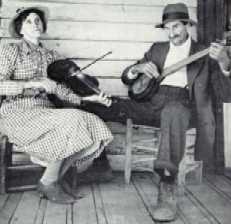
Adding "Watauga County" to the search produced some results, including this from the Watauga Arts Council.
Another banjo by a maker who learned from his father:
watauga-arts.org/2006_instrume...fford.jpg
How many references to mountain banjo makers who learned from their fathers is necessary before we believe that we are in fact looking at a traditional folk art here, and not a product of Pete Seeger's imagination, photos like these notwithstanding:

Edited by - banjopogo on 04/17/2015 00:50:45
Joel Hooks - Posted - 04/17/2015: 03:44:43
"Product of Pete Seeger's imagination"... Nope, I did not write that.
Andy FitzGibbon - Posted - 04/17/2015: 03:57:23
I think what Joel meant was that the popularization of mountain banjos during the folk revival (by Foxfire, Pete Seeger, Frank Warner and others) lent a false sense of "widespreadness" to a style that was originally confined to a small area of North Carolina. He didn't mean that Pete invented them...
I was at the banjo gathering in Ferrum with the large display of mountain banjos, and I've seen many others in private collections. As with other folk instruments, they are very hard to put a date on, but almost all that I have seen looked to have been made after 1900. Here in West Virginia, metal stove pipe was not all that common in the mountains until around that time, and that goes for other areas od Appalachia as well.
Roddy Moore has spent a great deal of time researching this style of banjo and tracking sightings of them around Virginia and North Carolina.
Andy
csacwp - Posted - 04/17/2015: 09:52:02
quote:
Originally posted by banjopogoI wish I could remember where it was, but SOMETIME in the last couple of months, I saw photographs of a musician with a handlebar mustache and the old fashioned style of dress, and also the quality of photography led me to believe it was from around 1890 to 1900. The man had had his photograph taken with banjos, I remember at least three in one photograph, all of them "mountain style".
"depression era poverty".... before about 1880, the majority of Americans, something like 80% were subsistence farmers. Cycles of boom and bust were normal in US History, and either due to bad weather and crop failures, or bumper crops resulting in the prices for them dropping to close to worthlessness as far as cash value, subsistence farmers endured a LOT of lean times, and while they usually had enough to eat, were often cash poor, and could ill afford to spend what little cash they hand on something that was mostly for entertainment. Nails, tools, building materials and ammunition for hunting guns (to put food on the table after bad harvests) were all higher priority than instruments. So a banjo design that could use a bit of scrap stovepipe and recycled screws would have had appeal LONG before the Great Depression.
Words from an old Grange song:
"The farmer is the man, the farmer is the man,
Lives on credit till the fall.
And his pants are wearing thin,
His condition it's a sin,
We forget that it's the farmer feeds us all.
One key problem with mountain banjos is that the design is so simple, and the hardware so minimal, that there really isn't much to date them with.... unless you start using dendrochronology like they do for dating fine violins. (Dendrochronology matchs the tree ring patterns to tree rings in wood of a known age).
I've seen people reject banjos as being old because of the shiny screws, but if the original screws had gone rusty, they could easily be replaced.
No doubt Pete Seeger and the Foxfire books promoted a renaissance of mountain banjo construction, but to ascribe the origin of the design to them seems awfully extreme.
Another problem is this: the study of history thrives on documents. But folk instruments are were constructed by people who before a certain point were either illiterate, functionally illiterate, or were so busy just surviving that they were unlikely to keep diaries or write about their music if they actually were able to do so.
So there is an absence of documentation. The problem is that an absence of documentation does not prove that something DID NOT exist before a certain time, it only means its existence cannot be CONFIRMED before that time.
Minstrel banjo on the other hand was something that appealed to the middle classes who had the money to spend on banjo tutors and such, and being part of a commercial enterprise, there are various artifacts from those enterprises.
Also.... look at parallel things with other folk instruments.
Fiddles are pretty easy to make with minimal tools, and cigar box fiddles were common. Mountain dulcimers can be hand made too.
If someone could made a homemade fiddle or a dulcimer, if they had some scrap stovepipe and some screws, they could made a mountain banjo.
In fact, I see the mountain banjo as being the equivalent of say a cigar box fiddle. Both are basically substitutes for commercially avaiable instruments when the money to buy such instruments is not available.
A likely time for that would have been shortly after the Civil War. Memories of banjo music in the camps would have supplied the desire and it took time for local economies to recover from the destruction of the war, and the absence of able-bodied males. If the basic idea was introduced then, it would have spread like wildfire, at least in certain regions. The dulcimer isn't that widespread of an instrument in the mountains, and it's quite possible that the mountain banjo design was limited to certain regions.
Here is a banjo made by Homer Ledford of Kentucky in the 1940's.
wcudigitalcollection.contentdm...605/rec/6
Foxfire didn't start until 1966.
According to one maker and seller of mountain banjos, he uses:
"Stanley Hicks' family pattern from Watauga County, North Carolina, as featured in Foxfire 3"
I found this excerpt from a Foxfire book:
books.google.com/books?id=IERy...p;f=false
It focuses mostly on Ernest Franklin, but mentions Frank Profitt. Both are mentioned as saying they learned to make banjos from their fathers, which is going to put the origins of the design back before World War One at the very least.
Here is a photo in Jim Daniels photo section of a banjo in the Colonial Williamsburg museum of a mountain banjo dated around 1900:
Here is a photo of another banjo that shows another angle on the mountain style banjo which is to the left:
What's obvious to me is that while the basic idea is the same as the instruments in the Foxfire books, it shows quite a few details that are different.
In my searches about mountain banjos the last few minutes, one place keeps coming up:
Watauga County, North Carolina.
It's not unusual for folk instruments to actually come from a smaller region than people think. Mountain dulcimers were not that widespread originally, from what I've read. The nyckelharpa (keyed fiddle) is only common in a certain area of Sweden. Some places develop distinctive local craft traditions.
It seems Watauga County had something special going on with regard to mountain banjos.
Here is a photo labeled Buna Hicks.... with a fellow playing a mountain banjo:
Adding "Watauga County" to the search produced some results, including this from the Watauga Arts Council.
Another banjo by a maker who learned from his father:
watauga-arts.org/2006_instrume...fford.jpg
How many references to mountain banjo makers who learned from their fathers is necessary before we believe that we are in fact looking at a traditional folk art here, and not a product of Pete Seeger's imagination, photos like these notwithstanding:
This is all hearsay and speculation, and frankly it sounds like you really want the mountain banjo to be as old as you suggest so you are fabricating a folksy history to support that. I often hear from folk players that the surviving documentation and historical evidence from the 19th century doesn't pertain to their instrument and style because poor people don't leave evidence behind. In fact, there is evidence that these people left behind- it just doesn't support that your instrument and playing style were prevalent at the time, and therefore you ignore it.
cbcarlisle - Posted - 04/17/2015: 12:02:36
There are at least two distinct traditions of "mountain" banjers: one the small head, Watauga County style of the Hicks/Proffitt/Glenn families; the other a larger head style which looks more like it was turned on a lathe, like the photos above (and Homer Ledford's banjers). I found a dated version (W.I. Hawthorne, May 15, 1922) in that style, discussed here: banjohangout.org/blog/31741 . (There are other, even earlier, dated versions.) There are also, as would be expected, instruments which span the range of options in between.
The photos alluded to above are by Robert Winslow Gordon, an unjustly neglected early folklorist; see here: loc.gov/folklife/Gordon/photosPage2.html All the evidence suggests a well established tradition of homemade banjers from, at least, the turn of the century. The truth is out there... (most likely around Watauga County)
davidwigal - Posted - 04/17/2015: 13:45:36
What's with all the big to do about the age of this type of banjo anyway?
These are some radically-awesome instruments; speculation as to the exact date of their origination one way or the other should not really matter. Look at the gourd banjos; aren't they suppose to be one of the first banjos? Try to get an exact date that they first came out.
The Old Timer - Posted - 04/17/2015: 14:32:51
No expertise at all, but doesn't it make sense that early banjos at the birth of the minstrel era tended to be BIG headed, for volume on early theater stages? Whereas the mountain banjo was a later evolution toward a simpler "personal" home banjo that was in general smaller, simpler and easier to build and maintain (notably, hides from small animals)?
If it's even possible that the banjo design could "degenerate", considering its humble origin.
Just my thoughts...
mipake - Posted - 04/17/2015: 17:03:42
Thanks for all the input. With all historical questions there is verifiable fact, theory, and legend. We all get to choose what we wish to believe. I wish we had a forum devoted to the history of the banjo.
I received the book i ordered and i am off for a read.
Terms of Use | Privacy Policy | Privacy Consent (EU/GDPR Only)
Copyright 2026 Banjo Hangout. All Rights Reserved.


