
DVD-quality lessons (including tabs/sheet music) available for immediate viewing on any device.
Take your playing to the next level with the help of a local or online banjo teacher.
Weekly newsletter includes free lessons, favorite member content, banjo news and more.
Premier Sponsors


|
Please note this is an archived topic, so it is locked and unable to be replied to. You may, however, start a new topic and refer to this topic with a link: http://www.banjohangout.org/archive/297914
Page: 1 2
BDCA - Posted - 01/17/2015: 22:46:54
I recently acquired another Mike Ramsey. . it's a 12" thin rim and plays wonderfully BUT I have never quite liked the sound. A bit harsh and after playing with the head tension and bridges I decided a Balch head was the answer.
I have years of setting up tenor banjos, mostly vintage, and my favorite tail piece is the Oetinger style, where each string can be individually adjusted.
I currently own 4 open backs, two Ramseys and two Reiters and all came with No Knots. I would never dream of using a no knot on a tenor....but I just figured they all come that way because it sounds best for Claw Hammer.
The Balch head arrived Friday and went on relatively easily. My Elite head was a High Crown and was bottomed out at the neck. I was going t replace it wit h a medium but never got around to it.
When I installed the new head, the neck was absolutely flush with the cutout of the rim and maybe 1/4" higher than with the high crown. I strung her up and played Friday night at tour local jam. The improvement was significant but there was still something nagging about it. The I realized..DUH! The sound of the banjo is going to be drastically affected by the crown height when using a no knot. since the tail piece rests on the rim and the angle of the strings over the bridge, and the downwards pressure it totally a function of crown height, and of course bridge height.
I immediately pulled a Kershner from the parts box and what a difference! It's like the banjo just woke up! It's a totally different instrument.
So my question to all the open back builders and restorers is "What's with the No Knot tailpiece?
I am going to convert one of my 11" Whyte Laydies to a fyberskyn head with an adjustable tail piece and see what happens.
Any comments or suggestions welcomed..
Thanks!
Bob
Bill Rogers - Posted - 01/18/2015: 00:10:46
Well, if you look in the old Vega catalogs, their banjos had Kershners. The no-knots are from the gut-strung days. My old-time banjos have one type of tension tailpiece or another--a couple with Kershners (Mastertone and Essex Special XX). No-knots are fine for plunk, but if you like crispness and volume, as I do, a tenion tailpiece is preferable imo.
Emiel - Posted - 01/18/2015: 00:31:09
quote:
Originally posted by BDCAThe sound of the banjo is going to be drastically affected by the crown height when using a no knot. since the tail piece rests on the rim and the angle of the strings over the bridge, and the downwards pressure it totally a function of crown height, and of course bridge height.
No, it's not... The crown height does not change the position of the rim and the top of the head. It only determines how deep the tension hoop sits...
mtmncobb - Posted - 01/18/2015: 01:04:25
And...The no knot sits on top of the tension hoop. The higher the tension hoop sits, the less down pressure on the bridge. The lower it sits, more down pressure.
Emiel - Posted - 01/18/2015: 04:26:08
quote:
Originally posted by mtmncobb
And...The no knot sits on top of the tension hoop. The higher the tension hoop sits, the less down pressure on the bridge. The lower it sits, more down pressure.
Well, that's true of course. I guess Bob has it right after all, more or less. The No-Knot tailpiece rests on the tension hoop, not on the rim however.
Edited by - Emiel on 01/18/2015 04:27:21
jbalch - Posted - 01/18/2015: 05:29:52
It is awesome when you discover the components of a set-up that pleases you. Congratulations.
I've always been tempted to try an Oettinger style tailpiece on my openback banjos. Like you, I LOVE the original one on my B&D tenor. I bought a German-made "tensionator" tailpiece for my Williams bluegrass banjo. I've been using it for several months and do like the sound.
BTW - I'm pleased to hear that the head works well for you too!
Edited by - jbalch on 01/18/2015 05:32:13
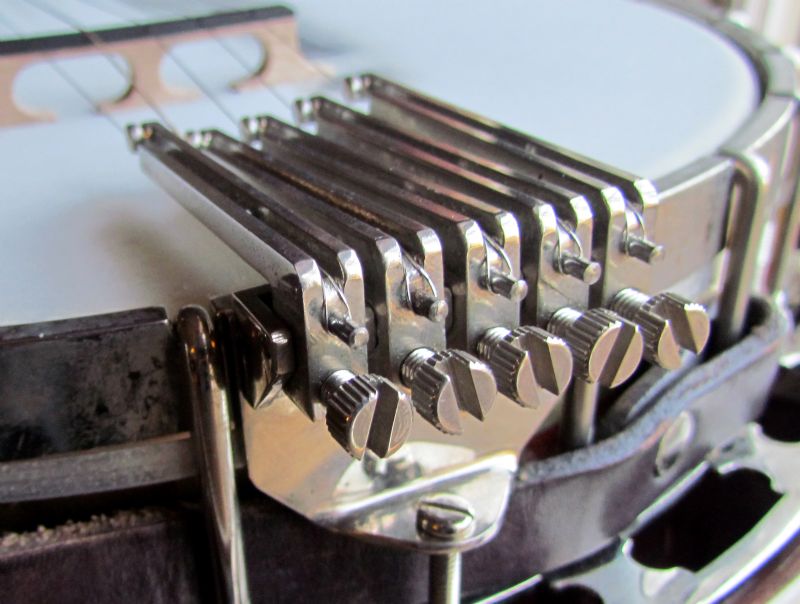 tensionator adjustors | 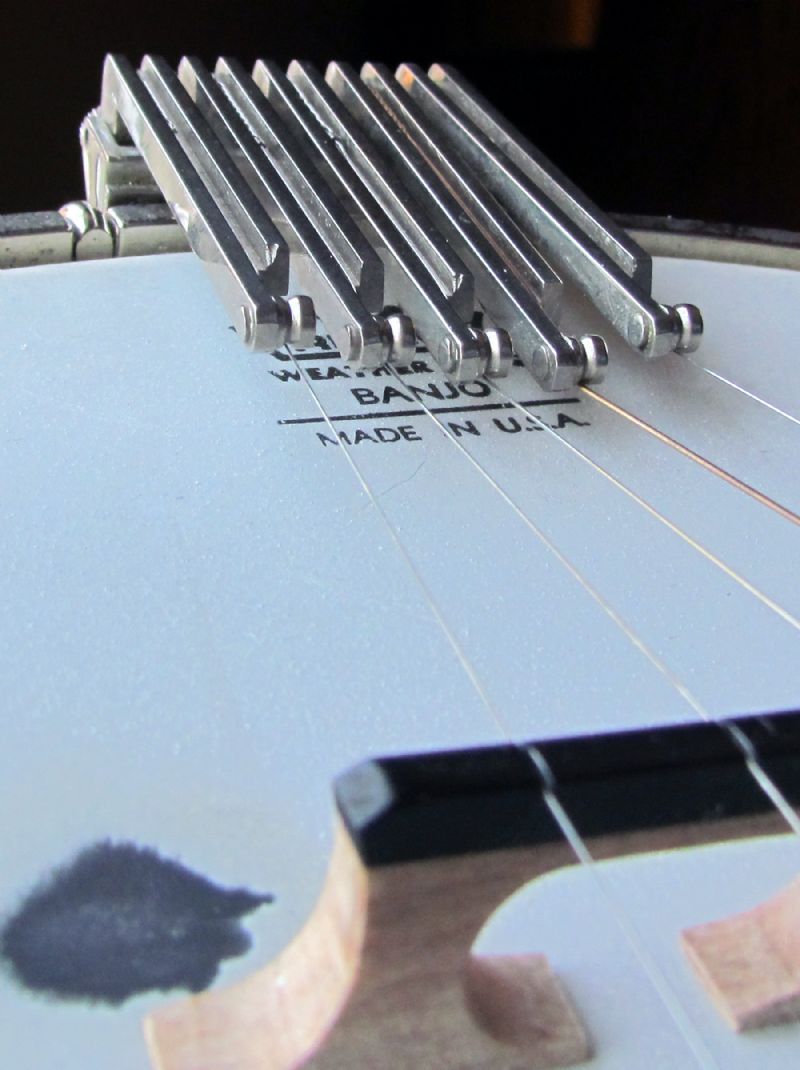 tensionator adjustment | 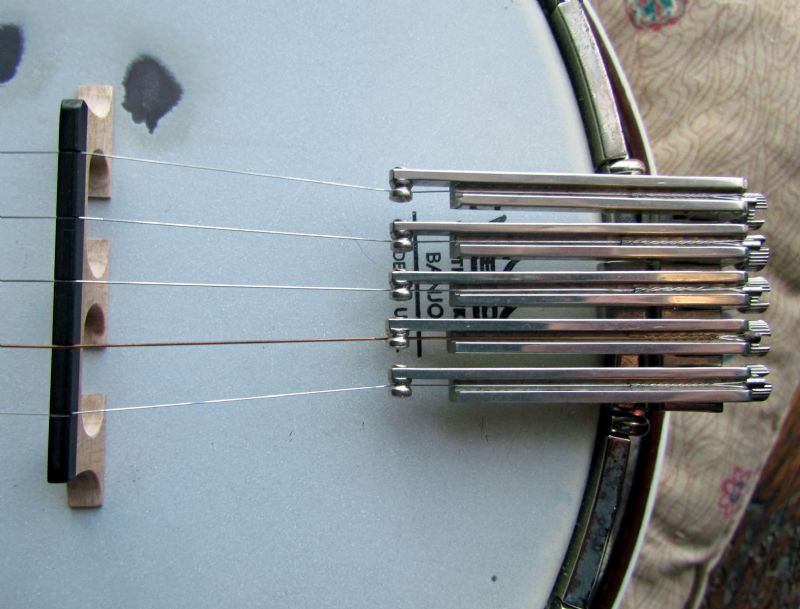 tensionator |
Bill H - Posted - 01/18/2015: 06:41:21
I agree Bob regarding the No Knot. An adjustable tail piece like a Kershner style makes all the difference in fine tuning the way your banjo sounds. Tone, volume, overtones--the adjustability is a must. No knots have a certain vintage look, and do work well on some banjos. I wonder though, if the idea of stuffing socks under the bridge of a banjo is to compensate for the lack of adjustment afforded by a no knot.
Joel Hooks - Posted - 01/18/2015: 12:24:25
quote:
Originally posted by Bill RogersWell, if you look in the old Vega catalogs, their banjos had Kershners. The no-knots are from the gut-strung days. My old-time banjos have one type of tension tailpiece or another--a couple with Kershners (Mastertone and Essex Special XX). No-knots are fine for plunk, but if you like crispness and volume, as I do, a tenion tailpiece is preferable imo.
As late as 1923 "regular" banjos-- i.e. 5 string banjos-- were still being cataloged by Vega as having "true strings." "True strings" are mechanically trued gut strings. The original Kershner patents also points out the no-knot attachment feature for gut strings.
So, technically speaking Kershner tailpieces are also from the gut-strung days.
The import Kershner tailpieces still have the no knot notches but they need to be cleaned up with 2000 grit sand paper before they are used.
Crusty - Posted - 01/18/2015: 13:36:54
Another benefit of a Kershner tp Bob is that with a hide head when it goes thuddy from a change in temperature/humidity you can get the tone back quickly by adding more downforce with the tp, effectively retensioning the head, rather than tweaking all of the nuts.
The side to side adjustment for centering the strings is icing on that cake.
BDCA - Posted - 01/18/2015: 13:58:51
That became immediately apparent and was probably a big factor in the design. Better than the light bulb solution...
Thanks!
Bob.
arnie fleischer - Posted - 01/18/2015: 14:02:13
I have no-knots on both my Cole's Eclipse and my Whyte Laydie No. 2. Each banjo is loud, crisp and clear - not at all plunky (I am not a fan of plunky). The Cole's has a skin head on the original flesh hoop and a 5/8" Bill Morris maple bridge, and even now, having loosened the head tension because of the cold, dry winter weather (even though it's pouring right now), the banjo is still pretty snappy. The Whyte Laydie has a Fibreskyn 2 head and a 9/16" Fielding maple/ironwood bridge, but I just ordered a premounted skin head for it from John Balch because I like the sound and feel of the skin head on the Cole's. Based on my experience with the Cole's I see no reason why the Whyte Laydie won't still sound crisp with a skin head and a no-knot tailpiece. I've always used light gauge steel strings on each of these banjos with no ill effects whatsoever - and I've had the Cole's since 1973 and the Whyte Laydie since 1990.
Edited by - arnie fleischer on 01/18/2015 14:03:21
arnie fleischer - Posted - 01/18/2015: 14:08:02
quote:
Originally posted by CrustyAnother benefit of a Kershner tp Bob is that with a hide head when it goes thuddy from a change in temperature/humidity you can get the tone back quickly by adding more downforce with the tp, effectively retensioning the head, rather than tweaking all of the nuts.
The side to side adjustment for centering the strings is icing on that cake.
Bluegrass banjo players (myself among them) often ignore that feature and remove those two little side adjustment screws.
banjered - Posted - 01/18/2015: 17:19:46
OK, here is another thought/observation. The Ramsey bridge is much more to the center of the pot and with a no knott there is hardly any downward pressure on the bridge. In older models such as the Whyte Laydies the bridge is much closer to the tailpiece and the sharper break angle of the strings over the bridge to the tailpiece makes for more downward pressure on the bridge. Recently I replaced a Fielding tailpiece I was using on an old SS Stewart which has some downward pressure on the bridge and went back to the no knott because of the short distance from the bridge to the tailpiece didn't need the longer arm of the Fielding. I put the Fielding on a Ramsey and I think both banjos are better for the switch. Banjered
XXXris - Posted - 01/18/2015: 18:53:10
I put a Kershner on my similarly sized Ramsey, and really like it.
My observation was that it helped control the overtones that are generated between the bridge and the tailpiece, which were noticable on the banjo. I assume that this is just because the tension tailpiece shortens the amount of string between the bridge/tailpiece. I also "corked" the tailpiece (search the forums...). I have no idea if this did anything, but it was fun convincing myself that it did.
I also think it looks cool. Some of Ramsey's banjos seem inspired by Kyle Creed's banjos, and KC often put tension tailpieces on his.
BDCA - Posted - 01/18/2015: 19:19:48
The Ramsey bridge is much more to the center of the pot and with a no knott there is hardly any downward pressure on the bridge.
True because this is a 12" rim, the new head is a much lower crown so the tension ring and No Knot are 1/4" higher than the old head. An 11" will naturally have a sharper string break angle and more downward pressure. The adjustable tailpiece manages all those factors.
Why didn't I think of it sooner??? duh! I'll be looking at adjustable TPs for my 2 Whte Laydies and a Tubaphone. This one has a brass ring.
Cya!
Bob
Paul Meredith - Posted - 01/18/2015: 19:40:03
I've built three banjos with steel strings, 11" rims. I tried no-knots on each and none sounded good - too much sustain and unpleasant overtones. They are now set up with Prestos and Kirchners. I have a 12" Chuck Lee banjo that sounds good with a no-knot but at some point I will put a Kirchner and see what that sounds like. Its a pity because no-knots, even Rickard's excellent one, are less expensive than Prestos & Kirchners.
rudy - Posted - 01/18/2015: 19:44:57
quote:
Originally posted by banjeredOK, here is another thought/observation. The Ramsey bridge is much more to the center of the pot and with a no knott there is hardly any downward pressure on the bridge. In older models such as the Whyte Laydies the bridge is much closer to the tailpiece and the sharper break angle of the strings over the bridge to the tailpiece makes for more downward pressure on the bridge. Recently I replaced a Fielding tailpiece I was using on an old SS Stewart which has some downward pressure on the bridge and went back to the no knott because of the short distance from the bridge to the tailpiece didn't need the longer arm of the Fielding. I put the Fielding on a Ramsey and I think both banjos are better for the switch. Banjered
You're getting to the heart of the matter, Tom.
The simple fact is that there's a lot more to the physics of how the tailpiece works than just if it has adjustable down force or not.
After length distance (from the bridge to the point that the strings attach to the tail piece) effect the string's ability to influence the bridge in more than one plane. Longer tailpieces restrict that movement, which isn't necessarily a bad thing. The no knot permits the maximum amount of string after length, but doesn't add down force. Any excess resonance from the string section between bridge and tail piece can be totally quieted by weaving yarn, a wide rubber band, or something similar between the strings in that area. (Or you can opt for chenille-ended strings.
The after length distance is of course tied to bridge location on the head. The bridge location is effected by head diameter, but there are other contributing factors such as scale length and nut to heel neck length.
On person's pleasure is another's poison, so it's really a matter of what's right for YOU, the player. There are lots of interacting factors in determination on tone, and tail piece choice, as well as down force applied by an adjustable tail piece can make things better, or worse.
One might be able to use a tensioning tail piece to brighten up the sound on a hide head that's dull from lack of tension, but I've never seen a banjo with a slacked hide that didn't already have the strings way too close to the upper frets. Adding down force on the bridge would push the strings closer and result in a totally unplayable instrument, at least in my case.
Edited by - rudy on 01/18/2015 19:52:19
BDCA - Posted - 01/18/2015: 19:51:54
Rudy, it's even more complex than that because you then have head tension and the effect of downwards pressure on the head at various tensions which will completely change it's resonance characteristics. I think this would have given Einstein a headache!.
Cya!
Bob
mikehalloran - Posted - 01/18/2015: 21:08:45
Only the Deluxe version of various Vegas had Kershners. A WL NO 2 or Tubaphone NO 3 came with a NoKnot through the 1920s.
Kershners could be bought on the aftermarket. So many NoKnots were replaced that people think that Kershner tailpieces were original.
1fiddle2play - Posted - 01/18/2015: 21:54:51
I like the adjustable waverly tailpieces........they've always done me good and well built.
rudy - Posted - 01/19/2015: 05:18:21
quote:
Originally posted by BDCARudy, it's even more complex than that because you then have head tension and the effect of downwards pressure on the head at various tensions which will completely change it's resonance characteristics. I think this would have given Einstein a headache!.
Cya!
Bob
Very true Bob, as well as the head material. ...and we can't forget the actual bridge itself.
I was attempting to limit my comments to just the tailpiece to try and keep my post from becoming overly-long; something I'm guilty of frequently.
BDCA - Posted - 01/19/2015: 05:35:55
But if it was easy EVERYONE would be doing it!! That's the story of...that's the glory of ...the banjo!
Bob
rudy - Posted - 01/19/2015: 05:47:56
quote:
Originally posted by BDCABut if it was easy EVERYONE would be doing it!! That's the story of...that's the glory of ...the banjo!
Bob
Yes, many kids today pick up a controller and spend their time with Guitar Hero rather than spending all that time learning to actually play an instrument. That's just PLAYING and doesn't even address all the time we invest in the pursuit of tone.
stevepicker - Posted - 01/20/2015: 14:45:13
I had the samer concerns. My Gold Tone OT 800 came w/ a no-knot. too much sustain. put a waverly on it, far better tone, more crisp. brighter.
banjo bill-e - Posted - 01/20/2015: 14:52:13
I want to try this. Anyone suggest a good source for tailpieces and an approx. price?
mikehalloran - Posted - 01/20/2015: 14:58:26
Saga dealers carry all of the usual suspects as does Stew-Mac, Elderly etc. Recording King dealers can get the most common ones. First Quality has a few that others don't carry. Bob Smakula and other specialists have even more.
BDCA - Posted - 01/20/2015: 15:09:41
I'd check out Bob Smakula. The quality is all over the place on these Asian tail pieces and if it's from Bob, the quality will be fine. Some of them use really thin metal and they bend rather than forcing the strings down. I think the mass has a positive effect on the sound.
Another BIG bonus is that the adjustable tailpieces make it easier to retune, Why didn't I think of the earlier...I suspect that many of the no knot aficionados use em because it makes a statement...."this ain't a bluegrass banjo"
Cya!
Bob
leadbelly - Posted - 01/20/2015: 16:17:32
Do any of the benefits of adjustable tailpieces apply with Nylgut strings?
OldPappy - Posted - 01/21/2015: 06:06:24
The "NO-Knots" were common in the old days, on the cheaper instruments. Most high end banjos in the early 1900s had adjustable tailpieces such as the Kershner. Banjos from the Paramount brand groups had an interesting adjustable tailpiece with the adjuster looking like a window latch.
I think because the No-Knots were on cheaper banjos, and poor banjo players in the backwoods tended to order the cheapest banjos in the mail-order catalogs, folks nowadays see pictures of those guys with those tailpieces on their banjos and think they should have one on their banjo.
Which has made them popular, and led some makers to use them as a sales point. They just look "Old Time".
Many times when the topic of No-Knots comes up, I have offered to trade two No-Knots for a decent adjustable tailpiece. I used to have a drawer full of the darn things because the first thing I did when someone wanted better tone out of their banjo was to replace the little boogers with a real tailpiece.
I still have a couple if anyone wants to trade their adjustable tailpiece for them, and when I run out, I would buy a pair of new ones to trade for a good adjustable like the Kershner, or Price style copies made today.
Otherwise, No-Knots go into the drawer in my shop, and the only time I put one on a banjo is when someone insists that is what they want. Sometimes just can't stop a Lemur from following the crowd over the cliff.
BDCA - Posted - 01/21/2015: 06:46:43
quote:
Originally posted by OldPappyThe "NO-Knots" were common in the old days, on the cheaper instruments. Most high end banjos in the early 1900s had adjustable tailpieces such as the Kershner. Banjos from the Paramount brand groups had an interesting adjustable tailpiece with the adjuster looking like a window latch.
I think because the No-Knots were on cheaper banjos, and poor banjo players in the backwoods tended to order the cheapest banjos in the mail-order catalogs, folks nowadays see pictures of those guys with those tailpieces on their banjos and think they should have one on their banjo.
Which has made them popular, and led some makers to use them as a sales point. They just look "Old Time".
Many times when the topic of No-Knots comes up, I have offered to trade two No-Knots for a decent adjustable tailpiece. I used to have a drawer full of the darn things because the first thing I did when someone wanted better tone out of their banjo was to replace the little boogers with a real tailpiece.
I still have a couple if anyone wants to trade their adjustable tailpiece for them, and when I run out, I would buy a pair of new ones to trade for a good adjustable like the Kershner, or Price style copies made today.
Otherwise, No-Knots go into the drawer in my shop, and the only time I put one on a banjo is when someone insists that is what they want. Sometimes just can't stop a Lemur from following the crowd over the cliff.
BINGO! That's exactly what I suspected. I am one of those Lemurs (actually a lemming, lemurs live in trees in Madagascar) .
Cya!
Bob
OldPappy - Posted - 01/21/2015: 07:24:20
Bob,
You are correct, the stories refer to Lemmings, not Lemurs, but you got my drift anyway.
There have been several over the years who have taken me up on my offer. I was happy, and so were they, and I like a deal like that.
BDCA - Posted - 01/21/2015: 07:52:41
No wonder it's a feature! Saves the makers $$$ on a real tailpiece offering an "authentic one"
A few Specs
Retail $1800+
| Nut | Bone | Tuners | GT Master Plantetary Tuners |
| Tailpiece | No Knot | Tone Ring | Rolled Brass Tone Ring |
| Strings | GDGBD - .010, .013, .016, .024w, .010 | Rim | 12" 3-Ply Maple Rim |
| Plating | Gold | Arm Rest | "Hot Dog" Armrest |
Mike Ramsey Tubaphone $2000+
 | 11" of 12" diameter maple rim |
| Tubaphone tone ring |
| Dowel stick construction |
| Renaissance head |
| No Knot tailpiece |
| Bracket band |
Bart Reiter:
Ships with Waverly though both my used ones (Tubaphone and Whyte Laydie) had No Knots.
Recording King
All ship with adjustable Tail Pieces
Other with adjustable:
Deering, Patterson, Wildwood
Chuck Lee $2000+:
Nickel plated Nuts, Shoes, Hooks, Tension Hoops, No-Knot tailpiece with black rim screws & washers are standard on all models with a Renaissance Head.
Others with the No Knot
Kevin Enoch, Vega (Deering Some do some don't), Brooks, Eastman, Ricard
I would never have guessed that so many makers use adjustable...I just assumed No Knots were desirable....
Duh!
Bob
stevepicker - Posted - 01/21/2015: 09:35:09
Hatfield music sells a Kerschner tailpiece for $35.00, and a beefy looking old waverly for $25. I think mass matters, too.
rudy - Posted - 01/21/2015: 09:55:29
Bob, I guess I'm not understanding your point.
Are you saying that several prominent makers are trying to cut corners and save $20 on a $2000 banjo by shipping with a No Knot?
OldPappy - Posted - 01/21/2015: 10:15:17
Rudy,
I am not Bob, but think he may have been responding to what I posted which included the statement "Which has made them popular, and led some makers to use them as a sales point. They just look "Old Time"."
I doubt any custom maker puts them on $2,000 banjos to shave $20 off material costs. I think they are there because so many people want them, and that helps sell the product.
BDCA - Posted - 01/21/2015: 10:24:55
I was trying to make two points, one is that assuming a good banjo costs $500 in parts. A $20 savings is not much but over 100 banjos....1000 banjos... And of course if the market thinks it's a feature, then flaunt it!
Point two is from my perspective I was surprised at how many manufactures use adjustable tailpieces as stock. All my open back 5 string purchases (2 Reiters, 2 Ramseys within the past year) and all had No Knots. I figured it was the standard. It never occurred to me to drop on an adjustable till last week.
Cya!
Bob
alubin - Posted - 01/21/2015: 10:33:27
All this talk makes me think I want to try an adjustable tailpiece. Is switching out the no-knot for an adjustable something I can do myself? It would be for my Reiter Bacophone+ with an 11" pot. I like the tone but want a little more crispness and volume, and fewer overtones.
I don't really have too much knowledge about repairs or building, and I would just be using hand-tools like screwdrivers and wrenches. A new tailpiece should fit without any drilling, right? Or is this something I would want to take to a professional?
Thanks!
Adam
OldPappy - Posted - 01/21/2015: 10:42:35
Adam,
Real easy to swap one tailpiece for another, no alteration of the banjo is required, you just loosen and remove the strings, take the nut off the tailpiece bolt which is often the same size as the nuts on the tension hooks so your key will fit either one.
BDCA - Posted - 01/21/2015: 10:44:12
Adam, it's a no brainer. Loosen and remove your strings at the tail piece. You can put a capo on the 4th fret to keep the strings in place on the headstock. The tailpiece is held on by a smaller nut that the bracket nut. Loosen, unscrew and remove the NO Knot and then replace with the adjustable. I like to keep the adjustable a credit cards width above the tension ring. Should take less than 10 minutes.
Cya!
Bob
banjo bill-e - Posted - 01/21/2015: 11:47:29
I knew nothing about banjos and my first was a Goodtime which had a Presto-type tailpiece. I then cycled through some quality banjos, two Ramseys and one Tradesman, all with No Knots. I do like the clean uncluttered look of the No Knot but tone rules!
I do remember reading Dwight Diller saying to throw those No Knots away. So, I will try something new and see how it goes. If I don't like it I can always change it back. Like many I am on an endless quest for the perfect tone, and I change bridges and heads, might as well change the tailpiece too.
Crusty - Posted - 01/21/2015: 12:12:12
Another Dwight Diller tip that really works to damp an overly bright open back banjo is to shove something firm but springy between the dowel and the head at the neck. It should be small in area and a tight fit between the dowel and head, rather than the large cushiony pads and cloths that we often see. I've found that the dense foam used in a fingernail buffing block is about right.
The banjo will have full tones while keeping full volume, but the higher harmonics are brought more under control.
This was a revelation to me and was just the opposite of the path I'd previously taken with so-so results.
OldPappy - Posted - 01/21/2015: 12:52:24
Dwight has lots of tricks, and the first time I met him I placed a No-Knot in his hand, as a joke. He didn't say a word, just grinned at me, and flung it toward the creek beside his house.
I don't understand why anybody wouldn't prefer an adjustable tailpiece.
Some banjos sound good with a No-Knot, but you don't have the option of even finding out if more pressure on the bridge will help it sound better.
mipake - Posted - 01/21/2015: 13:11:45
This whole thread confused me. I recently asked the "experts" on this site about setting up my goodtime for clawhammer. Bottomline was get a moon bridge and a no knot tail piece. Maybe Bob wants his banjo for ITM. If I want to play an open back for OT then why modernize it. I can play clawhammer on my Neckville phantom and it sounds great. but does it sound OT? Seems to me all the talk in this thread is meaningless unless you say what sound you are trying to achieve. too much sustain or not crisp enough are matters of taste. Should I put an adjustable tailpiece on my minstrel banjo?
OldPappy - Posted - 01/21/2015: 13:22:30
Depends on whether you want your banjo to sound "Great", or sound like what you imagine is "OT".
Take a look at the banjos played by Grandpa Jones, Wade Ward, or Dwight Diller, and tell me if they have "No-Knots", and whether or not you think they sound "OT" enough.
That will tell me more about where you are coming from.
My preference is to have a banjo sound as good as it can, and "great" is always the goal.
OldPappy - Posted - 01/21/2015: 13:30:50
Bob,
Thought you might get a kick out of this;
youtube.com/watch?v=AOOs8MaR1YM
mipake - Posted - 01/21/2015: 14:55:10
Andy
define "great"
To say I changed my set up and it had this effect is one thing. To define what is "great" is impossible.
Bob found that the no knot did not provide the sound he wanted and the adjustable did. good for him.
Who is to say anyone is the judge of what OT should sound like? If my goal is to replicate a musicians sound then by all means set up the way they did. If my goal is to have my banjo match an early vintage banjo then I want it to have the hardware that is had originally.
Seems to me grandpa Jones had a vega tubaphone that would not have had a no knot tailpiece and it had a resonator.
mipake - Posted - 01/21/2015: 15:02:06
Andy
was that video everyone rushing to buy a kershner tail piece?
rudy - Posted - 01/21/2015: 15:13:40
Beauty is truly in the eye of the beholder. I can tell you that I've known a few old time players who went with adjustables for a while and took them off, preferring the No Knot. As I stated before, it effects sound in more ways than just being able to adjust down force. It certainly doesn't cost all that much to try it, but don't be surprised if you really like the tone initially and then tire of the brightness of your new-found love. Don't throw out your No Knot yet...
Page: 1 2
Terms of Use | Privacy Policy | Privacy Consent (EU/GDPR Only)
Copyright 2026 Banjo Hangout. All Rights Reserved.


