DVD-quality lessons (including tabs/sheet music) available for immediate viewing on any device.
Take your playing to the next level with the help of a local or online banjo teacher.
Weekly newsletter includes free lessons, favorite member content, banjo news and more.
Premier Sponsors


|
Please note this is an archived topic, so it is locked and unable to be replied to. You may, however, start a new topic and refer to this topic with a link: http://www.banjohangout.org/archive/293893
davidwigal - Posted - 11/03/2014: 15:24:01
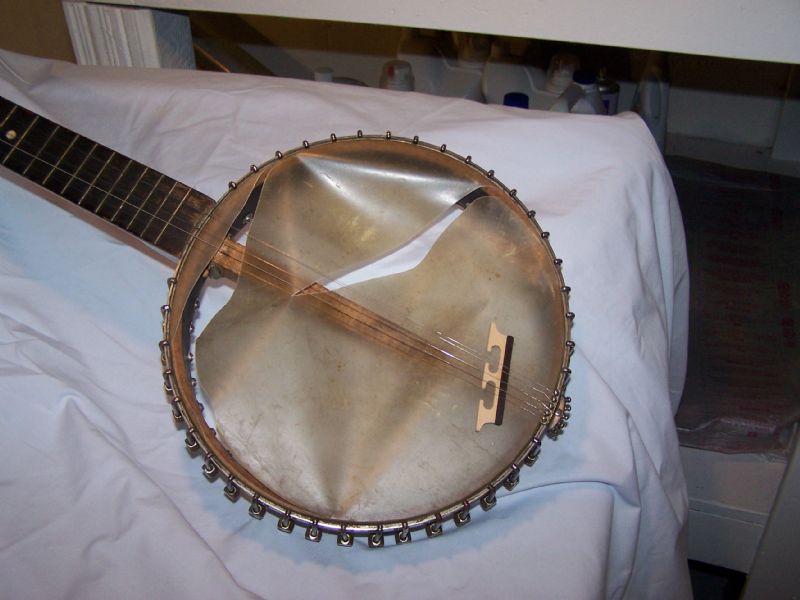
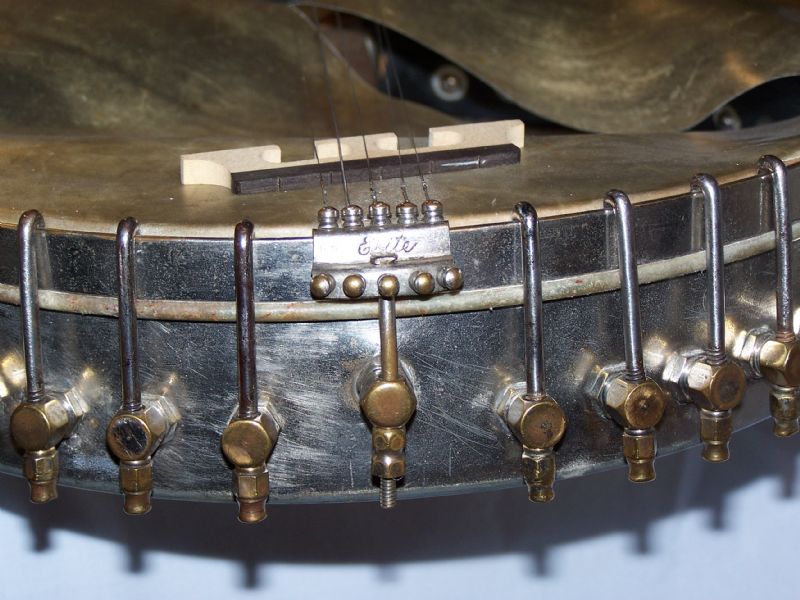
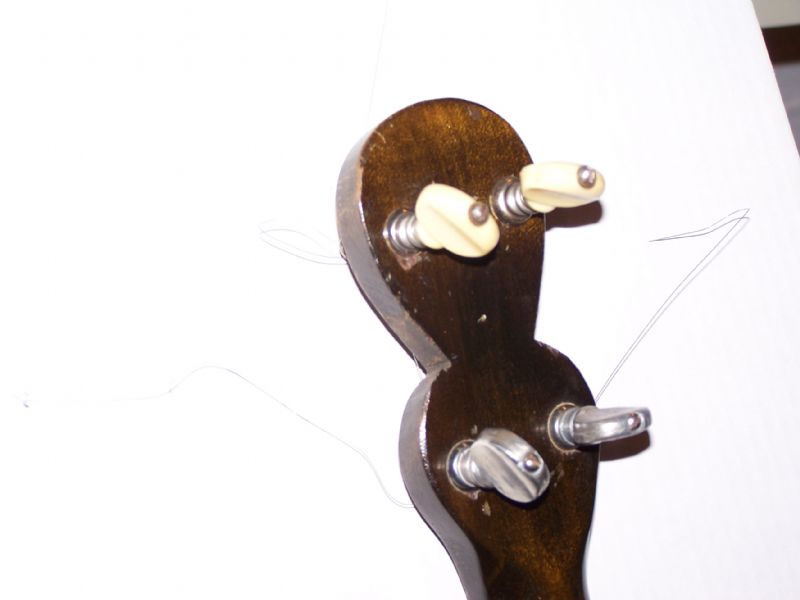
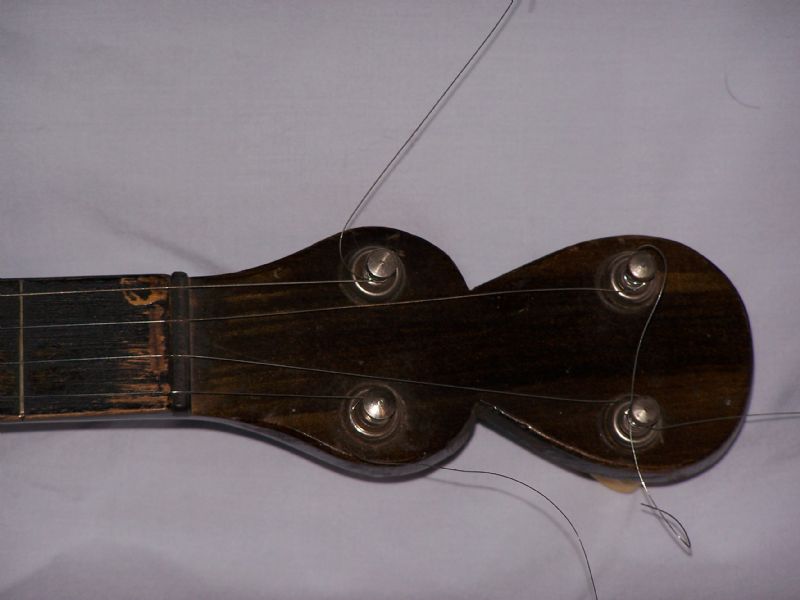
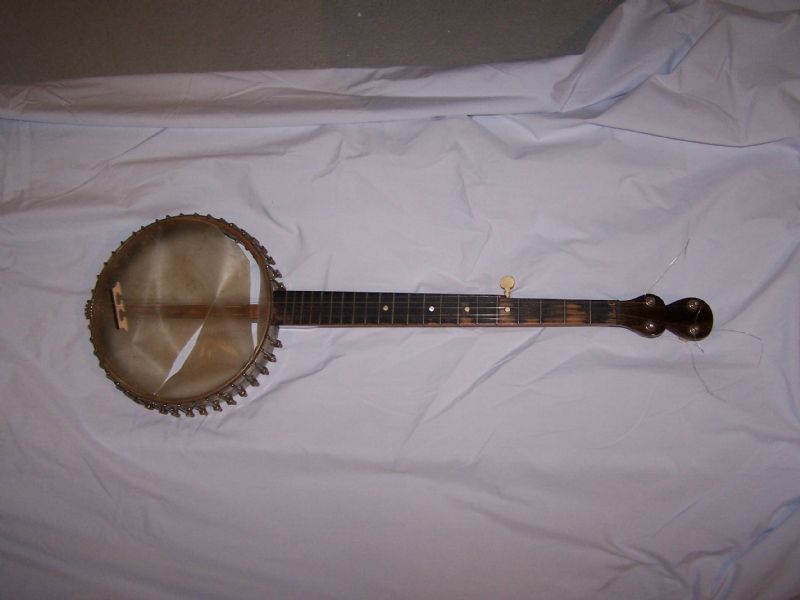
Hi all Buckbee aficionados, my friend Paul, who is a member here on the Hang-Out under code-name "Merganser," asked if I would post some pictures of a project that he is about to attempt.
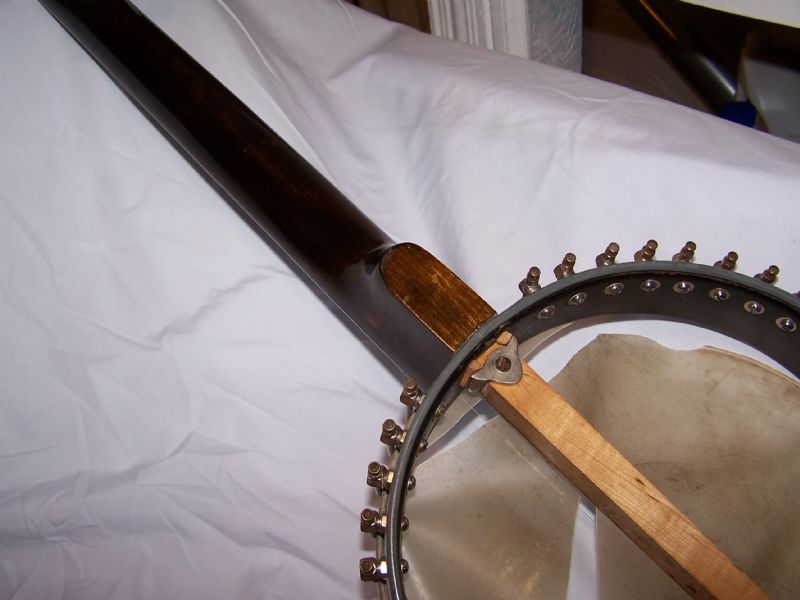
From the peg-head shape I surmised it to be a Buckbee make and from the number of tension-hooks maybe a better quality one. From our emails I take it that Paul would like to bring it up to at least playable condition and have it for his personal use.
Any information that anyone could provide on year, model or the like would be greatly appreciated; also some pointers on refurbishment such as a new head, tuners, bridge, strings, etc. would be great. I noticed that the dowel-stick seems to be a replacement and larger than the original have would been; I mentioned to him that it shouldn't really be a problem, looks as though it is doing it's job, and he might just want to leave it as it is- maybe paint it black? Maybe some of you folks might have some better advise.
Thank you for your time friends and please have a great day, Dave 
 |  |  |  |
jonredmond - Posted - 11/03/2014: 16:38:27
I like when the brass shows through on the old hardware.
Black on the stick to match the inside of the pot would look nice.
If you had any wood working skills you could trim the stick down to a slimmer taper and it would look more proportional. If it seems solid, I would keep it.
I think those hex shaped shoes where used on later than 1890 and into the 20th century
Buckbee type banjos.
Put a skin head on (i like goat) and use nylon strings. If the tuners work I would keep them. Nylon strings don't have much tension and older friction tuners work fine with them.
It should sound good.
Paul Foytack - Posted - 11/04/2014: 14:58:41
Thanks for the input Jon.
I like the idea of leaving the patina but I do see some that have been refinished and painted that have turned out nice.
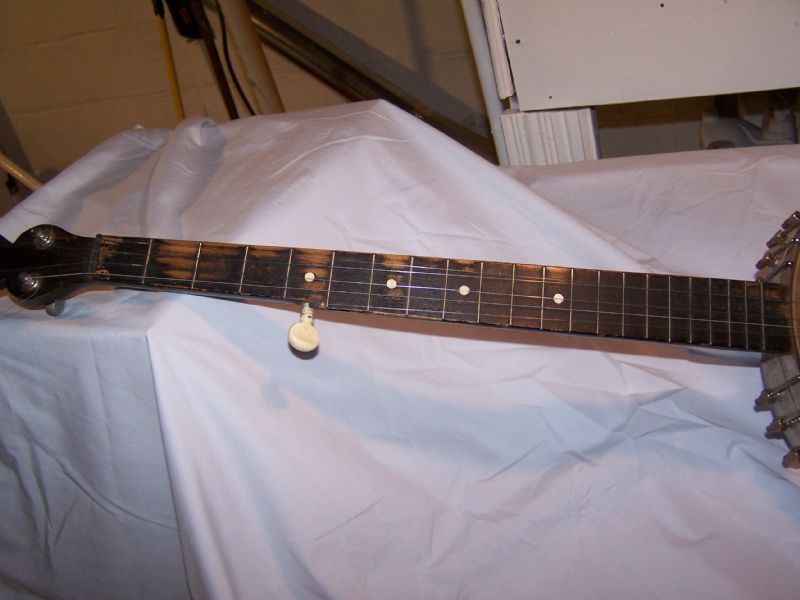
What about the finger board finish?
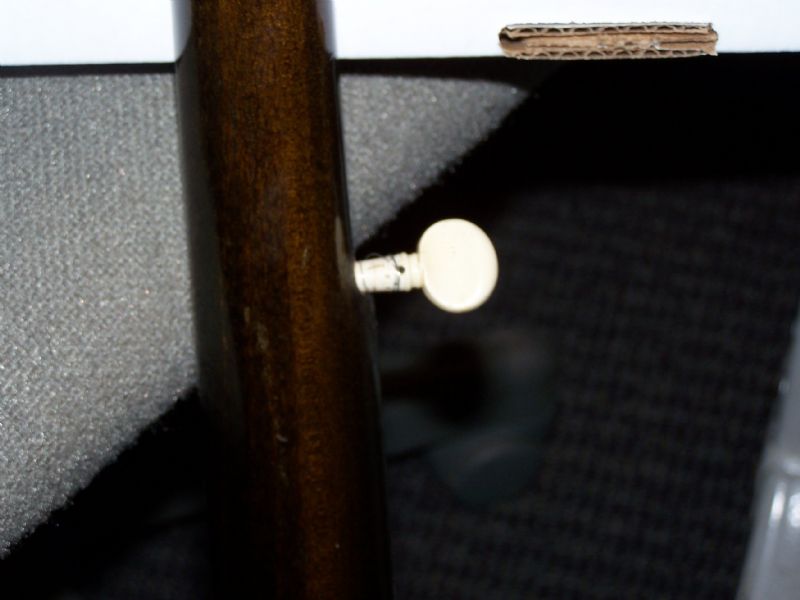
What about that 5th string peg? The hole is way away from the nut.
All input is appreciated.
G Edward Porgie - Posted - 11/04/2014: 17:48:09
Those old fingerboards were usually dyed black. Some of them were fingerboards in name only, as they were just the topside of the neck with frets put in; no ebony, rosewood, or even pearwood overlay.
The 5th string peg looks pretty normal to me and if it works okay, you should keep it, seeing as how it's ivoroid and might actually be the original.
Also, get rid of those steel strings. They're not good for what was originally a gut-strung banjo. Nylon, Nylgut, or real gut should be used.
I'd use a skin head, myself, but heads are a matter of preference, and some people feel that adjusting tension on genuine calf or goat skin is nothing but a load of trouble.
mipake - Posted - 11/04/2014: 18:00:27
I think the owner needs to answer the question. Do I want a refurbished banjo or a restored banjo? This banjo looks like it could get by with only a new head if it only needs to be refurbished. if the desire is to restore it to as near the original banjo as possible then the fret board is something that might need addressing. From the picture I can't tell if the fret board had a veneer or just stained. Are the frets in playable condition? i would install a new head and finish all work on the pot. then i would reassemble, string it up and check the tuners out. if they do not hold tuning they have to be fixed or replaced. check the action and frets . i have found even very worn frets may not produce any buzz. After all this you will have a better idea what you want to do.
the 5th string peg: I like all my tuners to match in type and color. if it were my banjo i would consider replacing the 5th string tuner to match the ones in the peghead or replacing them all.
My own philosophy is that my vintage banjos should be as close to factory original as my resources will allow. they have to be playable. this may mean new tuners of the original type if possible, new frets, even a neck reset.
I do not consider rust, dirt or even total lack of finish to be acceptable patina. I try to remove as much rust as possible Rust is the destruction of the banjo by oxidation. I should not play a banjo that has no protective finish on the wood. the finish was put there to protect the wood. if it is gone the wood is no longer protected.
I think it is fine to leave an old banjo exactly the way you found it . I also think it is fine to restore it to its original appearance.
Mike
davidwigal - Posted - 11/04/2014: 18:49:33
The fret-board, on any old banjo, is the one thing that trying to restore is really a mystery to me. I saw that you did a super-job on your Buckbee Mike; can you offer some advise for the total novice as to where we could find some instructional books, videos, or the like on the subject?
Paul Foytack - Posted - 11/04/2014: 19:29:57
OK I started taking this thing apart and I see the number 14 stamped on the rim above the hole where the dowel comes through.
Any idea what this means?
The 5th string peg just looks wrong to me in that the hole is way away from the nut which you can see in the picture.
The nut is a slotted screw. Original? or should it be bone.
What is used to clean / polish the metal outside of the rim?
Thanks
Paul
davidwigal - Posted - 11/04/2014: 21:10:55
Right on Paul, that number 14 is more than likely a factory assembly number and not a serial number; you know like you assemble the #14 necks to the #14 pots, the #5 necks to the #5 pots, and so on... Your original dowel-stick more than likely had a #14 stamped somewhere on it.
O.k. I am pretty sure that you mean that the little hole in the peg itself is far from the nut? if this is the case it is not a big problem; I have done this when a peg stuck too far out, just cut a little piece off the end of it and sand down the entire outside portion so it sits farther into the peg-hole. Remember if you mess it up it's no big deal because these parts are cheap; take your time and let this be a learning experience.
The fifth-string nut on this type of banjo should look a slotted screw, so your o.k. there.
As far as the cleaning there is a lot of debate here on the Hang-Out so check out this thread and try a couple things out; again your banjo is not super-expensive with gold-plated hardware so you can't mess it up too much; and I have a feeling that when you are finished you are going to be very surprised at how good it turns out and how easy it really is.
Please keep us informed to it's progress and please keep asking questions, no matter how small.
mipake - Posted - 11/05/2014: 04:35:32
David
I am a novice too. When I did my Buckbee I looked at the fretboard and determined that it had been a thin veneer that was 90% gone. I also knew my skills did not include creating a fretboad. I decided to remove the frets and sand the remaining veneer off. I then stained the fretboard with black Aniline Luther’s dye. I also stained the back of the neck with brown dye. The entire neck was then finished with shellac in the manner that Terry Bell recommends for his minstrel banjo kits. I then re-fretted the banjo. I found that fretting a banjo takes some practice and some special tools. When I look at a banjo I ask myself does the restoration/refurbishment require skills or tools I don’t have. Aniline dye can be obtained from Luthiers Mercantile international, lmii.com
Good luck.
Mike
davidwigal - Posted - 11/05/2014: 10:21:29
Thanks Mike. Removing and replacing frets sounds complicated; did someone show you how do them, did you refer to a repair manual or video, or possibly did you come across a thread here on the Hang-Out and follow the steps that they described?
I really appreciate your input, thank you
mipake - Posted - 11/05/2014: 12:15:51
David
I have only two books. Larry Sandberg Complete Banjo Repair and Roger Siminoff constructing a five string banjo.
I have to correct my previous post because the banjo you referred to already had the frets pulled when I got it. I did pull frets on another banjo.
My mistakes:
1. I did not tape over the fret board resulting in wood chipping up as the frets are pulled. Even if the fretboard is only the neck you have to do that. The dryed wood will chip.
2. When I fretted the banjo I needed to cut back the tabs at the end of the fret.
3. filing the frets at the ends after installation is tedious. If I ever finish another banjo that does not have a fretboard separate from the neck I will install the frets prior to finishing it. that way I can file and sand without damaging the finish on the neck.
tools you will need are fret cutter/puller. a fret saw that you can set depth on. small brass hammer.
I would think long and hard before re-fretting any banjo.
there is information on the stewart mac site and lots of threads on the hangout.
I hope someone with more experience than me will chime in. I don't feel qualified to give advice.
Mike
jonredmond - Posted - 11/05/2014: 15:22:25
If the frets or fingerboard are really bad you could turn it into a fretless. Usually it is the first five frets or so that are heavily used and you could also do a half fretless. I plan to do this on one of my old Buckbees soon by gluing down a brass plate. There are several old threads explaining this process on the Hangout and it seems somewhat easier than refretting. I have been lucky with most of my vintage finds in that the frets show some wear, but still play nicely.
davidwigal - Posted - 11/05/2014: 15:46:00
Thank you Gents I really appreciate the advise.
And thanks for pointing me in the right direction as far reference material Mike; now I have a starting-point and trial and error will probably teach me the rest. Good thing that these older Buckbees aren't too expensive
oldtimefolkie - Posted - 11/07/2014: 18:37:37
David and Paul, that banjo looks a lot like the one I have and posted about a week ago. Good luck with its rehabilitation! I'm envious of that elite tailpiece! Still looking for a good vintage one for mine. I'm missing 5 frets and thinking of pulling all the frets and started with new ones....keep you posted.
warren
Paul Foytack - Posted - 11/17/2014: 14:10:18
Hey Warren,
What is your plan on the fret board finish (excluding the frets)?
Are you doing any refinishing or leaving the patina?
Paul
oldtimefolkie - Posted - 11/17/2014: 19:16:30
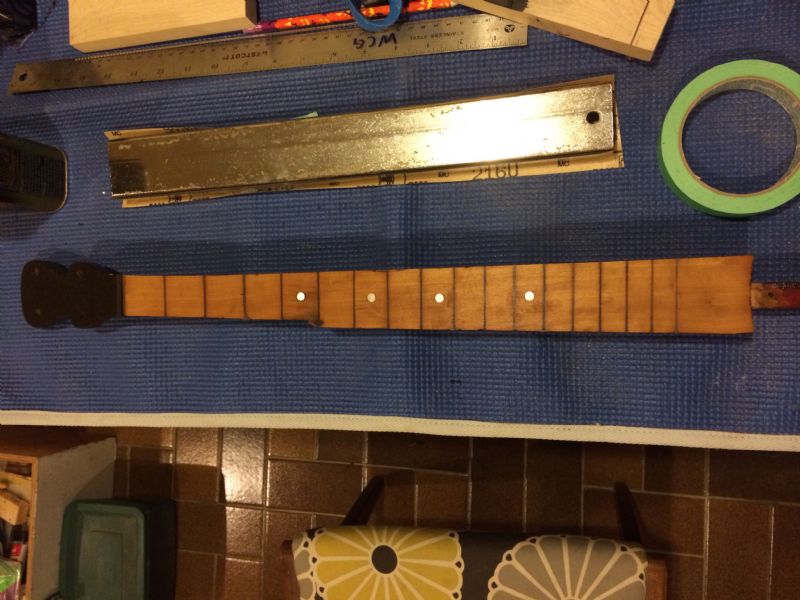
Decided to refret entire neck with narrow stew mac frets. I also had to refill all the original slots before leveling, some had been widened. I decided to apply a satin poly finish on the unstained, newly leveled fretboard. Next, I need to cut slots and fret. See below.
 |
davidwigal - Posted - 11/17/2014: 19:53:44
Oh wow that is so cool Warren; is this your first attempt at refretting or refinishing a fingerboard?
mipake - Posted - 11/18/2014: 04:58:56
looks to me like you are doing a great job. be sure to practice dressing the ends of the frets. that was what i had issues with.
best of luck
Mike
Paul Foytack - Posted - 11/19/2014: 04:25:54
I see the fret markers are the same as mine. 5/7/9/12
Can anyone explain why this is different than contemporary fret markers? ( 5/7/10/12)
Paul Foytack - Posted - 11/20/2014: 03:18:44
Warren,
I think I will start a new thread about fret markers under playing.
Might be interesting to understand why they are where they are.
blm10jn - Posted - 11/20/2014: 16:53:27
Fret markers. Some makers did the 9th fret, some did the 10 fret. Some did not do the 12 fret but did the 14 fret. Chicago area makers seem to do the 10th fret while east coast did the 9th fret. That is what is represented in the banjos I have that are ca 1900.
jun3machina - Posted - 11/20/2014: 17:51:25
such a cool thread! i hope you'll document your progress all the way through
oldtimefolkie - Posted - 11/22/2014: 21:08:11
Just posted some progress on my banjo on the building/repair forum if you're interested. Paul, have you begun your project too?
Paul Foytack - Posted - 11/23/2014: 03:19:33
Yes I have Warren.
All in pieces.
I am not sure yet how much I want to mess with the fret board.
The frets are in poor shape and I ma not sure if I should mess with them or put it back together with replacement pegs and nylgut and see how it works.
I would like to know what you and others think about how much to do in this case.
oldtimefolkie - Posted - 11/23/2014: 07:54:10
If you can use the old frets I would keep em. Way easier! How bad are they? Lots of grooves and loose? If you move this to the repair forum you may get more advice!
Edited by - oldtimefolkie on 11/23/2014 07:56:01
Paul Foytack - Posted - 11/25/2014: 03:34:05
They look rough to me but I will try them as is first.
Thanks Warren & David
Terms of Use | Privacy Policy | Privacy Consent (EU/GDPR Only)
Copyright 2026 Banjo Hangout. All Rights Reserved.