DVD-quality lessons (including tabs/sheet music) available for immediate viewing on any device.
Take your playing to the next level with the help of a local or online banjo teacher.
Weekly newsletter includes free lessons, favorite member content, banjo news and more.
Premier Sponsors


|
Please note this is an archived topic, so it is locked and unable to be replied to. You may, however, start a new topic and refer to this topic with a link: http://www.banjohangout.org/archive/291870
schlange - Posted - 09/26/2014: 09:41:48
Key of G – gDGBD
In this, Tunetorial number 18, Dan "Clawdan" Levenson teaches the tune Push the Pig’s Foot a Little Further Into the Fire aka Shove the Pig’s Foot a Little Further Into the Fire aka Pig’s Foot. Dan learned it as “Push” but no matter, a tune by any other name…
This was also a Banjo Hangout Tune of the Week back in 2008 where the title is explained and even a photo of a “pig’s foot” can be found.
The tune is often played at jam sessions and does appear at festivals a lot! Today’s playing of this tune is often credited to being first recorded by North Carolina fiddler Marcus Martin who according to the Koken/Milner collection – played it out of A cross (AEae fiddle) tuning. There are also references to older versions and even more titles of the tune if you search the web.
As in past weeks, Dan plays the tune as a chorded and melodic version as we break down sections on the fly. The tune pretty much speaks for itself so let’s just get to it!
One bonus of this week’s Tunetorial is that there is a short primer on Chords and their use as a back up tool as well as introduction to the I-IV-V chord progression theory. A bit on G scales as well but both only as they relate to using them as tools to learn and then vary a tune.
This tune is tabbed out in Dan's book (tune 37 in) Old Time Favorites for Clawhammer Banjo (MB 30224).
You can purchase the video lesson (for unlimited streaming and download) here on the Banjo Hangout for $6.
Dan and I would love to hear any feedback you have on these videos, so feel free to post or email us. Our goal here is provide a steady, affordable way for people to learn a new clawhammer tune weekly (or as often as they'd like).
It would be great to hear some of your versions so far so post them here for all to hear!
BDCA - Posted - 09/26/2014: 10:45:50
Hi Dan! We played two different versions of this tune at a jam in Durham this week. I believe the first one had a different name but I missed it.
Cya!
Bob
Crusty - Posted - 09/26/2014: 11:15:12
The post in the previous thread with a picture of an alleged pigsfoot is wrong, BTW. That's a poker shown.
Here's a picture of pigsfeet, a tool used by railroad workers to remove spikes driven into ties. Notice how they resemble a pig's foot. I'm not sure why you would want to shove one into a fire unless (as suggested by one of our fiddle players) it's referring to a forge, where they were first made by blacksmiths.
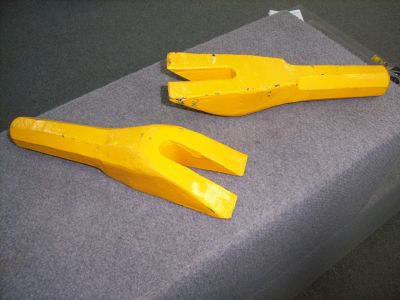 This is a Pig's Foot |
Clawdan - Posted - 09/29/2014: 08:01:50
Cool! Thanks Crusty.
Say Bob, when do you get back to Tucson?
Dan
BDCA - Posted - 09/29/2014: 08:43:19
quote:
Originally posted by ClawdanCool! Thanks Crusty.
Say Bob, when do you get back to Tucson?
Dan
Wednesday ifin' the creek don't rise and Chicago is back online.
Cya!
Bob
jojo25 - Posted - 09/29/2014: 09:40:30
I have taken the liberty of re-naming this tune...
"Watch the Irishman Slide Across the Bar"
or...short version...
"Slide Across the Bar"
the irishman being me:)
and because...per what I see in Walt/Claire's collection the tune is in A (as noted above)...and Marcus is sliding from a B note to a C sharp
If you are in G...that is an A to a B...for a fiddle in standard tuning that is nigh on impossible...in G cross tuning...doable...if the fiddler is in A or A cross...then doable
the slide is across the bar (if one is using standard notation...but no bars in the Walt/Claire collection)...you slide on the drop thumb note...guess I gotta post a recording of this...maybe my looming unemployment will give me the opportunity to do that
arkred - Posted - 09/29/2014: 14:35:08
Is that a Whyte Laydie pot with a custom neck you're playing. Sound like a Whyte Laydie. A Tuba-Phone has a little sharper sound.
mswzebo - Posted - 09/29/2014: 17:10:01
Crusty, I've always assumed the title is referring to shoving some other, ahem, iron-like object into some other warm place. Although admittedly the beautiful lilting sound of the tune doesn't seem to have anything to do with that. Hey I found this story about the title, here:
holdoldbald.tumblr.com/
Shove the Pig’s Foot a Little Bit Further Into the Fire
This is a fun tune but what’s even more fun is to read all the interpretations of the title.
The tune hit many people’s radar for the first time when Bruce Molsky recorded it on his Big Hoedown album under the title above.
The tune was a hit among the festival crowd, and most assumed the title referred to another form of strange animal treatment along the lines of “Squirrel Heads and Gravy” (which is NOT about biscuits) or the modern tune “Nail That Catfish to a Tree.” More recently, an alternative explanation has spread far and wide and is touted as THE DEFINITIVE TRUTH by many. This story claims that a “pig’s foot” is a tool used by a blacksmith (or alternatively, at a foundry) to hold a bit of pig iron (“pig” iron…how convenient) in a fire. While this explanation is nearly entirely wrong, there may be a grain of truth in it, as we will shortly see.
The fact is that this tune, like many, has seen its title change slightly over time.
The late John Hartford provided one of the few modern hints to this tune’s original title, when he played it (not on a commercial recording, alas), as “Shove That Hog’s Foot Further in the Bed” along with the sung refrain:
Shove that hog’s foot further in the bed
Further in the bed
Further in the bed
Shove that hog’s foot further in the bed
Katie, Katie, Katie, can’t you hear me now
So what are we to make of that? Is he a blacksmith asking a woman to move a tool further into a bed of coals?
No.
This song derives from an old slave folktale which later became a chant and finally a tune. The story goes like this. A slave had just stolen from his master’s larder a shoat (in other variants just its haunch) and had hidden the meat beneath his bed sheets (again in other variants it was hidden under the bed itself). The slave was in his cabin telling his wife of his prize when the master, along with a friend, appeared in the door of the slave’s cabin, requesting that the slave demonstrate his fine skill on the fiddle. Aware that the pig’s foot was exposed and its discovery, which appeared imminent, would cost him a whipping or worse, the slave quickly took down his fiddle and began to play and sing:
Shove that pig’s foot further in the bed
Further in the bed
Further in the bed
Shove that pig’s foot further in the bed
Katie, Katie, Katie, can’t you hear me now
The master and his friend watched the performance with glee while his wife Katie heard the message (hidden in plain sight) and covertly slid the pig’s leg beneath the bedsheets. At the end of the song the master exclaimed, “well, there’s a song I’ve never heard before!” and he and his friend gave the fiddler a short round of applause before making their exit.
In other variants, the slave’s wife’s name is Ginny, but the story is the same. The tale was a favorite among the miserable slaves who could always benefit from a laugh, especially from a yarn involving a slave pulling such a trick — two tricks really — on his loathsome master.
In time it became a field holler and later a fiddle tune. When Marcus Martin’s father learned it from white loggers working along the railroad lines in Western North Carolina, the title had apparently changed. Perhaps they were ignorant of the story and didn’t see why a pig’s foot would be in a bed, so they changed the word to fire. Perhaps they thought “bed” referred to a bed of coals and made, what they thought to be a reference to barbecue, more explicit. Or perhaps these railroad men were familiar with the tool known as a “pig’s foot” — a short crowbar with a cloven end — and took delight in the idea of the double-entendre permitted by such an image. Because of course, “poking the fire” was a well-known euphemism for the act of sex. Recall the famous story in which James Monroe expressed to Thomas Jefferson his surprise that James Madison was able to engage in carnal acts with a wife as homely as Dolley Madison. Jefferson replied with a broad grin, “My dear young man, I am quite certain that the President does not find the need to admire the mantel whilst he is poking the fire!”
Clawdan - Posted - 09/29/2014: 18:02:23
quote:
Originally posted by arkredIs that a Whyte Laydie pot with a custom neck you're playing. Sound like a Whyte Laydie. A Tuba-Phone has a little sharper sound.
11 13/16" Tubaphone pot (1915ish?) with Rogers skin head and a custom Kevin Enoch neck. It was one of the first instruments he built after we all left Goose Acres.
Clawdan - Posted - 09/29/2014: 18:05:34
Great history on the tune Mark! Thanks so much. The living nature of the music and the histories are all so illustrative of the story of the tunes and their transmission of them AND their stories over the years.
Terms of Use | Privacy Policy | Privacy Consent (EU/GDPR Only)
Copyright 2026 Banjo Hangout. All Rights Reserved.