
DVD-quality lessons (including tabs/sheet music) available for immediate viewing on any device.
Take your playing to the next level with the help of a local or online banjo teacher.
Weekly newsletter includes free lessons, favorite member content, banjo news and more.
Premier Sponsors


|
Please note this is an archived topic, so it is locked and unable to be replied to. You may, however, start a new topic and refer to this topic with a link: http://www.banjohangout.org/archive/289840
kaydee - Posted - 08/15/2014: 16:38:58
I changed to a set of Clifford Essex medium strings today from steel.
I am very impressed ,intonation is better,I am guessing that the greater stretch translates into less error,does this make sense .?I love the sound ,mellow plucky ,just nicer to listen to ,also I used to tone the banjo down by stuffing it ,(it's an open back) but now the volume and tone are perfect,so no damping needed.
slightly less sustain ,but other features are ease of playing ,fingers seem to slide and glide better,and interestingly the banjo stays in tune better.I am guessing that the much greater stretch for any given string means minor issues are less noticeable.
overall I have to say my re-acquaintance with nylon strings(I used to play a lot of classical guitar way back.)has been a huge pleasure. Steel I am afraid will be something I may return to but not for a while .Unexpected .!
davidppp - Posted - 08/15/2014: 17:50:29
Totally makes sense, and all guesses spot on. They'll last longer, too -- but the downside is that you'll be less likely to try other synthetic materials. I'm sure there're any number of BHO threads where people express their preferences. I suspect that nylon is the overwhelming choice of classical banjo players, but beyond that it's wide open. (I'm liking Aquila reds these days.)
Explorer - Posted - 08/15/2014: 20:07:25
I think that most folks are risk-averse if it's going to cost them money, or if it is likely to cost them money. They probably read up on stuff before making a jump.
For me, there have been so many folks who have noted how twitchy the Aquila strings are, to the point of breakage, that I'd rather wait until I don't read any such stuff for a few years before I will conclude they got the kinks worked out of them.
I never see a downside to letting others be the guinea pigs, but I always feel that way when it's my money on the line.
shane_lxi - Posted - 08/15/2014: 20:37:02
^ I had several breakage issues with aquila reds. I even tried tuning my 1st string up to D over a several day period, which resulted in a playable tuned banjo for about 10 minutes before it broke again, lol. I tried them with a no-knot used as designed, on a no-knot with bowstring knots, after polishing and deburring a no-knot, and with a nice walnut wood tailpiece. Always broke. I am using d'addarrio classical guitar string right now, and I like how easy they are to tune and that they stay in tune well, but I don't like how rubbery they feel. It should be noted that I was trying to tune my reds to standard G on a longer than average scale banjo (about 27"), and someone might have better luck on a shorter scale banjo.
kaydee - Posted - 08/16/2014: 00:14:27
I picked the Essex strings as they are made in England ,which is where I live ,and for £5 a set ,they were the obvious choice,I think I will get a set of Chris Sands strings in a couple of months and try them,they are slightly more expensive at £7-50 ,but even so a very cheap upgrade !thanks guys
davidppp - Posted - 08/16/2014: 09:22:57
For cheap per inch, nothing beats fishing line. On the other hand, if you're the only person involved, buying a lifetime supply by the spool may be a significant investment.
Aquila breakage (that is not due to nicks from sharp edges) points to a well-understood but simultaneously mysterious aspect of musical strings. For a given material, desired pitch, and scale length, making the string thicker will not make it less (or more) prone to breakage. (Think of "thicker" as just a bunch of thin ones in parallel.) Ukuleles have long done just fine with Aquilas. This all points to the possibility that typical banjo scale length, standard pitch, and the proprietary Aquila material aren't quite a good match. Along these lines, I suspect that there's no Aquila complaint from minstrel style players who tune lower relative to scale length, i.e., it's not the extra thickness of the sets labeled "minstrel" that makes them less prone to breakage.
rudy - Posted - 08/16/2014: 09:38:12
quote:
Originally posted by davidpppFor cheap per inch, nothing beats fishing line. On the other hand, if you're the only person involved, buying a lifetime supply by the spool may be a significant investment.
Aquila breakage (that is not due to nicks from sharp edges) points to a well-understood but simultaneously mysterious aspect of musical strings. For a given material, desired pitch, and scale length, making the string thicker will not make it less (or more) prone to breakage. (Think of "thicker" as just a bunch of thin ones in parallel.) Ukuleles have long done just fine with Aquilas. This all points to the possibility that typical banjo scale length, standard pitch, and the proprietary Aquila material aren't quite a good match. Along these lines, I suspect that there's no Aquila complaint from minstrel style players who tune lower relative to scale length, i.e., it's not the extra thickness of the sets labeled "minstrel" that makes them less prone to breakage.
Ah, the eternal Aquila love/hate relationship.
I have a few friends that use them (both original formulation and reds) with no issue of breakage. I use them on fretless (original formulation Classics in double C tuning for the most part) with no breakage after using a couple of sets over perhaps 4 or 5 years. I have a couple of sets of the reds to try one of these days. In my case the banjos that wear them are slightly shorter 25-1/2" scale which would lower the tension a bit, too.
Fishing line is cheap, but there is a huge difference in tone between standard fishing line and fluorocarbon strings. I can't remember reading a single comment from anyone who wanted to go back to standard nylon after using fluorocarbon line. If tone is the predominant reason for using synthetic strings then going to a string such as the Aquila nylgut raises the bar still further above fluorocarbon.
I guess the jury is still out for many where longevity vs. tone is concerned. I know that there are a large number of folks that are pretty satisfied with classical guitar strings fitted to banjo.
DEmery - Posted - 08/16/2014: 11:20:21
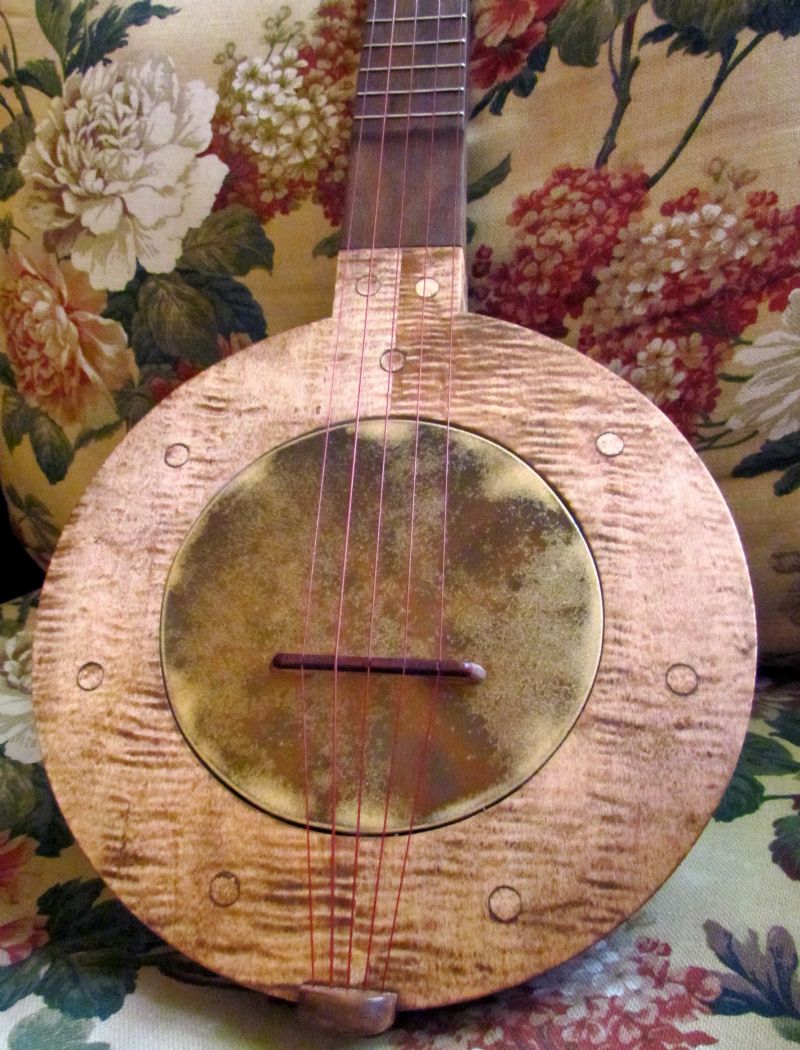
For some reason I have never had a breakage issue with Nylguts. I don't tune to standard G and typically tune down to Double A or E. Recently I acquired a mountain banjo and strung them with reds. I like em'. Cannot explain it; but they just feel different to me...better. I even like how they look. I have them on three very banjos including a flush fret and minstrel; and for my taste the strings perform very well. David E.
Edited by - DEmery on 08/16/2014 11:22:24
 |
banjukebox - Posted - 08/16/2014: 11:22:37
I have found that the 1st and 5th strings in the red Aquila sets are more prone to breakage. On one of my banjos, I have gone back to standard Aquila Classic mediums for those strings, keeping the reds for 2 through 4. My other banjo has a shorter scale length and the reds work fine.
Joel Hooks - Posted - 08/16/2014: 12:55:13
Admittedly, I'm a weird one. The Nylgut strings are too thick for me. I play with bare fingers and they tend to roll off the tips and not snap sharply. They also tend to sound clacky.
For my "tub" banjos I like guitar strings. I order individuals from that company in NH, being down the road I usually get them next day. I use normal tension rectified and tune to "Briggs'" pitch.
For my "regular banjos" I really like the La Bella No. 17. They recently went to a harder rectified nylon from DuPont while keeping the same diameter.
That said, I go for an older time sound and not the modern "old time" sound-- Sharp loud and snappy.
One of the biggest myths floating around is that nylon (or any soft strings) are quieter than wire. There is some truth to this myth in that they were for a long time used with thick loose heads and the ridiculously overbuilt wire string bridges.
With a proper bridge, tight thin head and confident touch nylon strings will often have more volume tone and power than wire with none of the down sides. There are no overtones to fight and no shrillness that needs stuffing away. Frets no longer need replacing and finger nails no longer get torn off (though, when played with a thimble they will rattle the windows!).
As with anything, nylon is not something to just try-- a little bit of work is required to develop the proper touch. Techniques that were used with wire don't usually work with nylon. The main thing is to move the right hand towards the bridge. Playing over the neck gives a dull and thuddy tone.
Attached is a cut of a proper bridge style. Made of maple, hard pine or cedar, this style of bridge will show a shocking increase in volume and tone. Notice the way the notches are cut at a slant. I've found that to work the best with a strong attack, down striking or picking. The "hand made" version is simply rounded off on the supports and bottom of the cross piece. I've been doing this with a emery board. These are usually less than half the thickness of a wire string bridge. Ebony capped bridges are to prevent wire from cutting into the bridge. This is not a problem with nylon.
I recently have had good luck with an all ebony bridge on my Eastman banjo. I made it "razor" thin and smaller all the way around than the pictured cuts. When I get my shop set back up I'll take it down even more. It is very powerful. Most of my banjos get pine or maple.
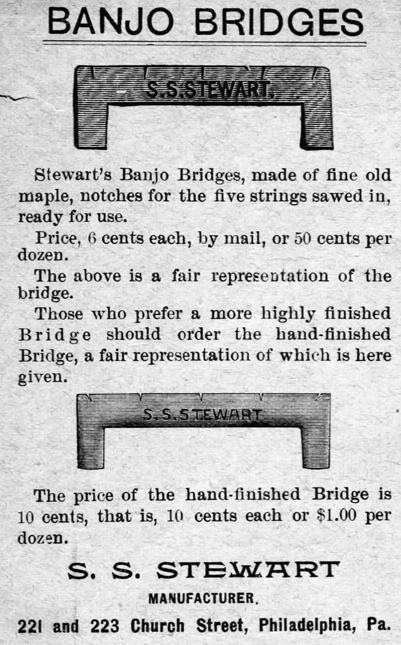 Stewart Bridges |
Bufo Bill - Posted - 08/16/2014: 13:23:15
On the subject of Aquila strings I agree with David on the reds.
Listen to what Joel says, he has given you the keys to success with his advice. The loudest bridge I had was under a gram in weight and was made of Douglas Fir and ebony, with a two footed design. I only took it off when I changed from Chris Sands to Aquila Reds, as the string diameters were different.
All the best from Bill. :D
davidppp - Posted - 08/16/2014: 15:27:40
Joel: Thanks for chiming in. Every once in a while, there's something on BHO that's just REALLY INTERESTING. The DIY-er in me says, "I have to make one and try it out," and the scientist says, "I have to figure that out." (The first one is always much easier, but no less satisfying.)
Joel Hooks - Posted - 08/16/2014: 17:27:56
quote:
Originally posted by davidpppJoel: Thanks for chiming in. Every once in a while, there's something on BHO that's just REALLY INTERESTING. The DIY-er in me says, "I have to make one and try it out," and the scientist says, "I have to figure that out." (The first one is always much easier, but no less satisfying.)
Be careful! I have found myself making a "library" of replica bridges to play around with. Anytime I find a catalog cut of a style I've just got to make one and try it out.
I recently made a few Bacon "Neverslip" bridges. I like them better than the "Cole" bridges. I always find myself going back to the SSS style, they seem to work the best with most banjos.
The best bridge making tool I've got is a cheap Harbor Freight 1" bench belt sander (not the one with the disk on the side-- just the belt). Wait till they are on sale and use a 20% off. I think mine was less than $20.
For others reading this, a hobby coping saw and some sandpaper is all you need. Paint stirring sticks are free. Cut the notches with welder tip cleaners. Hobby shops sell Basswood in 1/4" thick sheets. Basswood makes a pretty decent bridge but I find the notches wear sooner than maple or even pine.
trapdoor2 - Posted - 08/16/2014: 17:46:53
quote:
Originally posted by Joel Hooksquote:
Originally posted by davidpppJoel: Thanks for chiming in. Every once in a while, there's something on BHO that's just REALLY INTERESTING. The DIY-er in me says, "I have to make one and try it out," and the scientist says, "I have to figure that out." (The first one is always much easier, but no less satisfying.)
Be careful! I have found myself making a "library" of replica bridges to play around with. Anytime I find a catalog cut of a style I've just got to make one and try it out.
I recently made a few Bacon "Neverslip" bridges. I like them better than the "Cole" bridges. I always find myself going back to the SSS style, they seem to work the best with most banjos.
The best bridge making tool I've got is a cheap Harbor Freight 1" bench belt sander (not the one with the disk on the side-- just the belt). Wait till they are on sale and use a 20% off. I think mine was less than $20.
For others reading this, a hobby coping saw and some sandpaper is all you need. Paint stirring sticks are free. Cut the notches with welder tip cleaners. Hobby shops sell Basswood in 1/4" thick sheets. Basswood makes a pretty decent bridge but I find the notches wear sooner than maple or even pine.
Put a drop of thin CA glue in each notch, Joel, and they'll wear like iron.
Terms of Use | Privacy Policy | Privacy Consent (EU/GDPR Only)
Copyright 2026 Banjo Hangout. All Rights Reserved.


