
DVD-quality lessons (including tabs/sheet music) available for immediate viewing on any device.
Take your playing to the next level with the help of a local or online banjo teacher.
Weekly newsletter includes free lessons, favorite member content, banjo news and more.
Premier Sponsors


|
Please note this is an archived topic, so it is locked and unable to be replied to. You may, however, start a new topic and refer to this topic with a link: http://www.banjohangout.org/archive/283822
EggerRidgeBoy - Posted - 04/25/2014: 12:36:46
There seems to have been a bit of a glitch in the TOTW schedule this week, so I am posting an "emergency back-up tune", one that I had worked on awhile back but never finished writing up.
That tune is The Snouts and Ears of America, a tune collected from Sarah Armstrong by Sam Bayard and published in his 1944 book "Hill Country Tunes: Instrumental Folk Music of Southwestern Pennsylvania". I first learned of it last year at Clifftop, when I bought "Up Jumped Joe in the Middle of It: Old Time Music From Southwestern Pennsylvania - Selections from the Sam Bayard Collection", a CD from Mark Tamsula (fiddle) and Richard Withers (banjo) that consists of 26 tunes taken from the Sam Bayard collection (appalachianmusic.net/ujjoe/index.htm). As is often the case when perusing the track list of such CDs, it was the title that first caught my attention - how could it not - but upon listening to the CD I found that I enjoyed the tune itself just as much.
SARAH ARMSTRONG
Sarah Armstrong (1883-1957) was born in Westmoreland County, Pennsylvania, and lived in the area her entire life. Her family was of Irish heritage, and her father and his four brothers were all accomplished musicians, playing regularly for local dances. Sarah took up the fiddle at age five, and learned most of her repertoire from her Uncle Laney.
More about her family and her music can be found here: laurelmountainpostonline.com/2...ray-boys/
Sarah Armstrong
SAM BAYARD
We know of her tunes today because of the efforts of Samuel Bayard (1908-1997), a folklorist and musicologist from Penn State University who spent 35 years collecting traditional music from southwestern Pennsylvania and northern West Virginia. Bayard was born in Pittsburgh, and spent a good deal of time as a child at his uncle's farm in Greene County, in the southwestern corner of the state. Bayard was originally inspired to learn and preserve folk music on a trip to Ireland with his family at age 20, when he heard traditional Irish music in the town of Connemara. As her later wrote "An old Irish woman sang me several Irish Ballads and I took them down. I had taken to music early, but it was the first time I realized I could take down tunes by ear that way. I was delighted and immediately made plans to go back and collect folk songs in Ireland."
Bayard never made that tune-collecting trip to Ireland, since upon returning to the U.S. he discovered that his home region of Pennsylvania had a rich musical tradition of its own. "I was visiting my uncle in Greene County when I happened to find out that two of the neighbors were old-time fiddlers and folk song singers. I had known them both for years, but never realized that while I sought folklore far away, it was right at my door."
One of those neighbors was Sarah Armstrong, who Bayard first visited on November 5th, 1943. He transcribed four tunes that day, returning on November 18th to transcribe 33 more. Those 37 tunes made up over a third of the tunes in Bayard's "Hill Country Tunes", published the following year.
HILL COUNTRY TUNES
Bayard's work is well-known in the old-time music community, as is the name Sarah Armstrong. In part that is due to the popularity of Sarah Armstrong's Tune, the title later given to the tune that was published in Bayard's book as "#33 - Old Reel". In recent years it has become a festival and jam session favorite (and was discussed in TOTW #108: banjohangout.org/archive/184806).
Although there is evidence that Sarah Armstrong's fiddle playing was recorded by her family, no such recordings have yet come to light. The Slippery Hill site has a page devoted to Bayard's Hill Country Tunes, on which modern versions of the volume's 95 selections can be found (slippery-hill.com/HillCountry/). Among those recent recordings are several by Mark Tamsula & Richard Withers, and by Todd Clewell.
Mark and Richard have produced two CDs devoted to the Hill Country collection - the aforementioned "Up Jumped Joe in the Middle of It", and "Up in the Batten House" (appalachianmusic.net/sbug/). They contain many of Armstrong's tunes, along with those from several other artists included in Bayard's book. Todd Clewell's CD "Sarah Armstrong Tunes" focuses - not surprisingly - solely on her tunes, and consists of 27 of the tunes collected from her by Bayard, including The Snouts and Ears of America (toddclewell.com/sarah.html).
"Hill Country Tunes" has long been out of print, but Penn State has made the entire volume available online as a free PDF download: mne.psu.edu/lamancusa/tunes/hct/
THE SNOUTS AND EARS OF AMERICA
The Snouts and Ears of America appears in Hill Country Tunes as Tune #58. The meaning of the title is unknown. Indeed, I could not even find much speculation on its meaning, an unusual situation when researching old-time tunes - evidently it is such an inexplicable phrase that few try to figure out its origin. That includes Sam Bayard. In his notes about the tune, he merely states "The title of this fine, spirited piece may not be a corruption, but as it stands it is incomprehensible".
He goes on to write "The editor knows of no other version; but it is not impossible that the air is a derivative of the familiar Irish Washerwoman tune, recast in 4/4 time,and with the order of parts reversed. If so, it makes a distinct improvement on the original melody".
It is in D Major, with a standard AABB structure.
RESOURCES
I found a few Youtube videos of the tune, all fiddle versions.
youtube.com/watch?v=eokiVawgk9E
Linda Vik teaches the tune on the fiddle: youtube.com/watch?v=UxFzPwL9BBo
(Speaking of "learning videos", here's a version played by an elementary school orchestra soloist: youtube.com/watch?v=EoBiUzhMBPY)
I have yet to come across any banjo tablature, but the standard notation for the tune can be found here: hatds.org/contradans/reels/Sno...erica.pdf
Edited by - EggerRidgeBoy on 04/28/2014 14:10:33
hendrid - Posted - 04/25/2014: 13:03:36
This medley has the tune at the end
youtube.com/watch?v=uI-eFKf6_3Y
J-Walk - Posted - 04/25/2014: 17:04:30
One of the best tunes names ever. Second only to "Maggots in the Sheep Hide." Which is Tune #62 in that Hill Country Tunes book.
LyleK - Posted - 04/26/2014: 04:37:07
quote:
Originally posted by EggerRidgeBoy
I have yet to come across any banjo tablature...
Here's a pretty "vanilla" tab.
Edited by - LyleK on 04/26/2014 04:39:33
 Snouts 'n Ears |
ndlxs - Posted - 04/26/2014: 11:45:56
My hearing of the tune in the first video in ABC notation:
X:1
T: The Snout and Ears of America
M:4/4
R: Reel
K:D
(3ABc)|d2D2D2DD|F2A2d2ed|c2A2ABcd|e2A2A2Bc|dcBA G2F2|E2D2ABAG|F2D2E2DE|1F2D2D2:|2F2D2D2||
AG|F2A2A2AA|F2A2A2BA|G2E2E2E2|A2d2dcBA|F2A2A2AG|F2A2A2BA|G2E2ABAG|F2D2D2:|
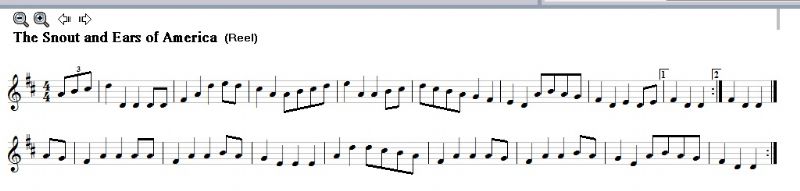 Snout and Ears of America |
JanetB - Posted - 04/27/2014: 13:59:02
I'm grateful to you, EggerRidgeBoy, for pointing the way to Sam Bayard's Hill Country Tunes and to Sarah Armstrong, the fiddler from whom he often collected tunes. I listened to Mark Tamsula and Richard Withers for my arrangement, and found it's very similar to Lyle's tab. I added several tied notes to imitate the fiddle. The two CDs I have from this talented pair of Pennsylvanians--a fiddler and a multi-instrumentalist--along with the added interesting resources they use from Bayard's collections, are delightfully worth having.
Edited by - JanetB on 04/27/2014 14:07:20
 The Snouts and Ears of America--TOTW 4/25/14 | The Snouts and Ears of America tab |
Don Borchelt - Posted - 04/27/2014: 17:56:08
Great picking, Janet, very nicely arranged and well played. A great choice for Tune of the Week. The tune certainly lives up to its wonderful title. I've attached my version below, worked up this morning. I'm three finger picking my 1902 Fairbanks Whyte Laydie in open D tuning (aDF#AD). I have a tablature posted on my website.
Edited by - Don Borchelt on 04/27/2014 17:56:43
 VIDEO: The Snouts and Ears of America (click to view) |
cbcarlisle - Posted - 04/27/2014: 18:05:56
If you don't mind hearing it on accordion (gasp!) here's a medley where it's called just Snouts and Ears.
youtube.com/watch?v=4LMxtp8zn2E
J-Walk - Posted - 04/27/2014: 18:55:25
I survived that video, Curt. Probably because I've been drinking Scotch.
EggerRidgeBoy - Posted - 04/28/2014: 12:24:30
quote:
Originally posted by hendridThis medley has the tune at the end
youtube.com/watch?v=uI-eFKf6_3Y
Thanks, Don - I missed that one.
EggerRidgeBoy - Posted - 04/28/2014: 12:27:35
quote:
Originally posted by J-WalkOne of the best tunes names ever. Second only to "Maggots in the Sheep Hide." Which is Tune #62 in that Hill Country Tunes book.
Yes, that's quite the memorable title - and another Sarah Armstrong tune. Someone (her Uncle Laney?) seems to have had a colorful repertoire.
(Don Borchelt covered Maggots on the Sheep Hide as TOTW #224, and included some good information on Sarah Armstrong and Sam Bayard: banjohangout.org/archive/249024 .)
Edited by - EggerRidgeBoy on 04/28/2014 12:31:09
EggerRidgeBoy - Posted - 04/28/2014: 12:35:45
Thanks to Lyle, Janet, and Don for your tabs, audio, and video!
EggerRidgeBoy - Posted - 04/28/2014: 13:20:15
quote:
Originally posted by cbcarlisleIf you don't mind hearing it on accordion (gasp!) here's a medley where it's called just Snouts and Ears.
youtube.com/watch?v=4LMxtp8zn2E
I actually enjoyed that - it's fun to hear the tune in a different musical context.
Brooklynbanjoboy - Posted - 04/28/2014: 13:50:30
I thought I'd take a hack at it:
EggerRidgeBoy - Posted - 04/28/2014: 14:03:26
quote:
Originally posted by JanetBI'm grateful to you, EggerRidgeBoy, for pointing the way to Sam Bayard's Hill Country Tunes and to Sarah Armstrong, the fiddler from whom he often collected tunes. I listened to Mark Tamsula and Richard Withers for my arrangement, and found it's very similar to Lyle's tab. I added several tied notes to imitate the fiddle. The two CDs I have from this talented pair of Pennsylvanians--a fiddler and a multi-instrumentalist--along with the added interesting resources they use from Bayard's collections, are delightfully worth having.

Thanks for your wonderful version, Janet.
I agree that those two CDs from Mark and Richard are great projects, due both to the music and the information they contain. I always appreciate folks who do such in-depth explorations of the music of a specific region - especially when that music and region aren't particularly well-known compared to other old-time music communities.
EggerRidgeBoy - Posted - 04/28/2014: 14:04:25
quote:
Originally posted by Don BorcheltGreat picking, Janet, very nicely arranged and well played. A great choice for Tune of the Week. The tune certainly lives up to its wonderful title. I've attached my version below, worked up this morning. I'm three finger picking my 1902 Fairbanks Whyte Laydie in open D tuning (aDF#AD). I have a tablature posted on my website.
I'm glad you are enjoying the tune, Don. Thanks for posting your version and for providing the tab.
EggerRidgeBoy - Posted - 04/28/2014: 14:09:47
quote:
Originally posted by BrooklynbanjoboyI thought I'd take a hack at it:
I also thought I should post the recipe for snouts and ears:
Play hard,
Lew
Thanks for posting your version, Lew.
And thanks - I think - for posting a snouts and ears recipe. :-) I probably should have guessed that somewhere there was such a dish - I mean, if people eat pigs feet and chicken feet and other such animal parts, why not snouts and ears. I wonder if that was the origin of the tune's title? I don't think I've ever come across a reference to eating "snouts and ears" in Appalachia - but perhaps Scotland or Ireland?
Edited by - EggerRidgeBoy on 04/28/2014 14:10:13
Harpist - Posted - 04/28/2014: 23:33:24
'And thanks - I think - for posting a snouts and ears recipe. :-) I probably should have guessed that somewhere there was such a dish - I mean, if people eat pigs feet and chicken feet and other such animal parts, why not snouts and ears. I wonder if that was the origin of the tune's title? I don't think I've ever come across a reference to eating "snouts and ears" in Appalachia - but perhaps Scotland or Ireland?'
________________________
Just about every time you eat a sausage you're enjoying snouts and ears - and many other parts. Great tune, btw!
Couchie - Posted - 04/29/2014: 06:25:17
I knew I could trust Mr. Borchelt and Ms. Janet B. to have great versions of an old time tune. This is what I love most about this place. Thanks for the seemingly endless well of creative inspiration.
I became a fan of Sarah Armstrong's music after I first heard the wonderful tune that bears her name. In "Snouts and Ears", I keep hearing Sailors Hornpipe.....in a good way.
Looking forward to Clifftop and Galax.
Keep on pickin.
Don.
Don Borchelt - Posted - 04/29/2014: 07:45:49
Couchie wrote: "In "Snouts and Ears", I keep hearing Sailors Hornpipe.....in a good way."
Thanks for the compliment, Don. You know, I thought the same thing, that it sounded more reminiscent of Sailor's than it did the Irish Washerwoman. But I was afraid to say it; these BHO folks can be a tough crowd, and might not cotton to disagreeing with the great Bayard..
Terms of Use | Privacy Policy | Privacy Consent (EU/GDPR Only)
Copyright 2026 Banjo Hangout. All Rights Reserved.


