
DVD-quality lessons (including tabs/sheet music) available for immediate viewing on any device.
Take your playing to the next level with the help of a local or online banjo teacher.
Weekly newsletter includes free lessons, favorite member content, banjo news and more.
Premier Sponsors


|
Please note this is an archived topic, so it is locked and unable to be replied to. You may, however, start a new topic and refer to this topic with a link: http://www.banjohangout.org/archive/283469
vrteach - Posted - 04/18/2014: 11:44:26
For my previous TOTW I chose something not really well known and also new to me. But, I've chosen for this weeks TOTW a tune that I've played for years, and for which I've never lost my enthusiasm. It's also one of those which is somewhat surprising hasn't been covered before--but I expect there are lots more in that category to come in the future. There are lots of tunes.
This was an easy choice because there is a good bit of information out on the web already, and I've just sort of gathered it together here. So let's delve into the tune.
First, the text from the Traditional Tune Archive:
COLORED ARISTOCRACY. AKA and see "Southern Aristocracy." Old-Time, March. USA, West Virginia. G Major. Standard tuning (fiddle). AB (Silberberg): AA'BB' (Brody). This late 19th century or c. 1900 tune is more correctly categorized as a cakewalk (which suggests ragtime from its syncopated rhythms) rather than a fiddle tune though the popular version played by 'revival' fiddlers has been sourced to old-time fiddler Sanford Rich, a resident of Arthurdale, West Virginia, collected in August of 1936. Arthurdale, according to Kerry Blech and Gerald Milnes, was a resettlement camp for displaced persons during the depression, a project of Elanor Roosevelt's, and it was there at a festival of folk heritage that musicologist Charles Seeger (father of New Lost City Ramblers member Mike Seeger) recorded the Rich Family for the Library of Congress (AFS 3306 B2). Gerald Milnes has located Sanford's son, Elmer Rich, an elderly man who still fiddles and who remembers the event. Mike Seeger learned the tune at a young age by playing the aluminum recordings in his parent's house. It became one of the first tunes recorded by his group the New Lost City Ramblers in the early 1960's, and introduced the song to "revival" era fiddlers.
The second chord in the accompaniment has been variously played as both an E minor and an E major. The origin of the title remained obscure, although it was speculated that it derived from Reconstruction sentiments (or resentments) about the perceived attitude (either within or without the black community) of some African-Americans (i.e. that "Colored Aristocracy" was a gentrification of "Uppity N....r"). However, Peter Shenkin tracked the title to a piece of sheet music from a 1902 revue entitled "In Dahomey," which starred the famous African-American vaudeville duo Williams and Waltker. The music (entitled "Leader of the Colored Aristocracy") is credited to Will Marion Cook, words by James Weldon Johnson (later of Harlem Renaissance fame), published by Tin-Pan-Alley composer Harry Von Tilzer. Another "Colored Aristocracy" dates from 1899 credited to one Gus W. Bernard (published by the Groene Co.); it is listed as a "Cake-walk" on the cover. Neither the Bernard tune or the one published by Tilzer is the "Colored Aristocracy" played by modern fiddlers, however. Bob Buckingham reports that a fiddling preacher of his acquaintance named Buck Rife (originally from the Beckley WV area) calls the tune "Young Man Who Wouldn't Hoe Corn (The)" and gave that he had it as a youngster learning clawhammer banjo from an uncle.
This entry is a little self contradictory as it first states that CA should more be considered a cakewalk rather than a traditional fiddle tune, but then says that published melodies called "Colored Aristocracy", and one actually published as a Cake-Walk, bear no resemblance to the melody we are talking about here. Actually, I'm glad to learn this as I've known of the sheet music for a while but don't read music and have not found a recording to listen to, so I always wondered.
Anyway, a cakewalk was a sort of dance associated with a type of music that is kind of in between a normal fiddle tune reel, a march, and ragtime. The Wikipedia entry on Minstrel Bands says that minstrel shows originally had three parts: comic songs, popular and sentimental songs, and a walk about. In the walk about the band would move from sitting to standing, and they would take turns stepping out in front of the band to dance, play, and sing. Later the minstrel shows would add the Cake Walk, which was similar to the Walk About, but with some of the members in drag as well as blackface. Here is a good page on Cakewalks, which includes links to some sheet music, and a 30-second movie from 1903 of a "Comic Cake Walk": ragtimepiano.ca/rags/cakewalk.html
The term "Colored Aristocracy":
The Traditional Tune Archive entry notes that one idea is that the term "colored aristocracy" stems from Reconstruction & post Reconstruction resentments, and that could certainly make sense. I've also read, though not necessarily from knowledgeable sources, that it was a term applied to the house slaves, to differentiate them from the field slaves. As far as I can find out, the first published version of the term comes from 1858. Cyprian Clamorgan wrote and published a short book titled "Colored Aristocracy in St. Louis," in 1858. Clamorgan was a "mulatto" barber in St Louis who also worked on the steam boats.
This from the discussion of the University of Missouri reprint of 1999.
"When Cyprian Clamorgan wrote The Colored Aristocracy of St. Louis" in 1858, he described what it took to "make it" as an anomaly in that city. He recognized that, in St. Louis as in antebellum communities throughout the United States, to be free and of African descent meant that one did not fit into a society that assumed that black people were meant to be slaves and that only white people could know freedom. Yet Clamorgan observed that there existed in the Mound City "a certain circle: a peculiar class- the elite of the colored race" who attained their high status through "wealth, education or natural ability". And the greatest of these was wealth.
Cyprian Clamorgan was a descendant of the voyageur and slave trader Jacques Clamorgan, who was one of the important founders of St Louis, and had fathered many children with a series of female slaves who were part of his business. When Jacques died he left his considerable fortune to his many illegitimate offspring, resulting in decades of legal entanglements. A grandson of this man, Cyprian Clamorgan "sought to benefit financially from the sale of Jacque's land claims and the marketing of a literary challenge to the "white notion that black people were all alike because they were black."" I have not read the book, but the reviews of the republished annotated version make it sound quite interesting. The annotator, Julie Winch, has also published a book on the Clamorgan family which I hope to read some time.
So, the tune that we all play isn't one of the published melodies from the late 19th or early 20th century. Then where did it come from?
There is a single source, which is a 1936 field recording by Charles Seeger at a Resettlement community. The Resettlement Administration (RA) was a New Deal U.S. federal agency that, between April 1935 and December 1936, relocated struggling urban and rural families to communities planned by the federal government. In 1936 there was a festival at the Arthurdale West Virginia resettlement community, and there Charles Seeger recorded the Rich family band playing Colored Aristocracy.
 I have not found a copy of the recording, but here is the Library of Congress catalog card for the 1936 field recording: lcweb2.loc.gov/diglib/ihas/loc...ault.html
One thing that that is particularly cool, is that Eleanor Roosevelt attended the festival, and where she traveled so did the news reel people. So here is a short clip of the First Lady dancing at the "prom," with music provided by the Rich family band!
youtube.com/watch?v=qGrktd_vdR0
I was alerted to this clip by Elliot's Music Blog, which is well worth visiting. The page that I link to is about Elmer Rich, who is shown in the 1936 news reel clip playing the mandolin. The older fiddler is his uncle Sanford Rich, who Elmer says composed the melody Colored Aristocracy, and I see no reason to doubt that. Elmer is a fine fiddler himself, and here is a clip of Elmer Rich playing CA in 2008: youtube.com/watch?v=rbNNszsn_pc He talks about his uncle and the tune, although it is a bit hard to understand his talk because of the low volume.
So from there, the New Lost City Ramblers (I expect through Mike Seeger) learned the tune, and released it on their 1958 LP, where you can hear a clip of their version: folkways.si.edu/the-new-lost-c...ithsonian
Here are the liner notes for that LP:
"From a field recording of Sanford and Harry Rich, fiddles, with Hensel Rich, guitar, and Elmer Rich, mandolin. Recorded by Charles Seeger during the Arthurdale Festival, Arthurdale, W.V., Archive of folk Culture, Library of Congress, AFS3306 B2 (1936)".
"According to a 1960s interview, the Rich Family was from Morgantown, West Virginia, and were hired to play at the Arthurdale event, which was said to have been attended by Eleanor Roosevelt. Ever since we recorded this in 1958 we've been sensitive to the possibly pejorative overtones of the title. In preparing these notes, I've spoken with a few of my African American friends, and I'll try to express my very brief distillation of those talks.
Understandably, people of African American descent have been searching over the years for a satisfactory and accurate term for their identity in the changing context of American life. Since the early 1800s these terms have included Anglo-African, colored (in the late 1800s to about WW 1), Negro, Black, Afro-American and recently African American. Because the title for this instrumental reflects non-pejorative usage during the time that this instrumental was probably composed, we have decided not to 'fiddle with tradition' by renaming it". (Mike Seeger)
And from there, many people learned the tune, and then taught it to others.
So, I worked it out from John Roberts' banjo version around 30 years ago. You can hear a little bit of his playing on CdBaby--it's track 4. Over the years this is one of the few tunes that I've developed sort of an arraignment; I tend to play it in a similar way every time I play solo. When we play it for dances we tend to do it for contras, and always do that semi-chromatic ascending phrase in the B part. Once in a while that phrase coincides with a dance move that makes the whole thing click.
I've attached me playing it, once slowish then faster. I look forward to other versions.
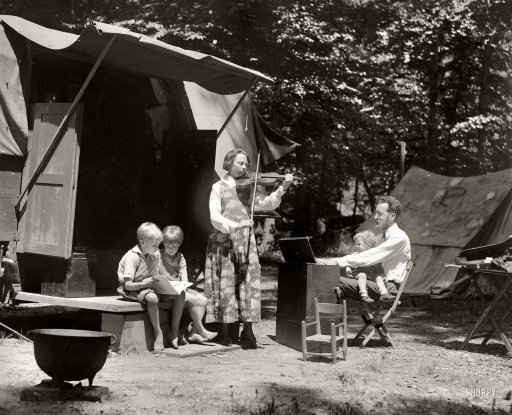
Also, for no particular reason other than I like the picture, I have attached a photograph of Charles Seeger & family on a camping trip in 1921. He is sitting at a portable reed organ with the toddler Pete on his lap, while wife Constance Edson Seeger is playing the violin. I'm sorry to say that I don't know the names of the other Seeger children sitting on the bench (I found them; Charles and John), Peggy and Mike were born later.
Edited by - vrteach on 04/18/2014 20:11:40
 Little Pete Seeger (family camping, 1921) |  VIDEO: Colored Aristocracy (click to view) |
banjo_brad - Posted - 04/18/2014: 13:37:29
Good choice, Erich. I've played this tune for several years after learning from Dan Levenson's "Festival Tunes" book. I've always played it at the slower tempo.
(My version from way back when I learned it.) I think I do it a bit faster, now, I should rerecord it.
Edited by - banjo_brad on 04/18/2014 13:39:07
vrteach - Posted - 04/18/2014: 13:49:24
Good one Brad, I'd like to hear a current version.
Also, I forgot to mention; through the years I've seen many people point to the Taj Mahal version. I actually had never heard it until I searched just now! Here is a link to a small example on Amazon.
bd - Posted - 04/18/2014: 14:49:10
Cool choice! I play this one a lot. It's a satisfying tune to play. Here's mine (I think I'm in open E or thereabouts):
 VIDEO: Colored Aristocracy (click to view) |
mworden - Posted - 04/18/2014: 17:24:21
A great choice and a very impressively researched write up, to say the least. Nice playing, too!
Here's a version I recorded a while back. I played this tune all the time for a while but then it kind of fell out of the repertoire. Time to pull it out again.
 Colored Aristocracy |
Adam Kiesling - Posted - 04/19/2014: 04:33:30
One of my favorites to play as well, but we never seem to play it much as I'd like. When I'm playing guitar, I like to throw in E major chords instead of the E minor.
vrteach - Posted - 04/19/2014: 10:31:15
What's a n E major on banjo in G tuning? I expect I could look it up
vrteach - Posted - 04/19/2014: 11:15:31
Oh, just play a C but move the index finger over a string. I think I can do that.
That Dave Hum was a fine bloke.
BD: I like it, and I agree that this is a satisfying tune. That's a nice banjo.
mworden: Very nice indeed. Really smooth.
Another thing I forgot to mention. I joined the Banjohangout in January 2006, the year I turned 50 and decided to get back to playing music (instead of other possible mid-life decisions). By May I got brave and posted my first entry to the BHO Sound Off section, and it was Colored Aristocracy. That was before the Hangout had it's own storage, so I put it on my own site: vrteach.org/content/colored-aristocracy It's at a fairly frantic tempo. I prefer one that I recorded in 2011 as one of a bunch of G tunes on my new-used Tradesman, which I really like in open-G tuning.
Edited by - vrteach on 04/19/2014 11:24:25
Colored Aristocracy |
JanetB - Posted - 04/19/2014: 14:45:15
That's extensive research, Erich. Thanks! The square dance link with the first lady was entertaining.
I enjoyed resurrecting this tune, too. I was aided by a tab from Lisa Schmitz and Alec Slater in Mel Bay's Complete Clawhammer Banjo Book.
 VIDEO: Colored Aristocracy (click to view) |
htb - Posted - 04/19/2014: 17:30:13
Here's mine- woke up early this morning, checked the forum and broke out the camera to record this. Was still a bit early and wasn't really warmed up or anything- couldn't be bothered to put on real clothes either, but there it is. I love playing this one, and often do a melody with big sciota - they seem to kind of fit together.
played on a 11" nate calkins dobson, short scale (24.75"), with goat skin head. I also recorded the same version played on a 1927 Vega Whyte Laydie and a 1913 Fairbanks Tub-A-Phone if anyone's interested in hearing the differences.
 VIDEO: colored aristocracy (click to view) |
whyteman - Posted - 04/20/2014: 11:25:16
My wife and I are in the in the E major camp. Sometimes I feel this video version is played too slow. Then I remember the cake walk definition. Still not sure what tempo we prefer! -Don-
Brooklynbanjoboy - Posted - 04/20/2014: 15:22:29
Happy Easter, TOTW stalwarts. This TOTW brought out a lot of intriguing alternative approaches to this tune.
OldPoppy - Posted - 04/20/2014: 19:49:46
This tune has stuck with me down through all the years. Even in times when I wasn't playing much, this one would always pop up whenever I got the banjo out. Like most of the banjo playing world, I usually play it in G, but I have always liked the version Taj Mahal recorded on one of his early albums playing in, I believe, open C tuning (gCGCE). So with apologies to Taj Mahal, here's my C version.
Edited by - OldPoppy on 04/20/2014 19:50:42
Colored Aristocracy |
stevel - Posted - 04/22/2014: 09:47:51
a tune i've always liked but never worked out. this dude hits it out of the park in my opinion.
vrteach - Posted - 04/23/2014: 11:16:41
What fun! All recognizable as the same tune, yet all different. Thanks folks.
In looking over the available tablature the BHO, it looks as though we need a clawhammer version in open-G tuning. Then again, since we have three three-finger-picking versions--we need a three-finger sound sample in this topic.
Marc Nerenberg - Posted - 04/23/2014: 11:59:16
Some time in the 1970's I came up with this "mash-up" of Colored Aristocracy" and "Old Plank Road".
Basically, I'd heard both and didn't really remember either of them very well, and I found myself singing something that approximated the words to Old Plank Road against something that approximated the melody of the A part of Colored Aristocracy. It seemed to fit, so I kept it. I didn't really remember most of the words either, so I made up some new verses. (It was the "folk process" in action.)
It's played here by the band I was in at the time "Armadillo Brand".
Won't Git Drunk No More (A.K.A. Old Plank Road) |
jmabus - Posted - 04/24/2014: 12:47:31
I have been playing CA since the mid 70's -- picked it upfrom the community of OT players hanging out in East Lansing thanks to Elderly Instruments.
Used to enter a lot of contests in those days, if there was $$ to be had. I played this tune at the Ohio Pumpkin Festival banjo contest in Barnesville, OH in 1979, (urged to do so by my friend John Hutchison of The Hutchison Brothers Band) There were no categories for style. Just 2 tunes of your choosing. NOT blind judging. I saw the fiddle contest go not to the best fiddler, but to a local teen athlete with a broken leg in a cast. He hopped up and down on his good leg and played an awful version of Old Joe Clark. So I knew how judging was handled.
I played a Mastertone RB-250 at the time. My first tune I played in melodic bluegrass style -- "Old Leather Britches" fast and full of licks & up the neck runs. Then for my second tune I announced "I am going to play a tune the OLD TIME way now" and I raised my right hand and with great flourish, pulled off my picks one at a time.
And I played my version of Colored Aristocracy, because it was a splashy tune full of chords and rhythm. I won the 1st place trophy (a ceramic pumpkin on a marble perch from Turks Trophy Shop) and $25 as I recall.
I always wince just a bit at the title, though I like the tune. So I often call it "The Banjo Meritocracy" since I won the contest on merit (and showmanship).
Here I am today, playing the tune for my laptop.
Joel Mabus
 VIDEO: Joel Mabus Banjo Meritocracy (click to view) |
Marc Nerenberg - Posted - 04/24/2014: 13:05:50
I really like the way you play it Joel. It merits winning the contest. I have a few of your albums though I've never seen you perform - so it was really nice to see you playing here, and not just hear you!
vrteach - Posted - 04/24/2014: 13:36:56
Hot Dog! What fun additions. As BD said a couple of days ago, it's a satisfying tune to play.
LyleK - Posted - 04/25/2014: 10:30:47
In "honor" of this being the BHO TOTW (OT) [OMG!] this was the first tune we played at the local jam last night. As an experiment following comments in this thread, I insisted that the chord playing instruments (a guitar and an autoharp) play an E major instead of an E minor. We fiddlers (there were two of us) went merrily on our way playing the tune. At some of the points where there would have been an E minor in the tune I know that I'm playing a double stop on fiddle that is an "E" and a "B". Technically that's noncommittal in that it could be an E minor chord (if there were a "G") or E major (if there were a G#). Given that the root is G, it's hard to argue that there should be a G#.
Anyhow, the chord players winced every time that they played an E major and it sounded horrible with what we were fiddling. So we'll be sticking with the E minor, at least in Chambana.
vrteach - Posted - 04/25/2014: 12:46:57
In my minds eye I can see your chord players wincing, and couple of them are pretty forceful wincers. Thanks for the experiment.
Edited by - vrteach on 04/25/2014 12:47:25
wtalley - Posted - 04/26/2014: 13:50:32
If anyone is interested in hearing the ragtime (sheet music) version, there is a MIDI sequence of it at the Primeline Midi Library (primeshop.com/MIDILibrary/midlist3.htm). It's about a quarter way down the page.
vrteach - Posted - 04/27/2014: 07:04:45
Thanks! I've been wanting to hear it, and I only found reference to one recorded version.
whyteman - Posted - 04/27/2014: 14:57:30
Enjoyed seeing Joel in Boonville Mo. a few years ago at Cathy Barton's festival. Both concert and workshop performances were first rate. -Don-
...and we enjoy listening to his parlor guitar album.
ZEPP - Posted - 05/16/2014: 14:20:35
OK, a few weeks ago, Colored Aristocracy was the TotW, and I realized that while I had learned the tune 50 or more years ago when I was in high school, I had learned it on mandolin, and had never bothered to play it on banjo.
So, of course, I finally set out to play it. Most of what I heard was in open tunings, so I did it in double D. As is my wont, I tune the 5th string up to A and then capo the other strings, so that the 5th string sounds two frets higher than the 1st string when fretted at the same piece of fret wire. Thus, I’m tuned aCGCD and then capoed 2 frets to be aDADE.
The banjo is a new Ome Wizard that arrived in the shop today; nice banjo! BTW, I did have to make a small modification to the banjo for this recording. Ome (as do many builders) set the 5th string pip at a height such that the 5th string is in the same plane as all the other strings; I like it much lower so that I can easily fret it at the 7th and other frets (not to mention not pulling the note way sharp). So I removed their pip and inserted my own, lowering the string down to normal height above the frets & then replaced the Ome pip when I was done.
Anyway, it’s a work in progress, but better late than never?
Cheers,
ZEPP
 VIDEO: Colored Aristocracy, played on a new Ome Wizard (click to view) |
oldwoodchuckb - Posted - 05/16/2014: 16:42:27
Coloured Aristocracy is not a Cake Walk. It is a proto-rag piece and shows what may be the earliest elements of ragtime structure.
I don't know how or when people started associating it with the Cake Walk - a strutting about dance in a completely different and more rigidly syncopated rhythm. The Cake Walk was definitely closely associated with the musicians and dancers who developed ragtime, but I would describe the Cake Walk as a cousin to rag, one that died young.
From the title it is obvious that this piece was not written by an African American, and it is most likely a white man's interpretation of what he heard the slaves and/or free blacks of that period playing.
Terms of Use | Privacy Policy | Privacy Consent (EU/GDPR Only)
Copyright 2026 Banjo Hangout. All Rights Reserved.


