
DVD-quality lessons (including tabs/sheet music) available for immediate viewing on any device.
Take your playing to the next level with the help of a local or online banjo teacher.
Weekly newsletter includes free lessons, favorite member content, banjo news and more.
Premier Sponsors


|
Please note this is an archived topic, so it is locked and unable to be replied to. You may, however, start a new topic and refer to this topic with a link: http://www.banjohangout.org/archive/281846
beezaboy - Posted - 03/21/2014: 18:54:39
I have reason to believe that there was an early liaison between Bacon and Day many years before they formed their famous "partnership" on September 18, 1922.
Fred Bacon and David Day appear to have been acquainted since about 1902. Bacon played a Fairbanks banjo professionally and was one of the artists in the Fairbanks photo portfolio (1903). Day was Fairbanks' GM at this time.
In the mid-nineteen-aughts Bacon introduced his Bacon Professional Banjo. He does not appear to have had a banjo factory to produce them. Many people speculate (even state unequivocally) that Fairbanks/Vega produced the early Bacon Professional banjos. David Day was managing the Fairbanks side of Vega at this time.
Soon after Fred Bacon introduced his Bacon Professional Banjo he left town (Hartford, Conn.) literally. He went touring with his Bacon Banjo Trio for a time. Then about one year after he introduced the Bacon Professional Banjo (when sales began to increase) Mr. and Mrs. Bacon went on a 6 month mid-west vaudeville tour. Bacon's mail (and banjo orders) went through an intermediary in Chicago.
So, who was making, setting up and shipping Bacon Professional Banjos while Bacon toured the country?
Because many state that early Bacon Professional Banjos were made by Fairbanks (I suppose this conclusion has been reached by knowledgeable people inspecting and comparing features and cues) the conclusion appears to be that David Day managed the de facto banjo factory for Bacon Professional Banjos and handled the complete factory function for Mr. Bacon by receiving orders from Mr. Bacon then building, setting-up and shipping the banjo to the customer.
For example, in mid-March 1907 Bacon Professional Banjos were displayed at the Philadelphia John Wanamaker Department Store as part of the Guild Convention festivities. At the same time, Mr. and Mrs. Bacon were in Winnipeg Canada performing a vaudeville engagement. So, who manufactured the banjos, set them up and delivered them for the Wanamaker display?
David Day??
What do you think? Are there any clues to help solve this mystery? If Day did handle Bacon's banjo manufacturing in the aughts it makes their partnership in the twenties actually the second time they collaborated.
esmic - Posted - 03/21/2014: 21:44:44
Banjo historians agree that Fairbanks Vega (FV) made the early Bacon banjos, c 1905 to 1910 or so (up to around serial no 600). This was indeed a first collaboration for B&D. While it is likely FV, under Day, was responsible for both production and setup, whether they handled full distribution is unknown. Bacon did make a point of getting many of his earliest instruments into the hands of well known performers and teachers. Several wrote him letters back, praising their new Bacon banjo , which Bacon printed as testimonials in his first catalogue. Bacon is also reputed to have sold his banjos out of the back of his car after performances at this time.
As for the Wanamaker display, it seems likely that Day would have attended the Guild Convention as FV's banjo manager, and would be the logical person to bring Bacon's instruments for the display in his absence.
Andy FitzGibbon - Posted - 03/22/2014: 04:24:35
Even though there is no hard evidence, I've never talked to anyone who would argue with the consensus (based on inspection of extant instruments) that the early Bacons were made by Vega. I personally find the Vega-made Bacons to be some of the nicest Bacon banjos overall, and certain Bacon instruments are among the nicest banjos that Vega made at that time. The workmanship on Bacon's own early instruments doesn't match that of the Vega-made instruments. To my eye, the early Bacon-made Bacons are somewhat crude when put next to a Vega-made Bacon.
I recently worked on a couple early Bacon-made banjos- they had fairly crude necks, but had rims that were much nicer and appeared to have been made by Vega. Perhaps Fred didn't have the facilities to make his own rims when he started out on his own, or maybe when he ended his deal with Vega there were some leftover internal resonator rims that he ended up with.
Andy
beezaboy - Posted - 03/22/2014: 04:37:03
Shawn, Thank you.
It is unfortunate that the early history of this Bacon and Day collaboration is not found in published form and thus preserved.
I have a Frederick J. Bacon article based on an interview with him published in Jacobs' Orchestra Monthly - October 1926 - which recites in part: "he [Bacon] patented his first banjo which was known as the 'Bacon Professional' and for several years had this instrument manufactured for him by two of the well-known banjo manufacturers of that time".
The "well-known" manufacturers are not identified in the article.
Point: From the drawings of the first Bacon Professional Banjo it appears that this banjo had a bracket-band rim. If so, the banjo consisted of Bacon's patented tone ring and Day's unique bracket band rim construction. Certainly not a superficial collaboration. So, might we not conclude that the Bacon Professional banjos and especially the famous "Chubby Dragon" were in fact the first "B&D" banjos lacking only the appropriate branding?
beezaboy - Posted - 03/22/2014: 04:47:06
Andy - We cross posted. Thanks for your confirmation of the Bacon and Day connection. From the advertising at least it appears that in the 1905-1907 time-frame Vega kept its Fairbanks unit separate. The advertisements for Vega products and Fairbanks products (mainly Whyte Laydie) are separated in the magazine and you'd know the relationship only by noticing the same Sudbury street addresses. So, perhaps David Day had a lot of latitude within the Vega organization at that time. He was, after all, making a competing banjo from the Vega owned factory.
Edited by - beezaboy on 03/22/2014 04:57:19
esmic - Posted - 03/22/2014: 07:31:45
"From the drawings of the first Bacon Professional Banjo it appears that this banjo had a bracket-band rim. If so, the banjo consisted of Bacon's patented tone ring and Day's unique bracket band rim construction. "
Despite what the drawing may have shown, there is no known Bacon Professional with a bracket band. The rim design is indeed unique, but unlike any of Fairbanks higher grade tone ring banjos. It featured a spun brass dish tone ring, internal resonator sound chamber and shoe bolts drilled through the rim. See sketch section below.
I don't think you should read too much into this first collaboration. Vega had recently acquired Fairbanks following their disastrous fire and may have simply been anxious for suitable new business to see their latest division prosper.
I agree with Andy that the Vega made Bacons are particularly well designed and crafted, but Bacon gives no credit in his catalogue to their origin. He presents them publicly as his product. To me at least, Bacon's affiliation with Day appears to have started as a contractual, business arrangement. However, Bacon may have serendipitously found a kindred spirit in Day, and eventually built a strong association through shared interests and complementary skills.
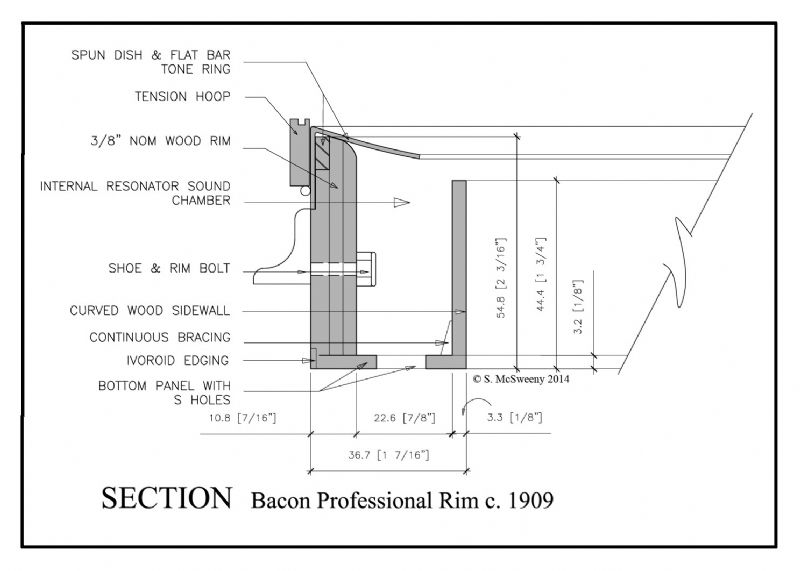 Bacon Pro Rim Section |
beezaboy - Posted - 03/22/2014: 09:03:21
Shawn - Thank you for your guidance.
Attached is the advertisement to which I made reference. The quality is poor because I am working from microfilm.
Your assessment of the early Bacon/Day relationship sounds accurate. When pulling many tidbits from magazine after magazine one soon cannot distinguish the forest from the trees and my enthusiasm for new discoveries overwhelmed a cautious approach.
Thanks again.
PS - I have learned that Frederick J. Bacon was an extraordinary man.
esmic - Posted - 03/22/2014: 11:13:29
John : Thanks for posting the Cadenza ad.
Regarding the 1926 Orchestra Monthly article mentioned above: The "two well-known banjo manufacturers" making the Bacon Professional in its early several years were first Vega in Boston and later Lange in New York.
We don't know why Bacon didn't renew with Vega. One possibility is that Bacon shopped around and Lange simply offered comparable quality at a better price. Another is that Vega may have begun to see Fred's growing success as a competitive threat that they no longer wished to support.
beezaboy - Posted - 03/22/2014: 12:34:26
Shawn -
Thanks for the Wm. L. Lange alert. As I wade through the Cadenza magazines searching out Mr. Bacon I'll be keen to any clues that might explain the manufacturer change. Perhaps the success of the Tubaphone may have played a part. We'll see if anything develops.
Meanwhile, we mostly think of Frederick J. Bacon in his tuxedo playing complex "classical" pieces on the banjo to a white glove gathering.
However, I think Mr. Bacon equally enjoyed playing to vaudeville audiences as will be seen from the attached Cadenza ad from August 1908. The Cadenza editor once remarked that Bacon wrote his own ads
esmic - Posted - 03/22/2014: 14:29:12
John :
Bacon started out as a wild west show banjo player. In the 1890's, with lessons from the great Alfred Farland, he developed into a virtuoso banjoist. He was apparently comfortable with both classical and popular music. You mentioned above realizing he was extraordinary. Perhaps even more so than you thought.
Edited by - esmic on 03/22/2014 14:30:20
beezaboy - Posted - 03/22/2014: 17:41:47
Shawn -
Yes. Wild West. The Jacobs' articles states re: Bacon's early career: "He [Bacon] joined Bronco John's Wild West Show - Not, however, as a bronco buster, but as a featured banjo soloist. ...he was billed as Nebraska Fred: The Banjo Kid". Also: Bacon dressed in cowboy attire and "He [Bacon] let his hair grow down to his shoulders".
I confirmed the existence of Bronco John's Wild West that appeared in St. Paul, MN in Sept 1894. Then again in NYC in 1889. No Bacon mentioned in the notices but the actors were named "Bronco John", "Lasso Mike", "Wyoming Bill" and a "score of other horsemen..."
Apparently, Bacon left the wild west show early on but continued as a solo vaudeville cowboy banjoist.
Thanks again for helping with this research.
carlb - Posted - 03/23/2014: 06:14:58
quote:
Originally posted by esmic
"From the drawings of the first Bacon Professional Banjo it appears that this banjo had a bracket-band rim. If so, the banjo consisted of Bacon's patented tone ring and Day's unique bracket band rim construction. "
I don't like the picture you represented. Here are a couple of pictures of the patent and text submitted in 1905 for the Bacon Professional. Note that the tone ring does not touch the top the pot; it only rest on the shelf on the outside of the pot and on the shoes.
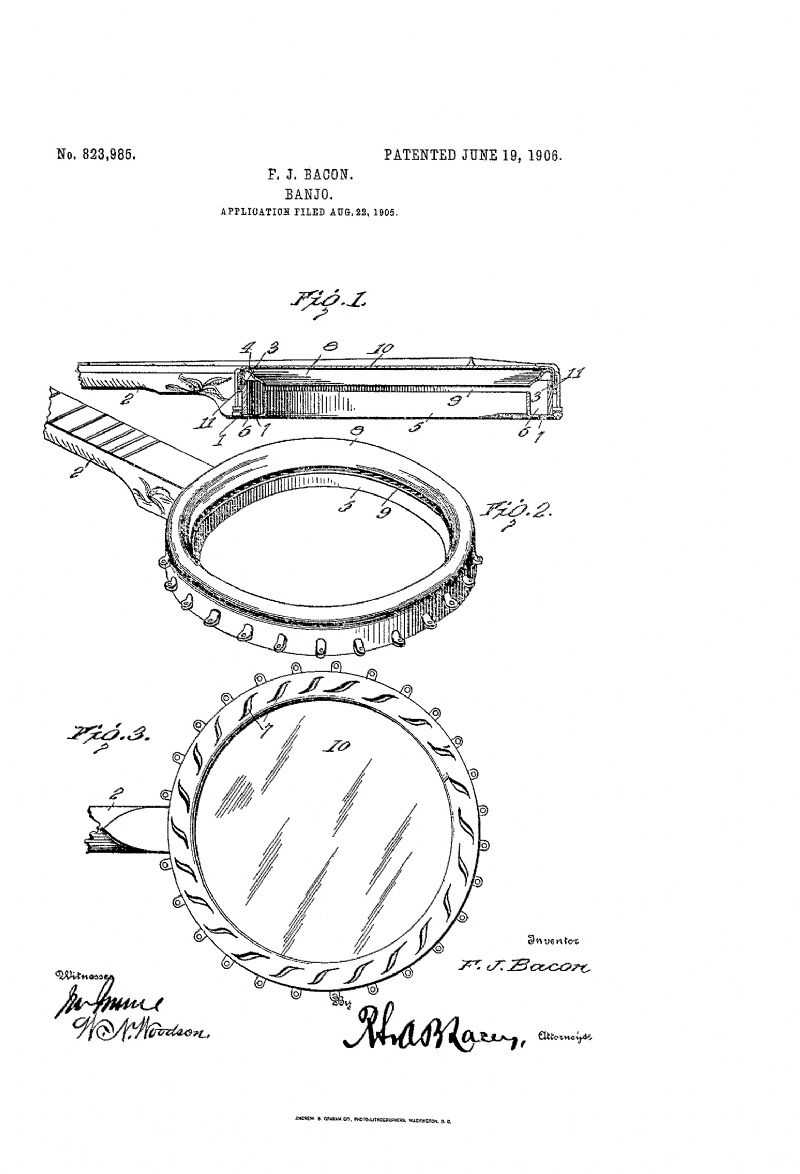 Bacon Patent 1906 Picture | 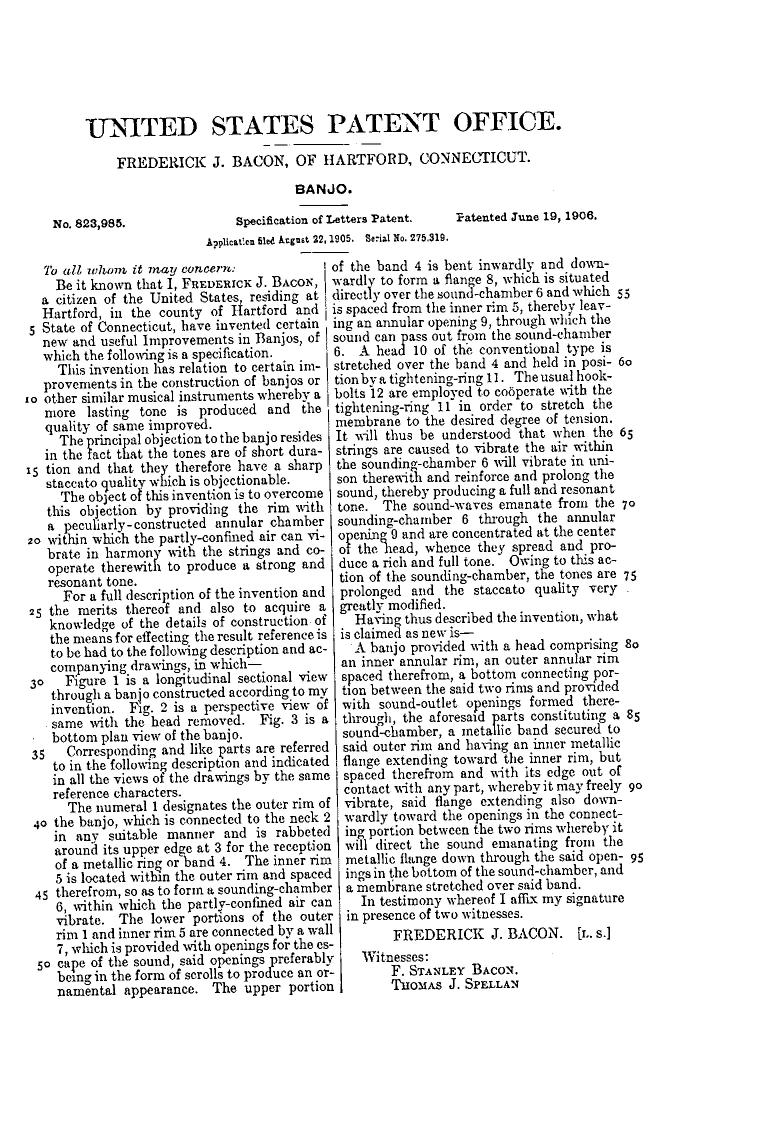 Bacon Patent 1906 text |
esmic - Posted - 03/23/2014: 08:25:50
carlb
Sorry you don't like my drawing. I disassembled and carefully measured a c.1909 Bacon Pro No 1 rim to do it. By contrast, the patent drawing is an unscaled sketch that deliberately exaggerates the separation between tone ring and top of rim in order to make its point.
The actual separation between rim and tone ring is so very slight, it gets lost in the line weights of the rim and tone ring on my scale drawing. Perhaps you should disassemble your own early Bacon Pro to appreciate the actual construction first hand.
carlb - Posted - 03/23/2014: 10:35:03
quote:
Originally posted by esmic
The actual separation between rim and tone ring is so very slight, it gets lost in the line weights of the rim and tone ring on my scale drawing. Perhaps you should disassemble your own early Bacon Pro to appreciate the actual construction first hand.
I have many times since 1979, and have also examined many other Bacon Professionals. In no case, have I found the tone ring touching the top of the pot. The distance varies from about 2-5 mm in those with the dish tone ring. In mine the tone ring is rolled but is still one piece like the dish type. I can pass a piece of paper around the entire top of the pot (if I tightened the head more maybe it would rest on the top of the pot, but with the skins I've used, I haven't found that is the case).
Edited by - carlb on 03/23/2014 10:38:25
beezaboy - Posted - 03/23/2014: 10:58:22
From the "soft" approach to research (I was afraid to tinker with my Bacon Professional 3 tenor) here is what Mr. Bacon asserted about his Bacon Professional Banjo:
"This banjo is built entirely different from all others. Loud and sweet with wonderful sustaining power" 4/1907.
"The patent sounding chamber is hollow, like the shell of a violin, and is made of very old maple. [It] really gives that beautiful sustained tone not found in the ordinary one-rimmed banjo." 9/1907.
"Bacon Professional Banjo always has that clear, crisp, sustained tone NOT found in any other make." 7/1908.
"The Bacon Professional Banjo is built on scientific principles. Not a "tub" or "back number". LOUDEST AND SWEETEST TONE WITH SUSTAINING POWER NEVER BEFORE EQUALED AND CAN NOT BE OBTAINED IN ANY OTHER MAKE." 9/1905.
"Loud and yet sweet, with wonderful sustaining and carrying power" 11/1905
"Neither tubby or tinny" 2/1906.
"Is handsome (not gaudy) to look at and has a tone that NO other banjo has or can have. 5/1906.
"The Bacon Professional always sounds good - no matter what the weather - and plays the easiest of any banjo you ever tried, has that wonderful sustaining tone (length of sound, 12 to 15 seconds) and beautiful quality." 7/1906
"It has that that WONDERFUL SUSTAINED tone and CARRYING POWER that banjoists have long sought for but never found. BACON BANJOS are VERY loud and yet SWEET in quality".8/1906
"The hollow sounding chamber attached to inside rim gives it that wonderful SUSTAINED and LOUD and yet SWEET tone". 2/1907
Whew! That's enough. But you can see from Bacon's own words (he allegedly wrote is own advertising copy) what he was trying to accomplish with his design of the Bacon Professional Banjo.
blm10jn - Posted - 03/23/2014: 20:08:40
I always thought that the connection to Lange came from Farland. Bacon had been his student and Lange built the Farland Banjo.
beezaboy - Posted - 03/24/2014: 05:01:08
blm10jn -
Thank you for some food for thought. My initial reaction to your post was skepticism. Farland was certainly a darling of early The Cadenza editor (Partee) and Farland is often featured or mentioned. I am not able to follow Farland while searching Bacon but ads for Farland's beveled wood rim banjos appear regularly in The Cadenza.
A.P. Sharpe's "American Banjo Makers" states: "Farland patented his 'metal head' about the year 1890 and his 'beveled-top wood rim banjo' in 1900".
The reason for my skepticism is that Rettberg and Lange was established in 1897 and made spun-rim banjos until 1903 when they introduced the Orpheum. I did not think R&L made a wood rim banjo until the Orpheum. That they may have made Farland's wood rim before 1903 comes as a real surprise to me.
But, it appears that Bill's banjos agree with your assessment. Definitely food for thought.
beezaboy - Posted - 03/24/2014: 10:03:26
More to the Bacon and Day early association.
Admittedly just a tidbit (attached) from January 1910 The Cadenza. Dinner with Day et al.
Also, another interesting description of the sound of the Bacon Professional Banjo found in a Bacon ad in The Cadenza Sept. 1908:
"Sounding chamber (hollow) sustains the tone and gives forth a most delightful quality, almost 'fluty'". 9/1908.
FLUTY!!
Andy FitzGibbon - Posted - 03/24/2014: 13:35:04
quote:
Originally posted by beezaboyblm10jn -
Thank you for some food for thought. My initial reaction to your post was skepticism. Farland was certainly a darling of early The Cadenza editor (Partee) and Farland is often featured or mentioned. I am not able to follow Farland while searching Bacon but ads for Farland's beveled wood rim banjos appear regularly in The Cadenza.
A.P. Sharpe's "American Banjo Makers" states: "Farland patented his 'metal head' about the year 1890 and his 'beveled-top wood rim banjo' in 1900".
The reason for my skepticism is that Rettberg and Lange was established in 1897 and made spun-rim banjos until 1903 when they introduced the Orpheum. I did not think R&L made a wood rim banjo until the Orpheum. That they may have made Farland's wood rim before 1903 comes as a real surprise to me.
But, it appears that Bill's banjos agree with your assessment. Definitely food for thought.
Every Farland banjo I've seen appeared to have been made by Rettburg & Lange.
Andy
NYCJazz - Posted - 03/24/2014: 14:22:53
I did a little research on the Wanamaker's store mentioned... Turns out I've been in the Wanamaker's annex building (built 1903-1907) many times. It's a K-Mart now, and it's right outside the Astor Place #6 subway station (where the cube is) facing the Cooper-Union building. There is an entrance to the store from the subway which was in operation at the time of the Cadenza story.

banjobilly32 - Posted - 03/24/2014: 14:58:50
About 20 years ago when I first retired I made a personal visit to see Walter K Bauer who was a prominent banjo player and instructor in the Hartford area. We sat and talked banjos for a couple of hours. Walter talked of playing with Fred Bacon and David Day in his younger days and he even mentioned Fred Van Epps.
Walter was a stickler for reading music and I talked to his former students who complained it was several weeks into instruction before they played a note. Walter autographed and gave me his published banjo instruction course. He said if I would learn to read music I would probably make a good banjo player!.
Walter was well into his 90's at the time, He played both tenor and 5 string classical style. He was a treasure of information such as you are seeking. From our conversation I assume the banjo players and builders were a rather close knit group.
beezaboy - Posted - 03/24/2014: 16:42:29
Nathan -
Here is a scan of the New York City Wanamaker's you visited!!
Interestingly, Wanamaker's was a Fairbanks/Vega retailer ca 1910.
I wonder what banjo brand Mr. Bacon used for his impromptu concert?
Bacon played a Bacon Professional Banjo professionally after its introduction.
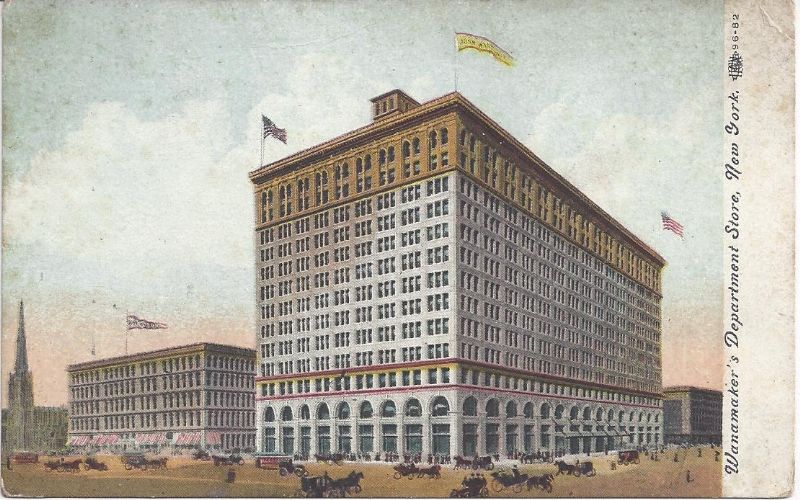 Wanamaker's Dept. Store - NYC |
trapdoor2 - Posted - 03/24/2014: 16:53:30
quote:
Originally posted by banjobilly32About 20 years ago when I first retired I made a personal visit to see Walter K Bauer who was a prominent banjo player and instructor in the Hartford area. We sat and talked banjos for a couple of hours. Walter talked of playing with Fred Bacon and David Day in his younger days and he even mentioned Fred Van Epps.
Walter was a stickler for reading music and I talked to his former students who complained it was several weeks into instruction before they played a note. Walter autographed and gave me his published banjo instruction course. He said if I would learn to read music I would probably make a good banjo player!.
Walter was well into his 90's at the time, He played both tenor and 5 string classical style. He was a treasure of information such as you are seeking. From our conversation I assume the banjo players and builders were a rather close knit group.
How cool. Do you know if he was related to either Albert Bauer (S.S. Stewart correspondent, civil war banjoist, etc.) or George Bauer (S.S. Stewart's later partner, etc.)? Joel Hooks probably knows but I can't recall if there was a family relationship there...
beezaboy - Posted - 03/24/2014: 16:59:04
Bill - You were fortunate to have had the opportunity to talk with Mr. Bauer. He is quite famous in The Cadenza magazine.
I've been lucky too. I've been corresponding with Dave Herbert who's TV name was "Banjo Billy" (of all things!) Dave had tv shows with he on the banjo in Cincinnati, Cleveland and Miami back in the 1950's - 1960's. Attached is a Dave Herbert photo from 1949. He was 18. He was awarded the B&D Serenader by Gretsch for his appearance on a popular radio show of that era.
In fact, that's where I'd like to go with this project - B&D banjos from start to finish. If I don't get finished myself
NYCJazz - Posted - 03/24/2014: 17:03:39
John
That is the building! The building in back at the far right is Cooper-Union, where Abraham Lincoln started his presidential campaign.
beezaboy - Posted - 03/26/2014: 10:56:41
I am starting a new thread as this one appears to have lost its momentum.
Terms of Use | Privacy Policy | Privacy Consent (EU/GDPR Only)
Copyright 2026 Banjo Hangout. All Rights Reserved.


