
DVD-quality lessons (including tabs/sheet music) available for immediate viewing on any device.
Take your playing to the next level with the help of a local or online banjo teacher.
Weekly newsletter includes free lessons, favorite member content, banjo news and more.
Premier Sponsors


|
Please note this is an archived topic, so it is locked and unable to be replied to. You may, however, start a new topic and refer to this topic with a link: http://www.banjohangout.org/archive/280809
Lyndon Smith - Posted - 03/04/2014: 05:24:27
The guy that built my fret slotting machine showed me his fan fret slotter.
For those of you that have not heard of fan frets (I hadn't until this guy showed me them) it's a way of having shorter treble strings and longer bass strings on a musical instrument. Some very top-end guitars use fan frets.
Has any one tried them on a banjo?
Pros and Cons?
jbalch - Posted - 03/04/2014: 05:36:13
Check with Dan Knowles - he has built a few banjos with fan frets.
banjohangout.org/topic/251124/77/#3538930
trapdoor2 - Posted - 03/04/2014: 06:47:13
Mockingbird made one some time ago: mockingbirdmusic.com/archive/MBbanjo.html
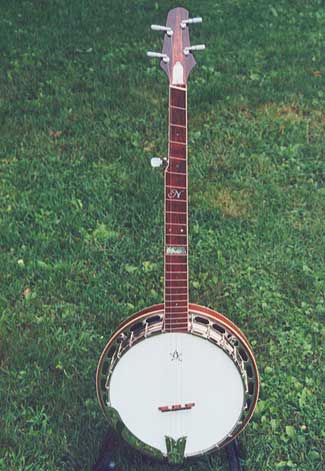
Lyndon Smith - Posted - 03/04/2014: 09:00:43
It all looks a bit like it's from Alice in Wonderland!
It must make the transition from neck to peg head awkward too.
What are they like to play?
gottasmilealot - Posted - 03/04/2014: 09:13:27
I have a Mockingbird. Very easy to play, sounds good. I'd highly recommend one. The only con I have is that some know-it-alls at jams try to tell me my bridge isn't on straight.
Edited by - gottasmilealot on 03/04/2014 09:20:00
Lyndon Smith - Posted - 03/04/2014: 09:36:05
quote:
Originally posted by gottasmilealotI have a Mockingbird. Very easy to play, sounds good. I'd highly recommend one. The only con I have is that some know-it-alls at jams try to tell me my bridge isn't on straight.
Do you notice the difference between bass and treble at all, in respect to a standard banjo?
Dan Knowles - Posted - 03/04/2014: 18:56:11
The basic thought behind the fan fret idea is this. A shorter scale length adds sweetness to the notes (within reason) and a longer scale adds strength and clarity to the notes (again within reason). So just put the two together in one neck.
Ralph Novak was the recent pioneer in this technique and was the person who influenced me to do some building in that direction. His suggestion was to build with an average of one inch difference between the treble and the bass with the bass side being longer. I've built several instruments using this technique. Here is one owned by BHO member Woodturner.

This banjo does indeed have a more balanced tone bass to treble. But the most interesting thing is this banjo is in tune no matter where you play. This is an anomaly I've seen again and again with fan fretted instruments. Although it may look as though it would be more difficult to play, it isn't. In fact it is quite comfortable.
So then we ask, if it is better then why don't we see more of this type of instrument out there?
Cause it looks weird and different. Which is cool if you like the unusual.
Lyndon Smith - Posted - 03/04/2014: 23:52:44
Thanks Dan, much appreciated. It looks very cool though a bit wierd. I can ask this guy to make me a fan fretted finger board, he even puts a radius on them (he builds very nice guitars). He built the fan fret slotting machine for George Lowden (top end guitar maker), so he's pretty good...
Hawgfiddle65 - Posted - 03/05/2014: 02:56:55
Hi Lyndon ......These photos make me feel dizzy! .....I can vouch for Lowden guitars my mate John has one and its possibly the best sounding guitar I've heard. my guitar hero RichardThompson plays one too!..Cheers Jim
rudy - Posted - 03/05/2014: 04:26:34
quote:
Originally posted by Hawgfiddle65
Hi Lyndon ......These photos make me feel dizzy! .....I can vouch for Lowden guitars my mate John has one and its possibly the best sounding guitar I've heard. my guitar hero RichardThompson plays one too!..Cheers Jim
Recently sold my mint O23C walnut / cedar Lowden (the RT guitar...) Love RT's stuff, Maggie Cameroon being my favorite Scottish tune.
Great guitar, but uncomfortable for my "older" body. George makes small bodies, but I've pretty much switched to crossover now. Besides, I doubled what I paid for it new!
Edited by - rudy on 03/05/2014 04:29:11
Dave1climber - Posted - 03/05/2014: 05:19:47
Dan
What sort of calculation do you do for the fret lay out? It almost looks as if the frets are radiating out of one point several feet away from the neck
rudy - Posted - 03/05/2014: 05:37:24
quote:
Originally posted by Dave1climberDan
What sort of calculation do you do for the fret lay out? It almost looks as if the frets are radiating out of one point several feet away from the neck
I've done one fan fret layout in CAD and that is indeed exactly what happens, although you still calculate the longer bass side scale length to plot the ends of the tangents which will become fret locations. Lacking CAD it's not a problem to calculate the longest and shortest string scale length and lay them out in the conventional fashion.
Dan Knowles - Posted - 03/05/2014: 05:46:07
Lyndon,
Make your own fretboard. It's not difficult. Lay out the bass side first. Fret 10 to 12 are your perpendicular frets. Square a line down and line up the short scales matching fret. Lay out the short scale, connect the marks and saw the lines. Remember to keep the length differential one inch or less.
For any careful woodworker this is not a difficult job. I often feel that we turn to machines in our minds way too soon when our hands would do the same job just as well and quicker.
Dave,
The bass on that banjo (if my memory serves me right) is 26 1/4" and the treble 25 1/2" .
Ken LeVan - Posted - 03/05/2014: 05:48:34
how far out is the tangent point from which the fan radiates?
Dan Knowles - Posted - 03/05/2014: 05:52:02
Ken,
I usually use fret 12 although fret 10 makes first position a bit more comfortable.
Dave1climber - Posted - 03/05/2014: 06:07:44
quote:
Originally posted by rudyquote:
Originally posted by Dave1climberDan
What sort of calculation do you do for the fret lay out? It almost looks as if the frets are radiating out of one point several feet away from the neck
I've done one fan fret layout in CAD and that is indeed exactly what happens, although you still calculate the longer bass side scale length to plot the ends of the tangents which will become fret locations. Lacking CAD it's not a problem to calculate the longest and shortest string scale length and lay them out in the conventional fashion.
Randy
How did you pick the distance to the center point? It is a function of scale length with the twelfth fret pointing at the center point and the center line of the fret board at right angle to that radian?
Edited by - Dave1climber on 03/05/2014 06:12:10
Lyndon Smith - Posted - 03/05/2014: 10:37:35
quote:
Originally posted by Hawgfiddle65
Hi Lyndon ......These photos make me feel dizzy! .....I can vouch for Lowden guitars my mate John has one and its possibly the best sounding guitar I've heard. my guitar hero RichardThompson plays one too!..Cheers Jim
Hi Jim, I too love Richard Thompson's music, particularly 1952 Vincent Black Lightning (I love V twin motorcycles too) : youtube.com/watch?v=5yw2yKNLEPc
Here's a great clawhammer banjo version: youtube.com/watch?v=LnFWKhULNTg
Maybe, just maybe, one day I will be able to play like that!!!
I can feel a fan fretted banjo project coming on, perhaps a half fretless... The mind boggles...
 My Beautiful Hog |
Lyndon Smith - Posted - 03/05/2014: 11:04:31
From what Tony, the guy who made my fret slotting machine told me about a fan fretted guitar, the 1st string has a measured scale length and the 6th string has a shorter measured scale length. The 2nd to 5th strings have whatever they get in the middle. He uses a series of calculations in a spreadsheet to set the measurement on each side of his slotting machine and cuts the slots just like he would for a regular fret board except the slot is angled a bit. Pretty much what rudy, says above.
It's not rocket science. Apparently...
rudy - Posted - 03/05/2014: 13:34:46
quote:
Originally posted by DanKnowlesLyndon,
Make your own fretboard. It's not difficult. Lay out the bass side first. Fret 10 to 12 are your perpendicular frets. Square a line down and line up the short scales matching fret. Lay out the short scale, connect the marks and saw the lines. Remember to keep the length differential one inch or less.
For any careful woodworker this is not a difficult job. I often feel that we turn to machines in our minds way too soon when our hands would do the same job just as well and quicker.
Dave,
The bass on that banjo (if my memory serves me right) is 26 1/4" and the treble 25 1/2" .
Lest anyone gets confused, there can be only 1 fret that is "perpendicular" to any point. More than 1 fret would require two parallel frets, which they cannot be by nature in a fan fret layout.
rudy - Posted - 03/05/2014: 13:37:31
quote:
Originally posted by Lyndon SmithFrom what Tony, the guy who made my fret slotting machine told me about a fan fretted guitar, the 1st string has a measured scale length and the 6th string has a shorter measured scale length. The 2nd to 5th strings have whatever they get in the middle. He uses a series of calculations in a spreadsheet to set the measurement on each side of his slotting machine and cuts the slots just like he would for a regular fret board except the slot is angled a bit. Pretty much what rudy, says above.
It's not rocket science. Apparently...
You wouldn't be very comfortable if your fan fret scale was set up like that. The fan would be opposite to what you see on the instruments pictured here.
rudy - Posted - 03/05/2014: 13:42:14
quote:
Originally posted by Ken LeVanhow far out is the tangent point from which the fan radiates?
Ken, The tangent point distance is dependent on the two "scale lengths" you pick for your outer strings.
rudy - Posted - 03/05/2014: 13:56:08
quote:
Originally posted by Dave1climberquote:
Originally posted by rudyquote:
Originally posted by Dave1climberDan
What sort of calculation do you do for the fret lay out? It almost looks as if the frets are radiating out of one point several feet away from the neck
I've done one fan fret layout in CAD and that is indeed exactly what happens, although you still calculate the longer bass side scale length to plot the ends of the tangents which will become fret locations. Lacking CAD it's not a problem to calculate the longest and shortest string scale length and lay them out in the conventional fashion.
Randy
How did you pick the distance to the center point? It is a function of scale length with the twelfth fret pointing at the center point and the center line of the fret board at right angle to that radian?
Dave, It's been long enough ago I'll have to look up the old fan fret CAD files I did. I usually annotated the beta drawings fairly well to know how to quickly get back to something that my limited brain power figured out.
As Dan Knowles alludes to, you can creatively move the radian origin point to skew the fan to favor the bass side in a forward or backward direction. That's the nice thing about CAD, you can grab the point and move it freely to see how it affects the fret angle and positioning. The important thing is whatever you do to manipulate position you must maintain the mathematical relationships of the note positions.
Ken LeVan - Posted - 03/05/2014: 14:17:23
I guess "tangent point" was the wrong term.
What I was looking for was the "vanishing point" or the point from which the "fan" emanates.
By my calculations, with the bass about an inch longer than the treble and the 10th fret going straight across, that point would be 48.75".

Lyndon Smith - Posted - 03/05/2014: 15:00:45
quote:
Originally posted by rudyquote:
Originally posted by Lyndon SmithFrom what Tony, the guy who made my fret slotting machine told me about a fan fretted guitar, the 1st string has a measured scale length and the 6th string has a shorter measured scale length. The 2nd to 5th strings have whatever they get in the middle. He uses a series of calculations in a spreadsheet to set the measurement on each side of his slotting machine and cuts the slots just like he would for a regular fret board except the slot is angled a bit. Pretty much what rudy, says above.
It's not rocket science. Apparently...
You wouldn't be very comfortable if your fan fret scale was set up like that. The fan would be opposite to what you see on the instruments pictured here.
Yes, rudy, you are of course correct. The 6th bass string is longer. Everything else applies...
Lyndon Smith - Posted - 03/05/2014: 15:06:48
It must make the transition point of the peg head to nut harder to make, especially if the peg head has an extreme angle.
Any thoughts on that?
mikehalloran - Posted - 03/05/2014: 19:21:44
quote:
Originally posted by Lyndon SmithIt must make the transition point of the peg head to nut harder to make, especially if the peg head has an extreme angle.
Any thoughts on that?
Since it is not critical, what looks good is good.
Since Ralph lives or lived in the area, we see his instruments a lot. He once offered to make me a fanned fretless bass but I thought that would be just too weird. I nearly bought one of his prototype Martin D-28 FF that was for sale at Gryphon Strings for awhile. It played well and sounded good but I wasn't in the market for a guitar when I found it.
Dave1climber - Posted - 03/06/2014: 05:40:28
quote:
Originally posted by Ken LeVanI guess "tangent point" was the wrong term.
What I was looking for was the "vanishing point" or the point from which the "fan" emanates.
By my calculations, with the bass about an inch longer than the treble and the 10th fret going straight across, that point would be 48.75".
Ken
Would the vanishing point distance be dependent on the scale length?
Ken LeVan - Posted - 03/06/2014: 05:57:42
quote:
Originally posted by Dave1climberquote:
Originally posted by Ken LeVanI guess "tangent point" was the wrong term.
What I was looking for was the "vanishing point" or the point from which the "fan" emanates.
By my calculations, with the bass about an inch longer than the treble and the 10th fret going straight across, that point would be 48.75".
Ken
Would the vanishing point distance be dependent on the scale length?
Yes. The greater the difference between the scale on the bass side from the one on the treble side, the shorter the distance to the vanishing point. Also, moving it up or down determines at which point along the fingerboard, the fret is straight.
It would be possible to lay this out on a big piece of plywood and make a drawing with a pencil and paper using a nail for the vanishing point and a string or long straightedge for the fret lines of the "fan"
Ken
Hawgfiddle65 - Posted - 03/06/2014: 06:32:37
Hi ....... I have enough problems with barre chorsd on a regular neck... they must be challenging on a fan fretted neck?... Jim
Lyndon Smith - Posted - 03/06/2014: 06:49:51
quote:
Originally posted by Hawgfiddle65
Hi ....... I have enough problems with barre chorsd on a regular neck... they must be challenging on a fan fretted neck?... Jim
I hate barres as well, Jim but this won't make much difference overall.
Lyndon Smith - Posted - 03/06/2014: 06:53:26
Ken, I like your way of thinking, certainly as far as laying out the fret positions. Certainly beats hundreds of spreadsheet calculations...
Ken LeVan - Posted - 03/06/2014: 07:09:28
quote:
Originally posted by Lyndon SmithKen, I like your way of thinking, certainly as far as laying out the fret positions. Certainly beats hundreds of spreadsheet calculations...
Lyndon, Thanks!
I can still recall a lively thread a while back concerning how many thousandths of an inch fret spacings had to be accurate to. A fan system like this would create a system so loosey-goosey as to throw that whole discussion on its head.
I would love to play one of these things at some point, as I am very curious about it.
Ken
rudy - Posted - 03/06/2014: 07:12:58
If you want to experiment with fanned frets and you don't use CAD I'll offer a suggestion.
Use the octave (12th fret) as the centerline of your fan vertex.
Going up or down a fret or two with your vertex point will not make much of a difference as the actual angles and distances just don't change that much. Using the 12th as the 90 degree tangent point to the third string centerline makes it quite easy to lay out your points for two scale lengths, just position the 12th fret on that single tangent line and literally connect the dots. between all the remaining points.
You don't need "hundreds of spreadsheet calculations"; run the numbers for your chosen two scales, plot the points and connect the dots. Easy pie.
I base my suggestion on working with CAD layout for fanned frets on a single episode, but it was based on doing a board with numbers ranging from 6 to 10 strings, so I had the chance to really understand the mechanics behind the layout.
Disclaimer: I have not built a fan fret banjo nor am I likely to entertain doing so. Why? Fan fret systems are designed to work with instruments that have a much greater diversity in string diameter than what you find on the banjo, pretty much negating all of the fanfare. (Yes, pun intended...)
Don't forget that whatever supposed advantages gained from fanning for a given string guage are now going to work against the smaller fifth string. It's usually twangy enough without the slightly higher tension from extending the scale length for the fifth string.
Don't forget to incorporate a radiused board if you're really after a more ergonomic feel. The radiused board on the narrow neck of the banjo will get you about a 93% improvement in the "ergonomics" of a fret board without the complexity, difficulty, or odd looks of the fanned fret board. The light tension presented by banjo strings doesn't call for huge efforts to make an easily playable instrument; that's part of the charm of the banjo in general.
Don't forget to consider how easy it's going to be to get clean break points on your bridge, if you have much of an angle induced with fanned frets (combined with compensation angle) it's going to be really difficult to produce a clean and concise "point of contact" for your string at the bridge.
Anyone starting to get the feeling I'm saying fanned frets aren't worth the bother?
Edited by - rudy on 03/06/2014 07:22:21
Ken LeVan - Posted - 03/06/2014: 07:53:12
quote:
Originally posted by rudyDisclaimer: I have not built a fan fret banjo nor am I likely to entertain doing so. Why? Fan fret systems are designed to work with instruments that have a much greater diversity in string diameter than what you find on the banjo, pretty much negating all of the fanfare. (Yes, pun intended...)
Don't forget that whatever supposed advantages gained from fanning for a given string guage are now going to work against the smaller fifth string. It's usually twangy enough without the slightly higher tension from extending the scale length for the fifth string. Anyone starting to get the feeling I'm saying fanned frets aren't worth the bother?
Ditto me.
gottasmilealot - Posted - 03/06/2014: 09:07:08
The only fret at 90 degrees from the fret board is fret 12.
When playing, I use the dots on the neck and don't worry about the angle of the frets, as your fingers fall right where they should. I haven't found any detriment to playability due to the design. If anything, it's easier, as the string tension is more even because the scale length is longer for the thicker strings.
I believe the design is patented.
rudy - Posted - 03/06/2014: 09:39:04
quote:
Originally posted by gottasmilealotThe only fret at 90 degrees from the fret board is fret 12.
When playing, I use the dots on the neck and don't worry about the angle of the frets, as your fingers fall right where they should. I haven't found any detriment to playability due to the design. If anything, it's easier, as the string tension is more even because the scale length is longer for the thicker strings.
I believe the design is patented.
According to Wikipedia (YMMV...) The original design patent issued to Ralph Novak has long since expired but he holds title to the registered trademark "Fanned Fret". The actual concept for multi-scale instruments existed long before any of us were born.
Ken LeVan - Posted - 03/06/2014: 09:55:32
quote:
Originally posted by rudyquote:
Originally posted by gottasmilealotThe only fret at 90 degrees from the fret board is fret 12.
When playing, I use the dots on the neck and don't worry about the angle of the frets, as your fingers fall right where they should. I haven't found any detriment to playability due to the design. If anything, it's easier, as the string tension is more even because the scale length is longer for the thicker strings.
I believe the design is patented.
According to Wikipedia (YMMV...) The original design patent issued to Ralph Novak has long since expired but he holds title to the registered trademark "Fanned Fret". The actual concept for multi-scale instruments existed long before any of us were born.
IF the patent still existed and IF anyone wanted to violate it, it would be nearly impossible to defend, like Tony Pass' patent on rims tapered on the inside.
Dan Knowles - Posted - 03/06/2014: 16:33:58
THURSDAY 6, MARCH 2014
Recently here on the BHO there has been a discussion of fanned frets on a banjo. Having built fanned fret banjos I figured I'd shoot some photos of just how I do this job. I will be posting this same stuff both here and on the Luthiers Life post.
Here is a photo of a banjo that I built for BHO member Denton Jordan fondly known here as Woodturner. This is a very adventurous instrument with fanned frets and a tunneled 5th. string.

This is basically how that "WEIRD" fingerboard is laid out...
First let me say that I have used a white pencil in the demonstration. Were this an actual emergency you would be instructed where to... Where did that come from?!?!?!? Instead of using a pencil, which even at its sharpest will create an inexact line, I would use a marking knife (shown later in the photos). First I use a rectangular finger board blank. On the bass side I lay out the longer of the two scales. Here it is 26 1/8".
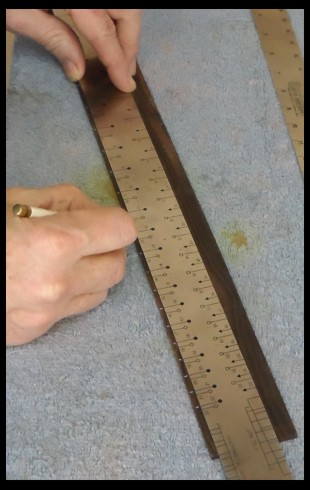
I mark the 12th. fret so that I can square across the blank.
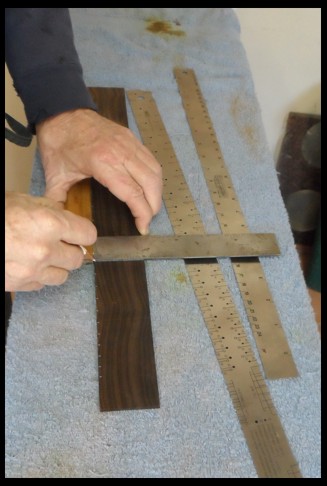
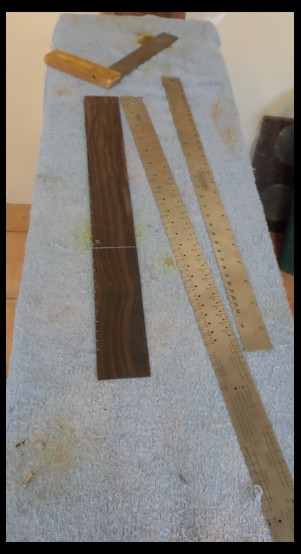
Then lining the shorter scale with its 12th. fret on the 12th. fret mark I lay that scale out on the treble side of the blank.
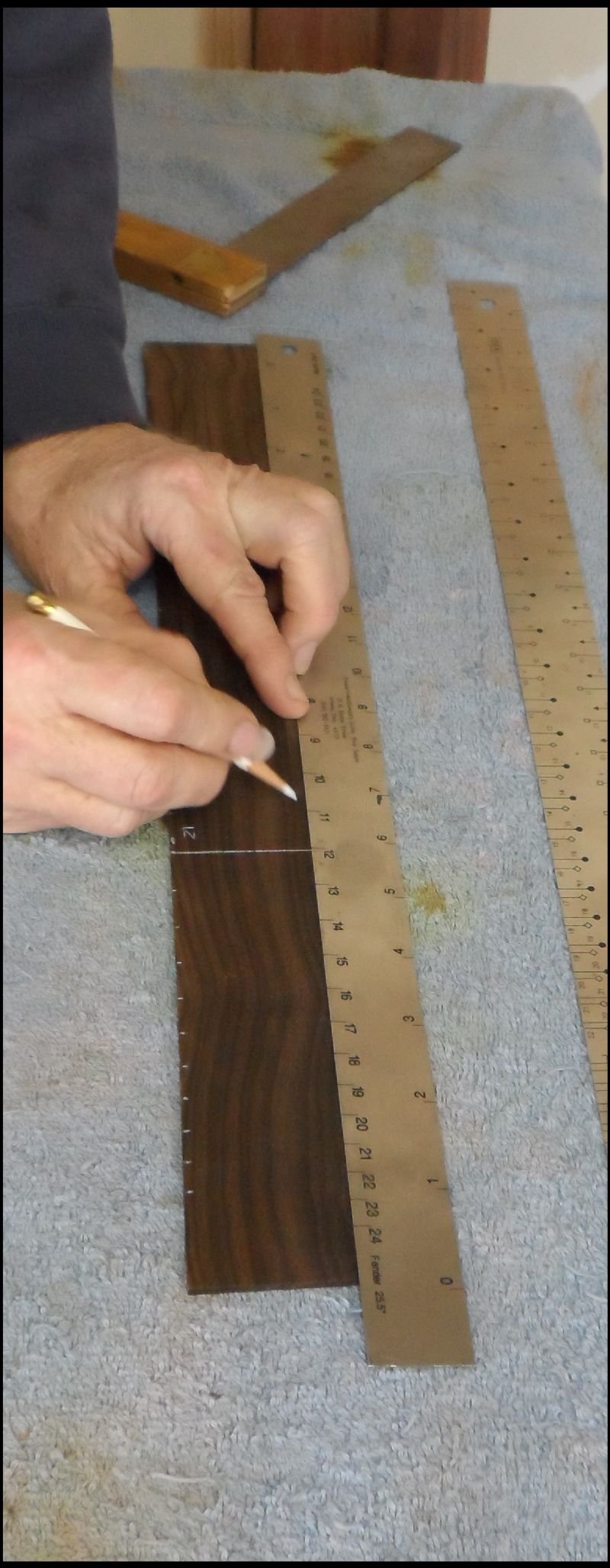
Next using a straight edge I connect the marks on either side of the board.
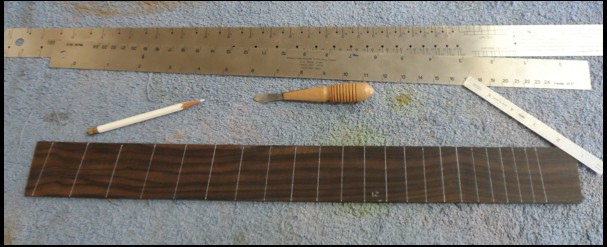
There you have it. Next I'd grab up a fret saw and go to town. If I felt necessary I would use an adjustable square beside my saw to get a good cut.
I hope this helps everybody!
Lyndon Smith - Posted - 03/07/2014: 04:34:11
Thanks for that, Dan, your time is much appreciated.
I'm not put off, at all.
I appreciate hearing the pros and cons and find it interesting that the fan fret players have good things to say about it.
I'm seriously considering making a fan fretted banjo with a short scale of 23" and a long scale of 24", wide neck, 12" rim...
Terms of Use | Privacy Policy | Privacy Consent (EU/GDPR Only)
Copyright 2026 Banjo Hangout. All Rights Reserved.


