
DVD-quality lessons (including tabs/sheet music) available for immediate viewing on any device.
Take your playing to the next level with the help of a local or online banjo teacher.
Weekly newsletter includes free lessons, favorite member content, banjo news and more.
Premier Sponsors


|
Please note this is an archived topic, so it is locked and unable to be replied to. You may, however, start a new topic and refer to this topic with a link: http://www.banjohangout.org/archive/279530
Helix - Posted - 02/11/2014: 05:05:40
Any one using nylguts on a longneck? With a Shubb slider? This is a new one for me, any setup tips would be appreciated.
Bufo Bill - Posted - 02/11/2014: 05:44:41
I don't think the strings will be long enough. I have heard of people doing well with fishing line strings on long neck banjos. See the Polymer Strings Group page.
All the best from Bill. :D
Ken LeVan - Posted - 02/11/2014: 06:05:18
That's incredibly interesting, Larry.
I have never heard of it before. I'd be interested to find out how high the action is and how wide the neck is after you set this up and debug it.
I don't know what gauge a nylon 5th would be, but you may have to raise the slider up a little.
Ken
john bange - Posted - 02/11/2014: 06:14:33
Fishing line is the way to go. for my 1st string, I use 30#, 2nd, 50#, 3rd, 60#, For my 4th string, I use the heavy 4th string from the aquilla all-nylgut set, and 40# for my 5th.
The Aquilla string is long enough only if you tie a no-knot type knot to my Kerschiner t/p
I almost never change strings because they never wear out or change tone. A gig or 2 each week plus practice and rehersal...they just don't wear out.
I have a Shubb long sliding capo that I use once in a while. I have found the nylon string sharpens up a lot when the capo is put down, To compensate for this, I lift the string off of the pip, placing it on the nearest fret inside of the pip. The pip holds it in place and I rarely have to retune but, It works either way.
Edited by - john bange on 02/11/2014 06:15:56
Ken LeVan - Posted - 02/11/2014: 06:30:27
quote:
Originally posted by john bangeFishing line is the way to go. for my 1st string, I use 30#, 2nd, 50#, 3rd, 60#, For my 4th string, I use the heavy 4th string from the aquilla all-nylgut set, and 40# for my 5th.
The Aquilla string is long enough only if you tie a no-knot type knot to my Kerschiner t/p
I almost never change strings because they never wear out or change tone. A gig or 2 each week plus practice and rehersal...they just don't wear out.
I have a Shubb long sliding capo that I use once in a while. I have found the nylon string sharpens up a lot when the capo is put down, To compensate for this, I lift the string off of the pip, placing it on the nearest fret inside of the pip. The pip holds it in place and I rarely have to retune but, It works either way.
John,
Do you know what the diameters of those fishing lies are?
Ken
john bange - Posted - 02/11/2014: 07:15:47
I don't know the diameters of the strings but they are similar to the Aquilla minstral set which is too short for the Long neck.
The 4th is not the red one that aquilla has listed, it is white in color ...about 35mm. I got them from Bernunzio. The La Bella #17 set has a wound 4th that is Long enough.
My Vega is not a t b phone either...it is a Little Wonder Deering with 25 fret neck...this set up does not perform too well on a t b phone pot...imho
John
john bange - Posted - 02/11/2014: 07:42:56
And Ken, you are right about the neck width. I just sold a Tommy George long neck to a player in New York. He is thrilled with it which is no suprise because it was a beautiful instrument. The nut was too narrow for the nylon strings and they would pull off the sides of the neck.
I have had a Deering Boston long neck and a Deering Vega Woodsong. These 2 banjos had nut widths that were perfect for nylon string. I had a couple of Vega SS-5's and they were good also.
The Gold Tone neck is also wide enough. I had a couple of OT800ln's and a Dan Pennington custom, all with the Gold Tone neck that worked well with the nylon.
Sadly, the Ode nut width is not wide enough and I had to stop looking for a model 33 long neck.
My Deering Vega Little Wonder custom is the best long neck I have had for use with nylon strings...the best that I could afford anyway
rudy - Posted - 02/11/2014: 08:04:22
Ken,
If you're thinking about investigating nylon strings I can tell you from doing a bunch of poking around in the past that most users end up with Fluorocarbon leader for instrument strings. The fluorocarbon strings are noticeably brighter in tone than standard nylon material.
Somewhere on my hard drive is a cross reference that roughly converts string diameter to "pounds test", which is the way leader is marketed. The most often recommended brand for stringed instrument use is Seaguar.
Ken LeVan - Posted - 02/11/2014: 08:07:21
Thanks, John,
That's good info. I make my longnecks on the wide side, so they would work with nylon strings if it ever came up.
I think I understand that the need for a slider is because the string gauge of the 5th precludes spikes, also the spikes would probably break the string even if they would work. You definitely need to capo the 5th string with a longneck.
How does the nylon 5th string work if you play the longneck open and tune it down to E?
If you have the banjo capoed on the third fret, what's the string height at the 12th?
Ken
Ken LeVan - Posted - 02/11/2014: 08:15:13
quote:
Originally posted by rudyKen,
If you're thinking about investigating nylon strings I can tell you from doing a bunch of poking around in the past that most users end up with Fluorocarbon leader for instrument strings. The fluorocarbon strings are noticeably brighter in tone than standard nylon material.
Somewhere on my hard drive is a cross reference that roughly converts string diameter to "pounds test", which is the way leader is marketed. The most often recommended brand for stringed instrument use is Seaguar.
Thanks, Rudy.
Fluorocarbon is "Teflon®". I did not know they made fishing line out of it. I'm amazed it doesn't slip out of the peg holes on a banjo when you are trying to tighten it.
You learn something every day.
Ken
rudy - Posted - 02/11/2014: 08:36:28
quote:
Originally posted by Ken LeVanquote:
Originally posted by rudyKen,
If you're thinking about investigating nylon strings I can tell you from doing a bunch of poking around in the past that most users end up with Fluorocarbon leader for instrument strings. The fluorocarbon strings are noticeably brighter in tone than standard nylon material.
Somewhere on my hard drive is a cross reference that roughly converts string diameter to "pounds test", which is the way leader is marketed. The most often recommended brand for stringed instrument use is Seaguar.
Thanks, Rudy.
Fluorocarbon is "Teflon®". I did not know they made fishing line out of it. I'm amazed it doesn't slip out of the peg holes on a banjo when you are trying to tighten it.
You learn something every day.
Ken
The fluorocarbon leader is slippery enough that Seaguar has a page devoted to the best knots to use with it:
seaguar.com/seaguar-community/...guide.htm
john bange - Posted - 02/11/2014: 08:42:34
4th string height with capo on third fret is 3/8 at the 12th fret...the 5th string about a 16th lower.
I think the 5th string sounds fine anywhere from E to G. no buzzing. If I was playing open E a lot more, I would go back to a standard heavy Aquilla 5th string.
The brand of fishing line I use is cheap. Essentials Southbend Monofilament
Ken LeVan - Posted - 02/11/2014: 09:20:49
quote:
Originally posted by rudy
The fluorocarbon leader is slippery enough that Seaguar has a page devoted to the best knots to use with it:
seaguar.com/seaguar-community/...guide.htm
Thanks, Rudy,
I use teflon for a few things. I always thought that if I did a tunneled 5th string I would use the tiny teflon tube that has an ID of .011" because of the slipperiness.
Of course, I will probably never do that - so many things, so little time
Ken LeVan - Posted - 02/11/2014: 09:26:35
quote:
Originally posted by john bange4th string height with capo on third fret is 3/8 at the 12th fret...the 5th string about a 16th lower.
I think the 5th string sounds fine anywhere from E to G. no buzzing. If I was playing open E a lot more, I would go back to a standard heavy Aquilla 5th string.
The brand of fishing line I use is cheap. Essentials Southbend Monofilament
I have half pound spools and it looks like they will last for years.
Thanks John,
This is really interesting - a whole different thing. Before I read this thread, I would have never imagined you could make a nylon strung longneck. Like classical guitars, you would want a flat fingerboard, and you could use softer frets, which would never wear out.
Ken
GSCarson - Posted - 02/11/2014: 09:43:59
Ken,
I believe I have rolls of just about every gauge of Seaquar salt***er fluorocarbon fishing leader. Expensive stuff but once you have it you're pretty much set for life. I got a gift certificate for Bass Pro and ended up using it for that about four years ago. I love it for banjo strings and especially for fly fishing! I do like it better for strings than standard nylon but I have never used it on a long neck and it sounds like John is the go to guy for that.
If you want to try it on one of your open backs email or call me and I'll cut some in different weights and send it your way to experiment with.
Glenn C
retread - Posted - 02/11/2014: 10:16:48
I left a little extra room under the 5th-string spikes on my starter banjo, thinking I might switch from steel to monofilament strings at some point. I did switch, and so far, haven't had any problems with the spikes breaking the fishing line - setup works just fine.
ClayTech - Posted - 02/11/2014: 10:37:17
Fluorocarbon fishing line is notorious for being poor at holding knots. As Rudy said, you have to use certain knots to get it to hold. Fishing line thickness can vary greatly from brand to brand, or even model to model within a brand, regardless of what type of line it is. All 20# fluorocarbon is not all the same thickness. Just from doing a quick check on Bass Pro, thickness of the 20# fluoro leader can vary from .4mm to .438mm. As you get into thicker lines the differences can be even greater. i don't know if that's enough to affect the string function or not, just wanted to make sure you're aware of it.
rudy - Posted - 02/11/2014: 17:33:47
quote:
Originally posted by Ken LeVanquote:
Originally posted by john bange4th string height with capo on third fret is 3/8 at the 12th fret...the 5th string about a 16th lower.
I think the 5th string sounds fine anywhere from E to G. no buzzing. If I was playing open E a lot more, I would go back to a standard heavy Aquilla 5th string.
The brand of fishing line I use is cheap. Essentials Southbend Monofilament
I have half pound spools and it looks like they will last for years.
Thanks John,
This is really interesting - a whole different thing. Before I read this thread, I would have never imagined you could make a nylon strung longneck. Like classical guitars, you would want a flat fingerboard, and you could use softer frets, which would never wear out.
Ken
Hi Ken,
Not to sidetrack the topic too much, but I've been delving into nylon guitar a bit lately. I was not aware until very recently that there's a bit of a movement to combine some of the features of the standard acoustic 6 with nylon strings. The relatively new classification are known as "crossover" guitars. I just converted an unused closet classical to a crossover by modifying the neck to a narrower 1-7/8" and adding a 16" radiused fret board. I did this before coughing up any money for a "real" crossover, as available from several manufacturers. Bottom line, a flat board is no longer considered a prerequisite for nylon-strung guitar players.
I've played banjos equipped with Nylaguts and a fifth string spike, they work just fine on the ones I've tried. I think it's because the force required to hold the string down isn't all that great, so as long as there aren't any severely sharp edges there should be no problem with using them, even as spiked strings.
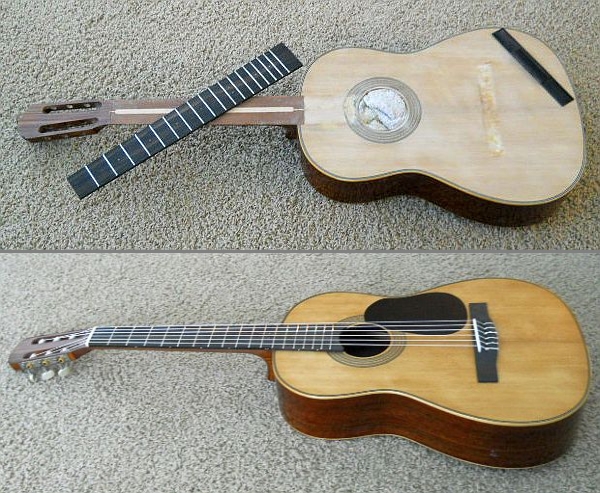 Classical to Crossover Guitar conversion |
rudy - Posted - 02/11/2014: 17:45:30
quote:
Originally posted by GSCarsonKen,
I believe I have rolls of just about every gauge of Seaquar salt***er fluorocarbon fishing leader. Expensive stuff but once you have it you're pretty much set for life. I got a gift certificate for Bass Pro and ended up using it for that about four years ago. I love it for banjo strings and especially for fly fishing! I do like it better for strings than standard nylon but I have never used it on a long neck and it sounds like John is the go to guy for that.
If you want to try it on one of your open backs email or call me and I'll cut some in different weights and send it your way to experiment with.
Glenn C
Glenn,
Since you have first-hand experience with using Seaguar for the banjo I'd appreciate if you could relay the test pound ratings you've found to be the most preferred for strings 1 through 5. I can add it to my info on fluorocarbon string use (when I eventually find it...)
It sounds like one of those things that might prove useful to add on my website for anyone seeking out the real story on fluorocarbon use.
rudy - Posted - 02/11/2014: 17:54:31
quote:
Originally posted by ClayTechFluorocarbon fishing line is notorious for being poor at holding knots. As Rudy said, you have to use certain knots to get it to hold. Fishing line thickness can vary greatly from brand to brand, or even model to model within a brand, regardless of what type of line it is. All 20# fluorocarbon is not all the same thickness. Just from doing a quick check on Bass Pro, thickness of the 20# fluoro leader can vary from .4mm to .438mm. As you get into thicker lines the differences can be even greater. i don't know if that's enough to affect the string function or not, just wanted to make sure you're aware of it.
It might not be that much of an issue, as the diameter reduces itself fairly significantly as the string is tensioned. I should get my micrometer out the next time I change strings for some real world numbers.
Another thing to consider is dealing with the inconsistencies that develop along the length of the tensioned string. Many have noted that intonation issues can be a real challenge on a fretted instrument equipped with nylon strings, and I've recently noted many different ways that players attempt to stretch the strings so they do so in a more uniform manner to improve the intonation characteristics of nylon strings.
Ken LeVan - Posted - 02/11/2014: 18:17:29
I don't know anything about harps, so maybe these wouldn't work, but there's a website where they sell nylon monofilament and would nylon strings in various gauges for harps in 46" lengths which would be more than long enough for longneck banjos.
robinsonsharpshop.com/strings.html
Helix - Posted - 02/12/2014: 04:54:31
I hope the nylguts people are listening, just a few inches of material to let the longnecketeers rock on.
Great responses, people, everyone learns something.
GSCarson: my customer is a student who gets the joke here, nothing is impossible, we just need to ask the right people. To do this properly, I need to buy a bunch of nylon, then I could spec these myself, longneck or no. Are you interested in supplying Helix with 2 sets of longneck strings? You got mail
My interest here has always been post earthquake, what to do when the lights go out. In the dark, in the distance, I'm sure we'll hear a banjo. Head for that, that's where we start over.
Thanks Ken and Rudy, always curious, a real pleasure, is it 2014 already?
GSCarson - Posted - 02/12/2014: 07:26:28
Helix, Although I've been messing around with banjos for almost 40 years, I have exactly zero experience with long necks. Please mail me the string lengths including fudge factor to tie appropriate knots (I think I've typically used an improved clinch since I know that as a fisherman) and you're mailing address. I'll go through my fluorcarbon line and send you some different sizes to try. Dealing with some nasty weather and am traveling this week, so there may be a little delay.... Glenn
BobJJ - Posted - 02/12/2014: 14:48:25
I am using:
#30 (0.020" ; 0.50mm)
#40 (0.024; 0.6mm)
#60 (0.030"; 0.75mm)
#80 (0.035"; 0.90mm)
#30 (0.020" ; 0.50mm)
"HI-SEAS 100% fluro carbon leader"
I like them.
Bob
Ken LeVan - Posted - 02/12/2014: 15:02:51
quote:
Originally posted by BobJJI am using:
#30 (0.020" ; 0.50mm)
#40 (0.024; 0.6mm)
#60 (0.030"; 0.75mm)
#80 (0.035"; 0.90mm)
#30 (0.020" ; 0.50mm)
"HI-SEAS 100% fluro carbon leader"
I like them.
Bob
Here are the sizes from the guys who make harp strings:

Close.
Helix - Posted - 02/12/2014: 15:05:34
Ah What a crew, Thanks so very much here, the player will thank you.
rudy - Posted - 02/13/2014: 09:43:46
HISEAS seems to have about any size / test that you could want:

Terms of Use | Privacy Policy | Privacy Consent (EU/GDPR Only)
Copyright 2026 Banjo Hangout. All Rights Reserved.


