
DVD-quality lessons (including tabs/sheet music) available for immediate viewing on any device.
Take your playing to the next level with the help of a local or online banjo teacher.
Weekly newsletter includes free lessons, favorite member content, banjo news and more.
Premier Sponsors


|
Please note this is an archived topic, so it is locked and unable to be replied to. You may, however, start a new topic and refer to this topic with a link: http://www.banjohangout.org/archive/275288
petercorfield - Posted - 12/04/2013: 16:51:12
Hi folks, looking for some help comparing Bacon-Day Silverbell components from the early period (1923) to (1938-39) such as:
- Large Spun Resonator plate vs. Veneer
- Small/Large/f-Hole flanges
- Tone Rings In, Out, Both, No Ventilation
- Presto vs. Oettinger Tailpiece
Polle has provided a view to the when: acoustudio.dk/BD%20Classic%20S...ment.html
Now wondering about the why?
What in their design progress really made the differences in sound, strength, etc.?
A few problems I've come across in my research f.ex are cracks that form in the small-hole flanges attached to the large spun resonator due to drying wood recess.
Large spun resonator also prone to warping.
Flange attachment problems
etc.
would like to get your expert views.
This will no doubt help future/current members to carefully select potential purchases with more comfort/knowledge.
Peter
Polle Flaunoe - Posted - 12/05/2013: 01:46:13
Peter,
Why? Simply because The Bacon Banjo Co. had David L. Day - very likely the most important figure in banjo history.
Together Bacon and Day kept on improving their banjo models during the 20s and early 30s - opposite most other manufacturers.
Some of the improvements went for strength, some for sturdiness, some for playability, some for performance etc.
Your next question will of course be: "Will a certain version of a B&D model always be better than previous versions?"
My answer will be: "I do certainly not want to open a can of worms!"

Polle
rudykizuty - Posted - 12/05/2013: 03:59:27
Maybe not a can of worms, but perhaps this is an exercise in chasing butterflies.
I have four different plectrum Silver Bells, ranging from 1924 to 1934, each of them with a different configuration. They each have a different voice unique to themselves, although in saying that, they are all recognizable as having that "Silver Bell" quality sound to them. But they vary between each other in appointments so much that I do not believe it possible to say what ONE thing attributes to each of the differences in sound character.
All I can say with any degree of certainty is that I do love them ALL.
PS later I will expand on the details of each model later. I need to get to work now so I can keep making money to buy banjos. LOL
Edited by - rudykizuty on 12/05/2013 04:05:12
beezaboy - Posted - 12/05/2013: 04:23:10
Can we open the can just a little bit? I have an anecdote to share. I once purchased a B&D Symphonie Silver Bell tenor #30882 (1931?) from a music store in the state of Washington. The store owner told me that 30882 was previously owned by an elderly accomplished local player. One day the 30882 owner came into the store and heard a man playing a late 1920's B&D Silver Bell tenor that had recently come in on trade. The old player heard the banjo, got excited and exclaimed "that's what a B&D should sound like!". The store owner told me the elderly man practically snatched the 20's Silver Bell from the man who was playing it and promptly traded his Symphonie 30882 for the late 20's model. The store owner told me that he was astounded by the episode and he remarked also how unusual it was to have two vintage Silver Bell banjos in his store at the same time.
Do the various generations of Silver Bell banjos have a distinctive sound? Probably so. Which is "best" is probably subjective.
Edit - Oops...I cross posted with Anthony.
Edited by - beezaboy on 12/05/2013 04:25:53
petercorfield - Posted - 12/05/2013: 05:00:52
@Polle,
"Some of the improvements went for strength, some for sturdiness, some for playability, some for performance etc."
This is exactly the point of the topic. Trying to figure out improvement X was suppose to solve problem Y.
For clarity, I completely understand that this topic is based on law of averages given that consecutive pieces will have different sounds. But if, on average, the solution didnt produce a significant resolve, than why the solution??
Background, I've been faced with many decisions, like others, on which SB year to buy... Which features "on average" produce the best sound? What to stay away from...
Polle, previous we've chatted about avoiding specific years, but there must be aspects of those years that are considered "safe features"...
Peter
rudykizuty - Posted - 12/05/2013: 10:20:56
I tend to agree that zeroing in on a specific year would not produce a particular expected result. I must also admit that my purchasing history has been based solely on the merits of the particular banjo at the time of purchase. But in my humble opinion, if you are going to profile what you want from a Silver Bell, then I would start with categorizing them by the 4 distinct tone ring designs utilized through the years 1923-1938.
To illustrate my point, I am 100% certain that the two banjos mentioned in Beezaboy's story did NOT have the same tone ring.
Edited by - rudykizuty on 12/05/2013 10:25:29
petercorfield - Posted - 12/05/2013: 11:34:13
Thanks @rudykizuty. This is definitely one of the aspects of my research. What are the high-level differences each produce? Or is it a lack there of that ultimately decided that no holes produces a similar results, thus save development/fabrication costs/time...
jbalch - Posted - 12/05/2013: 11:47:48
I am in no way an expert on all of the styles and the merits of each. I've seen only a dozen or so good original examples.
But - I LOVE the sound of the 1925-1927 era (+/-) models with interior holes in the tone ring (and none outside). See attached photo. The best I have personally heard is a 1927 #1 plectrum belonging to Jim McLellan. That banjo defines "the" B&D sound for me.
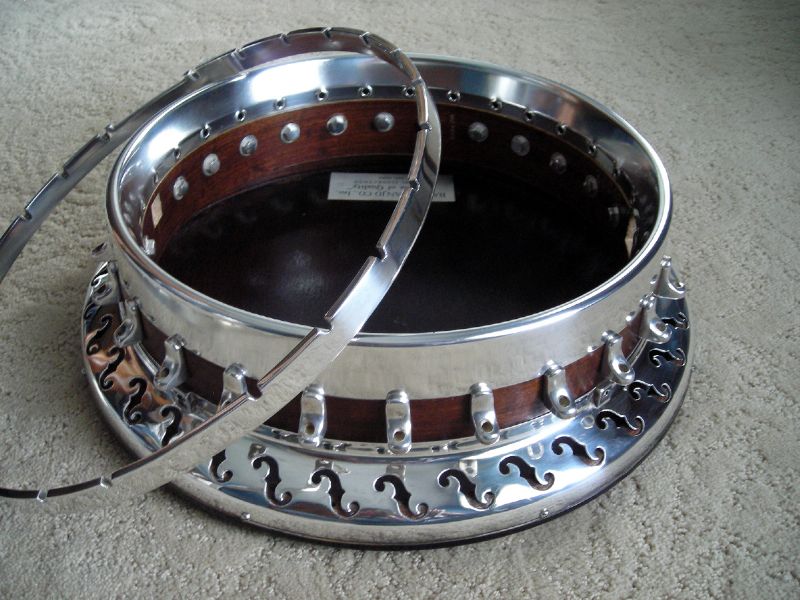 1925 Silver Bell #2 |
rudykizuty - Posted - 12/05/2013: 12:23:46
John Balch is not alone. This "second" design by B&D seems to be the one favored by most players.
rudykizuty - Posted - 12/05/2013: 16:17:40
FYI, There are several archived discussions if you do a search on the forums.
As for my personal collection, it includes the following:
a) 1924 Standard Silver Bell #1 with lathe turned resonator, style I tone ring (interior and exterior holes), original o-hole flange replaced with a Russ Presting reproduction F-hole flange, original Presto tailpiece replaced with a Richelieu repro of the Oettinger and all metal parts upgraded with gold plating. Very chubby neck sans the later issue standard steel reinforcement.
b) 1927 Standard Silver Bell #1 with the style II tone ring (holes inside only), upgraded many years ago to gold plating that is now worn away completely. This was previously my father's banjo that he has left to me since he has been unable to play due to a crippled right hand. He originally owned it starting in the mid-80's. This one has always been his all-time favorite as he believes it to be the "best" Silver Bell he ever played. It is hard to argue with his assessment. Of the four, this one probably packs the biggest wallop.
c) 1930 Sultana Silver Bell #1 with style III tone ring (no holes at all). Pearloid clad fingerboard, rim and resonator. IMHO opinion, the pearloid makes a tonal difference bringing out a much more trebly voice. So it cannot be compared with the others based on the tone ring alone.
d) 1934 Serenader Silver Bell with style III tone ring, walnut neck (as opposed to maple on the other three) and pearloid cladding on the rim only.
As you can see, they all have significant differences to them beyond the tone ring. They all have a different feel to them, each with a somewhat different voice, but all are generally in the range of what you would expect a Silver Bell to sound like. Each is incredibly pleasing in their own way. I enjoy them all and favor each of them for different reasons (with a lot of sentimentality involved with each as well).
Edited by - rudykizuty on 12/05/2013 16:25:05
Polle Flaunoe - Posted - 12/06/2013: 02:34:41
quote:
Originally posted by rudykizuty
John Balch is not alone. This "second" design by B&D seems to be the one favored by most players.
NOPE!
At least not for tenors - 90% of all SB´s built.
I have worked on hundreds of SB tenors - the examples with a Type III tone ring are a dream for a wizard like me - they have one or two extra dimensions regarding sound - via the tone rings floating inner lip. Only - you´ll have to know how to benefit from these extra dimensions.
Mr. Day knew his stuff - and so does OME - their Silver Bell tone ring is based on the Type III.
Regarding your Sultana - this model has a very complex and rich sound - partly due to its Type III tone ring, partly due to its extended 13½" resonator with a stepped flange and partly due to its Pyralin coverings. Yummi for a set-up wizard. But hard to work on for a not-so-skilled set-up guy/owner.
BTW - the same goes for the Symphonie model with its Type IV archtop tone ring.
Sorry! 
Polle
petercorfield - Posted - 12/06/2013: 02:52:46
Thanks @Polle,
So if type III (No Holes) produces the best sound, where did I & II lack?
Am I correct in assuming that Oettinger Tailpiece allowed for varying head pressures via the bridge angle of approach, which inherently affects tone?
the one that baffles me is the flange stages. Would like to have increased discussion about this one.
Peter
rudykizuty - Posted - 12/06/2013: 03:14:34
Polle,
I stand corrected. I believe I should have stated "most plectrum players I know", a more accurate statement.
And yes, I overlooked mentioning that the Sultana had the stepped flange with 13 1/2' resonator. I had a feeling I missed something! Thanks for mentioning it. And indeed, the Sultana was the one in the bunch that I had the most difficulty setting up to play and sound like I wanted. I eventually gave up and turned it over to the shop at Bernunzio's before reaching a state of satisfaction with it. They did a nice job in setting it up. :-)
Edited by - rudykizuty on 12/06/2013 03:22:57
Polle Flaunoe - Posted - 12/06/2013: 04:52:27
Peter,
Do notice, that I didn´t claim SB´s with a Type III tone ring to have a "better" sound - only more complex/rich. Many players do in fact prefer the more clear and dry sound from SB´s with a Type I or II.
Yes - the Oettinger TP is fantastic - an ultimate length and weight/stiffness ratio - plus you can via individual adjustments get an optimal sound/sustain equality across and along the fretboard.
Anthony,
Yes - the Sultana can be somewhat tricky - but it is possible to set it up for a performance very much like the standard SB´s - if wanted. Personally I prefer first of all setting it up with its natural complex/rich sound - maybe not especially suited for a large jazz or string (or Mummers) band - but indeed extremely suited for f.ex. a 3-4-5 piece jazz band. The same goes for the Symphonie model.
FYI - I´m the lucky owner of the best tenor banjo ever built - according to all experts and masters, who have experienced/played it - it´s of course a SB - and it has a Type III tone ring, an extended resonator and a stepped flange plus a Pyralin covering of the resonator (exactly like your Sultana) - only, this banjo has an ebony neck - my favorite tone wood - sadly less than a handful of this last version of a SB No. 6 Ne Plus Ultra were built.
Polle
petercorfield - Posted - 12/06/2013: 05:29:28
@Polle.
You mean you actually have the best banjo ever built, or the type of banjo you have is considered the best compared to others?? Seems very subjective of a statement. Lost in translation maybe, dunno....
Polle Flaunoe - Posted - 12/06/2013: 06:16:24
Peter,
No - my 1930 B&D Silver Bell No. 6 Ne Plus Ultra tenor - SN 28928 - as mentioned an ultra-rare example (maybe even a one-of-a-kind - I haven´t experienced other examples so far) of the last version built - is by all experts/masters, who have experienced/played it, considered the best tenor ever built.
As simple as that - do trust me or not regarding this statement - I don´t care. But - if you don´t trust me regarding this - don´t trust me at all. If so - don´t ask ask me for any infos, opinions, advices etc. in the future.
Peter - it´s all about trust - if you don´t have it - do forget about it. End of Story!
Polle
petercorfield - Posted - 12/06/2013: 07:08:34
@Polle, Down boy! Dont get your hair up too quick!
Let me school you a bit...
I think we can all agree that the eye of the beholder is just that... Its a matter of opinion, shaping and education. Trust has little weight without human rapport - and there is more to conversation than "End of Story"'s. Respect, different story... That you have from most...
Since I deal with facts only, I can only judge based on unbiased scientific results. Thus the point of the topic, not a pi$$ match of who has what.
From what I gather thus far:
1) Oettinger Tailpieces were an advancement
2) Tone Ring is sound shaping - not necessarily an advancement
3) Larger sound chamber is an advancement
4) Jury still out on flange designs?????
Peter
jbalch - Posted - 12/06/2013: 07:12:34
I've never played or seen a number 6. But they are - without a doubt - the most beautiful B&D style (IMHO).
A few years ago, my friend David Emery commissioned a custom 5-string banjo my master luthier Dan Knowles. As that project developed, the banjo ended up with an all-ebony neck and rim. Dan Knowles now has it and performs with it sometimes. I've played it many times. The ebony neck and rim give it an incredibly powerful sound and magnificent tone. I know that the #6 ebony neck banjos form B&D were part of the inspiration for the Knowles' custom banjo. Having seen the outcome of that great instrument, I can only imagine how fantastic the B&D originals must also be.
I agree that the various B&D configurations are are not necessarily "better" or "worse" than each other. They each have unique characteristics. "Better" is in the ear of the beholder.
I do indeed prefer the dry sound of the type II ring (over the later no-hole style). But that is just me. As the say: "It is all good!"
Edited by - jbalch on 12/06/2013 07:13:24
petercorfield - Posted - 12/06/2013: 14:38:29
The side experiment has apparently worked. I was "Unfriended". Great conversation! Somebody has taken their toys home... For those actually wishing to provide creative feedback in the free world, it would be greatly appreciated in order to help others make an educated decision on what to look for when purchasing a B&D Silverbell.
As mentioned earlier and other findings:
From what I gather thus far:
1) Oettinger Tailpieces were an advancement
2) Tone Ring is sound shaping - not necessarily an advancement
3) Larger sound chamber is an advancement
4) Flange attachments problems resolved with inner threaded components, relieving solder stress.
5) Large spun resonator had drying recess causing brass cracks.
6) Jury still out on flange designs?????
7) Does pyralin help sound???
8) Tuners/Steel Reinforcement bar - pretty self explanatory
Appreciate any further help.
Aradobanjo - Posted - 12/06/2013: 16:23:55
Hello,
Wouldn't pyralin be used to shape sound? With all the metal banjos have, having a light weight shaping material would be considered a boon to banjo design. Hey, if Bose, Dobros, Speakers cabinets, and other hollow body designs can use plastic, why not banjos? Granted a Gibson/Deering/Stelling/Yates/Hatfield/GRich/etc. design of a flathead banjo does not lend itself to using plastic very well, apparently the plectrum and A scale banjos could use it to their advantage. Never thought of using plastic except for imports or kid's toys.
rudykizuty - Posted - 12/06/2013: 17:30:45
Just my opinion, but I believe the original intent for Pyralin was design in appearance. Like many other things, when first introduced, it was a material that was not as inexpensive as it was to later become. So, it's use as adornment on high end banjos in the 1920's would seem to make sense. It was only later in the 30's when production became more plentiful and less costly that it started to appear on lower end models such as the Senorita. Perhaps by that point, it's effect on sound qualities were better known. I happen to also own a Senorita from about 1935. I was happily surprised by it's sound when I first got it. A much better sounding banjo than I had expected.
Polle Flaunoe - Posted - 12/07/2013: 01:11:16
Many factors are missing - f.ex.:
- neck profile - size/weight of peghead plus weight of tuners - elasticity of flange and thus resonance of resonator assembly - etc.
And of course the absolutely most important factor - wood sort.
Polle
Edited by - Polle Flaunoe on 12/07/2013 01:13:25
beezaboy - Posted - 12/07/2013: 03:55:33
It seems that a complicating factor to judging banjo sound and tone is that the banjo player does not "hear" his banjo the way that a listener does. Here is an old thread about that topic.
banjohangout.org/archive/262670
petercorfield - Posted - 12/07/2013: 04:14:29
@Polle - that's a good point. Is it the case within one specific model (lets say No.1 only) though? I understand that Mahogany & Ply Maple rims were the primary choices no?
Peter
Edited by - petercorfield on 12/07/2013 04:15:03
Polle Flaunoe - Posted - 12/07/2013: 05:03:41
John,
I do agree - however mostly for typical forward projecting banjos - f.ex. VegaVox´s.
A Silver Bell played while sitting - with the resonator back free of you body - projects backwards and upwards against your ears with nearly the same sound as projected forwards - only of course with a diminished volume. All SB players do appreciate this characteristic and great feature, I take.
In case of any doubt - do use the bathroom trick for a comparative test.
When playing gigs or concerts I do always bring and on top use my personal combined monitor/FOH BOSE system - placed behind me - I do very much depend on hearing my banjo in exactly the same way as the audience. But that´s me - many players can do without such sophisticated devices - LOL!
Also - at the present age of 66 years my hearing ability is now down at max. 9 kHz - however I´ve been told by experts and great musicians even older than me, that my brain does in a somehow strange way compensate for this limitation. But - whenever I these days perform professional recordings/masterings in my studio - I´ll always for safety have some youngsters checking the end result for especially any digital distortions in the 10-20 kHz range. LOL!
Polle
Polle Flaunoe - Posted - 12/07/2013: 05:32:09
Peter,
I do now realize, that your thread was maybe originally meant for the standard/classic/basic Silver Bell model only.
Some confusing postings - also by me - may have popped up - typical for BHO threads. Sorry on my behalf.
As for a standard/classic SB #1 - all versions have a maple ply rim - mostly with an outer veneer of "blackwood" (AFAIK) - and what´s more important - their necks are all made of maple (straight grain or curly) - with laminations of ebony or "blackwood" (sometimes hard to tell).
Mahogany was never used for this model.
As for "friendships" - I do personally not care so much about "respect" - but to me trust is a must. Please give the difference a thought.
Regards
Polle
Edited by - Polle Flaunoe on 12/07/2013 05:42:08
beezaboy - Posted - 12/07/2013: 05:39:16
Polle -
Good work. Very thorough.
The actual sound produced and projected from a banjo is probably a factor that most of us do not consider when evaluating the tonal qualities of a particular instrument.
John
G Edward Porgie - Posted - 12/07/2013: 18:17:21
Polle, it's true that the brain has a way of compensating for those high frequancy hearing losses. I had the opportunity of working for some time with a piano tuner in his mid-seventies, He once admitted he really didn't hear the highest octave on a piano. But if you checked behind him, that upper octave was always perfectly tuned. According to the Piano Tecnician's Guild her in the U.S. the highest score ever achieved by anyone on their standardized tuning test was achieved by another tuner in his seventies.
Don't ask me how it happens, but I know for a fact that before I quit tuning pianos due to degenerative discs and an arthritic shoulder, I was tuning way better than I ever had when I was in my thirties. It's just something that happens, and I don't think that even hearing specialists have a clue as to why.
High frequancy distortion still drives me nuts, so if there aren't any kids arond to check behind you, I wouldn't worry too much. Some of those young people probably don't even hear as well as you do.
Polle Flaunoe - Posted - 12/08/2013: 04:34:11
George,
The frequencies for the upper octave on a piano (C7-B7) goes from 2093 to 3951 Hz - I hope, that my hearing ability will not come down below this range within many years to come. LOL!
In 2000 I recorded a great album with a Danish Gypsy swing band - their violinist was at that time 77 years old. His hearing ability back then did go a little over 7 kHz (he had it measured every second year) - I would gladly settle for this measure, when I turn 77. BTW - he´s now 90 years old and AFAIK still playing his violin.
If so, I´ll only miss the very high overtones - not the basic tones - plus science tells, that my brain can often compensate for / in a virtual way recreate missing overtones.
Back in the 80s (I think) SONY came up with a sophisticated hardware/firmware for their upper grade CD-players - this could detect missing overtones over 20 kHz (the physical top limit for the CD-media) by comparing lower notes from a certain instrument/voice and re-create the missing overtones on basis of this. So maybe/hopefully my brain has the same "device" built-in. LOL!
For those of you not familiar with advanced acoustics - if you play 2 absolutely clean notes (f.ex. from a pipe organ) at the same time - the first outcome will be 4 notes - the original 2 notes at full power plus the difference between and the sum of these notes - at a much lower power. The 2 latter are so-called overtones. Secondly these 4 notes will be combined in a similar way - however with their overtones at an even lower power. Etc. etc.
The mixture of 1st, 2nd, 3rd etc. overtones are the ones telling you about an instrument being f.ex. a guitar or a banjo.
So much for theory/science - now back to some serious playing/practicing on my lovely B&D´s - they are staring at me!
Polle
Polle Flaunoe - Posted - 12/08/2013: 07:02:18
Guys,
Please do for safety never trust me - I´ve off-line in harsh words been told by a BHO-member posting at this thread, that I´m not a person to be trusted.
Highly respected - Yes - but trusted - No!
Strange for me - as a typical Dane I do trust ALL people unconditionally - that´s btw. one of the main factors for the year-after-year declaring of Danes being the most happy/content populations at this globe. In case of any doubt - do search the internet for infos regarding this issue.
So - please don´t trust me! For safety!
Poll
petercorfield - Posted - 12/08/2013: 10:56:22
Soap-box away, but keep it in context please. The topic, which you don't have to contribute to, is asking for pretty straight forward information about advancements in SilverBell technology - whether that be in specific models or higher end ones. Not how good your ear is, or how great of banjo you think/presume/been told to have. It's not the proper venue, as I understand it...
@Polle - BTW, another SN for your database - Here is a Smeck Stage model with Pyralin fingerboard that I uncovered several weeks ago, unfortunately the auctioneer wouldnt let 'outsiders' in on the bidding... But has been immediately relisted on Ebay:
ebay.com/itm/VINTAGE-B-D-BACON...134926799
As mentioned earlier and other findings:
From what I gather thus far:
1) Oettinger Tailpieces were an advancement in string/bridge pressure
2) Tone Ring is sound shaping - not necessarily an advancement
3) Larger sound chamber is an advancement
4) Flange attachments problems resolved with inner threaded components, relieving solder stress.
5) Large spun resonator had drying recess causing brass cracks.
6) Jury still out on flange designs. However, change in projection setup may help the escape, versus enclosed chambers
7) How does pyralin help sound???
8) Tuners/Steel Reinforcement bar - pretty self explanatory
Appreciate any further help.
All the best...
Peter
G Edward Porgie - Posted - 12/08/2013: 14:43:19
Peter, you can blame me for some of the off-topic conversation. I tend to notice and comment when someone mentions overtones, frequencies, and acoustics due to my background in piano technology. That sometimes elicits a response or two that some people may not be looking for.
I do feel, however, that some of this acoustics discussion applies to the B&D Silver Bells conversation. I would wonder if any kinds of scientific tests with well calibrated equipment have been performed to see just what might be happening to various overtones, volume levels, and sustain with the various incarnations of the Silver Bell. I'm not sure how much hooking up an oscilloscope would tell a person, but perhaps it might say something useful. Gab sessions and opinions are one way of learning, but science might also be used to contribute.
petercorfield - Posted - 12/08/2013: 15:34:31
@G Edward Porgie.
Do completely agree there is a space for discussion which proves-disproves that certain aspects have improved from previous versions... What is of course important, is how we interpret the information. We have to assume that greater volume/outward projection/tones/sustain/etc... are all desired outcomes... This is where subjection comes into play... Therefore, it may make more sense to consider strictly obvious qualities like sustain, sturdiness, frequency block, etc...
Very hard to put fingers on "up to interpretation" figures as silver bullets. It becomes a black-hole of supporting arguments... The sample to make any valid findings is pretty much elusive, short of having hundred of banjos to poke & prod in a controlled fashion... So if there have been any know studies, I'd love to incorporate into this discussion.
Peter
Terms of Use | Privacy Policy | Privacy Consent (EU/GDPR Only)
Copyright 2026 Banjo Hangout. All Rights Reserved.


