
DVD-quality lessons (including tabs/sheet music) available for immediate viewing on any device.
Take your playing to the next level with the help of a local or online banjo teacher.
Weekly newsletter includes free lessons, favorite member content, banjo news and more.
Premier Sponsors


|
Please note this is an archived topic, so it is locked and unable to be replied to. You may, however, start a new topic and refer to this topic with a link: http://www.banjohangout.org/archive/270824
Page: 1 2
BrittDLD1 - Posted - 09/20/2013: 21:09:15
75 Years ago, today -- Sept. 21,1938
"The Great New England Hurricane of 1938" barreled across Long Island Sound, and smashed into the southern coast of New England. The Bacon Banjo Co., Inc., situated near the mouth of the Thames River, in Groton, CT, was inundated with brackish water. (Contrary to popular myth... the Bacon buildings were NOT destroyed by the Hurricane -- and still stand today.)
The Bacon Banjo Co., Inc. was already under financial stress, from low sales during the Great Depression. And the Hurricane of 1938 signaled its death blow. The company contracted with the Fred Gretsch Company (in Brooklyn, NY) to finish and assemble any usable parts, into saleable banjos. But ultimately, The Bacon Co. could NOT continue.
David L. Day filed the corporation's Annual Report, on Jan. 1, 1939 -- listing the Officers and Directors. The corporation also filed for bankruptcy in 1939. (I don't have the exact date at hand.) In February of 1940, Gretsch purchased all of the corporation's assets (except the land and buildings) including: inventory, tools, materials, supplies, remnants, copyrights, trademarks, and patents.
The Corporation's buildings and land were finally sold -- by David L. Day (as President of "... The Bacon Banjo Co. Inc. ... now in dissolution...") and Mildred W. Lucy (as the corporation's Assistant Treasurer, and Assistant Secretary) -- on May 11, 1943. Day was again living in Revere, MA, at that time.
Epilogue:
The Gretsch Company continued to build "Bacon" banjos until 1972, when their parent company, Baldwin Piano & Organ, moved the operation to Arkansas. Gretsch then took over production of the "Baldwin" banjo line (formerly The ODE Co.) which Baldwin had acquired in June of 1966.
Production of Baldwin banjos stopped in 1980, when Baldwin's financial arm, Baldwin-United Corp., started to have financial problems, eventually resulting in corporate bankruptcy in 1985. "Baldwin Piano & Organ" was sold as part of Baldwin-United's reorganization plan. (The "Baldwin Piano" brand is now owned by Gibson...)
Best-- Ed Britt ©2013
Edited by - BrittDLD1 on 09/20/2013 21:11:58
richard baskowski - Posted - 09/21/2013: 05:06:57
i love my bacon #3 professional. ser. 10712 1925 it has the internal resinator. i play classic style with it so it is set up with nylon strings. i also use it to play clawhammer style. very versatile and well made ( lange). thanks for the info on such a fine co. rick
Bill H - Posted - 09/21/2013: 06:09:27
My parents often talked about the 1938 hurricane. They would point out places in Rhode Island that would remain forever changed by this huge storm, places that had meaning to them from their childhoods. Much was lost to future generations, as it has been with many recent weather events. It is certainly a testament to Mr. Day that his banjos are still so highly prized. My understanding is that he played a significant role in innovations that are still imitated and cherished today.
Grey Dog - Posted - 09/21/2013: 06:13:36
Between the above, the Gibson fiasco, and the current Ome predicament: I'm wondering if Poseidon/Neptune doesn't like banjos.....
vintagetenor - Posted - 09/21/2013: 07:33:26
Thanks, Ed! Tragic event. I wonder what would have been the course of events if the hurricane hadn't hit the factory.
Mike Amato
PS - Great to be in this group!
Polle Flaunoe - Posted - 09/21/2013: 08:53:16
quote:
Originally posted by richard baskowski
i love my bacon #3 professional. ser. 10712 1925 it has the internal resinator. i play classic style with it so it is set up with nylon strings. i also use it to play clawhammer style. very versatile and well made ( lange). thanks for the info on such a fine co. rick
Richard,
Your Bacon Professional #3 SN10712 was manufactured late 1923 - and AFAIK Lange wasn´t in any way involved in its production.
I have included it in both my extended and my general database - acoustudio.dk/BD_and_Bacon_database.html
Polle
BrittDLD1 - Posted - 09/21/2013: 09:08:06
Richard --
(Polle beat me to it, with his info about your banjo -- while I was rambling-on about Fred and Dave...)
At serial #10712, your Professional FF No.3, was one of Bacon's Top-of-the-LIne banjos, at the time. But that serial number indicates was probably made in late-1923, or early-1924. It was NOT made by Lange. (The higher-model 'teens Bacons were made by one of the NYC makers -- presumably Lange.) Your banjo was made, completely, at the Groton factory -- under the direct supervision of Fred Bacon and David Day. Bacon only had about 15 employees at that point. (And that included 2 secretaries, and 3 women who packaged strings, and other accessories.) So it was a small company, in comparison to other major makers...
The FF Style No.3 TENOR was SHOWN in the "1925" Catalog (prepared in late-'24). But the "Professional" models were NOT listed in the accompanying '1925' Price Sheet. ("Effective Sept. 1, 1924") Styles change... and your banjo is one of the last of a dying breed. (But that doesn't mean it's not a GREAT banjo! And it's considered 'rare' for that period.)
**********
Bill H --
David Lucien Day (MY banjomaker hero!) started in the banjo business with Fairbanks & Cole, in 1883 -- at the tender age of 18. When F&C split, in 1890, Day went with Fairbanks.
When AC Fairbanks SOLD his banjo co., to some business associates, in 1895 (to go make wooden bicycle rims, in MY 'hometown' of N. Tonawanda, NY) David L. Day assumed the title of "General Manager" of the AC. Fairbanks Co., Inc. And David Day is THE person directly responsible for producing the GREAT Fairbanks banjos (along with contract designer-engraver Icilio Consalvi), during its finest period -- of 1895 to 1904. (The new owners were businessmen -- NOT 'banjomakers'.)
The fire of 1904 put the Fairbanks Co. out of business. The Fairbanks name, and all of its trademark, copyright, and patent rights -- as well as any existing inventory, and any usable materials or parts, were sold to The Vega Co., and D.L. Day signed as 'witness' on the bill of sale. But Vega's President, Julius Nelson, recognized Day's unique knowledge, talents, and business acumen, and hired Day as "V.P. and General Manager" in charge of Vega's fretted instruments, and "The A.C. Fairbanks Co." (now a 'division' of Vega) in particular.
The patent on the Fairbanks Whyte Laydie had NOT been filed before the 1904 fire. When Day collaborated with Julius Nelson on the development of the TU-BA-PHONE, they realized BOTH designes needed to be patented. Day is listed as the 'inventor' (with rights assigned to Vega) for the entire Whyte Laydie rim assembly. For the TU-BA-PHONE patent, Julius Nelson (Nelon J. Nelson) is listed as the inventor (with rights assigned to Vega) of the "improvement' (the tone ring) -- with a reference to the Day Whyte Laydie patent, for the primary construction of the rest of the rim.
Day is also the inventor (with rights assigned to Vega) in the Design Patent for Vega's "cylinder-back" mandolins.
When Vega's President, Julius Nelson, died unexpectedly of an intestinal obstruction, in 1920 -- Day realized he had lost a friend, collaborator, and his "champion" at Vega. Julius was a skilled cabinetmaker, by training, and considered an expert in selecting fines woods.
(And the higher-quality of the curly maple used on the Vega-made Whyte Laydie No. 7's -- is visibly superior -- to the lower-quality of the curly maple used for the Fairbanks-made Whyte Laydie No. 7's. Even though the craftsmanship on the Fairbanks WL's was superior to Vega...)
Again, contrary to popular belief, it was Julius who was responsible for overseeing all manufacturing at Vega -- NOT David Day!
Day was more like a modern Product Line Manager -- responsible for OVERSEEING, and MANAGING all aspects of research, planning, design, concept prototypes, production requirements, advertising, sales ('marketing') and "Artist Relations" for the fretted instrument divisions.
Unfortunately the other partner in Vega, was Julius' brother, Carl Nelson -- an accountant, with little technical knowledge. But Carl's son, Bill Nelson (in his late-'teens) would be the one to eventually run The Vega Company. David Day apparently didn't get along well with Carl, or Bill -- and was looking for a way out, when he was approached by Fred Bacon, in the spring of1922. Bacon's Factory Manager was going back to the engineering consulting group, he had previously worked for.
Bacon and Day had known each other since the mid-'90s. Fred was one of Fairbanks' top endorsers, and Fairbanks also sold Fred's small products: strings, bridges, armrests, tailpieces (the NO-Knot, and Bacon-Kerschner), etc. Day was looking for an 'escape route' -- and Bacon provided it, by asking Day to become his VP and General Manager. Both of them were innovative, and inventive. Fred made a small fortune (really) with his patent for "ice-shoes" for horses. It paid for Fred's mansion in Vermont. He also patented a lawn-mowing device.
There is a HUGE difference between the quality of the 'teens Bacons (made by one or more of the "NYC-school" makers) and the banjos that Bacon & Day designed together. and the quality, design, and workmanship continued through the '20s. The onset of the Great Depression in 1929 -- set different needs and requirements into motion.
David Day was 73 years old, and still President of The Bacon Banjo Co. Inc. when the Hurricane of '38 hit. He worked at closing-down and selling-off Bacon
for another 5 years... He died just 5 miles down Main Street, from where I currently sit -- in 1956, at the age of 92.
I'll try to describe some of the Depression Era at Baocn, tomorrow, when I get some time. (Gotta go set-up sound, for our local coffeehouse concert tonite.)
Best-- Ed Britt ©2013
Edited by - BrittDLD1 on 09/21/2013 09:29:20
beezaboy - Posted - 09/21/2013: 10:36:46
Thanks, Ed. Great work!
I've always been fascinated (curious) about the "Epilogue" part of your initial post.
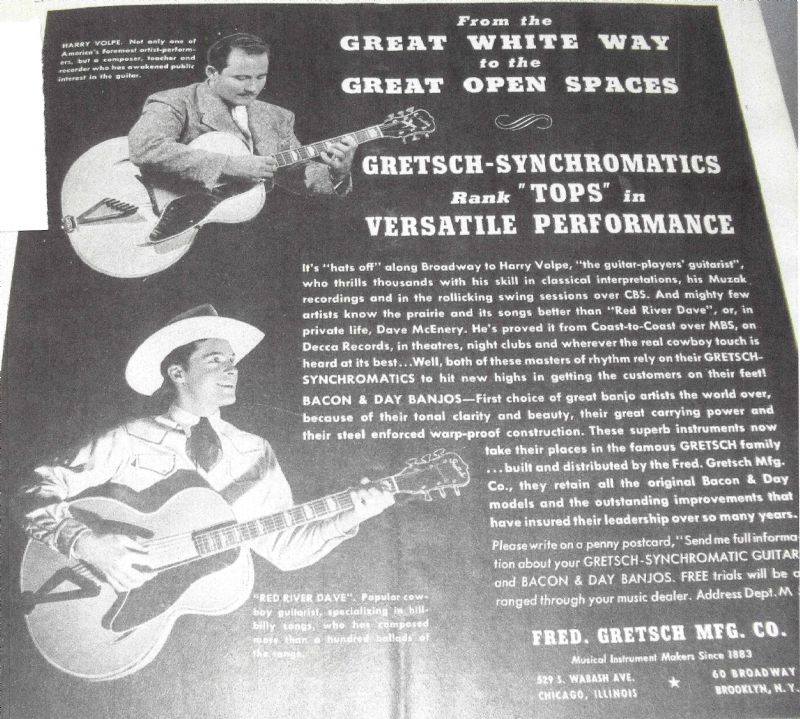
Attached is an ad from the Nov. 1940 issue of Metronome magazine with an announcement for Bacon & Day Banjos "which now take their places in the famous GRETSCH family".
Gretsch had about two years (1940 and 1941) ownership of the Bacon Banjo Co., Inc tangible and intangible assets before the war interrupted their banjo manufacturing. I've often wondered what models of Bacon and Day banjos were being made during this period (if any) in the Gretsch Brooklyn factory and how they were being serial numbered.
Recently a Bacon and Day Rajah banjo with serial number 40293 appeared on ebay (attached). Polle Flaunoe has several 40XXX Rajah banjos in his database as well as a couple of Serenaders with 40XXX numbers.
I wonder if these 40XXX banjos were an early Gretsch practice of continuing the Bacon serial numbering system and that 40XXX serial numbers were Gretsch Bacons made before the U.S. declared war in 1941 It is odd that the Rajah brand would be in this mix as I would have expected Gretsch to use a more recognizable B&D model name
 Bacon & Day in Metronome Nov. 1940 | 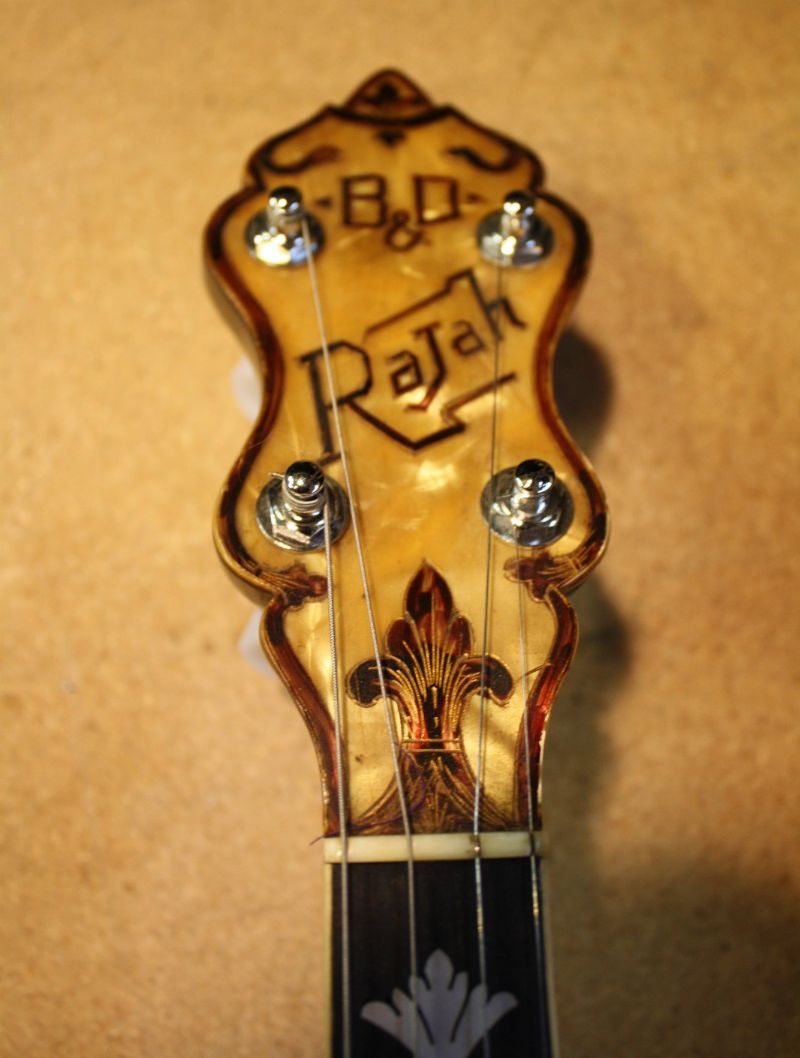 Rajah 40293 | 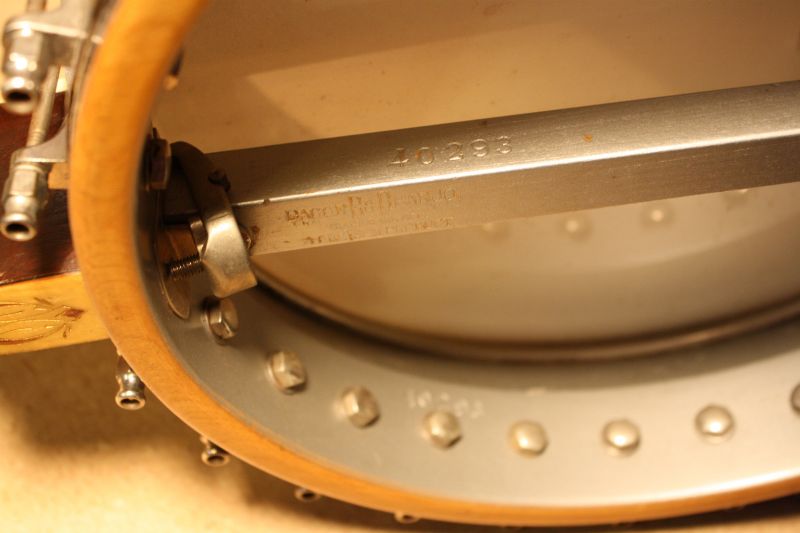 Rajah 40293 |
rbergesch - Posted - 09/21/2013: 13:31:33
This is great information; I have been curious about these relationships for a long time, but these posts have clarified a lot of the mysteries for me.
Thanks for posting, and I'm looking forward to these next postings as they come available.
.
Polle Flaunoe - Posted - 09/21/2013: 20:05:35
Ed,
Great and interesting stuff - thanks!
As for "-- and was looking for a way out, when he was approached by Fred Bacon, in the spring of 1922" - how are your thoughts these days about a possible "secret co-work" between Fred Bacon and David L. Day in the period after Julius Nelson´s death in 1920 till the "approach" early 1922 as mentioned? Especially with regards to the development of Bacon´s Blue Ribbon line?
I´m looking forward for more "stuff" from you - LOL!
Polle
Polle Flaunoe - Posted - 09/21/2013: 20:19:05
John,
There´s in my mind no doubt - that the 3 Rajah´s, 2 Serenader´s and 1 Senorita with serial numbers in the 40248 - 40332 range and present in my DB were manufactured in 1940/41. However I´ve seen pictures of only one of these - SN 40293 - as shown by you.
I/we´ll however have to wait for more examples - inclusive of detailed infos/pics - with 40XXX SN´s to pop up - before making a final conclusion regarding this.
Polle
richard baskowski - Posted - 09/22/2013: 09:11:06
hi guys. thanx for all the info. I guess I spend alot more time playing than I do on the research end of things. so, I appreciate those of you who do. this keeps the memories alive. that type of information brings me closer to the instrument,and allows me to understand more about where its roots are. Polle, thanks for putting her on the register I think that is so important what you are doing there good job. Ed thanks for responding and helping out with the info. You really know your bacon! I am curious about the ff designation that you used,asI thought that had to do with the style of tone ring installed. the ring in 10712 appears to be a plain spun rim? I extends down the side of the rim to a little beyond the brackets,as they rest on the edge of the ring. I am thrilled to learn that it was made in groton and not by Lange, that was wrong info given by a collector.I also had the year wrong and the banjo just keeps getting older by the minute.So now we can go ahead and make celebration plans, Happy 90 birthday! Since we are yakin about this I thought you might be interested in how the banjo came into my hands. while working as a painter on a new addition, the owner of the house and i were chatting and the music subject came up. when i told him i played banjo, he said i have something to show you. he pulled the banjo out from under a bed, where it had been resting for 30 years. In the original case and all there.He had been working in a music store when a person came in with it to sell. they gave him 60 dollars for it.He took it home plunked a little while at college, then retired it to its resting place.I popped on the bridge and played a few tunes for him, even though the head was busted.ten years went by and i often thought about it just sitting there until one day the phone rang. the man said he needed some work done on the house,paint the dining room and stain the deck. when i arrived at his house he had the banjo all tuned up and said you might take it home to see if it is something you might want.He wanted it to go to someone who would play it rather than collect it. he also did not want to talk money, so the deal was made . we traded even the banjo for the labor. we both agreed that musical instruments have a soul and that he had gotten it so that I would end up with it.
BrittDLD1 - Posted - 09/22/2013: 09:13:15
quote:
Originally posted by Polle Flaunoe
... how are your thoughts these days about a possible "secret co-work" between Fred Bacon and David L. Day in the period after Julius Nelson´s death in 1920 till the "approach" early 1922 as mentioned? Especially with regards to the development of Bacon´s Blue Ribbon line?
Hi Polle --
In studying that early period of Bacon, in New London/Groton 1920 -1922, it becomes obvious that Day and Bacon WERE "in cahoots" (secretly working together) BEFORE Day went to Bacon. And YES, I do believe that Julius Nelson's death -- and the lack of design and production knowledge, on the part of his brother Carl Nelson (and Carl's son, Bill Nelson) had MUCH to do with making Vega a VERY uncomfortable situation for Day.
An intriguing coincidence:
The 'date' usually given for the dowel-stamp change from -- "Fairbanks Banjo Made by The Vega Company" to "The Vega Company" --- is 1919. The change is attributed to AC Fairbanks' death, that year. The theory is, that there *might* have been some type of contractual clause, stating: "Use the Fairbanks name, until AC dies." That's possible, but NOT very plausible. AC had already SOLD The Fairbanks Co., to Cummings and Dodge, in 1895! And there is absolutely NOTHING in the Sale agreement -- signed by Cummings and Dodge (and witnessed By DL Day) after the 1904 fire -- about such a clause.
I believe a more plausible scenario, is: The dowel-stamp was PURPOSELY changed in 1920 -- AFTER Julius' death -- to eradicate any reference to the "Fairbanks" background (and Day's major contributions) to claim the banjos as original VEGA designs.
HOWEVER... the flagship "Whyte Laydie" models were primarily DAY's 1901 creation -- while HE was running Fairbanks, from 1895 to 1904. Vega (with Day's obvious approval) simply made some production 'modifications' to the WL. And even Julius Nelson -- in the 1909 Tubaphone Patent -- credits the overall rim design, and bracket-band, to DAY's Whyte Laydie patent!
In MY opinion, the elimination of the "Fairbanks" name was intended as a direct 'slap-in-the-face' for Day -- and a psychological 'demotion' of his rank in the company.
In the Oct, 1922 Crescendo Magazine article (pg 8), about Day becoming VP of Bacon, it notes: "... A few days before Mr. Day severed his connection with the Vega Company, the employees at the Vega factory presented him with a fine gold watch as a token of their esteem. ..."
Note that it was the EMPLOYEES who gave Day a gold watch -- and NOT Management! (And Vinnie Mondello's grandfather was apparently one of those employees. I first heard the story about Day's gold watch from Vinnie.)
Back to Fred and Dave "secretly working" together:
Day could NOT have produced Bacon's "flagship" Supertone/Super Blue Ribbons (with the full-spun perforated tonering, and improved snap-in resonator) in such a short period of time (9/22 to 4/23) -- WITHOUT having some prior knowledge of the earlier standard Blue Ribbon, and having (certain features) built into them, previously. (Day was a master of "modular design"-- where one 'primary' part can be easily modified for different variations.)
The 'standard' (half-spun tonering) Blue Ribbon, was introduced at the April 1922 Guild show, in NYC. In the group photo, published in "The Cadenza" Magazine, Day is shown standing next to Fred Bacon. Maurice Sherman (Fred's General Manager, in charge of production) and Frank Bradbury (another superb banjoist, one of Fred's star students, and endorser for Bacon and Vega) were standing nearby.
As I mentioned above, Fred and Dave were LONGTIME friends, with a past business relationship. You also need to know that Day did not drive. He took the train from Boston to NYC, and often stopped by Groton or New London to see Fred. The "smoking gun" (evidence) is that the PATENT for the standard Blue Ribbon was filed 6 days before the 4/23/22 Guild show. It's MY theory that Fred wanted Day to see the "prototype" Blue Ribbons, and to read and 'approve' the patent application BEFORE it was filed, on 4/18/22. And then, they traveled to NYC together.
Apparently, Fred and Dave finalized their employment negotiations by mid-summmer. And Day gave Vega notice that he was leaving, shortly after.
David L. Day walked in the door of the little converted house, next to the river, on Thames St., Groton, CT -- on Sept 18, 1922 -- to assume his duties as Bacon's new VP and General Manager of The Bacon Banjo Co., Inc.
In only 8 months, Day would create the Bacon "Supertone"/"Super Blue Ribbon" model, on the 'bones' of the earlier Bacon standard "Blue Ribbon". The Bacon "Super Blue Ribbon" would then 'morph' into the "B&D Super Banjo" by April 1923 -- and in-turn (with the addition of an unusual extended-back resonator) the "B&D Super Banjo" would become the "B&D Silver Bell", by the end of July, 1923. Day also created an improved version of the 'standard' Bacon "Blue Ribbon" (with 1/2-spun tonering) calling it the "B&D Blue Bell".
The banjos made under David Day's direct supervision, at Fairbanks, Vega, and Bacon -- are considered some of the finest "professional grade" banjos ever made. Many of those banjos are STILL being played, and cherished -- 75 to 120 years after they were produced.
(More on the #40xxx banjos, later. But, Yes -- I do agree they ARE pre-war Gretsch-made banjos, c1940-1942.)
Best-- Ed Britt -- ©2013
Edited by - BrittDLD1 on 09/22/2013 09:25:52
BrittDLD1 - Posted - 09/22/2013: 09:42:04
OOPS! Sorry... I previously wrote:
"... In only 8 months, ... (with the addition of an unusual extended-back resonator) the the "B&D Super Banjo" would become the "B&D Silver Bell", by the end of July, 1923. ..."
That SHOULD be: "... by the end of MAY, 1923."
The B&D Silver Bell was introduced, the first week of June, 1923 -- at a Music Trades convention, in Chicago.
Best-- Ed Britt
Edited by - BrittDLD1 on 09/22/2013 09:49:19
esmic - Posted - 09/22/2013: 10:55:41
Day's career achievements are all the more remarkable in that his critical career moves were triggered by seemingly random, yet "effing" powerful events : Feud (Cole vs Fairbanks c. 1890); Fire (1904); a Funeral (Julius Nelson 1920); and Flood (1938).
BrittDLD1 - Posted - 09/22/2013: 15:19:41
quote:
Originally posted by richard baskowski
... Ed thanks for responding and helping out with the info. You really know your bacon! I am curious about the ff designation that you used,asI thought that had to do with the style of tone ring installed. the ring in 10712 appears to be a plain spun rim? I extends down the side of the rim to a little beyond the brackets,as they rest on the edge of the ring. I am thrilled to learn that it was made in groton and not by Lange, that was wrong info given by a collector.I also had the year wrong and the banjo just keeps getting older by the minute.So now we can go ahead and make celebration plans, Happy 90 birthday!
Hi Richard --
The "ff" comes from musical notation, meaning "forte forte". The word "forte" means "strong", or "loud". So "ff" simply means "very strong" or "very loud". For a 'professional-grade' classic banjo, back in 1905 -- being able to play it very loud was important in a concert hall. And that's why Fred Bacon called it his "FF Professional" model.
The rim was designed, and patented by Fred. The spun tonering was supposed to add some sustain, or "bell-like tone" to the banjo. The "internal resonator" (donut resonator) also added to the tone and sustain.
MY guess is, if you were to take your rim apart, you'd find a brass-rod hoop sitting on top of the rim, supporting the radiused top of the spun tonering. The original version (that Fred had Vega produce from 1905 to 1910) did NOT have a rod under the tone ring. As a result, many of the skirts on those early tonerings collapsed, or buckled -- as the edge of the skirt popped out of the narrow recess, and hit the tops of the bracket shoes.
It's interesting that you note your Professional model made under Day's supervision had the lower edge of the skirt positioned BELOW the tops of the shoes. That detail would keep the lower edge contained -- so the skirt couldn't buckle as easily.
And yes... Happy 90th Year to your banjo!
That's a great story about how you got your banjo. Sounds like it was a good 'trade' -- of your services, for the banjo. Enjoy it!
Best-- Ed Britt
pgroff - Posted - 09/22/2013: 16:00:14
banjohangout.org/global/ckedit.../icon.png) center no-repeat #ff0000;cursor:pointer;top:-8px;-moz-border-radius:2px;border-radius:2px" title="Insert paragraph here">↵
quote
:
Originally posted by BrittDLD1
Richard --
(Polle beat me to it, with his info about your banjo -- while I was rambling-on about Fred and Dave...)
At serial #10712, your Professional FF No.3, was one of Bacon's Top-of-the-LIne banjos, at the time. But that serial number indicates was probably made in late-1923, or early-1924. It was NOT made by Lange. (The higher-model 'teens Bacons were made by one of the NYC makers -- presumably Lange.) Your banjo was made, completely, at the Groton factory -- under the direct supervision of Fred Bacon and David Day. Bacon only had about 15 employees at that point. (And that included 2 secretaries, and 3 women who packaged strings, and other accessories.) So it was a small company, in comparison to other major makers...
The FF Style No.3 TENOR was SHOWN in the "1925" Catalog (prepared in late-'24). But the "Professional" models were NOT listed in the accompanying '1925' Price Sheet. ("Effective Sept. 1, 1924") Styles change... and your banjo is one of the last of a dying breed. (But that doesn't mean it's not a GREAT banjo! And it's considered 'rare' for that period.)
**********
Hi Richard, Ed, Polle, and all.
I notice in Richard's post 9/21 he listed his banjo as a "bacon #3 professional. ser. 10712" But in Ed's reply quoted above, he added the "FF" designation. Richard, is your banjo actually stamped with the "FF" letters?
Maybe this is the reason for Richard's question later. It sounds like Richard's banjo may be similar to my Bacon Professional tenor #3, serial number 9846. Mine also has the simpler ring (and the skirt of mine also extends to just below the upper edge of the shoes).
I have noticed for a while now, and mentioned this several times on the hangout, that some people automatically add the "FF" designation when discussing any of the Bacon internal-resonator banjos -- but although some were stampled "FF" along with the model number, others were never stamped that way. This came up for example when Wyatt Fawley had a 1920s Bacon internal-resonator tenor for sale, he described it as an FF model (possibly a # 2 or #3) but when he mentioned it had the non-donut ring I predicted it would not actually be stamped FF on the dowel stick and that proved correct.
The reason I think this may be interesting is that I have a hypothesis that there may be a general rule -- that the IR banjos without the wide "donut' Bacon ring may have specifically *not* stamped as FF, and perhaps no longer considered FF models at all. Just "Professional #3 tenor" etc. Maybe this only started in the 1920s with the increase in proportion of tenor banjos among the IR models, and maybe these tenors were more likely to have the (shorter sustaining?) Little-Wonder-like tone ring.
If so, then Richard may have a point in his later comment that (at least in the 1920s) whether or not a Bacon IR banjo is stamped FF may relate to the type of tone ring installed originally.
BTW, although my 9846 came with the non-donut ring as original equipment, I tried the Stew-Mac reproduction "Bacon Ring" (sic) on the rim and it was a perfect slip fit with no alteration needed to rim or ring, and no shimming needed. I believe the rim of that banjo (and perhaps other similar IR models at that time) was cut to fit either type of ring.
PG
Edited by - pgroff on 09/22/2013 16:08:33
richard baskowski - Posted - 09/22/2013: 16:22:08
ed more thanks thanks for clarifying the ff thing .i should have known it was tor double forte,whereas everyone was trying to amplify the sound. the tone ring was a neat approach to the problem.you are correct in your assumptions about the ring and there is only one ever so small buckle if you will on the top side near the neck which you would have to really squint to notice. so it seems that the bracket setup worked. seems as though your hero was a genius and contributed greatly to the science and was really " in tune" with all aspects of the whole picture. What a life he must have lived to be so immersed in such a worthwhile and fulfilling endeavor. by the way ed I live in ma also N. brookfield,out by the quabbin.
richard baskowski - Posted - 09/22/2013: 16:42:48
PG, there is no ff designation on #10712 . the # is on the stick and on the rim. Now you guys got me looking at it all over real close. I'm lovin it thankx. on one side of the stick it is:10712 No.3 THE BACON PROFESSIONAL. On the other side it's:MADE BY THE BACON BANJO CO. INC. GROTON,CONN. U.S.A.. Love that last part. Also I'm glad they used chrome as it looks, well, new.Now that I refer to her as a number I realize she needs a name . Ed thanks again for the inspirational post!
pgroff - Posted - 09/22/2013: 17:03:53
Richard,
Many thanks for that, another data point. Sounds like you have similar or the same stamped info as on mine.
I don't have a catalog collection like Ed's or Polle's, but here's one Bacon catalog available online in which the "Professional #3" was called simply that, with no "FF:"
crystalforestmandolins.com/Bac...talog.pdf
(see page 6 of the catalog, page 7 of the document)
I wonder if possibly the 5-string banjo players focus on the "syndrome" of: (Bacon + internal resonator + wide donut tone ring)
and they consider this all the "FF" concept.
That may make sense historically, but later on those three aspects were not always present in Bacon internal resonator banjos.
Thus, you have Bart Reiter (and Stew Mac) using the term "Bacon ring" for just *one* of the many kinds of tone rings used by the Bacon banjo company, and one of at least two different rings used in the internal-resonator banjos.
Often on the hangout people are confused about the idea of a "Bacon" banjo that somehow doesn't have (and never had) a "Bacon ring" in that sense . . . especially if it's one of the internal-resonator banjos. I could cite thread after thread here on the hangout where that confusion arose (I just reminded myself by searching).
I think when you have a 1920s Bacon that is stamped "Professional - 3" and described in the catalog as a "Style No. 3 Professional" it may actually be misleading to call it an 'FF #3 Professional."
Just my opinion, stated before but again relevant here.
PG
Edited to add -- And another thought, Richard: If the rim of yours is cut like mine, that means you can do what I did, and try out the Stew-Mac reproduction of the "Bacon donut ring." It may be a perfect fit to the rim with no alterations needed, as was the case with mine. I did have to file the ring a little to accommodate the dowel I think, in the same place that the original ring was filed to fit the dowel. Easy and reversible with no changes to the original parts of your banjo. I found the wider donut ring gives a little extra shimmering sustain and the narrower ring a sound that better suited choppy chords played with a flat pick. YMMV. The Stew Mac ring is well made and not expensive as an option to try.
Edited by - pgroff on 09/22/2013 17:21:16
Polle Flaunoe - Posted - 09/22/2013: 23:24:43
Paul,
I´ve had a look at Carl Baron´s database - I can´t find any consistency regarding the FF ~ donut ring issue.
BTW - I have your #9846 marked as a FF in the database - on basis of your own report, I think - I wonder, is it or isn´t it a FF?
Do have in mind - I know very little about the early Bacon´s.
Polle
Polle Flaunoe - Posted - 09/23/2013: 00:02:00
Ed,
Yet another great posting by you - thanks a lot.
However - here comes an interesting question - with regards to this quote:
"David L. Day walked in the door of the little converted house, next to the river, on Thames St., Groton, CT -- on Sept 18, 1922 -- to assume his duties as Bacon's new VP and General Manager of The Bacon Banjo Co., Inc.
In only 8 months, Day would create the Bacon "Supertone"/"Super Blue Ribbon" model, on the 'bones' of the earlier Bacon standard "Blue Ribbon". The Bacon "Super Blue Ribbon" would then 'morph' into the "B&D Super Banjo" by April 1923 -- and in-turn (with the addition of an unusual extended-back resonator) the "B&D Super Banjo" would become the "B&D Silver Bell", by the end of July, 1923. Day also created an improved version of the 'standard' Bacon "Blue Ribbon" (with 1/2-spun tonering) calling it the "B&D Blue Bell"."
Why not move these 8 months backwards by let´s say 3-4 months?
Maybe Fred and Dave finalized their employment negotiations shortly after the April meeting - and maybe Day started his "secret" developments at that time?
The reason for me asking this is - in my extended database I have the following "first time" production dates:
10/22 - Supertone / Super Blue Ribbon
1/23 - B&D brand / Super model
3/23 - Silver Bell model
Polle
richard baskowski - Posted - 09/23/2013: 05:03:07
hi guys thanks for more great info.the discussion about#10712 i am realizing is a little side tracked from the topic so I will start another discussion, and maybe there will be some new interest.as for the bacon &day story,i love it as the the plot thickens.
pgroff - Posted - 09/23/2013: 06:30:26
quote:
Originally posted by Polle Flaunoe
Paul,
I´ve had a look at Carl Baron´s database - I can´t find any consistency regarding the FF ~ donut ring issue.
BTW - I have your #9846 marked as a FF in the database - on basis of your own report, I think - I wonder, is it or isn´t it a FF?
Do have in mind - I know very little about the early Bacon´s.
Polle
Hi Polle,
Your database is in error -- and not because I misreported the information.
This is exactly the point.
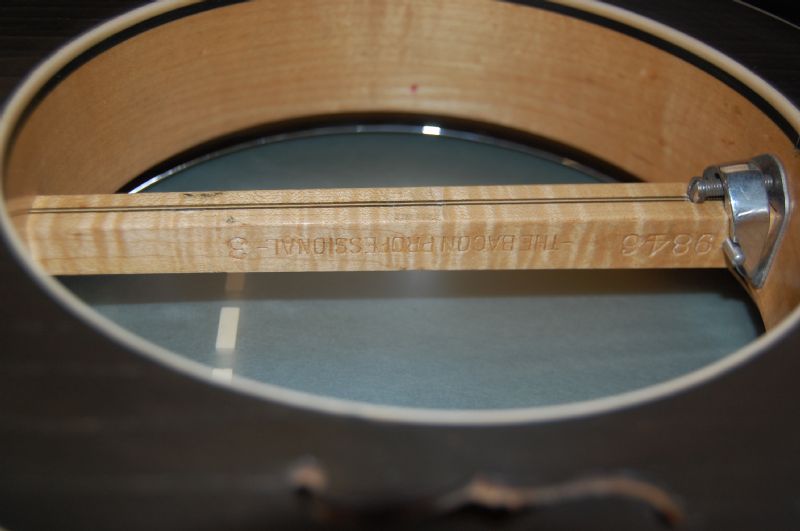
My banjo is *not* stamped as a Professional FF. It is stamped as a "Professional - 3." (will try to attach a photo). In the catalogs I have found from that period, the model is *not* described as a Professional FF. It is described as a "Style no. 3 Professional."
But because my banjo has an internal resonator, like Richard's, many smart banjo people *automatically* call it a "Professional FF" or "FF Professional."
I discussed this with Carl years ago and he and I agreed that many banjos listed in the database as "Professional FF" may not actually be stamped that way. The database is full of errors on this point, because of the misleading description of Bacon IR banjos in general as "FF" models.
For that reason, it's hard to use the database to test my hypothesis -- that the 1920s internal-resonator banjos with the narrower ring were *not* stamped FF.
I believe this may have been why Carl began to call his database a list of "FF and Professional Models." Note "and."
Paul
Edited by - pgroff on 09/23/2013 06:32:03
 |
BrittDLD1 - Posted - 09/23/2013: 07:25:54
Richard --
I wouldn't worry too much about going "off-topic", discussing your Bacon "Professional". The topics about The Bacon Co. ALWAYS wander around a bit. Bacon Banjos were made from 1905 to 1932, with Fred at the helm. And from 1905 to 1910, and 1922 to 1940, with David Day involved. He became President, in 1932, when Fred retired.
Then, Gretsch bought Bacon in 1940 -- and continued to make and sell Bacon banjos until 1972.
That's 67 years of Bacon banjo production. So a lot of specific questions, about specific models ALWAYS come up in these 'collector' discussions. There's lots of good information, lots bad information, and lots questionable information to debate.
I DO tend to separate the banjos made under Fred and Dave's direct control, from the later Gretsch-made models. Gretsch never really had 'the vision' of what a banjo should, or could be -- in the same way that Fred and Dave did. BUT... they are still a 32-year chapter of The Bacon Story.
I'll try to answer Polle's and Paul Groff's postings later today, or tomorrow.
Best-- Ed Britt
Edited by - BrittDLD1 on 09/23/2013 07:32:02
beezaboy - Posted - 09/23/2013: 07:45:37
I hope I'm not messing up this thread with photos of a banjo called "The Bacon Professional - 3". It is serial number 8247. In my ignorance I always thought this double rim shell was a the species referred to as "internal resonator". But instinctively I felt it was not the species called "FF".
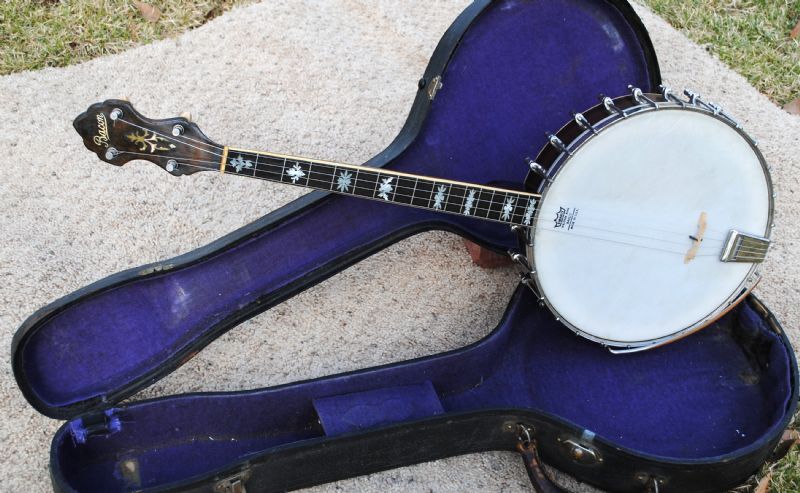 The Bacon Professional 3 - SN 8247 | 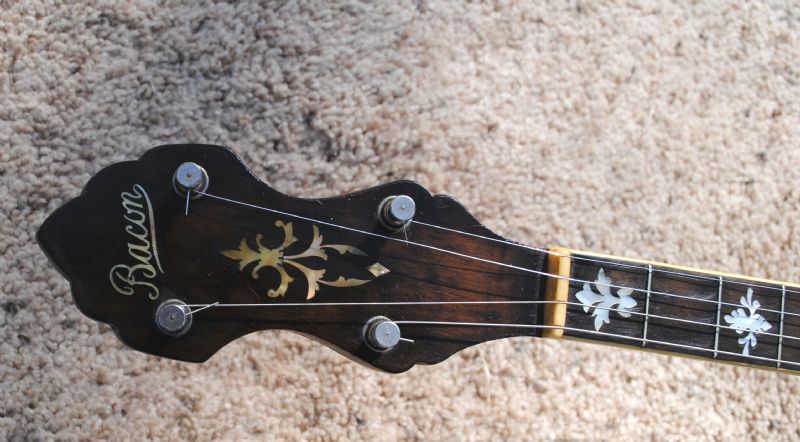 Bacon Professional 3 | 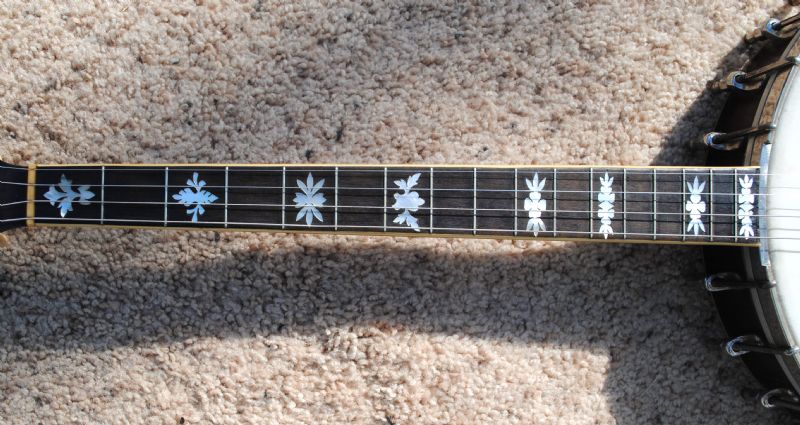 Bacon Professional 3 | 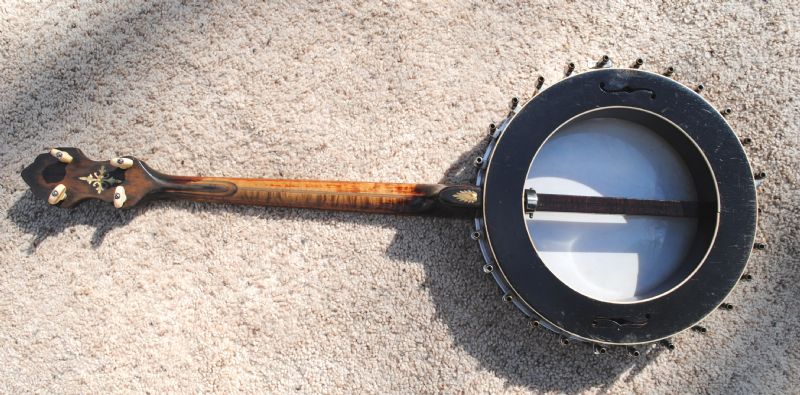 Bacon Professional 3 |
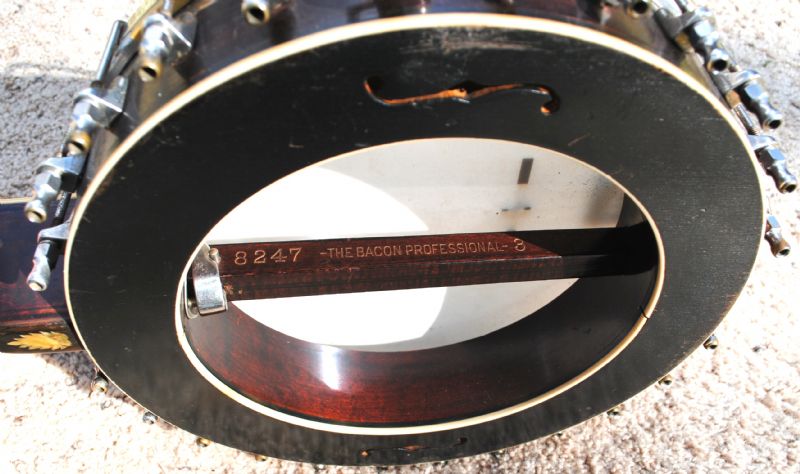 Bacon Professional 3 | 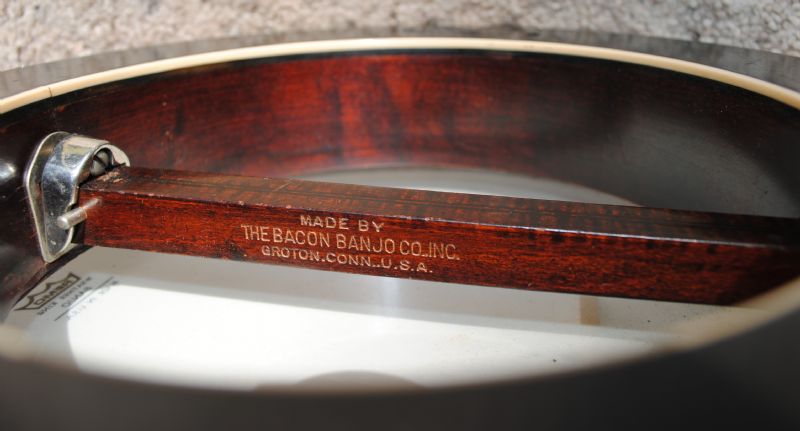 Bacon Professional 3 | 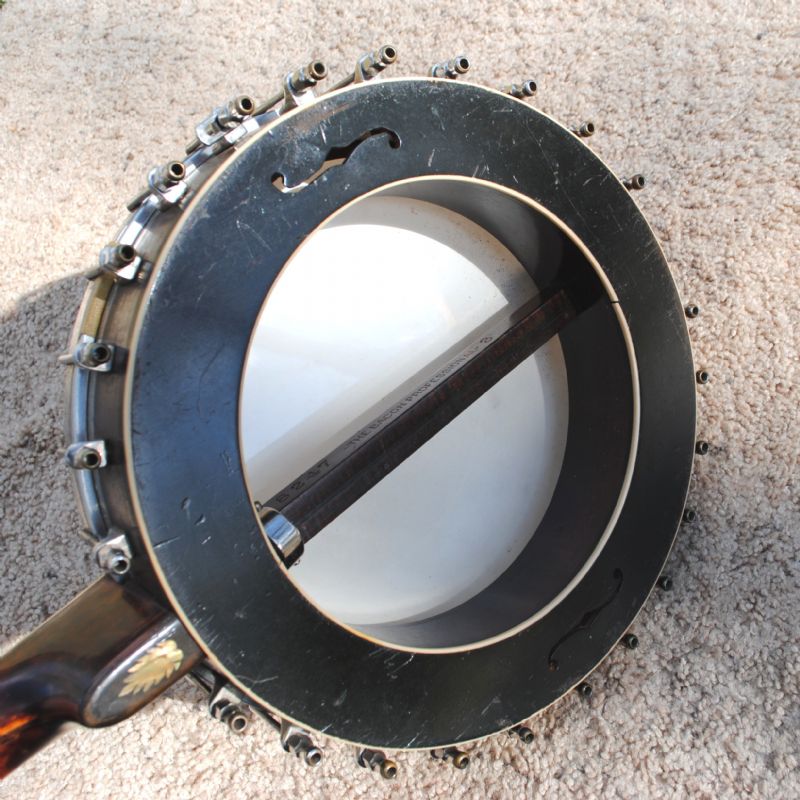 Bacon Professional 3 | 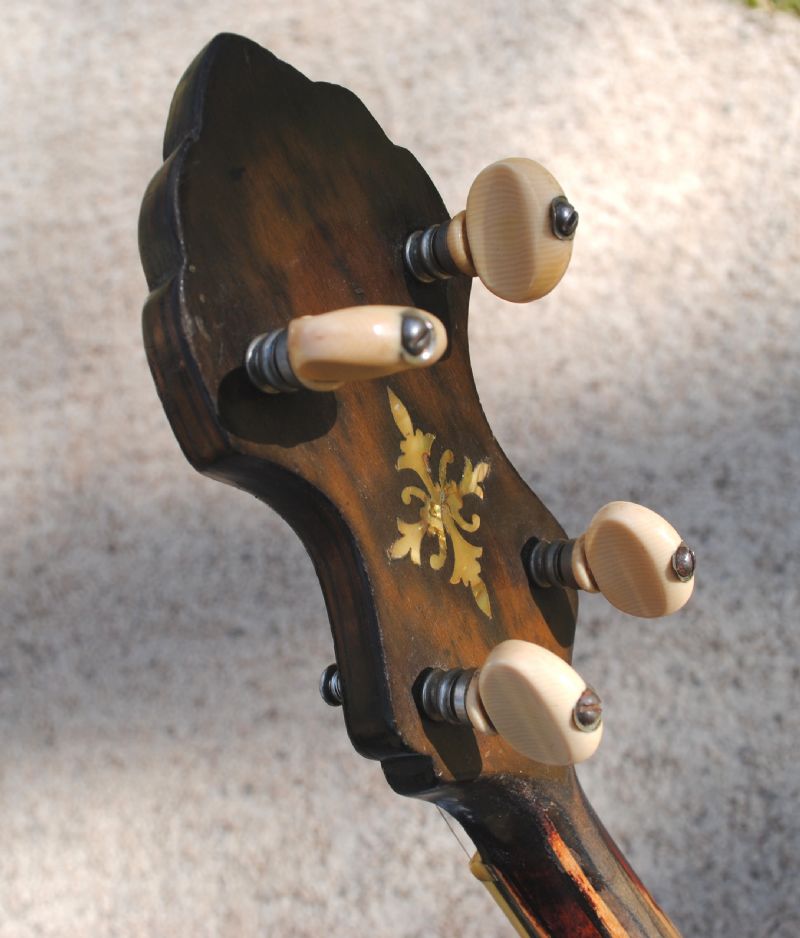 Bacon Professional 3 |
pgroff - Posted - 09/23/2013: 08:06:43
quote:
Originally posted by beezaboy
I hope I'm not messing up this thread with photos of a banjo called "The Bacon Professional - 3". It is serial number 8247. In my ignorance I always thought this double rim shell was a the species referred to as "internal resonator". But instinctively I felt it was not the species called "FF".
Hi John,
I agree with you that this is the best way to describe the model name for such a banjo.
My hypothesis would predict, based on the stamping of Bacon ser. # 8247, that its original tone ring would be the narrower, non-donut ring. Or that, if it had been given the wider, donut-type Bacon ring, it would have been stamped "Professionall FF" like the banjos in these results from a quick google image search:
dev.pickerssupply.com/sites/de...s/l_1.JPG
elderly.com/items/images/60U/6...ick-3.jpg
lh4.googleusercontent.com/-te-..._ring.jpg
Now, my hypothesis might turn out to be "always right," "right in X proportion of cases out of a sample of X" or possibly there's only a random relationship between the stamped model designation and the original tone ring type for these Bacon IR banjos. Right now, the data are too messy because of confused terminology used in describing the banjos.
I do realize that some of the above banjos were made earlier than the 1920s. My hypothesis is only relevant to the time period in which both types of tone rings were used in Bacon internal resonator banjos. But again, it's hard to answer my question when so often the Bacon IR banjos seem (almost as a reflex) to have been described as "FF" models whether or not so stamped . . . even by experts such as Ed, above.
PG
Edited by - pgroff on 09/23/2013 08:12:01
Polle Flaunoe - Posted - 09/23/2013: 09:07:20
banjohangout.org/global/ckedit.../icon.png) center no-repeat #ff0000;cursor:pointer;top:-8px;-webkit-border-radius:2px;border-radius:2px" title="Insert paragraph here">↵
quote
:
Originally posted by pgroffHi Polle,
Your database is in error -- and not because I misreported the information.
This is exactly the point.
Well - we can´t have that - so I´ll at once delete the published version of my DB.
Polle
pgroff - Posted - 09/23/2013: 09:12:26
quote:
Originally posted by Polle Flaunoe
banjohangout.org/global/ckedit.../icon.png) center no-repeat #ff0000;cursor:pointer;top:-8px;-webkit-border-radius:2px;border-radius:2px" title="Insert paragraph here">↵
quote
:
Originally posted by pgroffHi Polle,
Your database is in error -- and not because I misreported the information.
This is exactly the point.
Well - we can´t have that - so I´ll at once delete the published version of my DB.
Polle
Hi my friend,
I don't see the emoticon that you are joking so please forgive me if I offended you!
I'm using strong terms here to bring this issue to clarity.
I was not the source of the information that this banjo is an "FF" -- because I don't consider it one.
But you may not be to blame either!
You may have gotten that information from the ebay listing when I bought the banjo, from another expert, etc.
Even if there are errors, of course such a database is invaluable!
But to improve it we ought to seek accuracy in describing the instruments and in interpreting the data archived in that database.
Thank you, Polle, and thank you Ed and John, for all your tireless work.
I am actually trying to help you here.
Best regards always,
Paul Groff
Polle Flaunoe - Posted - 09/23/2013: 09:21:11
Paul,
Well - thousands and thousands and thousands of hours researching the Bacon/B&D history seem waisted.
YOU are mentioned as the REPORTER/REFERENCE for your banjo in my DB - meaning that either you have reported it - or that you have asked me to be put in as the reference for it - if so without correcting the datas for it.
YES - I´m deeply offended!
Polle
pgroff - Posted - 09/23/2013: 09:32:52
Hi Polle,
Again, I deeply apologize.
I disagree that your work is wasted and I think this process of publicly addressing problems in categorizing and describing instruments is an important way to improve such a database over time.
I'm very sorry that I never noticed your database designated my Bacon # 9486 as an "FF" model.
For the record, it is a tenor Professional - 3 (or Style No. 3 Professional) that originally came to me with the narrower ring. That's the ring I tend to call the "non-Donut Bacon ring" and which Carl calls "ring" -- when he includes that information.
I hope you will take into consideration that
1) I have been raising this point about the, possibly too-general, use of the term "FF" (and the term "Bacon ring" for that matter) since at least 2008 here on the hangout, with little success in changing how most people describe these banjos.
and
2) I'm mostly involved in research on entirely different kinds of musical instruments while
3) having to find some other way to make a living
and
4) raising a family
Best regards always to a friend and much respected banjo mentor,
PG
esmic - Posted - 09/23/2013: 15:06:36
Some thoughts regarding the Professional FF designation :
In both the 1906 and c.1914 (Forest Dale) Bacon catalogs the "Professional" model's descriptions and woodcuts made no reference to the FF designation, but when stamps were applied, FF was typically present in its own cartouche on the dowel, through many years of production.
Obviously a larger sample would be better, but from the very small list of dowel stamps below, it looks as though the FF designation remained until around SN 6800. (c. 1921), when a new stamp was developed. Whether this corresponds with the introduction of the narrower, non-donut ring is for the experts to fathom, but it seems reasonable. Timing-wise, it is closely coordinated with the production startup for Bacon's latest innovation, the Blue Ribbon.
If the Professional's donut ring was altered at this time, it was possibly to suit changes in musical demands or more likely to reduce costs as that model was being relegated to second tier status alongside the Blue Ribbon.
So it looks as though the sun was setting on the old Professional FF even as it was rising on the Blue Ribbon.
SN Model Dowel Stamp
5266 Renecked “Bacon Professional FF”
6041 5 String Described as “Bacon Professional FF 3”
6735 Tenor “Bacon Professional FF 3” plus Oliver Ditson tag
6774 5 String “Bacon Professional FF 2”
6810 5 String “The Bacon Professional - 3”
7690 Renecked “The Bacon Professional - 3”
8413 Mando Bjo “The Bacon Professional - 3”
11483 5 String “The Bacon Professional - 3”
pgroff - Posted - 09/23/2013: 15:20:15
Hi esmic,
Very interesting, thanks!
Would you agree with my point, that we should not call an internal-resonator Bacon banjo an "FF" if it is not stamped that way on the dowel or listed that way in the catalog?
IMO The tendency to call all of the IR Bacons "FFs" (and perhaps list them as such in databases even if not so stamped) has made it hard to answer my question about correlation of stamping with ring type.
PG
Edited by - pgroff on 09/23/2013 15:22:07
esmic - Posted - 09/23/2013: 16:36:06
pgroff :
As you may know, before the internet it was impossible to find/see the number of examples of these fairly rare instruments needed to identify subtle changes, when they occurred or if known, to get that information into wider circulation.
FF has been the popular, yet not always accurate, term in common use to describe all Bacon internal resonator banjos for at least a couple of reasons:
1. "FF" is both more distinctive and easier to say. than the rather generic "Professional".
2. The internal resonator is a unique banjo design strongly associated with the Professional FF for its first 16 years. The successor Bacon Professionals preserve that look, and the subtle differences of tone ring and dowel stamp which you are pointing out may have escaped the attention of many.
The complete history of the Bacon banjo works is still very much a work in progress, chaired largely by Polle and Ed. Today you are adding to it. Perhaps others will join this discussion, confirm or clarify facts on the final days of the FF designation.
pgroff - Posted - 09/23/2013: 16:54:43
Hi esmic,
I understand the past practice! I was hoping (yet again) that we could reform that practice.
My argument since 2008 here on the hangout has been that the terminology related to the Bacon internal-resonator banjos has been applied so loosely that it can be a real effort trying to communicate accurately.
With Vega banjos, I can't believe any player or historian or machinist or builder would think about picking one of the various tone ring types and calling that a "Vega ring," as in "I am making a banjo and it will have a reproduction Vega ring."
Yet that is the situation with the so-called "Bacon ring," leading to a lot of confusion.
Same with the FF designation
It reminds me of the diner scene from Five Easy Pieces -- Mentally categorizing, and often describing, all the internal-resonator Bacons by default as "Professional FF banjos with a Bacon ring" except some of those IR banjos aren't stamped "FF" and don't have a "Bacon ring," they have another ring that Bacon used . . .
PG
esmic - Posted - 09/23/2013: 17:19:57
While the Forest Dale catalog refers to the Professional tone ring as "bell flange top" and its distinctive back as the "annular sounding chamber", those two horses left the barn years ago under assumed names. Good luck bringing them back.
pgroff - Posted - 09/23/2013: 17:33:09
quote:
Originally posted by esmic
While the Forest Dale catalog refers to the Professional tone ring as "bell flange top" and its distinctive back as the "annular sounding chamber", those two horses left the barn years ago under assumed names. Good luck bringing them back.
lol,
I wouldn't dream of it.
But the terms "internal resonator" which can be abbreviated "IR," and if we list the actual markings stamped on the banjos, it's easier to be clear and mean what we say.
Again, my gratitude toward those who have done all the work to understand these banjos. My hope has always been to help un-confuse people, which is why I joined this discussion. I saw Richard confused by Ed's introduction of the "FF" term which might have seemed like a red herring to Richard.
I am so sorry to have offended Polle, but he did accuse me of mis-informing him that my banjo is an "FF" model -- which to me was ironic to say the least!
:-)
PG
Edited by - pgroff on 09/23/2013 17:49:46
pgroff - Posted - 09/23/2013: 17:57:40
Sorry, ran out of time to edit that last post -- should read
"The term internal resonator can be used pretty clearly to describe the construction of these Bacon banjos and can be abbreviated IR. But having raised the question whether the *absence of an FF stamp* might be meaningful, I would like to argue that we shouldn't describe a Bacon banjo as "FF" unless it is so stamped.
Just my opinion though!
Hoped that perspective might be helpful to your project.
PG"
Edited by - pgroff on 09/23/2013 18:00:04
Polle Flaunoe - Posted - 09/24/2013: 01:23:24
With the logical consequences ruling in my general database - I´ve loosened the Gordian Knot there.
Polle
carlb - Posted - 09/24/2013: 06:38:45
I've made a tone ring comment.
banjohangout.org/topic/270956/#3415394
Polle Flaunoe - Posted - 09/26/2013: 02:15:57
quote:
Originally posted by pgroff
Hi esmic,I understand the past practice! I was hoping (yet again) that we could reform that practice.
Paul,
I´ve done that - meaning - reformed that practice.
In my databases the expression/"designation" FF is no longer present. There is and was never a reason what-so-ever keeping it.
As for your theory regarding a correlation between the FF stamping and the presence of a "donut/dish" tone ring - this is easily proven wrong.
Bacon didn´t stop stamping their Professional banjos with a FF due to a shift to "ring" tone rings - they did that in connection with the development of the new model stamp early/mid 1922 - as mentioned and shown by Shawn.
You can find several Professional´s later than yours - including tenors - with the same new model stamp - and no FF stamp - but born with a "donut/dish" tone ring.
Do also have in mind - that many many of the early Bacon´s have been altered over the years - inclusive of a replacement of the original tone ring - as you´ve done on yours - only others may have replaced the original "donut/dish" ring with an original/replica "ring" ring.
It seems, that most players, collectors, dealers, major music stores, museums etc. worldwide these days are using my general DB for describing and dating Bacon/B&D´s - I take, that this over time will lead to a situation, where FF will no longer be in use.
Polle
Polle Flaunoe - Posted - 09/26/2013: 03:05:40
PS!
I´m of course not offended at all - LOL!
But - you´ll have to know - comprehensive researches and databases like mine do call for a strict consistency - ideas are welcome - theories also to a certain degree - but at the end I have to keep focus on the facts and the consistency mainly. Otherwise the results can´t be trusted by others.
That´s the reason for me to keep the column REFERENCE/REPORTER in my general database - any wrong infos will lead to the person mentioned - not me!
As for the PRE-GROTON Professional banjos - other factors come into mind - f.ex. different wood sorts used - different inlays etc. - and also different rim sizes. Plus the fact, that Bacon developed other models/types/versions "expressly meant for concert playing".
Edited by - Polle Flaunoe on 09/26/2013 03:22:15
pgroff - Posted - 09/26/2013: 06:07:53
Dear Polle,
Many thanks!
Again I apologize for shirking my duty as the listed reference for your data on that banjo, to make sure those data were correct!
Of course, you will make the decisions that are best for you and your project. I personally wouldn't advise throwing out the "FF" term, but would recommend including that as a data field to be noted when a banjo is stamped that way, but not otherwise.
If I understand you correctly, I appreciate the new information, to me, that
*Before a particular date, all Bacon internal-resonator banjos were stamped FF, and after that date, none were stamped FF.* [Call this hypothesis A]
This is a very important hypothesis about the correlation of the FF stamp with date (and presumably serial number), and I will trust you that it has been carefully tested by you.
I did already believe it likely that my earlier hypothesis, (for Bacon IR banjos, a positive correlation between FF stamp and wide, donut ring; and a positive correlation of the lack of the FF stamp and the narrow ring) was not likely to be 100% deterministic, but to be supported or falsified based on a statistical sample if or when *accurate descriptive data* could be available. It might be found that there could be statistical support for these correlations, even if there was not a universally consistent rule followed at the Bacon Co. If these correlations had proved very strong however, it might have solved another problem for us. I have made the case that Bacon historians ought to reform the nomenclature used to describe the non-Silver Bell tone rings, since the existing names are confusing or inconsistently used. If the presence of the wide "donut" tone ring had proven extremely highly correlated with presence of the FF stamp, it might have been reasonable to rename that wide donut ring the "FF" ring.
I agree that there will always be some doubt and error in the data due to unknown historical events. Yes, as you mention and as I have also mentioned, post-production tone-ring switches may have occurred (that's part of the reason I always mention the ease of switching, for my banjo). That's in addition to this week's issue that "non FF stamped banjos are often described as FF models," and the issue that the tone ring type has not been clearly specified for many of the IR banjos known.
But, working now from your hypothesis A, which I assume you have tested and for which you have found great support, we can now ask revised questions. One example,
What is the trend over time in percentage of the IR banjos that have the narrow, non-donut ring, and does the evident increase in its occurrence in later years of the Bacon IR banjos (which I had noticed in the negative correlation of this ring with the FF stamp) correlate better with the year of manufacture, or with the number of strings on the neck (4 vs 5)? This is not a deterministic question, it's a question to be asked statistically and in terms of the relative explanatory value of two variables. It's also a hypothesis that might need to be abandoned and/or modified in the future! :-)
Thanks as always for the work you, Ed, Carl, John, esmic (Shawn?), and all my mentors and teachers have contributed here.
PG
Edited by - pgroff on 09/26/2013 06:21:30
carlb - Posted - 09/26/2013: 06:50:57
quote:
Originally posted by pgroff
If I understand you correctly, I appreciate the new information, to me, that
*Before a particular date, all Bacon internal-resonator banjos were stamped FF, and after that date, none were stamped FF.* [Call this hypothesis A]
This is a very important hypothesis about the correlation of the FF stamp with date (and presumably serial number), and I will trust you that it has been carefully tested by you.
I have looked through the Excel spreadsheet. For those instruments that I have pictures for 2166 is the earliest that is stamped as "The Bacon Professional 3" and is the only one that I have a picture of. There is an earlier one, 503, which is just listed as "Professional", however, this entry is the result of Bob Carlin's original survey sheets and could have been a omission of the owner. Also, in this category (i.e. no pics) is 4921.
These are all from pictures, except as stated:
6947 is stamped with "The Bacon Professional
6774 is stamped with "Bacon Professional FF 2"
6810 is stamped with "The Bacon Professional 3"
7646 is stamped with "THE BACON PROFESSIONAL-2" [only a statement in Ebay description; no pic of dowel]
8363, in Polle's list, is the highest number that listed as FF 3, but I have no pictures. No further FF stamps occur in numbers higher then this one.
Note, that some have "The" and some don't. So for now, that hypothesis doesn't hold true.
Edited by - carlb on 09/26/2013 06:53:27
pgroff - Posted - 09/26/2013: 07:21:14
Hi Carl,
Thanks for those data points and that perspective.
I agree that the data you list do not clearly support hypothesis A.
However, would you agree that it's possible for hypothesis A (if phrased just in terms of FF stamp and date) to be consistent with the data you list, for example
- if the serial numbers were not assigned sequentially by date
- if the descriptions of these banjos as FF or not are not always reliable (error in the data)
Again, this brings to the fore
1) the need for accurate data -- quality of the descriptions. Over time, I think these may be improved if we develop a better terminology that is used more explicitly to describe exactly what features are present in each banjo listed
2) the importance of recognizing where the data in the databases may be unreliable. For example, we have suspicions there may be an inconsistent use of "FF" in the descriptions (listed when not stamped, not listed when stamped?).
Thanks again for all your work here!
PG
Edited by - pgroff on 09/26/2013 07:23:58
stever1422 - Posted - 09/26/2013: 08:32:11
Ed-
Thanks for your great history of Bacon and Mr. Day. I am a big fan of Tu-ba-phones and I know that his fingerprints are all over mine.
Almost 40 years ago I drove by Bacon's old location in Groton, CT. I recall an abandoned building on the site. What is there now?
Steve Roberts
Polle Flaunoe - Posted - 09/26/2013: 08:33:48
quote:
Originally posted by carlb
I have looked through the Excel spreadsheet. For those instruments that I have pictures for 2166 is the earliest that is stamped as "The Bacon Professional 3" and is the only one that I have a picture of. There is an earlier one, 503, which is just listed as "Professional", however, this entry is the result of Bob Carlin's original survey sheets and could have been a omission of the owner. Also, in this category (i.e. no pics) is 4921.
These are all from pictures, except as stated:
6947 is stamped with "The Bacon Professional3". [highest number with a picture of the dowel stick]
6774 is stamped with "Bacon Professional FF 2"
6810 is stamped with "The Bacon Professional 3"
7646 is stamped with "THE BACON PROFESSIONAL-2" [only a statement in Ebay description; no pic of dowel]
8363, in Polle's list, is the highest number that listed as FF 3, but I have no pictures. No further FF stamps occur in numbers higher then this one.
Note, that some have "The" and some don't. So for now, that hypothesis doesn't hold true.
Carl,
Sorry - but I´ll have to correct some of these infos.
SN 2166 is either mis-stamped or mis-read - I have many pics of the banjo, but they are very dark - due to this I can´t read the first digit of the SN correctly. Do however notice, that it´s stamped with the Groton stamp - meaning, that it´s manufactured in the 20s. I guess, that the correct serial number will have to be 7166, 8166 or 9166. Do also notice its only 2 F-holes at the IR - a typical Groton feature.

SN 4921 is totally out of line - no other Bacon banjos have a SN in the 4XXX range. Most likely again a mis-stamping or a mis-read.
SN 8363 is a mistake - either by the reporter or by me - if the latter I´m very sorry for the mistake.
The rest are OK! and fit the model stamp shift early/mid 1922.
Polle
Edited by - Polle Flaunoe on 09/26/2013 08:38:35
Page: 1 2
Terms of Use | Privacy Policy | Privacy Consent (EU/GDPR Only)
Copyright 2026 Banjo Hangout. All Rights Reserved.


