DVD-quality lessons (including tabs/sheet music) available for immediate viewing on any device.
Take your playing to the next level with the help of a local or online banjo teacher.
Weekly newsletter includes free lessons, favorite member content, banjo news and more.
Premier Sponsors


|
Please note this is an archived topic, so it is locked and unable to be replied to. You may, however, start a new topic and refer to this topic with a link: http://www.banjohangout.org/archive/267625
The Old Timer - Posted - 07/27/2013: 14:37:37
Last fall I put on one of Balches' best quality calfskin heads on the old Granada, tuned it up to about G# by the thump test, and played it very happily all winter and spring.
I haven't taken it out for any summer activities like festivals because I knew it would be sensitive to night dew and stuff like that.
Got it out yesterday just out of curiosity and found it very dumpy and thumpy. The head had slacked to an F# note. I just put it back in the case, not wanting to mess with tightening it now and having to remember to slack it when fall comes. I'm fortunate to have other good banjos which of course have modern plastic heads.
I dehumidify my music room in summer to 55% relative humidity.
It made me think of the first generation and how they must have tweaked their hide heads pretty much for every show! What a pain banjos must have been then!
Aradobanjo - Posted - 07/27/2013: 14:55:52
Hello,
I also use one of John Balch's fine calf heads in a 1928 TB-1. I let it sit for a while. Now the head sags as the 1/2" bridge it came with is not high enough. Yet, the sound is much different than Mylar and better. I concur that the use of animal material is a good exercise of waiting. But, recordings are unique recordings are special events.
Ken LeVan - Posted - 07/27/2013: 15:15:11
This is exactly why plastic heads became instantaneously popular, totally replacing skin heads when they first came out - I'm old enough to remember, and they replaced skin drum heads first - banjo heads were an afterthought. The name "Weather King" says it all. You didn't have to worry about the weather - ask someone who played in outdoor venues before plastic heads came along. The skin heads also broke more readily. The great Earl Scruggs said "A man wouldn't need many plastic heads in a lifetime".
Skin heads are wonderful in many ways, and I love them, but I live in the NE, in Pennsylvania, where the humidity fluctuates. You have to learn to love them enough to live with their inherent problems.
Dan Drabek - Posted - 07/27/2013: 15:27:07
IMHO, calfskin heads fall into the same category as film cameras, tube radios, gut guitar strings, vinyl records, bamboo fly rods, and French polish finishes. Some swear they are superior to modern alternatives, and wouldn't use anything else. And some of us choose convenience, durability, and reliablility.
I've owned a few skin-head banjos and frankly, wouldn't choose them even if they were not so much trouble. On the other hand, I wouldn't care to live in a tent, but have to admit that it's a lot of fun if done occasionally.
DD
Ken LeVan - Posted - 07/27/2013: 15:53:18
Well said, Dan.
I have a mahogany Deardorf 8x10 camera, exactly like the one Ansel Adams used. It's sitting in an attic along with all the Norman strobes, softboxes, and very expensive Schneider Kreuznach lenses, each and every one costing more than a Canon Rebel 12 megapixel digital camera. I gave the enlarger and all the darkroom stuff to a relative, along with a 4x5 camera and a couple of lenses. I gave up film photography kicking and screaming (used to make a good enough living to send kids to college doing it), but it's gone. If I could visit the place where it went to, I'd probably also find my old Remington Rand typewriter, a couple of slide rules, all my bottles of rubber cement and the waxing machine, endless boxes of transfer type, large pieces of illustration board for mechanicals, rubylith, and in my banjo parts box, some perma-tension 5th pegs and a couple of skin heads.
No question that the Deardorf makes photos that kick the pants off a digital camera, but nobody really cares and few can tell the difference.
Ken
Dan Drabek - Posted - 07/27/2013: 16:15:28
Hey Ken, I should have known you were a photographer from the excellent shots of your banjo construction. I'm just a serious amateur, but switching to digital was a no brainer, since where the pro's go, so go the amateurs. Digital is just plain too quick and efficient for production. And what it lacks in dynamic range, can be adjusted in Photoshop.
How about stat cameras, Art-O-Graphs, air brushes, Rapid-O-Graph pens, drafting machines, light tables, drafting tables, scanners, digital typesetting machines, typesetters, photo-typositors, keyliners, litho strippers, etc. Don't get me started.
I think maybe the fascination for banjos and skin heads may well be part of an escape back to times past when life was so much more complicated. 
Speaking of complicated, I recall that the guy who invented the linotype machine spent his last days in an insane asylum.
DD
Aradobanjo - Posted - 07/27/2013: 17:02:49
Hey,
The sound as compare to Mylar is different, sweeter. That is when the weather is right. This is why it is not on the RB-12. Besides, the early recordings have a sweetness that is different from today. Granted, the old recordings are with hodge podges of best guesses. We are always looking to replicate the sound.
Dan Drabek - Posted - 07/27/2013: 17:07:50
quote:
Originally posted by Aradobanjo
The sound as compare to Mylar is different, sweeter. That is when the weather is right. This is why it is not on the RB-12. Besides, the early recordings have a sweetness that is different from today. Granted, the old recordings are with hodge podges of best guesses. We are always looking to replicate the sound.
To my ear, it doesn't get any sweeter than, say, Allison Browne. And I'm fairly certain she plays on mylar. But of course, everybody has a different pair of ears. I do think that it has more to do with the hands than it does with the head.
DD
tomberghan - Posted - 07/27/2013: 17:10:21
quote:
Originally posted by The Old Timer
It made me think of the first generation and how they must have tweaked their hide heads pretty much for every show! What a pain banjos must have been then!
And that is why the Top Tension flange was such a great invention! The banjo player can make adjustments very quickly without having to remove the resonator. I love hide heads, and someday I want to get top tension banjo. Besides, I love the art deco look of those Gibson Top Tension Banjos. I doubt I will ever be able to afford an old original one. They are very collectable . . . waaaay out of my league.
banjo bill-e - Posted - 07/27/2013: 17:17:07
I recently got to spend a morning with John Balch and David Emery, hearing and playing an impressive collection of banjos. The one thing they all had in common was a hide head by John Balch. And I left there knowing I would soon have one on my Ramsey, and would be willing to put up with a little tweaking now and then. Because they do indeed sound sweet and rich and complex. It may not be worth it to those who play in a group, but I play solo and the tone I hear has a major effect on how I play and how much I enjoy the experience.
Bill
The Old Timer - Posted - 07/27/2013: 17:23:37
I appreciate everyone's comments. I really like the sound of that Balch head during dry times. "Complex" is a good word. Much thicker, deeper and less overtoned than a plastic head. But I also agree if you only had one banjo the hide head would be completely impracticable, in this day and age.
And much like the parallel discussion of cameras, it is very true that essentially "nobody cares" how much "better" the old performed than the new, when used perfectly.
Most (but not all) of the banjos I hear on recordings now are far too "jangly/jingly" for my bluegrass tastes. I like that dry "AM radio" tone much better. To this day I can't imagine how Earl got that "spang!" tone on the original cut of Randy Lynn Rag, it's really astounding for a hide head banjo! That's why he's Earl, and we're not (to paraphrase Chevy Chase).
DEmery - Posted - 07/27/2013: 17:51:47
Bill it was really a good time getting to meet you while visiting Murfreesboro and glad that you got to work your way through a wall of banjos. You are right...all of them had skin heads and each in their own way sound great with them properly set. I understand the observations about skin heads fluctuating with changing conditions. They do. Plastic does overcome some of this but even with changing temperatures; I have found after nearly 35 years of playing anything with wood, skin, and wire - temperature impacts instruments in general. Skins simply adds another piece requiring some attention. I don't see adjusting a head as a problem any more than tuning a banjo due changing conditions. I respect those that do; but for me the quality of sound to my ear is worth the adjustment. I did put a skin head on a Gibson TB-1 from the late 20's. Since it had no tone ring (brass hoop) there wasn't enough power to drive a skin head; so I went back to a standard plastic head. It was appropriate for that banjo while I am sure it was outfitted with skin when the banjo was built by Gibson. There is not one answer for these things beyond one's personal taste.
I will say that many feel skin is too delicate to take tension. Full disclosure; I have used John's heads for years and he provides a consistently thicker head that falls in a sweet spot that provides a good balance of performance and strength. I set them tight and find after a period of time they require little attention. I played out in heavy humidity at UDMD and checked the tension at one point and found it had not changed at all. If it had - a minor tweak would have addressed it. With an open back this is no problem but I understand the issue with a resonator banjo.
Bill I hope you enjoy the Ramsey banjo coming to you soon. Maybe next time I am in town you can bring it by. David E.
banjobilly32 - Posted - 07/27/2013: 18:08:32
I started playing before the plastic head was invented so I know you couldn't predict how your banjo would sound due to the different humidity every day. A good cure was a small light bulb inside the resonator for about an hour, and sometimes plugging into electric during a gig. If you tightened the tension to make it sound good the chances were that the first nice dry day would bust the head! I had a top tension Ludwig that required very little tweaking to make it sound good with the hide head, while other open back 5 strings I had would become completely unplayable till the weather changed.
Most Gibson banjos in those days would always sound good. On a dry day those arch top Gibsons would really crack. There weren't many flatheads in the area where I was playing.
Once I tried a plastic head I switched on most of my banjos. I did play a hide head on a PB150 converted to 5 string for a long time. That combination recorded very well, but lacked volume for playing live with a group.
Jimmy Mills can sure pull the tone from a hide head!
jbalch - Posted - 07/27/2013: 18:23:06
Thanks for all the mentions... I guess we know why Ron Poleil avoided the lucrative field of hide banjos heads.

You can't "Set it and Forget it. 


Edited by - jbalch on 07/27/2013 18:35:43
 set it and forget it |
Tim Zowada - Posted - 07/27/2013: 21:02:22
This is an interesting discussion, to be sure. I find the tone of a hide head to be pleasing to my ear. But, that is only on the days where the weather, and head tension cooperate. That seems to be about 50% of the time. Sometimes I will take the time to tweak it. Other times, I'm just too lazy.
I think If I played in a band, or moved around a lot, I would have a plastic head. But, since I prefer the sound, and love to tinker, I stick with the hide.
Don't underestimate the joy of tinkering. Some of us are just wired that way. We can't resist the urge to tweak things. That is why I still fish with bamboo, shoot 6x6 and 4x5 transparencies, load my own ammunition, wear automatic watches, write with fountian pens, and friction shift on my bicycle. Maybe I'm just a ludite. Most of my folding knife customers prefer to pay a premium so they can disassemble their knives, with the handmade screws and custom wrench.
Then again, there is the practical side of things, just getting the job done. In that category, since we are also talking about photography, is my Nikon D7000. If I need to get photos done quickly, it is the only way to go. Usually, I can't afford to wait two weeks to get photos back from the lab. For a trip to town, when I have time to kill, I ride my bike. When I just gotta get there, I take the car.
I think it all boils down to, different people find enjoyment in different things. Different people place value on different things. Some of the joy that comes from owning something, is maintaining it. Or, it is in the process of getting there, wherever "there" is.
In the world of hobbies, there isn't really better, or best, just different. It's all fun.
rubicon - Posted - 07/27/2013: 21:11:41
I also have been using hide heads for some time now , I must agree that the set it and forget it method will not work ,however I find that on the good days there is nothing sweeter than the sound of a good hide head when it decides to sing !!
pastorharry - Posted - 07/28/2013: 01:45:35
youtube.com/watch?v=fxKeI27kcEo Give a listen to Jim Mills playing several pre war Gibsons all wearing hide. To me skin heads take away much of the metallic shrillness that can be an irritant , and frankly has contributed to giving the banjo a bad name ,lumping it in with accordions, bagpipes and the like. Someone mentioned depth, I think you can hear it in these examples.
Fathand - Posted - 07/28/2013: 04:52:33
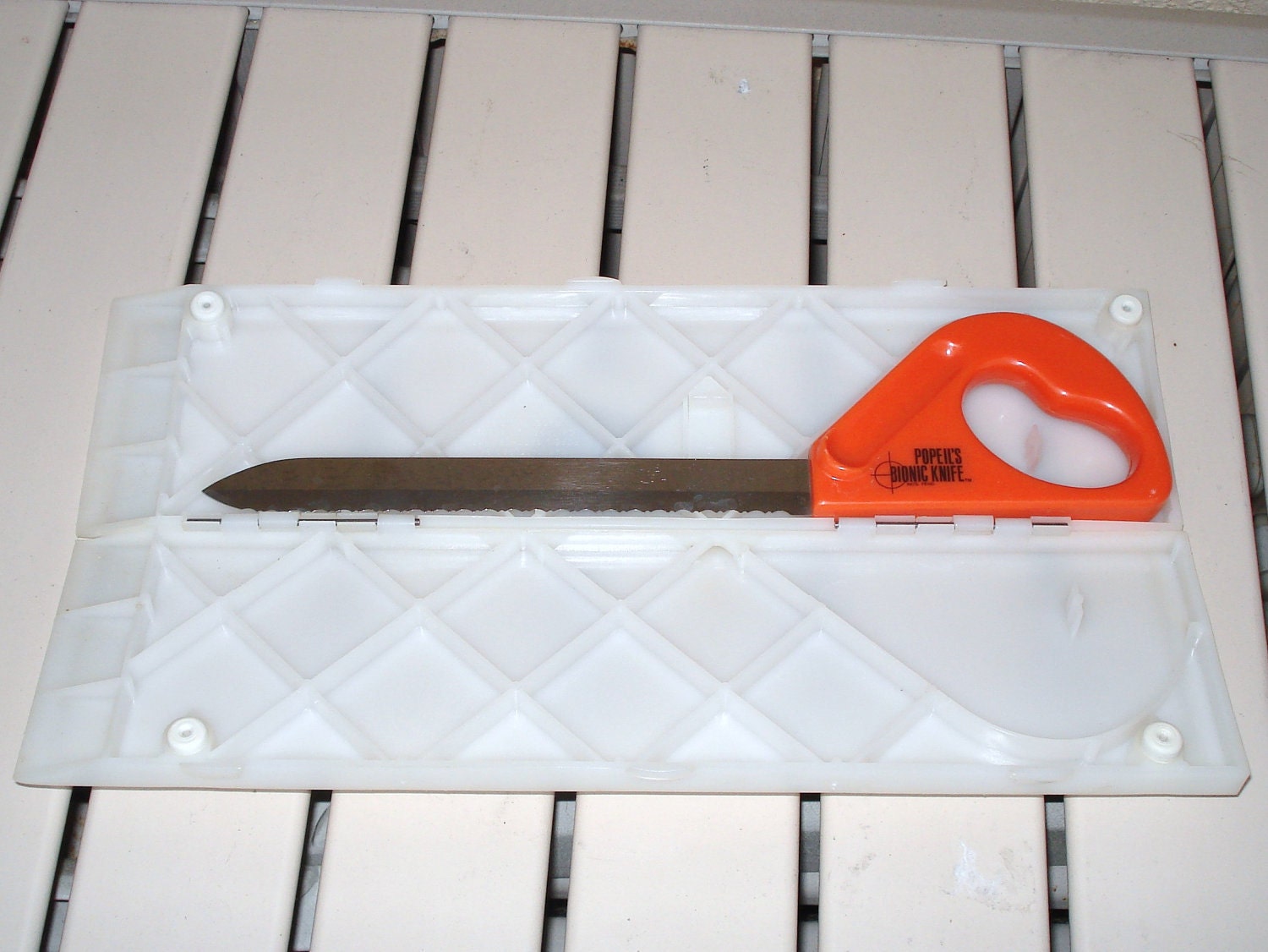
Ha Ha, I have a Ron Popeil's Bionic Knife that I received as a wedding present in 1935. It is almost indestructable and my son has already asked for it as part of his inheritance.
As for Skin Heads, I hear of people using a sealer on them to help keep out the humidity. I would think the aerosol sealers they give you when oyu buy a leather coat should be a good choice.
quote:
Originally posted by jbalch
Thanks for all the mentions... I guess we know why Ron Poleil avoided the lucrative field of hide banjos heads.
You can't "Set it and Forget it.
jbalch - Posted - 07/28/2013: 05:14:58
quote:
Originally posted by Tim Zowada
...
I think it all boils down to, different people find enjoyment in different things. Different people place value on different things. Some of the joy that comes from owning something, is maintaining it. Or, it is in the process of getting there, wherever "there" is.
In the world of hobbies, there isn't really better, or best, just different. It's all fun.
Well said.
Personally, I'm one who LOVES the sound, feel, look and experience of using natural hide heads. I find them to be quite reliable (and not too much maintenance really - even here in the "central basin" of Tennessee - that John Hartford called "the bathtub of the South"). But ... I don't mind turning a wrench occasionally when necessary.
But I absolutely understand why others feel differently. And ... I always keep one bluegrass banjo set up with a mylar REMO head - for "that" sound.
It is all good!
rudy - Posted - 07/28/2013: 05:43:46
No pony in this race, but readers might be interested in Brooks Masten's "set and forget" hide head installation process.
Brooks uses a mounting technique combined with goat skin that he maintains isn't finicky about humidity change or conditions. I'd be interested in what others have to say about it. Scroll down a bit in his Babbling Brooks section to read about the entire process:
brooksbanjos.com/index.php/babbling/
Helix - Posted - 07/28/2013: 05:57:08
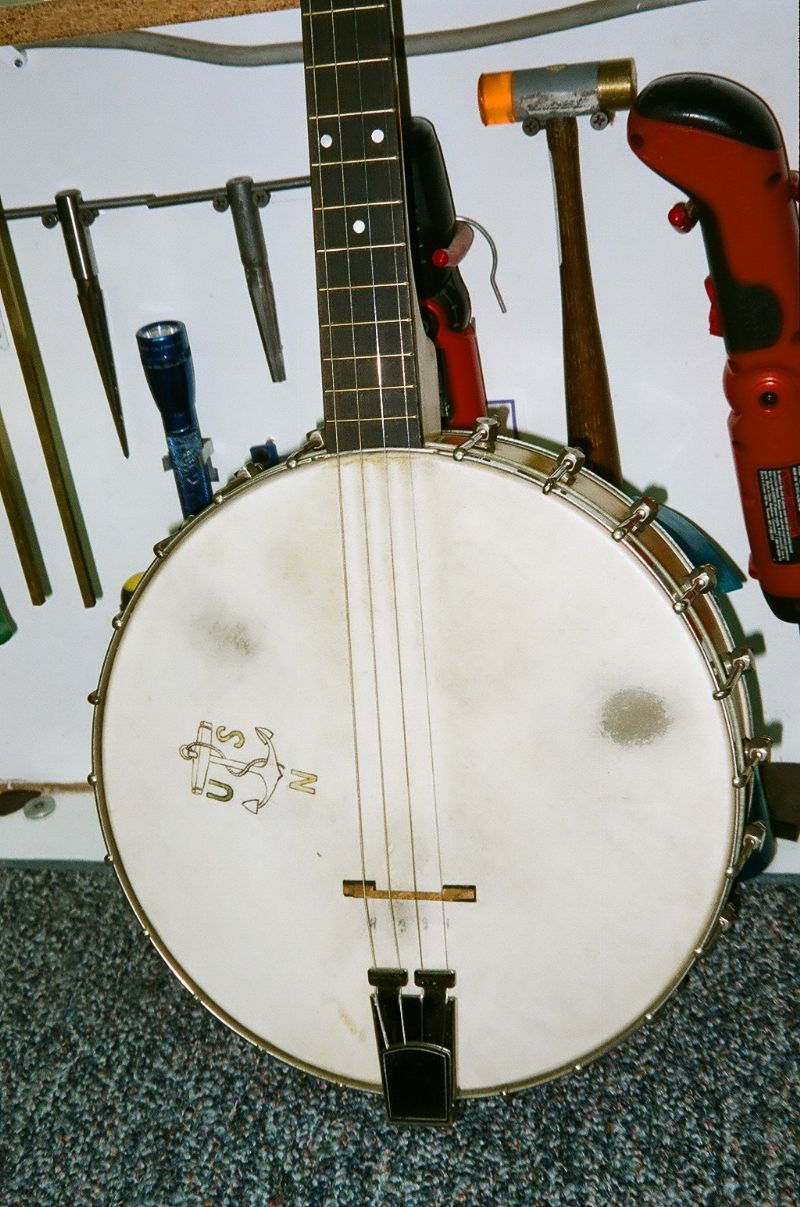
here's some ebony shoes devised for weather, some used pennies,
Humidity should be a national export for some of you guys.
 U. S. Navy stamp |
jbalch - Posted - 07/28/2013: 06:20:06
Rudy:
I think what Brooks does is accelerate the process that I call "seasoning." I bet works quite well.
Hide heads that have been exposed to humidity - allowed to stretch - and appropriately tightened - eventually "season" so that continued variation is minimized. This process occurs naturally over a little bit of time as the hide stretches, settles, and matures. Seasoned hide heads are often quite stable.
From what I understand, Brooks sets the initial crown low (leaving 3/8" of the tension hoop proud of the top). Then he exposes the head to high humidity and tightens to stretch the hide and pull the hoop down (finally settling at about 1/8" proud of the top). He is speeding the "seasoning" process. He also cautions about over tightening and exposing to conditions that will cause the head to break ... good information.
I try to set my pre-mount crowns similarly low. This allows room for the head to "season" and stretch when installed on the users rim. This process may take a little bit of time and requires some adjustments after installation. But the end result is a seasoned head that can be very reliable. My target is that after stretching and a couple of rounds of tightening by the user, the hoop should settle to sit slightly above the head +/- with good stability.
One additional consideration with a pre-mount is that your rim & tone ring profile might be different than my Bart Reiter "Special" mounting jig. That means that the crown I set - might sit differently on your banjo. Plus, some users insist on ordering a high crown ... which sometimes results in a head that settles with the hoop sitting lower than I prefer.
Lew H - Posted - 07/28/2013: 06:26:56
Lots of ideas and experiences posted here. Here's mine. My first banjo had a skin head. Rather than tightening and loosening the head according to the humidity, I held my banjo's pot over a space heater (the kind that were the sole source of heat for rooms in past decades) or gas cookstove. The heat would dry and tighten the head for a couple of hours, so I didn't need to tighten the bracket nuts. A few years ago I bought an Orpheum missing its resonator that had strange burn marks on the back of the rim. These seemed like cigarette burns to me, but a friend pointed out that, more likely, a previous owner had stuck that banjo's pot into a hot oven. I stick with plastic heads nowadays.
jbalch - Posted - 07/28/2013: 06:37:49
quote:
Originally posted by Helix
here's some ebony shoes devised for weather, some used pennies,
Humidity should be a national export for some of you guys.
I sometimes use a "summer" bridge that is 1/64" or 1/32" taller than "normal." That can prevent the need to tighten if I don't want to pull the crown higher.
Shawn Hoover - Posted - 07/28/2013: 08:14:25
quote:
Originally posted by rudy
No pony in this race, but readers might be interested in Brooks Masten's "set and forget" hide head installation process.
Brooks uses a mounting technique combined with goat skin that he maintains isn't finicky about humidity change or conditions. I'd be interested in what others have to say about it. Scroll down a bit in his Babbling Brooks section to read about the entire process:
brooksbanjos.com/index.php/babbling/
I've had my eye on Brooks's method for a while. I let my banjo with hide head get flabby instead of properly seasoning over the past few months because I did the low initial crown set and barely left enough threads to install the thing. I already stripped a couple hooks and my banjo is "missing a tooth". I acquired a nice set of 2-3/4" steel hooks from ebay and will try the accelerated seasoning technique when I tear down the banjo for final tweaks and seasoning soon. Once it's stretched a little more and settles, I'll use leather spray, put the brass hardware back on, and see how it does over the next year. I play alone indoors, so it's a low risk endeavor for me.
Jaunskots - Posted - 07/28/2013: 09:02:01
Very interesting -- and good natured at that -- discussion of (modern!) simplicity versus pursuit of absolutes. I'm just too lazy to adjust a hide head with the swings in humidity, so a Renaissance or Fiberskin does well enough. The sound is plenty good enough, because it's better than I am, consistent, and simple to keep up. I've never worried about forgetting to slack off a plastic head when I fired up the woodstove and drove the humidity down. (The temperature here swings about 130 degrees F between winter lows and summer highs, and the humidity correspondingly.) As Ken LeVan et al. say, the plastic head is comparable to the digital SLR as opposed to the film cameras. I've given away the film cameras, typewriters, tube radios, Rapidographs, and mechanical watches -- to my kids, who appreciate them and have the energy for the hard work and complexity. My fly rod is not bamboo any longer; it's better than any bamboo rod I could afford in the old days or now -- as a rod if not as art.
But I still have a slide rule in my desk drawer, and my ham radios although solid state (although one has a 12AY7 driver and 6146B finals if that means anything to anyone) are all old enough not to have surface-mount components -- I can fix them.
The equivalent of the hide head for me, to stray a little from banjos, is my fiddle, which is very sensitive to humidity. Carbon-fibre instruments are wonderfully immune, and if the price goes down by 80%, they may get really attractive for some of us, as carbon bows already have. Kind of the equivalent of a Weather King fiddle. I don't suppose that CF banjo necks need to have the truss rods tweaked either, although the cost/benefit ratio isn't within a couple of orders of magnitude of that of plastic heads.
As Tim Z says, it's a hobby for most of us, and we compromise or don't as pleases us and the amount of energy we are prepared to put into it versus the rewards we perceive. A hide head doesn't deliver as much reward for me as a little practice time. De gustibus ...
Harold
rudy - Posted - 07/28/2013: 09:05:02
quote:
Originally posted by Shawn Hoover
quote:
Originally posted by rudy
No pony in this race, but readers might be interested in Brooks Masten's "set and forget" hide head installation process.
Brooks uses a mounting technique combined with goat skin that he maintains isn't finicky about humidity change or conditions. I'd be interested in what others have to say about it. Scroll down a bit in his Babbling Brooks section to read about the entire process:
brooksbanjos.com/index.php/babbling/
I've had my eye on Brooks's method for a while. I let my banjo with hide head get flabby instead of properly seasoning over the past few months because I did the low initial crown set and barely left enough threads to install the thing. I already stripped a couple hooks and my banjo is "missing a tooth". I acquired a nice set of 2-3/4" steel hooks from ebay and will try the accelerated seasoning technique when I tear down the banjo for final tweaks and seasoning soon. Once it's stretched a little more and settles, I'll use leather spray, put the brass hardware back on, and see how it does over the next year. I play alone indoors, so it's a low risk endeavor for me.
Brooks lists some salient points for his "set and forget" skin mounting methodology, one about the necessity of using goat skin. He adds that he has found no need for any type of moisture barrier on the heads when he uses his mounting technique.
jbalch - Posted - 07/28/2013: 10:10:54
As far as goat vs. calf goes ... in my experience is is not really possible to predict how a hide will perform based just on the species. Sound and reliability are really functions of the texture and thickness of the individual hide (more than the type of animal).
I get the most reliable results from natural (unbleached), semi-mottled, skins of proper thickness. I prefer them to be .013 in. to .016 in. thick and as even as possible. The natural mottled areas give the hide a stiff texture and are stronger than soft, white bleached hide. Those types if skins (goat or calf) can accept sufficient tension to be reliable.
I've had less than satisfactory results from some very white hides (that I assume were chemically bleached). Such hides may be soft and thin and easy-to mount. But I've found some of them to be unreliable.
I think good natural calf skins are actually stronger than goat. So, they can be a little thinner and still achieve great results. Jos. B Rogers hides were calf. They considered goat to be inferior. I like sanded calf skins (from Stern Tanning Co.) for bluegrass banjos ... and natural goat skins for open-back (old-time) banjos. The mostly translucent calfskins can be VERY sturdy. Those can take plenty of tension and make good sounding heads.
I spray my pre-mounted heads with a waterproofer. I don't think it is absolutely necessary ... but it might help with initial response to humidity.
Edited by - jbalch on 07/28/2013 10:13:21
tomberghan - Posted - 07/28/2013: 13:01:06
We've been having hot weather and using AC in the house, but that costs money so we turn it off at night and open the windows (the big dog is on guard and he takes his role VERY seriously). Anyway, the cool moist air gets in the house and even though I keep all instruments in their cases, it still gets in there somehow. So just this morning, I picked up my 1926 TB2 with a hide head and the tone was off and the frets were buzzing.
It took me four minutes to adjust it and most of that was looking for the right sized wrench. It AIN'T a big deal! My banjo and I are now happy together again and pickin' good tunes.
Shawn Hoover - Posted - 07/28/2013: 15:37:22
quote:
Originally posted by rudy
Brooks lists some salient points for his "set and forget" skin mounting methodology, one about the necessity of using goat skin. He adds that he has found no need for any type of moisture barrier on the heads when he uses his mounting technique.
Rudy, on the first point I took it as a disclaimer that the goat source Brooks uses is what he knows and he just doesn't have the experience with calf. John makes a good point about the thickness and preparation being more critical, like variations in different boards from the same tree. I will assume the same technique works for calf and try it. As for the moisture barrier, Brooks does make a good case that it's not necessary, but I figure if John does it and I've got the thing apart anyway, why not do it as cheap insurance? Maybe if I was mounting 300 heads I would be more scientific about it.
jbalch - Posted - 07/28/2013: 18:59:08
I take Brooks statement re: goat the same way. He obviously as a good source for the hides and gets great results.
rudy - Posted - 07/28/2013: 20:11:45
Thanks for the additional views and insight John and Shawn. The jury's still out on this one for me since I have little practical experience with hide, having only used the Goldtone pre-mounts. I've got a thin hide to mount sometime when the opportunity arises, so I'm always looking for knowledge and ideas to squirrel away for later use. I have been very satisfied with Ren heads generally, and they truly ARE "set and forget" once they settle in.
Shawn Hoover - Posted - 07/29/2013: 09:40:43
Yeah, rudy, from what I know about your building techniques with a strong emphasis on eliminating fuss, I'm surprised to find you even participating in this conversation! 
rudy - Posted - 07/29/2013: 11:04:00
quote:
Originally posted by Shawn Hoover
Yeah, rudy, from what I know about your building techniques with a strong emphasis on eliminating fuss, I'm surprised to find you even participating in this conversation!
I DO like to keep an open mind...
Terms of Use | Privacy Policy | Privacy Consent (EU/GDPR Only)
Copyright 2026 Banjo Hangout. All Rights Reserved.