
DVD-quality lessons (including tabs/sheet music) available for immediate viewing on any device.
Take your playing to the next level with the help of a local or online banjo teacher.
Weekly newsletter includes free lessons, favorite member content, banjo news and more.
Premier Sponsors


|
Please note this is an archived topic, so it is locked and unable to be replied to. You may, however, start a new topic and refer to this topic with a link: http://www.banjohangout.org/archive/267023
steve davis - Posted - 07/17/2013: 14:57:47
I've been thinking how inconvenient 10" straightedges are and am going to correlate tapped head notes with coins under a 6" ruler.
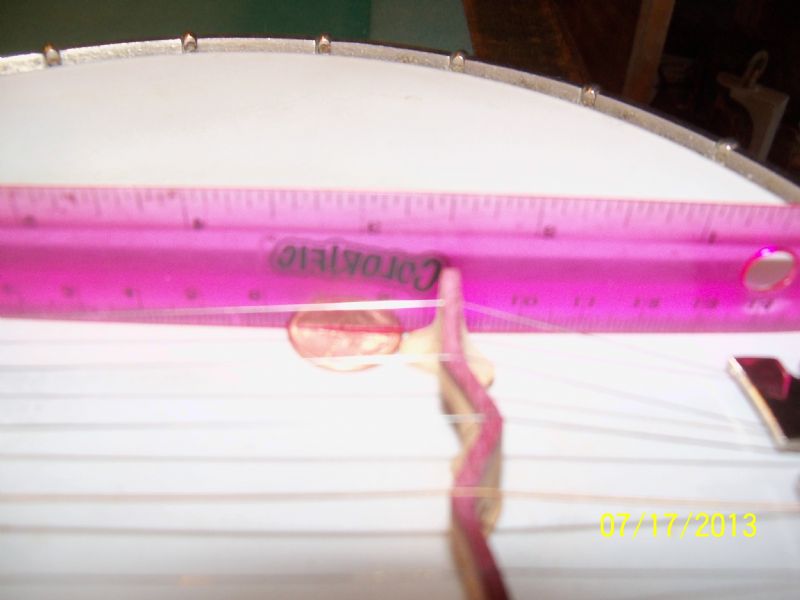
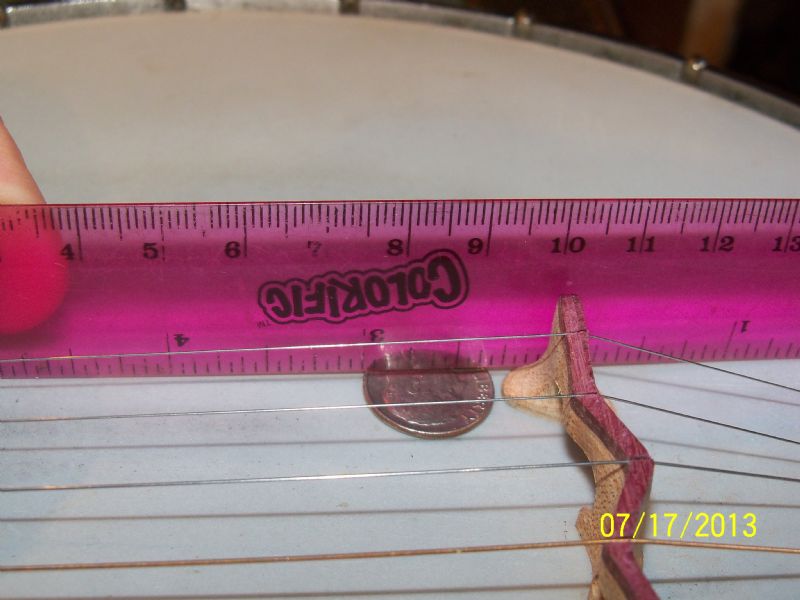
Using a 6" ruler as a straightedge(held on edge) line up the 3" mark with the bridge and slide a penny between the head and ruler at the treble foot of the bridge for a Bb head note/tight penny.
A head note/loose penny.
More coinage under a 6" straightedge to follow.
Edited by - steve davis on 07/18/2013 09:05:49
lightgauge - Posted - 07/17/2013: 15:21:23
Don't start complicating a simple system that has been so well received. Tight pennies and loose pennies ????
steve davis - Posted - 07/17/2013: 15:50:42
This doesn't affect the quarter/10" straightedge process or info.
I just want to offer an alternative to having to make the 10" ruler.
If you want to get similar results using a very common.ready to go 6" ruler,this info will help.
Fathand - Posted - 07/17/2013: 18:12:11
I suppose we could also go with feeler gauges instead of coins for accuracy. Personally it took me 30 seconds to take a 12" ruler down to my basement and cut 2 " off on my bandsaw.
Marv - Posted - 07/17/2013: 18:35:40
I like my pennies a little loose to keep from chafing.
Oh, wait, that's something else. Never mind.
steve davis - Posted - 07/17/2013: 19:25:47
I spoke a bit hastily in the first post.
Here are the carefully figured out measurements.
Here are 2 examples using the 6 incher.
Being able to synchronize rulers by lining up actual measurements is very handy for consistency.
The shorty can be moved around some such as :
A penny's thickness with the ruler set at 2 1/2" is the same A as a quarter under a 10" straightedge.
The measurements are finer and quicker at 6",but very consistent as far as I can tell at this time.
The other pic is a dime with ruler @ 2" mark at bridge end for a nicely brittle Bb head.
The 6" list at present looks like:
B head note/dime @ 3"
Bb " " /dime @ 2"
A " " /penny @ 2 1/2"
G# " " /penny @ 2"
G " " /nickel @ 3"
The 2 is hiding behind the the end of the bridge in the Bb/dime/2" shot,but this gives you a good shot for where the 2,2 1/2 and 3 numbers are coming from.
I'll still use my 10" se but this is just another way of reaching the same goal.
Edited by - steve davis on 07/17/2013 19:38:12
 |  |
Hankon5 - Posted - 07/17/2013: 20:33:17
Rat's ..now I have to carry more change in my banjo case...It's getting HEAVY!! OR.. I could use my large change holder in my car's console.....NAW!!!
Edited by - Hankon5 on 07/17/2013 20:34:47
Ken LeVan - Posted - 07/18/2013: 05:17:51
Steve,
Can you post a list of the coins and approximate pitches for the original 10" straightedge?
Bart Veerman - Posted - 07/18/2013: 05:34:17
This method is one of the coolest and cheapest ways to get a banjo to sound good without running the risk of busting the head. Over 300 people have read this post and give or take none, approximately zero people have bothered to click the LIKE button. Sigh...
Way to go Steve, atta boy!
steve davis - Posted - 07/18/2013: 05:43:46
Sure,Ken.
10" straightedge head note/coinage
B/penny
Bb/nickel
A/quarter
G#/2 dimes
G/penny and dime
F#/quarter and dime
dickinnorwich - Posted - 07/18/2013: 05:48:24
On my retirement salary, I can't afford this. I'm going to have to sell a banjo just to be able to carry around the array of coins I'm going to need to tune my head!!
Tatersoup - Posted - 07/18/2013: 10:15:02
I'm sure it works but why not use the "standard" 10" so that you can compare with others for the purpose of discussion. A simple straight piece of cardboard will work.
steve davis - Posted - 07/18/2013: 10:44:10
I'm just offering both measurents in case someone wants to use a very common,already made 6" straightedge.
One way doesn't affect the other.
I already compared them(6" and 10") giving both sets of measurements.
Marv - Posted - 07/18/2013: 11:28:18
quote:
Originally posted by Hankon5
Standards change...that's why wed have erasers!!!
I have to be careful when I write something down. I usually chew the erasers off my pencils.
Hankon5 - Posted - 07/18/2013: 12:34:18
quote:
Originally posted by steve davis
What do you mean about standards and erasers,Hank?
You know the old saying.....but don't worry, I like your ole standard!!! And everyone else's standard!!!!!!
Edited by - Hankon5 on 07/18/2013 12:36:16
Ken LeVan - Posted - 07/18/2013: 13:59:11
I have to say that I really like Steve's idea, and I have told him that he ought to make it into a product before GoldTone or someone like that does. I call it the "Davis Gauge" (credit where credit is due), and I use it all the time when I'm setting up a banjo to get it into the "ball park" My piano's upstairs, and I don't have a drum dial. I need to have a quick method of tightening the head during setup, and the Davis Gauge works wonderfully - I have it in the shop, I don't care if it gets lacquer thinner or aniline dye on it - I love it.
With mine, I don't use coins, but feeler gauges that I made which are the same thicknesses as coins - I'm too cheap to use coins, I think to myself).
Anyway, Steve just sent me the rundown of coins he uses to get the various pitches of head tunings with the 10 inch straightedge, which is what I use.
I miked a lot of coins, and they vary depending on how old and worn they are (I am old and worn myself, but haven't gotten thinner like the old and worn coins).
Here are the thickness of representative coins:
penny - .0590"
nickel -.0740
quarter -.0675"
dime -.0545"
based on that, I wanted to make a kind of tapered feeler gauge that Steve could market instead of coins.
Right now, I make tapered feeler gauges for checking string action, and they are very accurate and easy to make. I call them the "action Jacksons" Here's a picture of them -a simple no-brainer, but works like a charm. The sound of the string tells you when you have arrived at the action height:

So, I thought, This could work with Steve's "Davis Gauge" - you just make a tapered thing from wood, metal, plastic (mine's made from acrylic), mike it and mark it at critical points, and you have a tapered feeler gauge - easier to use than coins, and Steve can make it into a product he can sell (coins are public domain):

You ought to do this Steve, before someone rips you off and patents it. It's as simple as Archimedes' lever.
Ken
steve davis - Posted - 07/18/2013: 14:25:08
That's very slick,Ken.
The different diameters of coins influences the readings a bit so a direct thickness translation to the acrylic tapered gauge may need some fine tuning...not sure.
That's a good idea,Ken.
Patents start at around 2k.
Ken LeVan - Posted - 07/18/2013: 14:40:16
quote:
Originally posted by steve davis
That's very slick,Ken.
The different diameters of coins influences the readings a bit so a direct thickness translation to the acrylic tapered gauge may need some fine tuning...not sure.
That's a good idea,Ken.
Patents start at around 2k.
Steve,
I already took the coin vagaries into consideration and smoothed them out to make the intervals even:

I think you just have to make some product, even a prototype, and sell it to someone for $1 to get it into the marketplace. My "inserta-nut" has become the "zero-glide" nut as marketed by someone else. That is a product that requires a professional luthier to install, so I'm not imagining a stampede of people buying them, hence I am not concerned - I turn down offers to make them. Your head tension system, on the other hand, is much simpler and universally applicable.
steve davis - Posted - 07/18/2013: 18:23:19
Well,you've talked me into it(finally) Ken.
I'm in the process of ordering a sheet of lexan to make the straightedges from.
My design will be slightly different with an attached pivoting arm that will descend into the depression on one end and have a pointer on the other with a series of dots for each note.
I'll make a 10" and a 6" prototype and see what's what.
If I feel good about them I'll give them to a couple of BHOers to put through their paces and keep,if wanted.
Hankon5 - Posted - 07/18/2013: 19:30:24
I agree Steve.....Patent it...You will sell a ton of those!!!
Marv - Posted - 07/18/2013: 20:20:22
quote:
Originally posted by randyz714
anyone got change for a 20?
You don't need change, you need a body guard.
Tim Zowada - Posted - 07/19/2013: 07:45:41
I typed this before I saw Kens post above. I like his idea better. But, it is the same basic concept of tweaking the accuracy from Steve's excellent idea. Ken, you have just taken a chunk out of my day in the shop. Now, I have to go out and make one of those gizmos.
Steve, you really should make and sell these...
Here is my "hide heads" post:
With hide heads, I have noticed that the head tension can be a little fussy. So, I have modified Steve's technique a little. Rather than just saying, " a quarter", I also notice where on the quarter the straight edge will rock. Rocking near the bridge foot is quite different than rocking in the center of the quarter.
For technique, I usually hold the 10" straight edge down to the head, on the tailpiece end. I then gently tap the other end to see, and hear, when the coin is acting like a little fulcrum.
With that said, I have found that I get excellent, bright tone, with good base, at 1/2 diameter across a quarter. I think I get my best tone at 1/3 of the way across a penny. 3/4 diameter across a penny gets "tubby". That is still tighter than a quarter. Once I get the tension down to 1/2 way across a quarter, things get good again. I have yet to find the equivalent of, "tighten it until it breaks, then back of a little".
This technique makes it easy to deal with the daily changes in the skin head tension. My thanks to Steve for a wonderful idea.
Once I became a hid head convert, I sold my drum dial. I found, on a hide head, the readings were inconsistent.
I hope this helps a little.
Tim Zowada - Posted - 07/19/2013: 07:45:42
I typed this before I saw Ken's post above. I like his idea better. But, it is the same basic concept of tweaking the accuracy from Steve's excellent idea. Ken, you have just taken a chunk out of my day in the shop. Now, I have to go out and make one of those gizmos.
Steve, you really should make and sell these...
Here is my "hide heads" post:
With hide heads, I have noticed that the head tension can be a little fussy. So, I have modified Steve's technique a little. Rather than just saying, " a quarter", I also notice where on the quarter the straight edge will rock. Rocking near the bridge foot is quite different than rocking in the center of the quarter.
For technique, I usually hold the 10" straight edge down to the head, on the tailpiece end. I then gently tap the other end to see, and hear, when the coin is acting like a little fulcrum.
With that said, I have found that I get excellent, bright tone, with good base, at 1/2 diameter across a quarter. I think I get my best tone at 1/3 of the way across a penny. 3/4 diameter across a penny gets "tubby". That is still tighter than a quarter. Once I get the tension down to 1/2 way across a quarter, things get good again. I have yet to find the equivalent of, "tighten it until it breaks, then back of a little".
This technique makes it easy to deal with the daily changes in the skin head tension. My thanks to Steve for a wonderful idea.
Once I became a hid head convert, I sold my drum dial. I found, on a hide head, the readings were inconsistent.
I hope this helps a little.
steve davis - Posted - 07/19/2013: 09:45:11
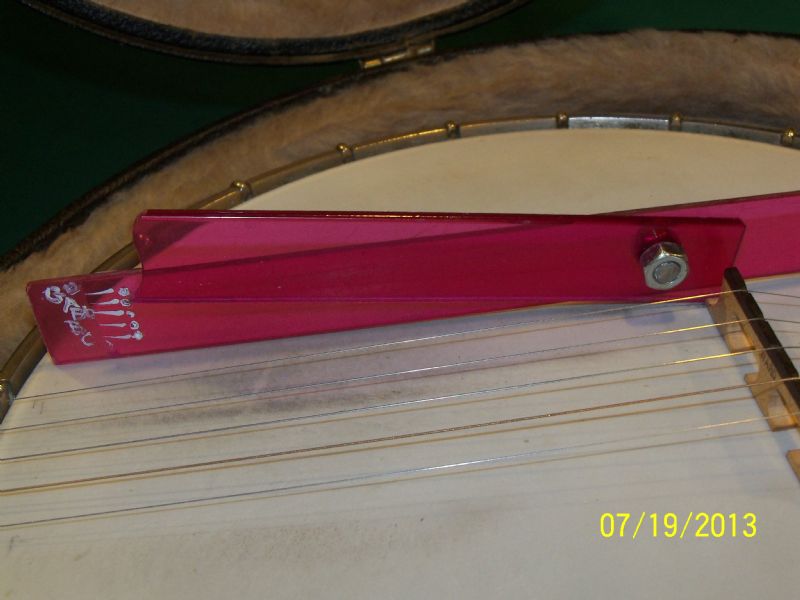
"Proto I" almost done.
I thought I was going to have to go uptown to Home Depot,but found the perfect stock in a polycarbonate clipboard that I already had.
I may still need to go uptown to the Ace hardware for a good looking pivot pin/bolt.
Klondike Waldo - Posted - 07/19/2013: 10:15:49
quote:
Originally posted by Marv
quote:
Originally posted by randyz714
anyone got change for a 20?
You don't need change, you need a body guard.
I thought the tough-looking young lady with the cigar was his bodyguard.
steve davis - Posted - 07/19/2013: 18:43:35
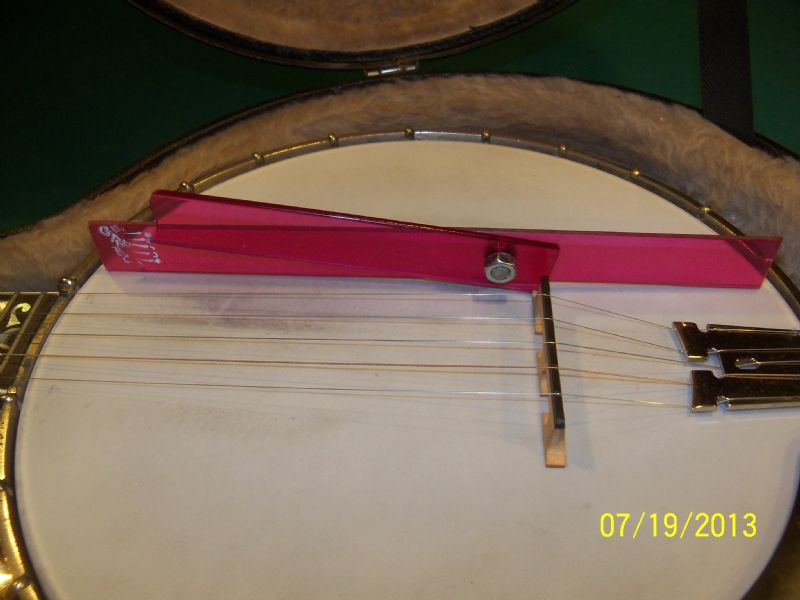
This is #1 10" version.
I used my Ward bridge for calibrating.
I suspect my comp bridge will perform the same,but I'll run it through the tensions tomorrow to compare.
Interesting little problem to get the pivot ratio so that the head note letters are within the range of the width of the straightedge.
I'm going to replace the nuts and threaded shaft with some kind of brass set like is used in handsaw handles.
Edited by - steve davis on 07/19/2013 18:56:06
 |  |
Roll Player - Posted - 07/19/2013: 19:18:35
Umm, isn't a nickel thicker than a quarter? I think it's the penny that should equate to a Bb head and a nickel somewhere between G and G# (at least for that high after-ring that you listen to for a note.)
The 6" measurements seem unnecessary to me, but whatever... can't hurt to have an alternate method. And for those who like a prefab, this new gadget (Steve's or Ken's) will sure do the trick.
Steve I think your comp bridge will read slightly greater deflections being a bit less wide than a standard 3-foot. (And speaking of the Davis bridge, I should have a sound file up soon for the beech bridge. I've done one recording, but have since lowered the tailpiece a bit and want to record that too before I post my findings.)
steve davis - Posted - 07/19/2013: 19:28:27
I'm going to make an 8" version tomorrow that will be more case friendly.
Most of my cases have a 9" compartment.
The smaller diameter of a nickel lets it ride lower in the depression,Art.
The 6" option might be be a solution for somebody.
Edited by - steve davis on 07/19/2013 19:32:59
vlawson - Posted - 07/19/2013: 19:45:32
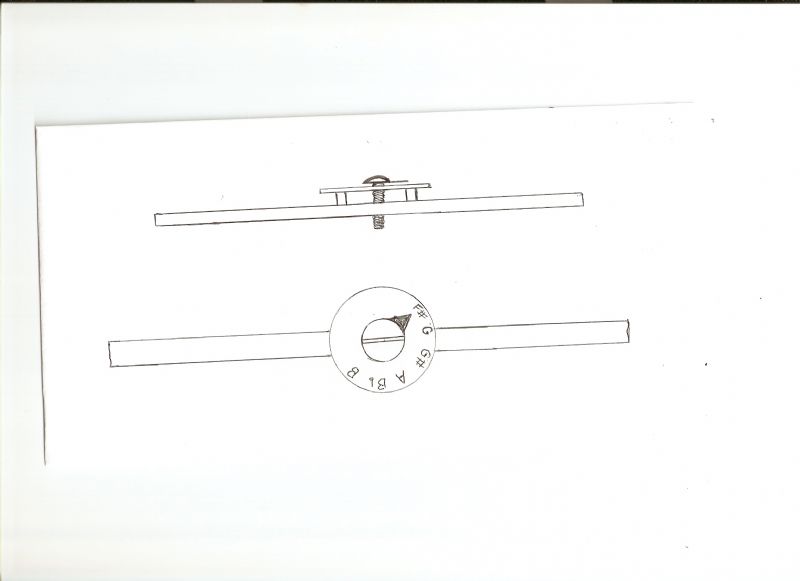
Hey has anyone ever thought about making the straight edge like this. With a screw and a homemade dial? I just thought of it an drew it on to paper. But I bet you could make something like this if you wanted too.I probably drew the letters backwards but you now what I mean.
Virgil
Edited by - vlawson on 07/19/2013 19:47:45
 |
Kenneth Logsdon - Posted - 07/20/2013: 05:36:03
Yes.... many, many times at least a half dozen or more different variations from the 60's/70's and earlier... However the ideas are usually dropped rather quickly as it proves to be impractical from one banjo to another... and nothing replaces your ear...
It could provide a neophyte with a general place to start...
Edited by - Kenneth Logsdon on 07/20/2013 05:38:31
steve davis - Posted - 07/20/2013: 05:54:28
It could teach some folks to hear the head note.
Mylar banjo heads are very consistent.
Edited by - steve davis on 07/20/2013 05:55:15
Marv - Posted - 07/20/2013: 09:09:48
quote:
Originally posted by steve davis
This is #1 10" version.
I used my Ward bridge for calibrating.
I suspect my comp bridge will perform the same,but I'll run it through the tensions tomorrow to compare.
Interesting little problem to get the pivot ratio so that the head note letters are within the range of the width of the straightedge.
I'm going to replace the nuts and threaded shaft with some kind of brass set like is used in handsaw handles.
How about sometitng like this. Home Depot has them in aluminum and nylon. Should be available in brass somewhere.
homedepot.com/webapp/catalog/s...earch+All
They come in a variety of sizes. They work great as a replacement for Chicago screws on my straps.
steve davis - Posted - 07/20/2013: 12:35:45
I just got home from town where I got a sheet of .093 acrylic and a pair of "male/female" rivet sets from ACE hardwarethat make a very neat looking connection.I'll have to see how they wear.
If these don't do it I'll be trying those fastenings,Marv.Thanks.
Edited by - steve davis on 07/20/2013 12:40:07
Terms of Use | Privacy Policy | Privacy Consent (EU/GDPR Only)
Copyright 2026 Banjo Hangout. All Rights Reserved.


