
DVD-quality lessons (including tabs/sheet music) available for immediate viewing on any device.
Take your playing to the next level with the help of a local or online banjo teacher.
Weekly newsletter includes free lessons, favorite member content, banjo news and more.
Premier Sponsors


|
Please note this is an archived topic, so it is locked and unable to be replied to. You may, however, start a new topic and refer to this topic with a link: http://www.banjohangout.org/archive/262361
Rusty - Posted - 05/09/2013: 08:42:55
I have tried and tried to learn this style of banjo playing, love the music but cannot seem to play it any suggestions?
Rusty - Posted - 05/09/2013: 08:48:45
Forgot to mention been playing three finger since 79, this may be the problem?
Spitfire-Smith - Posted - 05/09/2013: 09:03:24
The biggest secret is to practice the basic bum-ditty stroke very slowly. That will give you a good base to build your skills off of. Try the Rocket Science Banjo series (rsb.pricklypearmusic.net/) by fellow Hangout member oldwoodchukb.
oldwoodchuckb - Posted - 05/09/2013: 10:41:49
Look particularly at the videos on my site. It will probably take a month of practice (or more or possibly less - depending on any prior downstroke experience and how much time you can devote to this per day) to get the basic clawhammer motion working smoothly but you can be working on other aspects of OTM at the same time. The first chapter of the book is about this stroke which is about 95 percent of all you ever will do in clawhammer.
While I consider my book supplemental for beginners, I feel that those with plenty of experience on banjo don't really need all the beginner's material found in most books. RSB covers the basic stroke(s), and some advanced techniques. There are also essays on memorizing and on why old time banjo uses so many tunings.
The free ebook also contains 40 songs and tunes in tab that can actually be played in a 2 finger style while you are working on getting the clawhammer motion to work. Once you have the claw, you simply convert the tunes. If you like them I have a collection of tabs I sell with 160 more tabs currently and more on the way. It is a sort of subscription service and once you are a subscriber, you are in for life - my life.
Selmer - Posted - 05/09/2013: 11:24:01
Try Chris Coole's DVD (comes with tab). Its brilliant.
woodhallmusic.com/chris...e_DVD.html
Uncle Brad - Posted - 05/09/2013: 13:05:54
WoodChuck,
I'm watching your videos on RSB and have a question. For the Cluck, I understand you are using your index finger for the basic frail, and the middle and ring fingers for the cluck. You then move on to doing it. However, you don't explain exactly what you are doing with the middle and ring fingers to produce the cluck sound. Initially I thought you were strumming with these two fingers, but after viewing the video again it almost appears you are hitting one or more strings and immediately deadening the sound. Please explain.
Crimjo - Posted - 05/09/2013: 14:16:27
quote:
Originally posted by Selmer
Try Chris Coole's DVD (comes with tab). Its brilliant.
woodhallmusic.com/chris...e_DVD.html
This ^^^
I've been playing three finger Scruggs style on and off for the last 3 years and to be honest I picked it up REALLY quickly. For some reason recently I've been really liking the old time clawhammer sound and 2 weeks ago I picked up Chris's DVD. I kind of suck at clawhammer, BUT, I feel that Chris explains everything extremely well and now I have the first 2 songs down pretty dang good if I do say so myself. Seriously practice the basic strum slowly any time you can. You'll eventually get it!
laertes22 - Posted - 05/10/2013: 06:09:10
I'm a newbie myself, so take anything I say with a grain of salt. I've been taking lessons with Dan Levenson for about a year now, and IMHO (and I am sure there are plenty of folks that would disagree), but I feel like the importance of "Bum Ditty" is somewhat overemphasized. Rocket science banjo kind of talks about this some, and also Dan Levenson in his books and class, but I think it is to focus on the basic clawhammer action-having your hand act and retract as a cohesive unit with one cohesive smooth action, as opposed to having your fingers strike a string and your thumb pluck the 5th string a separate entities is a good place to start.
Also, I notice that some folks tend to keep their hands in a fairly rigid claw and they strike the strings with their hands almost parallel to the strings or at a very small angle (less than 45 degrees). This works for them, and I do not knock it-it, however, does not work for me. Dan taught me to have a much looser,relaxed claw with the hand and arm at a greater angle to the strings (maybe somewhere between 45 and 90 degrees?). And instead of actively striking the strings, it is almost like you let gravity and the finger/hand/wrist's natural movement get your fingers to strike the string. He had me hold my arm and hand out straight in front of me and then slowly release the tension in my wrist, hand, and fingers. As you relax the muscles and release the tension, your wrist will naturally bend, your hand will droop at the wrist, and your fingers will droop at their joints. Do the same thing while holding your banjo, and your fingers will naturally come down on the strings and your thumb will catch on the 5th string. Then, when you retract your hand back to the original position, your thumb will move in such a way that it will naturally cause the 5th string to sound. Then repeat like a million times until you can do it smoothly and without thinking. Anyway, for some reason this clicked for me where other methods and teachings had not. May work for you, may not. My explanation is probably crap and difficult to understand, and I apologize for that. Good luck and whatever method you settle on, keep at it!
htb - Posted - 05/10/2013: 08:42:32
Unc Brad- two videos I slapped together to highlight the cluck are here:
Ed Stanley - Posted - 05/10/2013: 08:47:07
Another great place to check out is Pat Costello's page. Great guy, funny and has some great learning techniques. Simple approach and plenty of free downloads. Both of which you don't see very often.
slc - Posted - 05/10/2013: 08:52:20
quote:
Originally posted by laertes22
Dan taught me to have a much looser,relaxed claw with the hand and arm at a greater angle to the strings (maybe somewhere between 45 and 90 degrees?). And instead of actively striking the strings, it is almost like you let gravity and the finger/hand/wrist's natural movement get your fingers to strike the string. He had me hold my arm and hand out straight in front of me and then slowly release the tension in my wrist, hand, and fingers. As you relax the muscles and release the tension, your wrist will naturally bend, your hand will droop at the wrist, and your fingers will droop at their joints. Do the same thing while holding your banjo, and your fingers will naturally come down on the strings and your thumb will catch on the 5th string. Then, when you retract your hand back to the original position, your thumb will move in such a way that it will naturally cause the 5th string to sound. Then repeat like a million times until you can do it smoothly and without thinking.
I think this is a wonderfully accurate description! Actually I made a (very amateur) video recently going over some of these same points - I'll post it below. Just ignore the bad/non-existent editing...
One thought I've had recently: I usually also teach the concept that the thumb and the finger land on their strings at the same time - and it's the momentum of the hand pulling the thumb off that makes the thumb sound after the finger, like you mention above. But lately I've been noticing - I could swear that my thumb lands a microsecond BEFORE the finger strikes. The whole hand moves just as you say, except the thumb touches the fifth or inside string first to make an anchor, THEN the finger strikes. I may be wrong here - it seems like a very subtle distinction - but it makes sense in terms of the hand dynamics: the thumb is more naturally closed; allowing the touch of the thumbed string first to open the hand like a spring allows for a more unified motion, and having the stability before the finger-strike makes 'targeting' easier. Pretty esoteric and possibly wrong, but interesting to think about :-) Anyone else notice this?
One day I'll also add a 'cluck' video, to add mine to the many out there (lol!) - but I've written way too much on this stuff already!
Edited by - slc on 05/10/2013 08:54:11
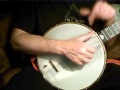 VIDEO: Notes on the Right Hand for Clawhammer Banjo (click to view) |
Uncle Brad - Posted - 05/10/2013: 09:07:59
Thank you htb. Very clear!!
slc, great explanation. You cleared up a couple of longstanding questions of mine.
Edited by - Uncle Brad on 05/10/2013 09:19:11
oldwoodchuckb - Posted - 05/10/2013: 09:24:35
On Bum Did-dy
Neither I nor Dan Levenson starts students with Bum Did-dy. Once you can do Bum-dy, you can do anything - Bum Bum-dy, Bum-dy Bum, Bum Bum, Bum-dy Bum-dy - in other words all the possible combinations involving a frail on the first half of the beat. We get into combinations with NO frail later ("rest-dy" is the only way I can explain them in text - in tab I call it the M Skip).
Bum Did-dy is just one possible rhythm. Over-emphasis on this has led to a situation where I have spent a lot of my teaching career, painstakingly weaning people off bum Did-dy that is so engrained in their playing that they literally cannot break away from it without great struggle. I find it simply better to avoid Bum Did-dy altogether in my teaching. That way I know my students won't end up needing remedial banjo lessons in the future.
For this same reason, I introduce Drop Thumb to beginners as soon as they can smoothly play the 5th string. I've watched people struggle with drop thumb after years of avoiding it. Some people say they have no use for drop thumb - fine with me, but I feel it is easier to not use a technique you know than to learn one you don't know. Some people point out that Doc Watson didn't drop thumb in his frailing - others say he did drop thumb and did so at least once in a video where he was demonstrating that he didn't. I don't know about that. I just know that my students usually didn't have an over-riding desire to reproduce the sound of an older player who didn't drop thumb, and by making sure they got it, I was giving them the choice.
oldwoodchuckb - Posted - 05/10/2013: 09:39:37
Uncle Brad,
On the cluck video I should have cut to a better close-up, and if ever I re-do that one I might see about using Zepp's approach using a clear head, as well as getting the cluck from several angles above.
I literally crash the Middle and Ring fingers through the strings, so they sound and instantly damp the strings (1,2, and 3). this involves a rotation in the wrist for me. When I do the I stroke my wrist is in a position where the other fingers don't hit the strings at all. Then for the Cluck Stroke the 2 fingers (some people use all 3 fingers) come down hard as the wrist turns parallel to the head. I frail with the Middle finger most of the time now and Cluck with the Middle and Ring.
This Cluck (I call it "The Big Cluck" in RSB) was taught to me by Scott Ainslie who got it from Fred Cockerham. There are other clucks and I discuss a couple in the book.
Having the Cluck labeled as Lesson 3 in the videos is rather misleading. I consider the clucks to be advanced techniques. If you have less than a year or two doing clawhammer - don't bother with the cluck - It is basically a string band technique, and you really don't need it for playing alone (unless you love it - in which case Gopher It!)
Rusty - Posted - 05/16/2013: 11:12:17
Thanks for all the great information I am feeling inspired to push on and learn!
westsideryan - Posted - 05/16/2013: 11:18:29
You should look into Cathy Fink's clawhammer lessons on TrueFire. You can sign up for 30 days of free access. The lessons look quite good.
Clawdan - Posted - 05/16/2013: 17:29:21
Thanks Genford, that description is right on though many hear it differently and all modify for themselves to refine what works for them. And Stephan, you are probably correct and I have often noticed that (perhaps the thumb lands first) but I do feel at that point you start to get hung up in the analysis of the details which starts to belabor the point. For most saying that they land at about the same time works.
I also wanted to say that Genford has been taking his lessons via Google Video Chat (like Skype) and it seems to be working out quite well for him. He has made progress equal to if not better than any competent "in person" student I have had over the years.
OWC says it well too, once you can get the bum-dy, anything is possible.
Thanks all.
Play Nice,
Dan Levenson
Author - Clawhammer Banjo From Scratch and Fiddle From Scratch
Clawdan.com
Terms of Use | Privacy Policy | Privacy Consent (EU/GDPR Only)
Copyright 2026 Banjo Hangout. All Rights Reserved.


