
DVD-quality lessons (including tabs/sheet music) available for immediate viewing on any device.
Take your playing to the next level with the help of a local or online banjo teacher.
Weekly newsletter includes free lessons, favorite member content, banjo news and more.
Premier Sponsors


|
Please note this is an archived topic, so it is locked and unable to be replied to. You may, however, start a new topic and refer to this topic with a link: http://www.banjohangout.org/archive/262175
mwc9725e - Posted - 05/06/2013: 07:30:38
Someone recently asked me for some tab. That reminded me that I know nothing about the process of writing tab, I read it just fine. The process sounds self-evident, but I have to admit I wouldn't know how to even get started writing. Any tips? Do I need lessons or a book or something? Maybe just a viable brain :>)
trapdoor2 - Posted - 05/06/2013: 08:52:51
I taught a class in writing TAB just yesterday at Smoky Mountain Banjo Academy. It isn't terribly complicated...but like anything else, it can be made so.
The biggest mistake I run across is where they've gotten the timing/rhythm wrong. The notes are all there ('cause you can easily just look at your fingers and see what string you're playing and how, etc.) but the rhythm is off or they've started it on the wrong beat, etc.
Most clawhammer is in 2/4 time (1 and 2 and), so I tell folks to find the beat and write in the downbeats first (the numbers). Then fill in the notes that fall on the backbeat (the "and"). Then, if there are additional notes, like pull-offs or hammer-ons or whatever, you fill those in.
Same goes for any time signature, really. I just lay down the groundwork (the downbeats) and start filling in the rest.
Of course, there are odditites that can cause you to grind your teeth occasionally. Pick-up notes challenge many folks. Tunes often have them and they lead into the first measure...but are often mistaken as part of that measure.
A great way to learn how to do it is to find a book (better yet, a free online example) of pre-existing tab (esp. some that you like) and use it as a basis for writing your own.
Edited by - trapdoor2 on 05/06/2013 08:54:23
Fathand - Posted - 05/06/2013: 09:06:33
If you know how to read tab just try writing out something simple that you know how to play.
Jim Yates - Posted - 05/06/2013: 09:44:54
Apparently the type of tab most folks use these days was invented for lute players, but fell out of favour and almost disappeared until Pete Seeger revived it with his book How To Play The Five String Banjo. Today most players of fretted instruments have at least a rudimentary knowledge of how it works. Any search of tabs on the web will show you that many folks have their own way of writing it. Quick slides, chokes, hammers and pulls are indicated in different ways.
As trapdoor2 stated, the biggest problem with the tabs you find here is the rhythm. Sometimes it's incorrect and sometimes it's just absent. A tab without any rhythm seems useless to me unless you can listen to the exact version being played on a tape or CD. I say "the exact version" because it seems that no two banjo (guitar, mandolin, fiddle...) players play a tune exactly the same way. Look at 10 tabs for Cripple Creek and you may have 10 different versions of playing the tune. If a tab is written properly, you should be able to play it even if you've never heard the tune before.
I write tabs for my own reference, if I come up with a lick that I'm afraid I'll forget, or for those students who learn visually (Not all of my students learn from tab) on regular manuscript paper using a fine tip Sharpy. I indicate rhythm the same as in standard notation. I have yet to find a satisfactory way of indicating rhythm on the computer without a program like TabEdit. I like to place the fret numbers on top of the lines rather than having the lines bisect the fret numbers, but both ways work fine and I haven't found that students have problems switching.
I have one student who likes to tab his arrangements of songs/tunes and bring them to me. During the lesson we will try to find ways of improving them. His tab sheet is very marked up by the end of the lesson. I never would have chosen this method of teaching him, but that's what he wanted and it seems to be working for him.
Here's a sample of how I'd write a tab:
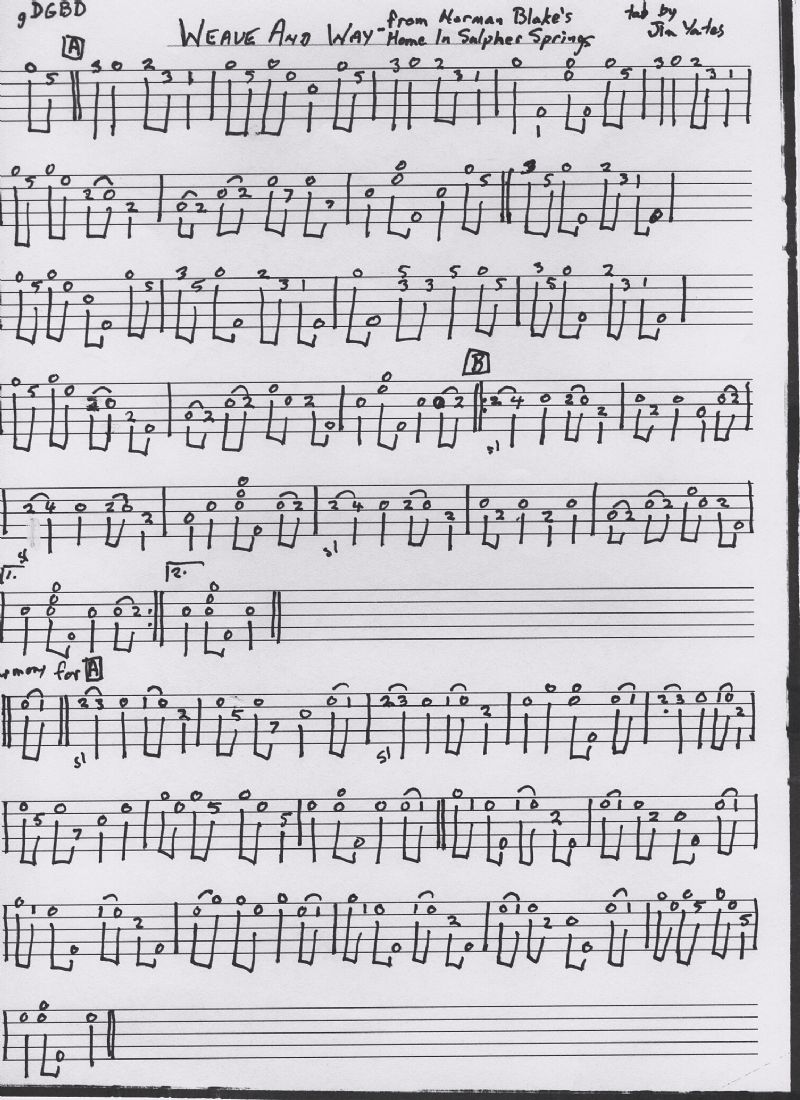 Weave and Way - CH |
banjoak - Posted - 05/07/2013: 11:26:27
For simple tab/notation and the rhythm; I think it's easy to just use much like trapdoor indicated; finding the main beats.
For CH it is pretty straightforward - the main beat is the BUM in bum-pa-dit-ty.
Usually it's written with 2 BEATs per measure, which would give possible 8 note units in a measure. BEAT-pa-dit-ty - BEAT-pa-dit-ty - or 1-e-&-a - 2-e-&-a.
In measures where all 8 notes/units exist - it's pretty straightforward; treat them like eighth notes; they will need a stem and a flag or beam. Beaming easiest to keep them together as 2 note pairs. - so for a fully filled note unit measure, you would have 4 pairs. [BEAT-pa] - [dit-ty] - [BEAT-pa] - [dit-ty] -
(4 note beamed group per beat is possible [BEAT-pa-dit-ty] - [BEAT-pa-dit-ty] )
When writing out measures when not all the note units are filled per beat - When writing - keep in mind, you are writing duration until the next note, so when you take out one unit, the note before the omitted one lasts twice as long, so changes to a single stem or single note. Quarter notes (replaces 2 eighth notes) are with a stem and no flag/beam. Half notes (replaces 4 notes) are just the number with no stem.
There are only a few basic possibilities in most simple tunes; since most will have a note played on each main beat, we can split each measure and show just possible for each beat;
Those are the most common, but 2 others come up occasionally
5. Half- - - - - - = bum- - - - - - -; or BEAT- - - - - -
(one beat held until the next beat, leaving out the "pa-dit-ty", "e&a").
single note no stem
6. Dotted quarter- - - - -eighth = Bum- - - - - -ty; or BEAT- - - - -a
(leaves out the "pa-dit"; and uses the "ty" as a pickup to the next beat)
single stem with a dot and a stem with a flag (not beamed)
The other thing you want to show is HO, PO, and slides - As in Jim's example, the PO and HO (measure 6 and 7) is indicated by a slur (curved line) marker. A slide is usually a diagonal line. All typically go from the first to the second note in the 2 note pair.
If written by hand or manually, for simple representation, don't get bothered by if it's 2/2, 2/4, or 4/4...
Even though the above uses CH bum-pa-dit-ty model; it works much the same with other music that has the same rhythmic meter.
oldwoodchuckb - Posted - 05/07/2013: 15:14:15
For 5 string banjo start with standard music paper.
Every frail followed by a thumb is going to be 2 eighth notes (there are exceptions but for normal frails you will be okay. eighths have flags and usually 2 together are linked. You can also link 4 eighths but I find twos easier to read as each pair is exactly one beat
Every frail not followed until the next frail is a quarter note
Where there is an M skip - put in an eighth rest (looks like a small 7) followed by the thumb eighth note
Almost everything you write out will be in 4/4 although there are a lot of waltzes. Old Time fiddle tunes are technically in 2/4 but writing them in 4/4 has been standard for as long as I can easily research. 2/4 is a PITA to read unless there are a lot of 16ths - and there are none in folk music.
Look at the tabs in my free ebook or the Tabonanza and try to follow that pattern for writing yours, not just because I put out really nice tab, but because Tabledit is really standard tab that most people can read (if they read tab at all) and it prints out shipshape and squared away. Something my arthritic hands cannot possibly do.
On the question of should the numbers go in the spaces or through the lines. When I hand write tab I prefer to use the spaces as the numbers are easier to read. For Tabledit tabs I use the lines since the printing process makes the numbers clear.
I use 7 stave music paper which I make myself - I cut up 8 stave paper and re-assemble the pieces into 7 staves per page. This allows me extra space for words - I like to include words wherever possible as it makes tunes easier to memorize. Tabledit widens as needed for a lyric line.
Once you have the process going well, think about buying Tabledit. If you wish to distribute your tabs Tabledit makes your life a lot easier. You can email out tabs and anyone with the free TEFView reader can read them without spending a penny. While Tabledit does have some minor glitches (I've yet to figure out how to make it work correctly on some kinds of triplet rhythms - mostly 9/8 slip jigs where there is no center note of many triplets. That is using MY version of the program (which is now about 5 years old (I'm not completely adverse to change - but I don't do it). This is something they might very well have straightened out since.
John Gribble - Posted - 05/08/2013: 03:07:01
An ancient and honorable tradition in learning music is to copy scores. Copy by hand some tabs you're familiar with. That will probably teach you all you need to know.
mwc9725e - Posted - 05/08/2013: 11:28:57
quote:
Originally posted by John Gribble
An ancient and honorable tradition in learning music is to copy scores. Copy by hand some tabs you're familiar with. That will probably teach you all you need to know.
By golly, that's not a bad idea. I'll give it a try. Thanks.
plunknplinkntwang - Posted - 05/08/2013: 11:56:30
I've found square or graph paper helps with the timing discipline.
abarten - Posted - 05/09/2013: 06:13:58
quote:
Originally posted by plunknplinkntwang
I've found square or graph paper helps with the timing discipline.
Good idea - never thought of that.
oldwoodchuckb - Posted - 05/09/2013: 11:02:13
BTW: I started taking flamenco guitar lessons around 1961, and except for my first teacher, every flamenco player I ever learned material from used tablature. I can't believe they all read Pete Seeger's book since some of them were barely literate in English and I doubt the book was available in Spanish.
Flamenco tab mostly was written without any time values assigned to the notes, just measure bars usually every 12 beats (one compas) - that sometimes were all off by a beat or two - especially on bulerias where the variations tend to start on the 12th beat. You could easily get lost in flamenco tab, but if you had a basic grasp of the falseta the tab helped keep your memory fresh and aided you in getting the more subtle moves down.
mwc9725e - Posted - 05/09/2013: 19:54:59
quote:
Originally posted by plunknplinkntwang
I've found square or graph paper helps with the timing discipline.
I'm very familiar with graph paper, but I have to say I have no idea how I'd use it to express timing. Can you give us a small example?
R.D. Lunceford - Posted - 05/09/2013: 19:58:35
If you can read it you can write it.
The best tab writing follows standard
musical convention... the thing I get
impatient with is tab that doesn't include
the timing.
abarten - Posted - 05/09/2013: 21:22:38
quote:
Originally posted by mwc9725e
quote:
Originally posted by plunknplinkntwang
I've found square or graph paper helps with the timing discipline.
I'm very familiar with graph paper, but I have to say I have no idea how I'd use it to express timing. Can you give us a small example?
I didn't make the original comment, but here is my take on it: If you lay out your tab so that one quarter note, for example, takes the same horizontal space as two eighth notes or four sixteenth notes, you will have a visual spacing that represents the timing. Graph paper can serve as a guide. If you used TablEdit, you'll notice that it spaces notes in a similar way.
-- Al
plunknplinkntwang - Posted - 05/13/2013: 16:00:28
As ABarten described. The even vertical lines just help with literary placement and can be useful when trying to visualize some of the syncopations. I can't show an example at the moment as Im not at home.
DroneAlone - Posted - 05/14/2013: 02:52:46
I'm currently learning how to play by ear and write my own tab. A good first exercise for me was writing the tab of a tune that I've been playing for quite a while and then compare it to the tab I originally learned it from... when I'm stuck or not sure, I sometimes peek into my tab books...
...and watch out for those pick up notes, especially if you write 2/4 as 4/4 (see oldwoodchuck's post above)
Peter
Edited by - DroneAlone on 05/14/2013 02:55:10
cb56 - Posted - 05/16/2013: 05:46:22
Get yourself a free download of powertab and set it up for banjo.
I haven't done any banjo tabs yet but here's one I did for uke.
docs.google.com/file/d/0B_MVzG...=CJbKvsML
Pretty simple once you get the hang of it. (and did I mention it's free?)
Terms of Use | Privacy Policy | Privacy Consent (EU/GDPR Only)
Copyright 2026 Banjo Hangout. All Rights Reserved.


