DVD-quality lessons (including tabs/sheet music) available for immediate viewing on any device.
Take your playing to the next level with the help of a local or online banjo teacher.
Weekly newsletter includes free lessons, favorite member content, banjo news and more.
Premier Sponsors


|
Please note this is an archived topic, so it is locked and unable to be replied to. You may, however, start a new topic and refer to this topic with a link: http://www.banjohangout.org/archive/257374
Tom Hanway - Posted - 03/01/2013: 10:34:47
Bill Monroe spoke reverently of the "ancient tones." Back in the mid-eighties, as a hungry bluegrass banjo player, this really grabbed my attention as I learned old fiddle tunes, and I wanted to get deeper inside Scottish, Irish, Scots-Irish, British Isles and Celtic music. So I set out on a pilgrimage, collecting tunes and eventually resettling in Ireland after I losing my first wife Kathleen to cancer on St. Patrick's Day in 2002. Kathleen, an Australian of Scottish and Irish descent, encouraged me to play and collect traditional tunes from Ireland and Scotland. I took her advice, and it's kept me going through some hard times. I was very blessed to have Kathleen, and she's still with me.
I've been collecting and transcribing tunes for some three decades, and my recent collections are designed especially for beginners, but also intermediate and advanced players who want to branch out or make friends with the "ancient tones” that Bill Monroe often spoke of.
So, I'm delighted to announce the release of my third Irish and Celtic tune collection, all of them currently available in all formats (Book/CD or eBook/audio download). Mel Bay's Easy Irish and Celtic Melodies for 5-String Banjo: Best-Loved Airs and Session Tunes (MB 21598 BCD and eBook) is now available as of March 2013. It was a labor of love for me, and I set out collecting favorite melodies and songs, including chords, standard notation, some lyrics and standard tab.

Here's the product description from the Mel Bay page:
This book and accompanying audio present Irish, Celtic and British Isles folk melodies for the 5-string banjo. The book demonstrates contemporary Celtic fingerstyle banjo in G tuning using modern techniques. 32 airs and song melodies are presented, with chords written in standard notation and tablature. Play-along and up-to-speed tracks are included in the audio. The tunes are suited for beginner and intermediate players, and include practice tempo suggestions. Advanced players will also benefit by learning subtle arrangements of traditional pieces. This is the companion work to Mel Bay's Easy Irish and Celtic Tunes for 5-String Banjo: Best-Loved Jigs and Reels (2012), with 68 tunes, combining for a total of 100 Celtic melodies. The pieces can be played individually or combined for session playing.
(There is a related BHO discussion about the 2012 Celtic collection, here: Easy Irish and Celtic Session for 5-String Banjo: Best-Loved Jigs and Reels.)
Complete Book of Irish & Celtic 5-String Banjo has 100 tune transcriptions.
|
Though I didn't plan it this way, it makes good sense for beginners to start with the latest collection and work backwards, so the last collection (2013) is the one to start off with, sort of a primer, and the first collection, "Complete Book of Irish & Celtic 5-String Banjo" (1998), is best for intermediate-advanced players, because it has lots of variations, including fretting and picking-hand ornamentation. It can also serve as a general reference for its cross-referenced Glossary.
For beginners, I did make sure to sneak in some simple tunes, jigs and marches, especially in the Chapter Five, "A Cross Section of Celtic Tunes."
For intermediate players, any of these collections is a good starting point for getting fluid in Celtic fingerstyle banjo.
Best ~ Tom
Edited by - Tom Hanway on 05/17/2013 12:56:29
kirbonite - Posted - 03/01/2013: 10:47:46
Tom, thanks for all the work on Celtic and Scottish tunes. I really enjoy playing them. I am so sorry about your loss. It's amazing how many people were affected by 9/11. Even if you weren't there. I was there shortly after 9/11 and experienced some of the emotions first hand.
On the bright side.. Look at these books. My birthday is coming up if any BHO member cares to remember me.

I was wondering if you might have any suggestions as to recordings of Celtic tunes involving the 5 string. I know there are tunes on Many albums but have not heard of a band or entire album embracing the style. I'm already a fan of Dave Hum and have many of his Celtic arrangements downloaded and I think Alison Brown's Stolen moments features a lot of Celtic stuff but I don't have that one.. Was wondering if you had a favorite.?
I'm glad the 5 string is making it's way into Celtic and I'm glad Celtic suits the 5 string.. I hope to see more in the future.
Tom Hanway - Posted - 03/01/2013: 11:19:48
quote:
Originally posted by kirbonite
Tom, thanks for all the work on Celtic and Scottish tunes. I really enjoy playing them. I am so sorry about your loss. It's amazing how many people were affected by 9/11. Even if you weren't there. I was there shortly after 9/11 and experienced some of the emotions first hand.
On the bright side.. Look at these books. My birthday is coming up if any BHO member cares to remember me.
I was wondering if you might have any suggestions as to recordings of Celtic tunes involving the 5 string. I know there are tunes on Many albums but have not heard of a band or entire album embracing the style. I'm already a fan of Dave Hum and have many of his Celtic arrangements downloaded and I think Alison Brown's Stolen moments features a lot of Celtic stuff but I don't have that one.. Was wondering if you had a favorite.?
I'm glad the 5 string is making it's way into Celtic and I'm glad Celtic suits the 5 string.. I hope to see more in the future.
Thanks Kirby! 
Okay, my three collections come with companion CDs, and the eBooks come with downloadable audio recordings. A lot of artists have made forays into Celtic (especially fiddle) music, going back to Bill Keith, John Hickman, Alan Munde, Tony Trischka, Béla Fleck, Allison Brown, Scott Vestal, Tony Furtado, Chris Grotewohl, Iain MacLachlan, Mary Z. Cox, Peter Somerville, myself et al. I recorded 'Horizon Hornpipe' with Mark Schatz (backing the melody on clawhammer) back in the early 90s in Nashville, and I'll have a full Irish CD out in the not-too-distant future.
Leon Hunt has a brilliant version of the 'Silver Spire' which you can find easily on YouTube. While I didn't copy his setting for obvious reasons, I certainly took notice of it, and I transcribed an Irish traditional setting (still playing up and down the neck) for Easy Irish and Celtic Tunes for 5-String Banjo: Best-Loved Jigs and Reels.
I always like to point people back to Béla's version of 'The Wind That Shakes the Barley' which he did for Homepun many years ago. This blew things wide open at the time, though Béla was relying on a lot of single-string technique and forward-roll triplets. It's beautiful! Again, while I was informed by that, I made a point not to use his triplet patterns and I provided a more bare bones setting using fretting-hand ornamentation (in imitation of the fiddle), also some Sligo-style "rolls" (another fiddle technique) and generally more legato (akin to "melodic-style") playing.
My Celtic fingerstyle banjo techniques, for both the fretting and picking hands, are explained in great detail in my first two books. It's too much to go into here, which is why I write books.
As for my Mel Bay commercial release, in the past year, I've recorded 100 Celtic tunes for the last two collections, not just for learning purposes but to show that there is a tradition building. I recorded 68 tunes for the first collection, all I could fit on one CD, though the Complete Book has 100 tunes transcribed.
Good question, thank you for asking. I have some lovely players lined up to make my recording here in Ireland. All will be revealed!
Best ~ Tom
Edited by - Tom Hanway on 03/01/2013 11:34:55
Tom Hanway - Posted - 03/01/2013: 12:01:46
quote:
Originally posted by kirbonite
I look forward to your CD ..
Hey, Kirby, I can help you with that, I have two CDs out (also on iTunes), where I play Celtic tunes. Here is one, an original composition just go to this hyperlink or do a search under: Tom Hanway & Blue Horizon and you can listen to and download 'Horizon Hornpipe'! It's that simple! Thank you for your interest.
All the Best ~ Tom
kirbonite - Posted - 03/01/2013: 21:12:23
Oh btw.. didn't search but if the cost is not high.. Maybe could they be on Amazon. I prefer the Amazon system to itunes myself.. just a personal thing..
Tom Hanway - Posted - 03/02/2013: 03:11:26
quote:
Originally posted by kirbonite
Oh btw.. didn't search but if the cost is not high.. Maybe could they be on Amazon. I prefer the Amazon system to itunes myself.. just a personal thing..
Kirby, no bother, I bet you can spring for ninety-nine cents if it’s just the one tune. And thank you again for asking! I look forward to hearing your recordings too. You can find examples of my Celtic fingerstyle playing on BHO, just go to my Music files at my Homepage.
How about you, what's in the works; what are your goals?
And yes, you can find these albums on Amazon, and the track in question, Horizon Hornpipe, which was one of my earliest Celtic compositions (1992), using wide interval leaps inspired by Irish (especially Sligo-style) fiddling.
While I'm playing in a highly ornamental style using lots of triplets, Mark Schatz, who played bass, came back the next morning to overdub a rhythmic clawhammer banjo break (down-picking), and so a banjo duet is happening that combines bouncy Celtic fingerstyle and driving Old-time banjo. These are not one and the same.
It worked and we were happy with the results, Mark flat-footing away in the studio upon playback. This tune has a super-bouncy, almost dotted-eighth-note feel, and it's danceable, very bouncy – good for step dancers. (We recorded this with engineer Bil VornDick at Music Row Audio in Nashville. Bil used to work a lot with Béla and New Grass Revival, and he also engineered on Bucket of Bees, featuring 'Morgaine's Hornpipe' – my first Celtic composition.)
So, not just for you Kirby, but for everyone interested in hearing how 3-finger up-picking can transform into Celtic fingerstyle, using ornamental approaches straight from Scottish and Irish fiddling, check out 'Horizon Hornpipe' at Amazon or, if that doesn't suit, find it at iTunes (see my previous post).
This was recorded over twenty years ago during a transitional period for me, as I was starting to play more and more traditional tunes at Irish sessions in the New York metropolitan area, at Ryan's, The Eagle Tavern, Dempsey's Pub, Joanie Madden's (Cherish the Ladies) session on 14th Street, and Paddy Reilly's Music Bar – Tony DeMarco's legendary session – where trad players from Ireland, Scotland and all across the States made regular stops, and you never knew who would be in town and might turn up. Scottish fiddling legend Johnny Cunningham (Silly Wizard) was a regular character on the scene ... ah, the good ole days!
Johnny inspired me to master and transcribe the cascading triplets for 'The Belfast Hornpipe' ('The Sweeps')' which is also on the companion CD to Complete Book of Irish & Celtic 5-String Banjo (1998) - you might want to check out the tune titles at the above link.
Thank you for writing, I appreciate it!
Best ~ Tom
kirbonite - Posted - 03/02/2013: 04:41:43
Will Check em out.
My goals, for now... really just to be able to play at jams. I'm lucky enough to play with a great guitarist who can help me figure out just about any tune.. just doesn't care for recording or performing too much.. If it works out maybe I can play weddings or something. Banjo is my hobby but I try to do my best still.
I'm working up a few tunes that come up at jams here.. Hoping to get at least one done and posted by St. Patricks day but my job keeps me very busy when I'm no posting on BHO
oh. hoping to one day have enough backing tracks worked up that I can perform on my own cause you can never count on other people.. good thing you don't have to pay alimony when you leave a band.
Edited by - kirbonite on 03/02/2013 04:47:16
AllanJ - Posted - 03/02/2013: 11:21:43
Hi Tom
I'm *really* looking forward to the Carolan book, put me down for the first copy! Even if I have to come to Ireland to get it.
Allan
redterra - Posted - 03/03/2013: 10:26:09
I ordered your beginner's book and look forward to learning celtic songs for banjo. My question is this: in your research have you come across the song Annagh Cuin (sounds like "anna koon")? It tells the sad story of the sinking of a boat and death of all aboard on Lake Corrib in Galway county.This song is especially dear to my family and I'd love to surprise them by learning to play it on the banjo.
Suzy
Tom Hanway - Posted - 03/04/2013: 04:50:29
quote:
Originally posted by kirbonite
Will Check em out.
My goals, for now... really just to be able to play at jams. I'm lucky enough to play with a great guitarist who can help me figure out just about any tune.. just doesn't care for recording or performing too much.. If it works out maybe I can play weddings or something. Banjo is my hobby but I try to do my best still.
I'm working up a few tunes that come up at jams here.. Hoping to get at least one done and posted by St. Patricks day but my job keeps me very busy when I'm no posting on BHO
oh. hoping to one day have enough backing tracks worked up that I can perform on my own cause you can never count on other people.. good thing you don't have to pay alimony when you leave a band.
That sounds great Kirby. Stick with your great guitarist, a banjo player's best friend. So many tunes, so little time, right?
Best ~ Tom
Tom Hanway - Posted - 03/04/2013: 05:02:16
quote:
Originally posted by AllanJ
Hi Tom
I'm *really* looking forward to the Carolan book, put me down for the first copy! Even if I have to come to Ireland to get it.
Allan
Allan, a head's up in case you want to get a head start: I have tabbed and recorded Planxty Irwin, Planxty Brabazon, O'Carolan's Concerto, Carolan's Draught and Sí Bheag Agus Sí Mhor (tab only) for Complete Book of Irish & Celtic 5-String Banjo.
Thank you for your interest. And sure, you'll enjoy the first copy (Book/CD)!
Come to think of it, Bill Keith suggested that I put together a Carolan (or O'Carolan) collection back in the mid-nineties. He gets the second copy!
Best ~ Tom
Tom Hanway - Posted - 03/04/2013: 05:51:35
quote:
Originally posted by redterra
I ordered your beginner's book and look forward to learning celtic songs for banjo. My question is this: in your research have you come across the song Annagh Cuin (sounds like "anna koon")? It tells the sad story of the sinking of a boat and death of all aboard on Lake Corrib in Galway county.This song is especially dear to my family and I'd love to surprise them by learning to play it on the banjo.
Suzy
Suzy - Welcome to the Banjo Hangout! And thank you for ordering the beginner's book (Best-Loved Airs and Session Tunes). Contents (tune titles) are listed for this book at the above link.
Okay, I did some different search, and they all came up blank, so I let Google help me and found some similar titles, and bingo, I'm almost certain you mean this or a variant of it (click on the title):
How's that?
Okay, let me know if this suits; if not I can also ask my trad friends here in Galway and Clare. Somebody might remember it. If we have it here, I can start on transcribing the melody for you, no prob. Gratis. Do you speak Irish. Well, you can sing it in English.
I have a copy of a very rare and old book of Irish songs that a lovely local man gave to me out of the blue. I put it away in such a safe spot, and I know it's somewhere around my office ... just buried somewhere ... looking now got it! Bummer, it's not even listed. Okay, we got one source, does that suit?
Hey, Suzy, thanks for asking, I'm happy to do this for you.
Best ~ Tom
redterra - Posted - 03/04/2013: 15:39:24
I cannot speak there is such a lump in my throat. You found it. Anac cuan is right. My aunt (voice like a warbling bird) will sing it only rarely now, because of respiratory problems, and my uncle has a beautiful voice. They sing it in irish. I am hoping to play it for them, and maybe record them singing it while I play. I can't thank you enough!
Suzy
Tom Hanway - Posted - 03/04/2013: 19:45:48
quote:
Originally posted by redterra
I cannot speak there is such a lump in my throat. You found it. Anac cuan is right. My aunt (voice like a warbling bird) will sing it only rarely now, because of respiratory problems, and my uncle has a beautiful voice. They sing it in irish. I am hoping to play it for them, and maybe record them singing it while I play. I can't thank you enough!
Suzy
Aw, I understand. That's sweet of you to want to do this. We'll get there one way or another using regular G tuning.
Okay, I'll come up with the easiest arrangement that I can figure out based on the melody. I'll keep the chords as straightforward as possible. Chords can always be re-harmonized, so I might give you some chord (harmony) options.
I'll start with the melody, just the bare bones on the banjo, and then I suppose a separate arrangement for vamping chords to back singers (including you). So it's two tabs, one melody, the other for backing a vocal. It's in 3/4 time. I take it that you are familiar with the tune, so at least you have a head start. I've never heard it, but I think I can make friends with it in short order, no prob.
I'll get on it tomorrow. Please send me your email address in BHO messages, and I will send you .jpg attachments of the tabs. I probably won't write in the lyrics (a lead sheet), unless it becomes obvious to me, and that would have to be in English, because I'm not an Irish speaker, and I don't know where to begin to hypenate syllables in Irish. I'm not sure I'll be able to put in any lyrics underneath the melody, but it won't matter if you can play the melody on the banjo, sing it, and play back-up. It sounds as if you have a fair idea. It doesn't look hard. I'll keep it simple for you. No panic.
This will be fun!
Best ~ Tom
Edited by - Tom Hanway on 03/04/2013 19:55:53
Tom Hanway - Posted - 03/05/2013: 06:44:33
quote:
Originally posted by redterra
I cannot speak there is such a lump in my throat. You found it. Anac cuan is right. My aunt (voice like a warbling bird) will sing it only rarely now, because of respiratory problems, and my uncle has a beautiful voice. They sing it in irish. I am hoping to play it for them, and maybe record them singing it while I play. I can't thank you enough!
Suzy
Okay, Suzy, I wrote you last night (just above this), and although the music that I've found is in 3/4, as sung or played as an air, it can be done with a high degree of rubato, moving beyond temporal uniformity, or strict time signature, transporting us back or forward in time.
Done sean-nós style, it doesn't necessarily need accompaniment, but if it is accompanied and done with rubato, then flicking (strumming) the banjo light as a feather, back and forth with a free finger, not using picks, but playing chords as cushions (pads) underneath the singing might be the safest, smoothest way to go. Just a thought, let me know your feelings about this, okay? I would not pound this out on the 5-string, but learning to play the melody is a worthy goal.
I found a lovely sean-nós version of 'Anach Cuan' sung by Dolly MacMahon, and I'm digging around for any other versions I can find on line. But this one is nothing short of brilliant! Please find Dolly MacMahon's version here.
Does it suit? Does her version sound close enough, or is it somehow too different?
How is the key, just right, too high, too low? If her version is different, how is it different, in the air (melody), or the meter, or something else? I need to know which meter I'm going to transcribe this in, though 3/4 seems logical (but not necessarily the only time signature).
I did an online search for the Irish poet, Anthony Raftery, credited for writing the lyrics. I'm not sure about that, because lyrics are sometimes collaborative efforts in oral tradition, in folks songs, but it's worth researching further. However, the accident occurred in 1828, according to the Galway Advertiser, during Raftery's lifetime, and it would have been tragic big news. This is just a cursory look, and I'm sure there's a lot more to unearth about this song, especially if one goes back to the original link.
I know this part of Ireland well, and used to swim here two summers ago, in Lough Corrib, at Annaghdown, would you believe it? It’s beautiful, so peaceful, though there’s a terrible problem with zebra mussels in Lough Corrib. (If you ever come to Galway, I know the best swimming spot, a lovely little beach, but it's hard to find.)
Okay, I'm just listening now, half-waiting to hear back from you, and I'll start transcribing the melody, and possibly some chords. I want the transcriptions to be what you're used to hearing and singing, so please get back to me about the questions I posed, here or privately.
We'll get there.
Best ~ Tom
Edited by - Tom Hanway on 03/05/2013 06:55:13
redterra - Posted - 03/05/2013: 19:35:36
I listened to the version you found by Dolly McMahon and it sounds the same as my aunt's. I think the key is right. I sent the McMahon version to my cousin; she'll be better able to tell me if there are any major differences. I would like to learn the melody for my private enjoyment. But I also like what you say about the featherlight playing when the song is done with rubato. I think my aunt sings it that way. I will send you a BHO message as soon as my cousin gives me any corrections. Dolly's version seem close enough to me. I really appreciate your help with this project.
BTW, my mother is from Annaghdown (more than 300 years on the same farm). I was last there in 2007. It is my favorite place on earth and my soul's true home... I keep drifting off into reverie just trying to write this :-)
Suzy
Tom Hanway - Posted - 03/06/2013: 00:12:04
quote:
Originally posted by redterra
I listened to the version you found by Dolly McMahon and it sounds the same as my aunt's. I think the key is right. I sent the McMahon version to my cousin; she'll be better able to tell me if there are any major differences. I would like to learn the melody for my private enjoyment. But I also like what you say about the featherlight playing when the song is done with rubato. I think my aunt sings it that way. I will send you a BHO message as soon as my cousin gives me any corrections. Dolly's version seem close enough to me. I really appreciate your help with this project.
BTW, my mother is from Annaghdown (more than 300 years on the same farm). I was last there in 2007. It is my favorite place on earth and my soul's true home... I keep drifting off into reverie just trying to write this :-)
Suzy
That's beautiful, "your soul's true home".... I can understand that. There's Annaghdown Pier, where one can hire boats. And some folks have their own boats, which is even better. I've never hired a boat, but I've gone swimming at a little beach here on Lough Corrib, with a pier where one can dive. I must return this summer and bring Denise (my wife) and husky (who wasn't even born the last time I was there). I think I brought Denise there once, but it was raining.... Okay, I'll get started on the bare bones melody with some of the melisma (melodic variations) that one hears in the vocal. Some melismatic variation I will probably leave out, and leave for the singing.
Do you play in an up-picking style, with or without fingerpicks? What is your training on the banjo, is it more OT or bluegrass, or something else? We're sticking with G tuning, in any case.
I'm glad to help. Best ~ Tom
Tom Hanway - Posted - 03/06/2013: 03:50:28
Suzy, okay ... *deep breath* ... this has me in bits. It derives from Anthony Raftery's original poem, and it's a lament, a keening song if ever there was.... I found a very good (and sad) video which tells the story in Irish with a partial re-enactment, and a woman singing sean-nós style, at Baitheadh Eanach Dhúin ón gclár 'Mise Raiftearaí - An Fíodóir Focal' ar TG4. Heavy stuff.
Please give it a listen: How is this key for you and your family? It works great on the banjo in E Dorian, or for A Dorian (capo V) (Dolly MacManus version).
I have heard this before, but not sung, and I'm sure I've heard it in Galway, probably at the Crane Bar. I'm fiddling around with it on the banjo in E Dorian, using simple fretting-hand ornamentation in the form of hammer-ons and pull-offs in order to get the melisma that one can hear in all these versions. It's become a popular piece among harpers, pipers, whistle and flute players, as a solo piece (even without lyrics). Still, it's a sean-nós singing piece first and foremost, a beautiful air with lyrics about a tragic boating accident, as you know.
Talk about "the Ancient Tones": It's a gapped minor scale, but not quite Natural Minor (Aeolian), It doesn't seem to use a flatted sixth in any of the versions I've heard (about half a dozen now), including, harp, whistle, uilleann pipes, and as sung by MacMahon and even Liam Clancy.
So, I've put a lot of thought into this, and I think we're looking at either E Dorian (TG4 version) or A Dorian (Dolly MacMahon). E Dorian would be my personal preference to play it in, but A Dorian is better for me vocal wise; however, transcribing it in E Dorian means that it can be capoed up five frets (A Dorian), or anywhere, and rendered in other keys, which is what I would suggest. Then you have it in two common keys, and everything else in between, e.g., F Dorian, F# Dorian, G Dorian, or G# Dorian. That should cover it.
So, I'm looking at E Dorian for the transcription. Will that suit?
Anach Cuain (and all its variant spellings) is from the old Irish "Eanach Dhúin" which in English is Annaghdown.
Best ~ Tom
Edited by - Tom Hanway on 03/06/2013 03:55:42
g3zdm - Posted - 03/06/2013: 09:39:10
Good reenactment and haunting song - good job they added subtitles though.
Closest I ever got was water skiing on Lake Killaloe.
Chris Muriel, Manchester,UK
redterra - Posted - 03/06/2013: 19:06:42
Lament is the word my aunt uses, too. The TG4 video was very good. Based on the info you have so graciously provided, I would say that E Dorian would be the way to go. I am a banjo novice-and by that I mean my banjo will be arriving in about 2 weeks! I have zero training on any stringed instrument. I played many years of C flute and can read music, but am rather rusty at it. I know nothing about the banjo other than I have always loved the sound and decided I wanted to learn to play. I had decided to start learning with clawhammer, and using fingerpicks, then i saw your post about celtic music for the banjo. To me, celtic music is sounds intricate and complicated, and surely beyond my skill right now, but I'm good at learning. And I'm sure that, while I learn, I can poke along practicing Anach Cuan until I master it :-)
Tom Hanway - Posted - 03/07/2013: 12:22:03
quote:
Originally posted by redterra
Lament is the word my aunt uses, too. The TG4 video was very good. Based on the info you have so graciously provided, I would say that E Dorian would be the way to go. I am a banjo novice-and by that I mean my banjo will be arriving in about 2 weeks! I have zero training on any stringed instrument. I played many years of C flute and can read music, but am rather rusty at it. I know nothing about the banjo other than I have always loved the sound and decided I wanted to learn to play. I had decided to start learning with clawhammer, and using fingerpicks, then i saw your post about celtic music for the banjo. To me, celtic music is sounds intricate and complicated, and surely beyond my skill right now, but I'm good at learning. And I'm sure that, while I learn, I can poke along practicing Anach Cuan until I master it :-)
It's all about intention and practice. You'll get there Suzy, because you want it. No panic.
Okay, it’s time to take stock of this thread and discuss “the ancient tones” in the context of Celtic musical traditions. Since many readers are perhaps new to the idea of Celtic fingerstyle “banjo,” but not musical novices, we need to go over some basic techniques that are needed to play typical ornamentation found in Irish and Celtic music. For Anach Cuain we have to start with bare bones melody, and two ornamental techniques, because this melody has ornamentation built into it. It’s the soulful melodies and ornamentation that makes so much Celtic music beautiful and intricate, but not impossible to learn – even for beginners. I’ll come back to this idea later.
As with all my transcriptions in Celtic fingerstyle, I try to carve out tune settings which are simple as possible, often incorporating ideas and techniques from both Old Time and bluegrass playing. That’s right, we have an overlap of styles and tune structures here, even some of the tunes themselves which can go back centuries.
Some Old Time and bluegrass techniques are common to many folk playing styles, for example, hammering-on and pulling off, though so-called “melodic” bluegrass playing tends toward playing every successive note on a different string from the one before it and articulating all the notes in a legato style. That is a style-driven technique, useful but distinguishable from Celtic fingerstyle, which also uses “single-string” techniques as well as melismatic and rhythmic variation that occurs on a one single using both fretting and picking-hand techniques. We have also moved beyond pattern picking, or playing Scruggs rolls, standard licks, tags, and the like. For the lament Anach Cuain, we’re not seeking a rhythm-based technique whereby we’re squeezing the melody into clawhammer technique. (Melodic clawhammer technique, as championed by Ken Perlman for Celtic tunes, can also be used to render melody and back-up quite successfully.)
This is where Celtic fingerstyle banjo departs from other five-string styles, because it needs to move freely outside the confines of Old Time and bluegrass playing while taking what it can from their conventions and usable techniques when they work. We begin with tuning the banjo. I stick with open G so that I can go from tune to tune, mode to mode, and key to key, without having to stop and re-tune, which would tend to disrupt the traditional session. Capo use is okay, a no-brainer, especially for tunes in A Major (working out of G position).
Celtic music at its core is a melodic tradition – not in the bluegrass sense of the term “melodic” or “Keith-Thompson” style which is about a set of progressive bluegrass technique – but about rendering melody and embellishing it, using melismatic, intervallic and rhythmic variation.
We are entering a different new realm that actually comes from a not-so-distant past. We are learning an older musical tongue, what Monroe was alluding to when he spoke fondly of “the ancient tones.” Monroe, in my opinion, understood Celtic music from within the Celtic diaspora, embodying it, being an entire branch of it inside the living tradition, and many of his compositions (when they’re not obviously blues-based) are played using the ancient tones, with its gapped scales (either pentatonic or hexatonic) and use of Celtic modes (Mixolydian, Dorian, Aeolian/Natural Minor, and Ionian/Major). Bluegrass Breakdown, Jerusalem Ridge, Kentucky Mandolin, Big Mon, Monroe’s Hornpipe, Scotland, Southern Flavor, Old Daingerfield, and so many others, have a discernible Celtic sound; in fact, at least one of them, Jerusalem Ridge, has found its way into traditional sessions in Ireland and Scotland. I’ve heard fiddlers, uilleann pipers, flute and whistle players render this tune. Bluegrass musicians in Ireland (as of this writing) are especially drawn to Monroe’s modal tunes, including all the ones above.
So, how does a beginner get inside the living Celtic tradition? It’s simple, sing, if possible. The voice is the first instrument. Learn one song at a time, one tune at a time. If singing is not an option, no bother. Learn to play bare bones melodies cleanly and evenly and begin to build up a repertoire, a storehouse of tunes. Take stock of them and maintain them like precious goods. They are precious, each with its own story, history, versions and variants, like leaves on the branch of a tree. Renew them by using them over and over. It’s that simple. One learns by doing, taking it one tune at a time, one tune after another. As one begins to learn lots of tunes, a good way to remember them all (and they stack up fast) is to combine them in medleys, in the same or closely related keys (more common in Scottish and Cape Breton dance-music traditions which sometimes combine different tune types), or changing keys but sticking to a single tune type (e.g., jigs, reels, or hornpipes, especially as heard in Irish and Scottish tradition).
How can a beginner approach Celtic tradition, which seems so rich in melody, so ornate in its embellishments? Well, less is more, and we need to go start with plain melody, even if it isn’t so “plain.” Getting back to playing Anach Cuain for playing (not singing) purposes, we can leave out some ornamentation, certain melismatic variations heard in the sean-nós singing. For example, we’ll leave out some of the grace notes sung as higher pitched intervals before a main melody note. (We could add these later by playing a pull-off into the main melody note.) We still have plenty of ornaments that are built into the tune. For certain melismata, where the melisma, the ornament, is sung to a single syllable, we can begin by choosing a key (in this case E Dorian) where we can get a main melody note on an open string, playing the melisma around the main note (string). Now, we can use fretting-hand techniques, e.g., hammer-ons or pull-offs, or combinations of these techniques around main melody notes – playing what’s known as melismatic variation.
In this tune, I have chosen E Dorian for good reason, because all E Dorian scale falls neatly across the first four strings of the banjo using blocked and open strings.
Okay, I’m off to a show in Cavan, and I'm late.
Best ~ Tom
kirbonite - Posted - 03/08/2013: 19:04:32
I plan on ordering the new book this weekend.. you have a couple of tunes in there that I can not resist.. looks like free shipping on Melbay.com as well.
K.
Mirek Patek - Posted - 03/10/2013: 13:20:33
Sweepstakes Giveaway for U.S. residents:
blog.melbay.com/mel-bays-easy-...giveaway/
Tom Hanway - Posted - 03/14/2013: 16:29:07
quote:
Originally posted by Mirek Patek
Sweepstakes Giveaway for U.S. residents:
blog.melbay.com/mel-bays-easy-...giveaway/

Tom Hanway - Posted - 03/15/2013: 15:19:08
quote:
Originally posted by redterra
Lament is the word my aunt uses, too. The TG4 video was very good. Based on the info you have so graciously provided, I would say that E Dorian would be the way to go. I am a banjo novice-and by that I mean my banjo will be arriving in about 2 weeks! I have zero training on any stringed instrument. I played many years of C flute and can read music, but am rather rusty at it. I know nothing about the banjo other than I have always loved the sound and decided I wanted to learn to play. I had decided to start learning with clawhammer, and using fingerpicks, then i saw your post about celtic music for the banjo. To me, celtic music is sounds intricate and complicated, and surely beyond my skill right now, but I'm good at learning. And I'm sure that, while I learn, I can poke along practicing Anach Cuan until I master it :-)
Suzy, okay, this tune has many variants, in 3/4 (air), 6/8 (jig), and 4/4 (air). I have a version in 3/4 that works as a solo piece on the 5-string, but it's a more condensed version of what Dolly MacMahon is singing in the video, so I have a dilemma: I can keep it in 3/4 and add fermatas, or I can put it in 4/4, which might make it even harder for you to read. Sung sean-nós, as an air, notes can be stretched out at will, so none of this is written in stone. It's not a dance tune the way I'm transcribing.
Now, I could transcribe it as a jig, and it's often played that way and there's a famous variation of it called 'The Sheep in the Boat'; however, but would be too hard and only confuse you, and it transforms to a different tune, even though it's still the same tune using the same melodic contours. So, we'll avoid that paradox.
This is a tricky (but not impossible) one for a beginner, and we can still achieve it once I know for sure how you want to sing it. If you can sing it with certainty, then you can make the banjo do as your voice does (more or less), and it won't be too hard, because you can feel it. The notes are easy to get, it's just the meter, 3/4 or 4/4, that adds a layer of complexity. To be honest, it almost defies meter, floating in space, other-worldly, a keening song beyond time and space. That's what makes it so haunting, so beautiful, so eternal. You picked a lament that is practically "between the worlds."
Two other transcribing technicalities are (1) Dolly MacMahon's version uses an intervallic variation where she shifts between the Mixolydian (with a major third) and the Dorian (minor third). That could affect the key signature, but to avoid confusion I'm transcribing all my versions (haha) in E Dorian mode (for beginners) and using the accidental, i.e., the sharp (#) symbol when it occurs on the G note.
Sometimes she comes down to the major third, e.g., at the top, while at other times she goes up to the minor third, as in most versions, so which is it? Haha, it's both and this isn't complex tonality , because we're still focused around a single tone center, let's call it "E" (though she's really singing it in A Dorian, not E Dorian). It's like the blues; in fact, the Dorian mode is almost a blues scale.
(2) In one of my transcriptions, I have left out MacMahon's intervallic variation (use of the major third) and kept it strictly Dorian. [Quick theory note about the Four Celtic Modes: Mixolydian mode has a flatted seventh pitch (relative to the Ionian or Major scale). Dorian mode has a flatted third and seventh, Aeolian (Natural Minor) mode has a flatted third, sixth and seventh. Phrygian mode has a flatted second, third, sixth and seventh is found in Spain and other Mediterranean countries, sounding Middle Eastern, and can be heard in some Cornish and Breton music, though it's exceedingly rare.]
Question: How do you want to sing it: Do you want MacMahon's version or the pure Dorian version, like the harp version here? 
Never mind that the first is in A Dorian and the second in E Dorian. I'm putting it in E Dorian, and then, theoretically, you can put on a capo to raise the key to whatever suits.
I have lots of tabbed versions of this, but I want to know which template to work from, because I now have the choice of keeping it in 3/4 using a fermata here and a fermata there, or putting it in 4/4.
It's tricky. 
I'm not rushing this, because there are so many ways of transcribing it, and I want to cater the tablature to suit your needs. We're still going for the melody, as sung.
Best ~ Tom
Edited by - Tom Hanway on 03/15/2013 15:33:26
redterra - Posted - 03/16/2013: 17:51:42
that harp version is stunning and I think has a closer interpretation of the sound on the opening notes. goes beyond mere sadness to a more anguished lament, which is how I like it. You are putting in so much work on this, I really appreciate it. I had no idea how complex this song would be!
Suzy
Tom Hanway - Posted - 03/17/2013: 09:24:36
Originally posted by redterra
that harp version is stunning and I think has a closer interpretation of the sound on the opening notes. goes beyond mere sadness to a more anguished lament, which is how I like it. You are putting in so much work on this, I really appreciate it. I had no idea how complex this song would be!
Suzy
Suzy, no bother, I am doing different versions of it because I love the tune, in all its variants, so I don't mind. (It's what I do!)
I'm actually working on Dolly MacMahon's version today (4/4), and then I will come back for the harp, probably putting that in 4/4 as well. I prefer 4/4 to 3/4, though I already have a finished tab in 3/4 (but as a solo banjo piece - not meant for singing sean-nós). I love the way she sings it, but she has really made it her own, so it's not the norm. It's lovely, and I don't mind tabbing her version of this.
I already have half-completed tabs for this, in E Dorian and A Dorian, and I'm tweaking them in stages, but I have gigs all weekend, one tonight near Virginia, in Cavan, and I'm still not close to being finished with any of these tabs. They're all a work in progress.
That's my process, I tend to make the simple complicated, but then, hopefully, back to simple again at the end, with lots of different versions that are all faithful to the basic melody, with all its variants. So I've really branched out on this tune, and I'm way out in the twigs, haha, but soon I'll produce leaves (as tabs). No worries.
Happy St. Patrick's Day to all!
Beir bua agus beannacht,
Best ~ Tom
Edited by - Tom Hanway on 03/17/2013 09:45:17
redterra - Posted - 03/17/2013: 09:43:34
Happy St. Paddy's to you! May the leprechauns dance in your heart and leave gold in your pockets :-)
Suzy
KidfromDeliverance - Posted - 03/18/2013: 15:09:50
Just placed my order for the two new "Easy Irish" banjo books. Great news about the forthcoming Carolan tune book - I'll be looking for it. Great solo material here. Those harp tunes sound like they were written for banjo!
Patrick
Tom Hanway - Posted - 03/20/2013: 07:16:04
quote:
Originally posted by KidfromDeliverance
Just placed my order for the two new "Easy Irish" banjo books. Great news about the forthcoming Carolan tune book - I'll be looking for it. Great solo material here. Those harp tunes sound like they were written for banjo!
Patrick
Patrick, I hear you. Harp tunes really work on the 5-string. Not just the Irish ones, but the Welsh ones. Thanks for posting, and let me know if I can be of help down the line. Best ~ Tom
Tom Hanway - Posted - 03/20/2013: 07:21:48
Some cool news: Irish TV will soon air a nationwide commercial featuring a rolling bluegrass-Celtic banjo with Irish and Canadian overtones. This is for Molson Canadian Beer. I played along to the TV ad, working closely with the composer and producer in Dublin.
Bluegrass Today, thanks to John Lawless, ran a feature article yesterday about Easy Irish and Celtic Melodies for 5-String Banjo: Best-Loved Airs and Session Tunes:
http://bluegrasstoday.com/new-celtic-banjo-book-from-tom-hanway/
Okay, I'll soon have a tab of an old Irish lament to put up here.
Best ~ Tom
KidfromDeliverance - Posted - 03/20/2013: 12:19:20
Quick question, Tom (or anyone else) -
I was watching Little Big Man on TNT the other night, which of course features the 7th Cavalry playing "Garryowen" as they march to their doom; I noticed that as the battle scene progressed, the tune changed a bit - if you're familiar with the film, would you know if those were variations of the same marching tune, or perhaps a different tune altogether?
Patrick
Tom Hanway - Posted - 03/21/2013: 00:55:40
quote:
Originally posted by KidfromDeliverance
Quick question, Tom (or anyone else) -
I was watching Little Big Man on TNT the other night, which of course features the 7th Cavalry playing "Garryowen" as they march to their doom; I noticed that as the battle scene progressed, the tune changed a bit - if you're familiar with the film, would you know if those were variations of the same marching tune, or perhaps a different tune altogether?
Patrick
Patrick, I know the arrangement. I used to play it with Harmonica Bob Meehan, who loves playing tunes, especially that lively medley. To be honest, that’s a disturbing scene in some ways, funny in other ways, but diabolical in its outcome. Warning: Lovers of animals and human beings: Do not play the video below, even if it’s only Hollywood. Trust me on that.
Okay, Patrick, you are asking about a Hollywood-edited version of the 6/8 quickstep (march) 'Garryowen' – a dicing and splicing of the typical melody, a re-arrangement, perhaps to add to the insanity of, or sync up with the scene – followed by another jig, 'St. Patrick's Day'. I think this arrangement of 'Garryowen' could be unique to Little Big Man, though it's fun to play that way, and I suspect it’s been copied by many. (I still remember it.)
Find Little Big Man.
It’s important to keep in mind that in Irish and Celtic tradition, tunes are linear, melody-oriented, not chord or harmony-oriented, i.e., not relying on note-stacking principles. However, this leaves tunes open to endless interpretation, harmonizing and re-harmonizing, creating all kinds of cross-cultural and crossover possibilities.
A word to the wise: At the core of the tradition as found in sean-nós (old style) singing and solo performance, it’s always about rendering melody and variations within fairly strict parameters. What one chooses to graft onto the tradition is, of course, one’s personal, artistic license.
Go for it!
Even Ludwig van Beethoven arranged Garryowen; check out:
Best ~ Tom
Edited by - Tom Hanway on 03/21/2013 01:11:20
Tom Hanway - Posted - 03/21/2013: 04:33:35
quote:
Originally posted by KidfromDeliverance
Quick question, Tom (or anyone else) -
I was watching Little Big Man on TNT the other night, which of course features the 7th Cavalry playing "Garryowen" as they march to their doom; I noticed that as the battle scene progressed, the tune changed a bit - if you're familiar with the film, would you know if those were variations of the same marching tune, or perhaps a different tune altogether?
Patrick
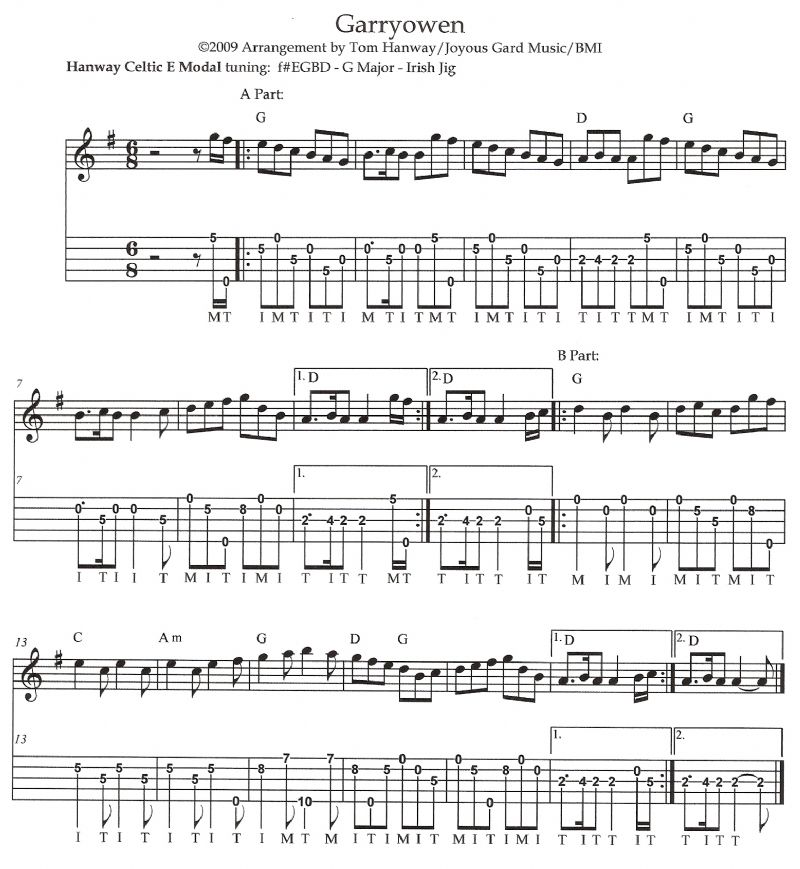
Patrick, see my first reply (directly above). It’s funny that you should bring up this Hollywood film, one of my favorites. Even without doing “due diligence” on the film arrangement of ‘Garryowen’, common sense has been telling me for years it could get messy (from a legal perspective) to transcribe and record the copyrighted arrangement for any of my Mel Bay collections – and the temptation has been great – going back to Complete Book of Irish & Celtic 5-String Banjo, where I settled on two transcriptions: (1) a bare-bones-jig version; (2) the Seventh Cavalry march-version of the tune (a little trickier). These can be played together, and the tune can be ornamented in other ways, also disassembled and reassembled as in the film score, which is an intervallic variation of the basic melody, a traditional approach to improvising or embellishing Celtic melody.
Mel Bay gave me permission (some years ago) to put up (from the "Complete Book") a few tab and mp3 samples to Banjo Hangout (exclusively), so here is an instructional recording of 'Garryowen' - Irish jig/American march from my first collection (1998).
Also, I have it tabbed in “Celtic E Modal” tuning (in my photos), which I stumbled across many years ago. I use this tuning (and related “Dogface” tuning) every now and again to re-fresh my ears and experiment with “complex tonality” and different modalities, in my photos under Garryowen. (Click on the link to open it in full-size.)
It’s a bizarre tuning, I admit, and it gives one unusual overtones from planet Vulcan Galicia. 
Best ~ Tom
KidfromDeliverance - Posted - 03/26/2013: 11:53:11
Thanks again for another learned reply, Tom. The "extra" tune that had caught my ear in the scene has to be "St. Patrick's Day," though I'm sure there's other stuff mixed in. And a good point about the potential legal issues tabbing out things like this, though I wasn't looking for that - I was mainly curious about the tunes being used. I don't have a tab handy for that one, but I might try my hand and working out something from the sheet music at The Session site.
Another good one that crops up in films and elsewhere, that you don't see in tab books, is "Lilli Bulero". A nice jaunty tune most everyone would recognize - I think it has some Irish connection, if not origin, am I right?
Patrick
g3zdm - Posted - 03/26/2013: 12:31:58
There are both Republican and Loyalist words to Lili Burlero, both most uncomplimentary to the other side and some versions too offensive to type here.
That tune goes well with Garryowen in a set - but Garryowen also upsets some folks. Both tunes play easily on the 5 string banjo though.
Chris Muriel, Manchester.
Tom Hanway - Posted - 04/06/2013: 18:33:00
quote:
Originally posted by redterra
That harp version is stunning and I think has a closer interpretation of the sound on the opening notes. goes beyond mere sadness to a more anguished lament, which is how I like it. You are putting in so much work on this, I really appreciate it. I had no idea how complex this song would be!
Suzy
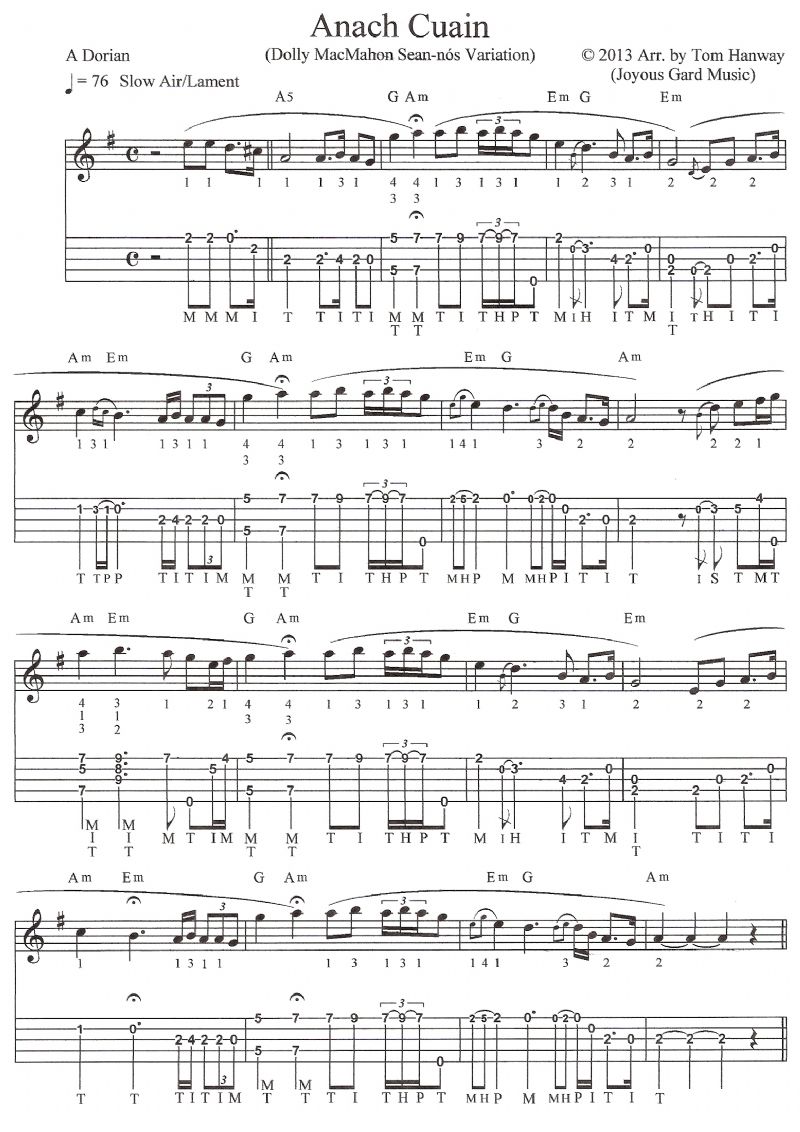
Suzy, the harp arrangement (as lovely as it is) I'm leaving for the time being, and I based my arrangement (for the most part) on the Dolly MacMahon variation of Anach Cuain. This version is how I would play it (though I can put in or leave out her variation at the top), and it's an advanced version. There are eight distinct phrases over seventeen measures (or sixteen full measures). I have indicated these phrases by use of ties above the standard notation. I added chords, and for Dolly's variation, which is an intervallic variation of the melody that adds an accidental (a C#) in the first measure, I use an A5 chord, a power chord, which has no major or minor third (just A-notes and E-notes), so this chord (neither major nor minor) would still work if one were to play the more common opening phrase (found here in the fifth full measure using Am/Em). I have several more variations for this lament, and I'm to say that two of them are "easy" bare bones melodies, i.e., variations that leave out ornamentation. This is the hard version, below. (It's not hard anymore for me, but it took a while.)
Suzy, I want you (and everybody) to see what this air looks like in standard notation (plus the banjo tab). As a beginner, you are not ready for this, and most beginners wouldn't be ready for this. It's very Irish, very sean-nós, and uses fermatas to indicate where notes can be held for longer duration.
Being able to play this very-ornamented arrangement requires being able to read music and having an intimate understanding of Irish and Celtic playing traditions, and the ornamentation is not far off what uilleann pipers would play, though a skilled piper might add even more ornaments by use of cranning and grace notes. So, for the craic, take a look at this. Best ~ Tom

Edited by - Tom Hanway on 04/06/2013 18:44:23
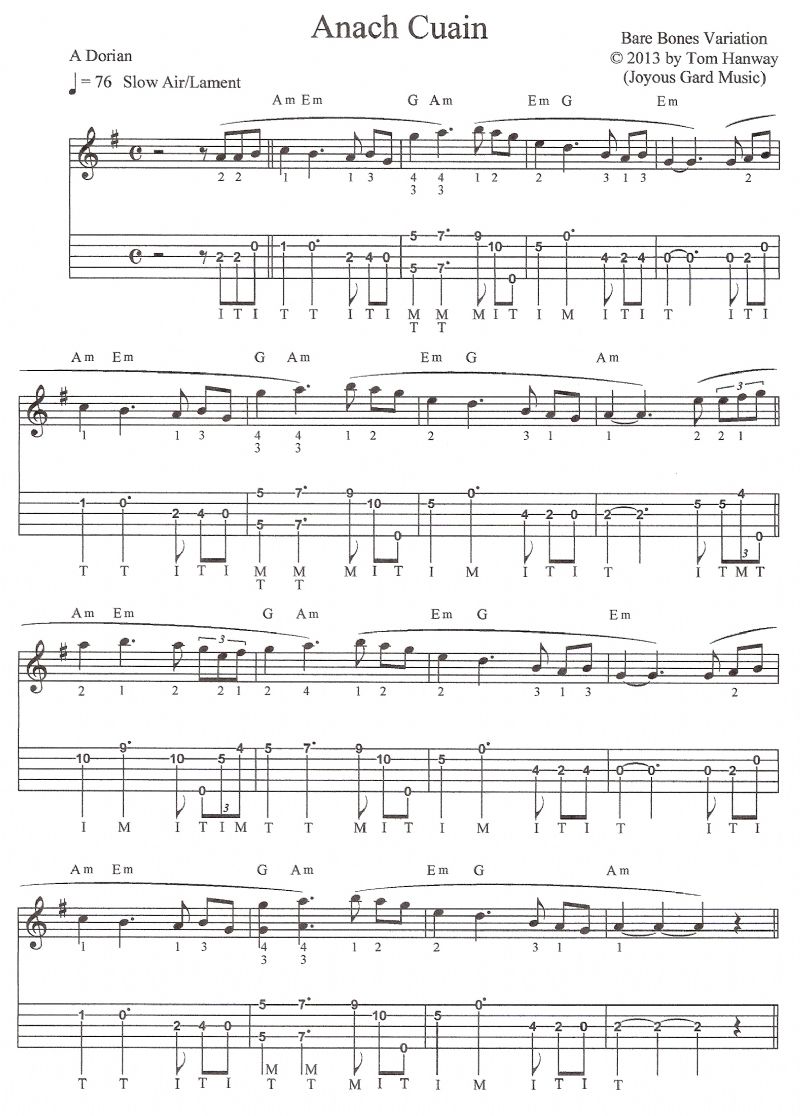
Tom Hanway - Posted - 04/07/2013: 14:55:31
Folks, above this transcription is a highly ornamented version of Anach Cuain in A Dorian mode. Here is a bare bones version for beginners, and for Suzy, who wants to learn to sing and play this Irish lament on banjo (for her Irish auntie). This setting is catered to her, and notice how I've put in fretting-hand fingerings underneath the standard notation. (I don't normally do this, but she's an absolute beginner. I hope it's not confusing: 1=index; 2=middle; 3=ring; 4=little finger.)
It's possible, of course, to mix the advanced (above) and beginner (below) versions, but I recommend starting with this beginner version. I will add another beginner version in E Dorian at some stage. A Dorian is the standard for this tune. For an aural reference, please check out the Dolly MacMahon variation. This setting is far simpler than what she sings, but I've got some of the basic melodic contour here (minus ornaments or melismata). (Tip: If the triplets prove difficult, just leave out the first note and play the last two notes of the triplet figure as two eighth notes.) I'm adding this tune to my vocal repertoire, now that I have it on banjo.
Thank you Suzy, for asking me to do this, and sorry it took so long. I absolutely love this, now that I've gone done the rabbit hole. Best ~ Tom 
Tom Hanway - Posted - 04/08/2013: 10:33:22
Okay, please see the bare bones beginner's setting above this one. Here is an updated arrangement for intermediate-advanced players. We have the poignant Irish air and lament, Anach Cuain in A Dorian. Notice that I've put in fretting-hand fingerings. This is not to be played too quickly, and it can be played with rubato. Notice the use of fermatas, where certain pitches can be held longer, stretching time. Enjoy. Best ~ Tom
Tom Hanway - Posted - 04/13/2013: 10:44:38
quote:
Originally posted by redterra
That harp version is stunning and I think has a closer interpretation of the sound on the opening notes, goes beyond mere sadness to a more anguished lament, which is how I like it. You are putting in so much work on this, I really appreciate it. I had no idea how complex this song would be!
Suzy
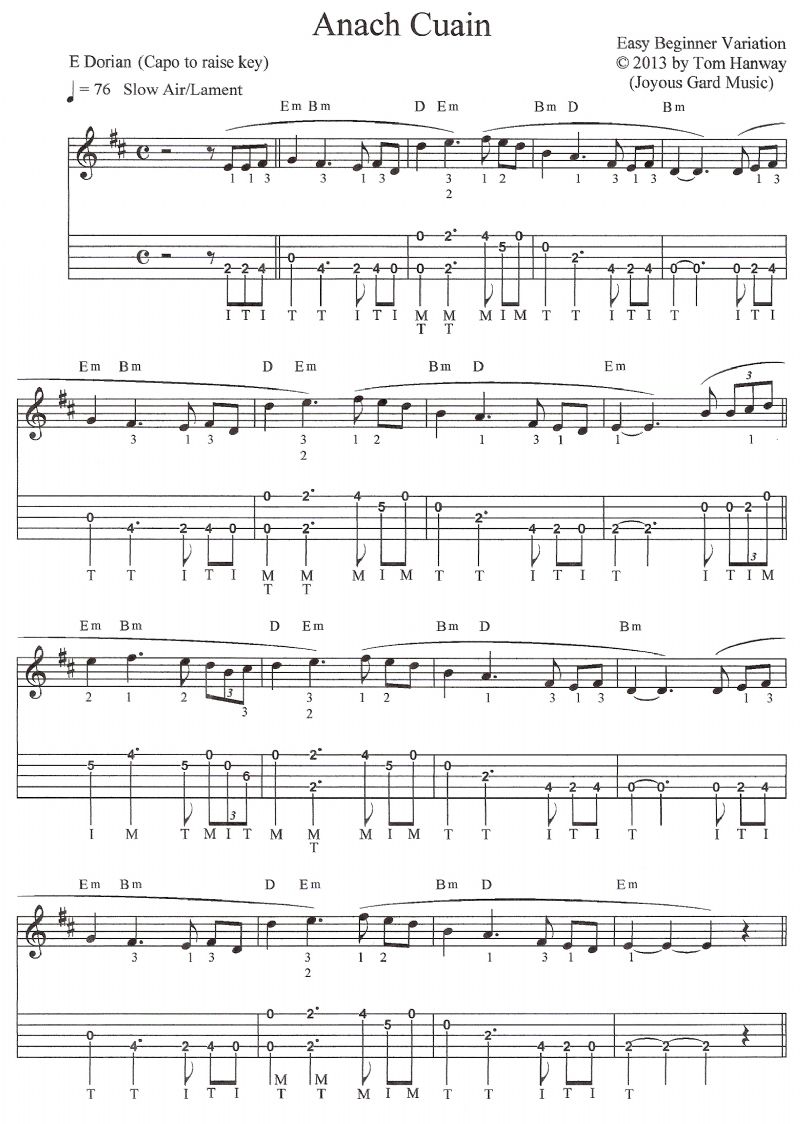
I've transcribed this simple arrangement for Suzy (who asked) and beginners who are interested in tackling Irish and Celtic tunes on the 5-string. This is the type of arrangement one finds in Best-Loved Airs and Session Tunes and Best-Loved Jigs and Reels . It's a beautiful slow air, and probably easier to play here than it is to sing, with fairly wide interval leaps. Now, folks may want to capo this, and one could go up five frets (also capoing the fifth string) to get to A Dorian, or play it anywhere in between, e.g., G Dorian (capo 3). This is as easy as it gets in Celtic fingerstyle banjo while remaining true to the basic melodic contour. This is the bare bones melody, transposed from the standard A Dorian to E Dorian. Of course, this can be arranged in countless other ways. This works for me, and I hope it helps beginners. Have fun, and take it one tune at a time. Best ~ Tom

Edited by - Tom Hanway on 04/13/2013 10:45:54
Tom Hanway - Posted - 04/13/2013: 17:12:01
Here's a cleaner version of the above transcription, with some very subtle changes. This is a very simple arrangement. Enjoy. Best ~ Tom
Terms of Use | Privacy Policy | Privacy Consent (EU/GDPR Only)
Copyright 2026 Banjo Hangout. All Rights Reserved.