DVD-quality lessons (including tabs/sheet music) available for immediate viewing on any device.
Take your playing to the next level with the help of a local or online banjo teacher.
Weekly newsletter includes free lessons, favorite member content, banjo news and more.
Premier Sponsors


|
Please note this is an archived topic, so it is locked and unable to be replied to. You may, however, start a new topic and refer to this topic with a link: http://www.banjohangout.org/archive/257135/2
BrittDLD1 - Posted - 03/09/2013: 08:24:34
Hi Wayne --
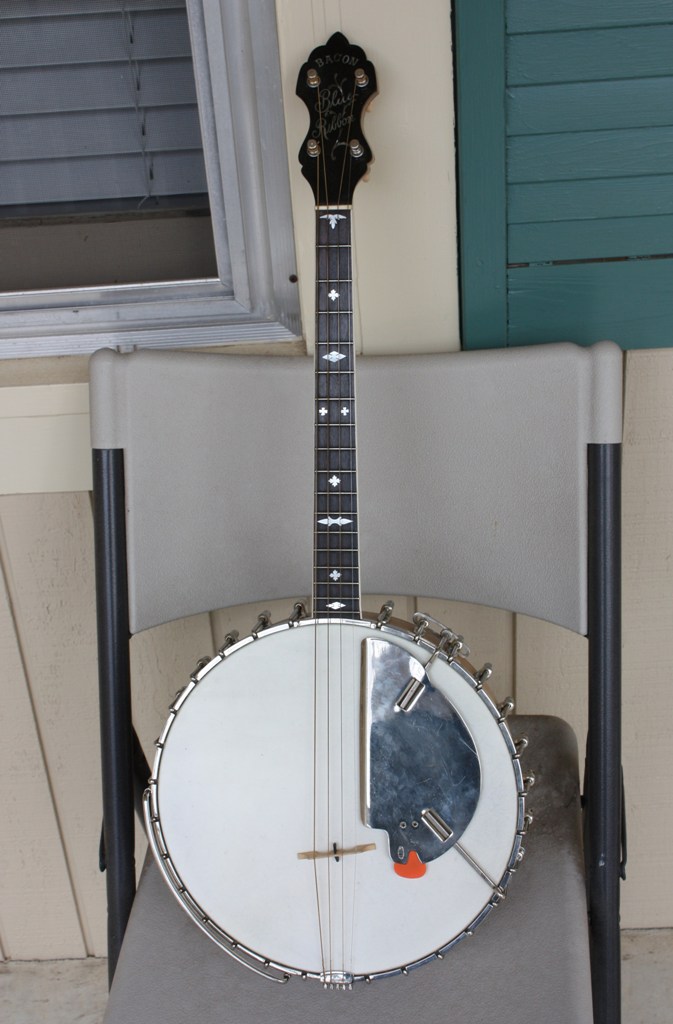
Your #7732 certainly sounds like a "De Luxe" Blue Ribbon -- so I assume it would have the "dark antique" finish. There were ONLY 2 finishes, at the time -- Natural maple, and Dark antique -- so I assume it would look the most like #7514, in my photos.
The type of resonator would have been just like #7514 -- the laminated one with the two metal plates, and a metal knob. Since the BRs (at that time) came in TWO rim sizes: 11" w/ 24 brackets, and 11-1/2" w/ 28 brackets -- you'll need to find a resonator that fits the INSIDE diameter of your rim.
The snap-in resonators ARE hard to find, for exactly the reasons that "mps Bob" pointed out: They tend to sound better WITHOUT the hubcap resonator. So... many of them were discarded, or left on a closet shelf. It's probably easier to have a solid lathe-turned resonator made, and finished to match -- than to find an original one in good shape. (But the metal plates are almost impossible to find.)
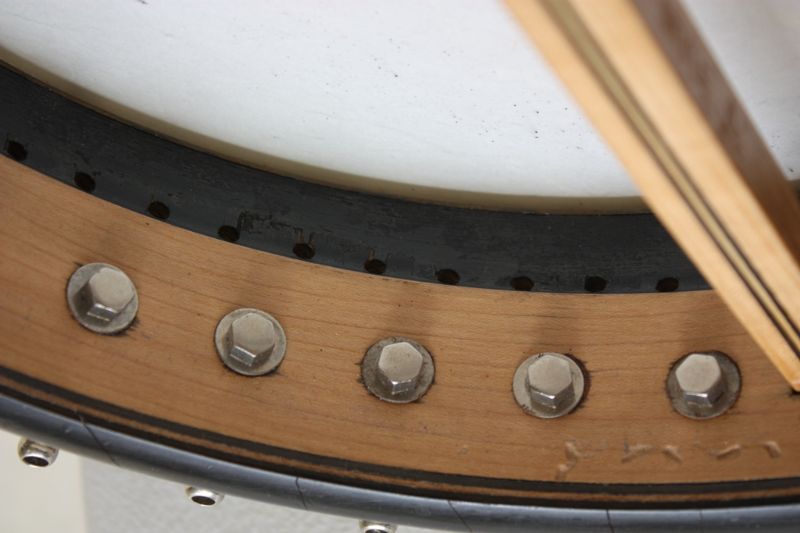
For that (short) time-period your banjo should have the 'standard' early 1/2-spun BR tonering. The tonering apron extends down the outside of the rim, and there would be metal grommets on the outside. But on the inside of the rim, near the head there is an inch-high beveled area, painted black. That black bevel MIGHT have white grommets in the holes. (Correct?)
The correct tailpiece for #7732 would be a gold-plated Grover 'square-hole'. (The predecessor to the "Presto".) Those are a bit easier to find (and cheaper), than the old Prestos -- but I don't believe any repros of the "square-hole' Grovers are being made. It's easiest to see the "square-hole' tailpiece on the 5-string, #7881 -- but it's missing its little cover, over the tail-end of the strings.
Best- Ed Britt
Edited by - BrittDLD1 on 03/09/2013 08:32:25
Wayne Holcombe - Posted - 03/09/2013: 10:32:44
Thanks Ed. Mine has the white grommets on the inside.The beveled area on mine has a wood finish,the same as the rim.The pot is 11 1/2 in. in diameter.I've get the original case with but someone cleaned out all the goodies in the pocket before I got it.I think I'll keep the same tail peice on it until I run across the right one.Since I plan on picking it should I use the skin head or replace it with a modern replacement ?What is the best way to adjust the string height?
Thanks again Ed,
Wayne
BrittDLD1 - Posted - 03/09/2013: 13:17:35
Marc --
That's a VERY nice example! That little inlay at the 1st fret is rare for one of this SN (after Day arrived). It was used on the early (Pre-Day) BRs. #6895 has that inlay at the 1st fret. (It was probably too "wild-'n'-crazy" for Day!) . ;-)
Best-- Ed Britt
BrittDLD1 - Posted - 03/09/2013: 13:54:23
quote:
Originally posted by Wayne Holcombe
... .Since I plan on picking it should I use the skin head or replace it with a modern replacement ?What is the best way to adjust the string height?
Hi Wayne --
Thanks for the info. Someone must have run out of black paint that day... Even the later half-spun B&D Blue Bells have the upper beveled area painted black.
If the skin head is tight, and its flesh-hoop is NOT touching the grommets, it might be best to leave it. IF a new head has too high of a 'crown' -- it could stretch, and the flesh-hoop could come down far enough to crush the grommets. (The grommets were Fred's idea... Not Dave's... ;-)
These banjos do NOT have any way to 'adjust' string action. Gibson came out with a single coordinator-rod design in the early '20s. but the idea hadn't caught-on. So... you have to raise or lower your action with a higher, or lower, BRIDGE.
The only other option is SERIOUS neck/dowelstick surgery... (Don't even think about it!)
Is the problem that the strings are too high? Or are they too low, and rattle? Is your fingerboard FLAT? Does it curve downward, in the middle? (Often called a "forward bend") Or does it curve upward in the middle? (Often called a "back bend")
One other RARE malady... Is your dowelstick straight? Or does it have a bend to it. The fancy De Luxe 5-string #8519 had a bend to its dowel. It required carefully heating and bending the dowel to straighten it... Needs to be done by someone who KNOWS how to do that.
(Most repair people have never even heard of that problem... I learned about it from an octogenarian here in town -- John Burgess -- who had been making and repairing banjos since he was a teenager, in the '20s. This was back around 1990.)
Best-- Ed Britt
Edited by - BrittDLD1 on 03/09/2013 14:00:55
Wayne Holcombe - Posted - 03/09/2013: 14:22:27
Ed, My neck appears to be straight.The strings are about 5/16 high where it touches the rim. It looks to have a 5'8 bridge on it.I guess that might be the best thing to adjust.
Side note: I've got a '75 Baldwin Ode, are you gathering serial numbers on those ???
BrittDLD1 - Posted - 03/09/2013: 15:43:35
quote:
Originally posted by Polle FlaunoeDo any of you know - how were the golden Bacon/B&D´s generally plated - gold over nickel as mentioned by Wyatt?
The reason for asking - I´ve experienced a few high grade Silver Bell´s, that were originally plated gold over silver over nickel.
Hi Polle --
Most of the EARLY (1921-1924) Bacons that I've seen, appear to have had the Gold over Silver, over Nickel. The Gold 'tarnishes' over time -- which should NOT happen. That's why I suspect there is Silver underneath the Gold -- which is tarnishing.
It's entirely possible that the later Bacons and B&Ds had the Gold directly over Nickel -- to prevent that type of tarnish.
Best-- Ed Britt
Edited by - BrittDLD1 on 03/09/2013 15:51:49
esmic - Posted - 03/09/2013: 17:50:18
Here are pics of what may be the last known Blue Ribbon, SN # 14134, with typical BR peghead veneer, but stamped Special, as it was likely assembled well after its time from left over parts. It belonged to the late Mike Seeger and has what must be the last iteration of the snap in resonator, with turned bead and nickel plated edge cap. As presently set up it is a wonderful classic finger-style player.
 |  |  |  |
 |  |
wfawley - Posted - 03/09/2013: 18:22:22
Hey Wayne ...... I have the correct tailpiece for your banjo if you're interested. The cover's missing of course, but its an original gold plated Grover "window" tailpiece. No need to email since I don't use email, but if you want to call me about 10 am tomorrow (724-943-4581) and give me your address, we'll sort out the details. It won't cost you an arm and a leg....maybe just a toe or a finger.
That's not the last Blue Ribbon ... yet. Just kiddin'. I am reduced to having to use big slingerland shoes on mine, but I mounted the tone ring this morning and just completed the inlay work. Norm's will be under lacquer tonight, with mine right behind. I'm going to use the dark finish on mine....leaving the maple laminations unstained. That's a great effect. I'll shoot some pictures when Norm's conversion neck and the "Fake-un" is done.
Wyatt
Edited by - wfawley on 03/09/2013 18:23:13
Polle Flaunoe - Posted - 03/09/2013: 18:30:06
Shawn,
FYI - In my database acoustudio.dk/BD_and_Bacon_database.html I have the records of two later examples - SN 15530 (TB) & SN 22138 (RB). I can´t tell much about these - they have been reported by Achim Hippenstiel and Carl Baron.
Polle
Polle Flaunoe - Posted - 03/09/2013: 18:45:52
quote:
Originally posted by BrittDLD1
quote:
Hi Polle --
Most of the EARLY (1921-1924) Bacons that I've seen, appear to have had the Gold over Silver, over Nickel. The Gold 'tarnishes' over time -- which should NOT happen. That's why I suspect there is Silver underneath the Gold -- which is tarnishing.
It's entirely possible that the later Bacons and B&Ds had the Gold directly over Nickel -- to prevent that type of tarnish.
Best-- Ed Britt
Ed,
Thanks! Most of the golden examples, that I´ve met, have been replated in the past - so it´s hard to tell something about the original plating.
But - the high grade Silver Bell´s with original gold-over-silver-over-nickel plating as mentioned by me are in fact late 20s/early 30s examples - so maybe they took up this plating again.
BTW - the silver gives the gold a fantastic bright shine - as maybe detectable here:

No tarnish at all!
Best - Polle
Edited by - Polle Flaunoe on 03/09/2013 18:49:12
BrittDLD1 - Posted - 03/09/2013: 22:04:08
ADDENDUM to: "The Bacon Transitional Banjos 1921-1924" -- posted above.
I should have pointed-out -- more clearly -- that ANY "Orchestra--Blue Ribbon", "Blue Ribbon", "Supertone Blue Ribbon", "Super Blue Ribbon", or "B&D Blue Bell" are VERY RARE. Not only were they developed in just 2-1/2 years, they were ONLY CATALOGED during those 2-1/2 years! (A few rare examples were made -- probably as special orders, or as 'floorsweeps' -- during the late-'20s, and 1930s.)
And... the "Bacon Blue Ribbons", and the "B&D Blue Bells" were NEVER CATALOGED CORRECTLY!
Even though the BRs were introduced in April of 1922, they were NOT shown in the Bacon "1922" catalog. (There is an exceedingly rare, half-fold one-page 'flyer' -- that was handed-out at the 1922 Guild show -- with black-&-white 'cuts' of the BACKS of the Style A, and the A1/De LUXE. But that was all it showed, since the BR peghead overlays probably weren't even finished, in time for the photos.)
The "1923" Bacon catalog was NEVER produced! They were running too far behind -- trying to get the B&D Silver Bell finished...
What SHOULD have been the 1923 catalog, came out as the "1924" Bacon catalog. (Which is the one commonly reprinted.) But the text and the photo-cuts are completely confusing -- because the company changed BOTH the details of the models, AND the names of the models, during the interim. Looking through it, we see such absurdities as:
o The B&D "Style A Blue Bell" described under a photo of a BACON "Blue Ribbon".
o The photo of the B&D "Style A Blue Bell" mandolin-banjo, has "B&D Super Tone" on in the peghead.
o The resonators on the B&D Blue Bells, in the catalog -- don't match the lathe-turned resonators on the actual banjos.
That's because the banjos were actually "Bacon Blue Ribbons" when the photos were taken! They had SOME of the original photos 'retouched' -- to change some construction details, and especially to show the new names and peghead designs.
At least the "B&D Super Banjos" are shown with the pegheads retouched correctly. (Except for the "De Luxe" tenor banjo -- which has "B&D DE LUXE TENOR" on the retouched peghead.) But again... the resonators in the photos don't match the lathe-turned resonators on the actual banjos.
More importantly, it turns-out that the FRONT images of the half-spun "Bacon Blue Ribbon" -- and the full-spun "Bacon Supertone Blue Ribbon", later renamed the "Bacon Super Blue Ribbon" -- were NEVER SHOWN in ANY Bacon catalog!
By the time the retouched images were published, in 1924, those models were already DISCONTINUED. They had evolved into the half-spun "B&D Blue Bell" (which only was ONLY described in the 1924 catalog -- and then discontinued), and the full-spun "B&D Super Banjo".
The "B&D Super Banjo" gained a full resonator, in 1925; was cataloged through 1928. After that, it was either discontinued, or it possibly 'morphed' into the "B&D Special" banjos, by 1930. After the "B&D Super Banjo" gained a full resonator -- no UPPER-level OPENBACK banjos were ever cataloged again, by Bacon. (To the best of MY knowledge.)
Best-- Ed Britt -- © 2013
Edited by - BrittDLD1 on 03/09/2013 22:09:10
wfawley - Posted - 03/10/2013: 08:26:16
Is the bullet catch that holds the resonator in place ... installed in the rim or is it in the resonator? I've figured out how to make the metal plates. I also know how to make a bullet catch, but need to know where it goes.
Wyatt
trapdoor2 - Posted - 03/10/2013: 09:56:03
It really isn't a trad. cabinet-maker's 'bullet catch'. The lower plate (with the knob) has a spring-tab with a dimple. The rim simply has a pin driven into it with a bit sticking out. The dimple in the tab falls over the pin and holds the whole thing together (along with friction from the perimeter felt). The upper plate has a thin tab sticking out and a grommet inlet into the rim. The tab fits into the grommet to locate the upper end.
I'll post some pix of the arrangement.
bigdream53 - Posted - 03/10/2013: 10:44:31
quote:
Originally posted by BrittDLD1
quote:
Originally posted by Polle Flaunoe
Do any of you know - how were the golden Bacon/B&D´s generally plated - gold over nickel as mentioned by Wyatt?
The reason for asking - I´ve experienced a few high grade Silver Bell´s, that were originally plated gold over silver over nickel.
Hi Polle --
Most of the EARLY (1921-1924) Bacons that I've seen, appear to have had the Gold over Silver, over Nickel. The Gold 'tarnishes' over time -- which should NOT happen. That's why I suspect there is Silver underneath the Gold -- which is tarnishing.
It's entirely possible that the later Bacons and B&Ds had the Gold directly over Nickel -- to prevent that type of tarnish.
Best-- Ed Britt
Hello Ed,
I've been checking out the discussion here and and I'd like to pick your brain here a bit regarding gold plating. Let me see if I understand you correctly.
Are you saying that with the "gold over silver over nickel plating", the gold tarnishes, or tarnishes more or more easily BECAUSE of the silver beneath it? If that's the case, what would be its advantage(s) over the "gold over nickel plating? Is it that, like Polle said, the gold holds a brighter shine with the silver beneath it?
What can you tell me about the two different methods...advantages and disadvantages, and proper handling and general maintenance of the two!
esmic - Posted - 03/10/2013: 12:11:51
Further to Ed's comment on BR rarity, and in the hope I'm not reinventing something already discussed elsewhere, Polle's database gives the opportunity to make some very simple, back of envelope approximations of BR production numbers, ( ignoring possible reporting bias or other data-scewing issues).
For the two or three interested readers, here is the approach : Approximate BR production period, (ignoring a few later exceptions) : SN 6500-9600 . Total Instrument production, all types, in this period : 3,100. The number of Polle database entries, all instrument types, for this period is 190, a sampling of about 6% of all factory production. A bigger sample would likely provide more accurate results, but after 90 years, the 6% is apparently the best one can do.
All BR entries for this period total 64, about 1/3 of the sample (64/190), suggesting the BR line was 30 to 35% of factory output. If that is so, the total BR production could have been about 1,000 instruments. Based on Polle's numbers : 36 tenors, 8 RBs, 3 PBs, 4MBs, 1GB, and ignoring the 13 ? (unknown), the production split within the BR line can be estimated as :
BR tenor 70% 700 units BR RB 15% 150 units BR PB 6% 60 units BR MB 4% 40 units BR GB 2% 20 units.
If this is accurate, BR tenors ruled, but Fred was still finding a BR market for his beloved five string and BR PB production was about 1 for every 10 TBs .
NYCJazz - Posted - 03/10/2013: 12:27:51
The tone ring on my '24 SB #2/3 has what I believe to be the original gold plating, and it's dull.
Just thought you'd like to know.

BrittDLD1 - Posted - 03/10/2013: 13:57:16
quote:
Originally posted by Polle Flaunoe
FYI - In my database acoustudio.dk/BD_and_Bacon_database.html I have the records of two later examples - SN 15530 (TB) & SN 22138 (RB). I can´t tell much about these - they have been reported by Achim Hippenstiel and Carl Baron.
Polle
Hi Polle --
#15530: I have a handwritten 3x5 card on #15530, It's a "B&D Super Banjo", that Norm Azinger had. I didn't mark the date on the card, but it was either from a telephone conversation with Norm, or a letter he sent to me. I have it listed as a "No. 1" -- but that was back in the late-'80s, when I was just starting to research the later "Transitional Bacons". It SHOULD be listed as a "Style A". It's an 11-inch rim, with the perforated FULL-spun tonering, and stamped 'grommets'. (Same tonering as the Super Blue Ribbons, and the early Silver Bells.) There is NO mention of it having a resonator -- so I assume it had a snap-in one, that was missing.
In your database, you have the possible date down as 1925. That's probably correct.
The 1925 Bacon catalog, used the SAME 17-fret "B&D Super Banjo" images (with snap-in resonator) as the 1924 catalog. And in the Price List ("Effective September 1, 1924) shows the Super Banjos was ONLY available as a "Style A" -- at $100. (A No.1 Silver Bell was $135 -- or $145 with geared pegs.)
As I mentioned previously, in late-1924 the "B&D Super Banjo" gained a FULL-resonator, with a flat-flange. (Bacon called the resonator a "B&D Tone Amplifier Chamber".) It also got a 19-fret neck. (As did the Silver Bell.) In the 1926 catalog, it was called the "Style A, B&D SPECIAL Super". With the full-resonator, armrest, and geared pegs -- it listed for $115. (The Silver Bell was $135 -- WITH armrest, and geared pegs.)
#22138: I also have a 3x5 card on this banjo. I saw it in-person at Jim Bollman's store, The Music Emporium, in Cambridge, MA -- during November of 1988. It's a 5-string with the "Bacon Blue Ribbon" peghead and backstrap. There was NO model stamp on the dowel. Matching serials on dowel and rim. It dad the "Groton" stamp on the dowel. 11" rim, with 26" scale. It had a typical "Style A" neck, with rosewood fingerboard, and typical late-inlay. It had what I NOW know to be the "B&D Blue Bell" half-spun tonering -- but it was NOT perforated. (So, there were NO grommets in it. ) The rim-bottom was painted black, with NO binding, and there were NO features for a snap-in resonator. It had 24 brackets, and a Kerschner tailpiece on it. They were asking $1150 at the time.
I assume #22138 was either a 'special order" -- for a simple openback 5-string. Or else, it could have been a 'floorsweep' -- purposefully made to use-up some older discontinued parts, and create a salable banjo.
Best-- Ed Britt
PS...
I'll try to follow-up with a bit more depth, on some of the other comments, after my nap... But for the moment:
Wyatt --
On the thick, Lathe-turned resonators... YES, a "bullet-catch" WAS used. It went into the edge of the resonator, and there was a larger grommet, in the rim -- for it to snap into. (I worry about ripping the little knob out... because it takes some serious pulling to remove it.)
Marc --
MULTIPLE variations of the 'latch' were tried, over time. Including the one you mention. All of them had pluses and minuses. The bullet-catch was best.
Ron (bigdream53) --
You'd have to talk with a jeweler/plater to know the pros and cons of what-to-plate, over-what. It's simply MY observation that the gold-plating on the EARLY Bacons would tarnish heavily -- going from a brownish color to some blue-ish/purple blotches. The blue-ish/purple blotches look like silver-tarnish to me. I've never seen gold plating do that, otherwise.
Shawn (esmic) --
I'm on-record -- 20 years ago -- as saying the Silver Bell was developed specifcally as a 5-string -- but became one of the most popular 4-string banjos. A few years into my research... I found-out that I was completely WRONG!!!
The Bacon Blue Ribbons (and the subsequent variations) were SPECIFICALLY developed to meet the needs of the 4-string orchestra musicians. (And your production estimates clearly show that intent.)
Fred Bacon TOURED with the THEN-well-known tenor player, Mike Scheidlmeier, and used him as Bacon's "test pilot" for the development of the BRs. Mike demo'ed the half-spun BR's at the Spring 1922 Guild show -- and the full-spun Super Blue Ribbons, at the Spring 1923 Guild show. In June of 1923, Mike INTRODUCED the new B&D Silver Bell to the WORLD (and represented The Bacon Co.) -- at the Chicago music trades convention. (And David Day did many HEROIC deeds, during that period -- to pull it all together!)
EJB
Edited by - BrittDLD1 on 03/10/2013 14:08:21
Deaf Lester Crawdad - Posted - 03/10/2013: 14:25:29
quote:
Originally posted by bigdream53
I've been checking out the discussion here and and I'd like to pick your brain here a bit regarding gold plating. Let me see if I understand you correctly
Are you saying that with the "gold over silver over nickel plating", the gold tarnishes, or tarnishes more or more easily BECAUSE of the silver beneath it? If that's the case, what would be its advantage(s) over the "gold over nickel plating? Is it that, like Polle said, the gold holds a brighter shine with the silver beneath it?
What can you tell me about the two different methods...advantages and disadvantages, and proper handling and general maintenance of the two!
Gold itself does not tarnish. Nickel does, and slowly becomes duller and grayer as it ages. Silver not only tarnishes, but eventually turns black. But silver is initially brighter than nickel, and gold plating is generally so thin that the underlying material shows through to some extent.
That means gold plated over silver initially has a brighter, lighter color than does gold over nickel. But as the underlying silver begins to turn darker and darker as it tarnishes that shows through the overlying gold plating as well, and gold plated over nickel generally looks better longer than does gold over silver.
At least that's been the case with many of the older banjos I've seen over the years.
Helpful?
~Pete
wfawley - Posted - 03/10/2013: 22:27:56
You passed, Bill.....
On the subject of plating gold over silver ... The vega deluxe I have here in the shop is plated that way, and so is the window tailpiece that I'm sending outto Wayne Holcombe tomorrow (if I can get there before noon ... they're killing our PO). The window tailpiece came from a style X banjo mandolin with a full 10 15/16" rim. Most of those were smaller and had the tailpiece riveted and soldered to the stretcher band.
Norm's coming tomorrow morning to pick up his Blue Ribbon conversion and a couple other more trivial things. I ought to have some nice pictures of 2 banjos tomorrow afternoon. Even though one's not old, it proves that not only "dead people" were able to build this stuff. I take no particular solace inknowing that after I'm dead ... my work will have broader appeal. Seems that's how it goes though. I used to joke with Vickii about faking my own death to improve sales.
Gotta run ... still lots to do.
Oh ... Thanks Ed, for the information regarding the bullet catch. The one and only Blue Ribbon I ever owned was way back in the early 80s, so I figuredI just didn''t remember it correctly. Every banjo has a story and I have fond recollections of this one. The local paper had done a human interest story on my work with banjos and the Mon Senor of the local Catholic Diocese showed up at my door with this banjo in it's emerald green lined HSC. It was in beautiful condition, and he asked what I would give for it. I told him "300 dollars on friday" ... to which he replied "how about 50 dollars today" ... and it didn't take me long to figure out which was the better deal....and I had the 50. May be one of the best buys I made when I was still "wet behind the ears". I think Dick Powell ended up with that banjo, and if he did, it found it's way to Norm .. almost certainly.
Wyatt
Polle Flaunoe - Posted - 03/11/2013: 01:38:07
Ed,
Thanks for the clarifications. I´ve revised the DB - now with you as the reference for the two banjos.
Achim´s records do carry many mistakes and errors - I´ve found many myself and either corrected them or removed the banjos in question from the DB.
I now call #22138 a BACON BLUE RIBBON CUSTOM - in order not causing confusions.
Polle
BrittDLD1 - Posted - 03/11/2013: 07:29:45
Wyatt --
The 'bullet catch" was only used on the later, 1923/24 B&D Super Banjos, and B&D Blue Bells -- which had the heavy lathe-turned snap-in resonator, with the raised ring. Since you are taking some 'liberties' with the resonator design... I figured THAT would work the best.
The EARLIEST snap-in resonators used a wimpy little bent staple (in the edge of the resonator) for the 'spring'. The rounded-head of a little brass brad, nailed into the inner surface of the rim, was used as the 'catch'. They weren't 'robust', and simply DIDN'T work. The felt trim, glued around the edge of the resonator, held the resonator in better than that -- just by itself.
On the resonators with the little metal plates... The little 'tooth', on the upper "Bacon" plate, will often break off.
Best-- Ed Britt
Edited by - BrittDLD1 on 03/11/2013 07:36:32
wfawley - Posted - 03/11/2013: 13:32:46
Norm left a little while ago, and while I did complete his Blue Ribbon, mine's got a little ways to go. I'm going to eat and take a (much needed) nap.I've been "on the clock" for 21 hours. Just a wee bit tired.
I may lathe turn a maple resonator for it next time I get some maple. I don't think I can bring myself to alter the spin on. I have the hardware for it that Norm didn't have.
Didn't make the post office this morning, Wayne, but will tomorrow for sure.
Wyatt
 |  |  |
NYCJazz - Posted - 03/11/2013: 17:03:44
Pretty fancy for a brand new 5-string!
Let's see the original neck, so we can check your work!
wfawley - Posted - 03/11/2013: 17:17:53
I'd have been happy to do that,Nathan, but Norm had already packed it up and taken it home. I could have used the originaldowel stick very easily. The glue joint had failed, and while it was still snug in the neck, it is a simple matter to pull it out. The five string neck has a new dowel stick and the original is still inthe tenor neck.
I did get the resonator and hardware (wall lugs/thumbscrews) for the Gibson GB-1 pot today.
Wyatt
NYCJazz - Posted - 03/11/2013: 19:36:31
It's not finished, but it's making music!
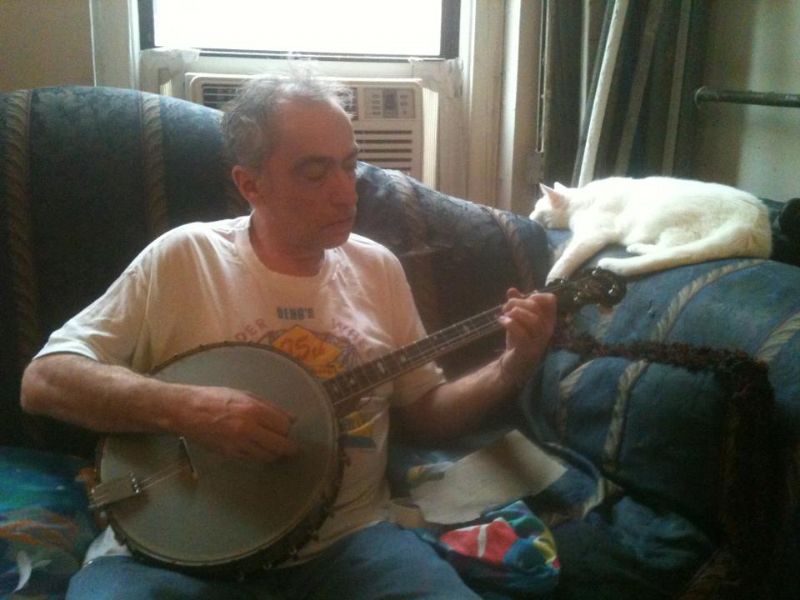
I'll have my wife shoot some video of me playing it later. It has a complex, unique sound.
BrittDLD1 - Posted - 03/12/2013: 08:22:57
Wyatt --
VERY nice job on that! It works well with the custom details. The early "orchestra" inlay looks great with the early rim, and 2-knob resonator. (Even though the originals were abalone...) The bound peghead is also a nice custom touch. Looks like Norm's gonna have a lot of fun with it! Enjoy tour nap!
Best-- Ed Britt
PS: I'm very GLAD you kept the original dowel WITH the original neck. (Unless the original neck is completely shattered.) No one is fooled by an original dowel in a repro neck. This way the original tenor neck stands a chance of being kept -- with the original rim and the new repro neck. (As it SHOULD be.)
Nathan --
Nice to see it's back together -- even if it still needs some tweaks.
Edited by - BrittDLD1 on 03/12/2013 08:31:53
Wayne Holcombe - Posted - 03/12/2013: 13:20:09
Ed, The dowell stick on mine is not marked.Is that unusual?
Wayne
BrittDLD1 - Posted - 03/12/2013: 16:00:43
quote:
Originally posted by Wayne Holcombe
Ed, The dowell stick on mine is not marked.Is that unusual?
Hi Wayne --
For a serial number in the range of #7737 -- and especially for a "DeLuxe" model -- YES, that is a bit strange. David Day was already at Bacon, for a few months, by the time yours was made. So... the dowel SHOULD be stamped with:
For THAT period, the dowel should also have black/white/black wood stripes inlaid on the back of it. But check the side of the dowel closest to the head, with a mirror. Sometimes the dowel was installed wrong (at the factory) -- and the some of those stampings are on the side toward the head. During this period, the finish (color) on the dowel should also MATCH the finish on the neck, and on the rim.
IF the finish on the dowel does NOT match the instrument finish; if the dowel does NOT have inlaid stripes on it; If there is NO SERIAL number stamped on the dowel (towards the heel of the neck) -- THEN the neck has been 'mucked-with'. The neck or dowel have been swapped, or replaced, it's a NON-factory repair, etc., etc. And that means it's "NON-original" and 'suspect'.
The banjo may WORK just fine... but that 'discrepancy' will lower its 'collector-value' -- if it has any. (A De Luxe model usually DOES have some level of value to collectors -- even with some damage -- as long as it's restoreable.)
As usual... a few close-up photos of the dowel, and the heel of the neck, will provide visual information for a better answer to your question.
Best-- Ed Britt
Edited by - BrittDLD1 on 03/12/2013 16:02:11
Wayne Holcombe - Posted - 03/12/2013: 16:40:19
The dowell is finished in a natural color.It has 6 plies laminated together that are the dowell stick.It has the same shape as the one on my Peerless.I checked underneath,next to the head and found nothing there.The serial number is on the tim.
I'll get some pictures up as soon as I can.my photo arn't working to well on my computer.
wfawley - Posted - 03/12/2013: 16:40:20
Hey Ed ....Thanks for the compliment on my work. But ... Norm's original inlays, (aside from the vine segments in the headstock), on the tenor neck were executed in white pearl and not abalone. The only real custom appointment was the headstock binding and the inlay at the 10th fret, which is a "tweak" of some of the others. Also, the inlay on the reverse of the headstock, I elected to cut from one large piece of pearl rather than have to mess around with aligning the 4 pieces correctly. If my astigmatism wasn't such a problem, I'd have cut the 4 pieces as I always have in the past.
Oh yeah ... these new necks have 2 way truss rods installed, adjustable at the end of the fretboard, so I guess that's kind of "custom".
I'll be doing the antique finish on mine, and I am going to make a resonator for it...as soon as I can. I hope to post pics of it soon.
Wyatt
Wayne Holcombe - Posted - 03/12/2013: 17:47:59
Ed, I'm still having no luck on my pics.If you'll send me an address I'll send a cd of pics with the BR and a couple of other tenors I've got here.You won't hurt my feelings if the BR is not right,I got it 15 years ago and its been put up since then.Around the same time I also acquired a Florentine.I was doing a lot of carving then and was looking for study pieces.Fortunately I've still got most of the banjos I've ever bought.When I go there is going be one heck of a yard sale in southern Michigan.Until then I'm trying to do all the fixing and picking I can.
Wayne
wfawley - Posted - 03/13/2013: 06:42:57
Wayne ... Your tailpiece is enroute to your Brooklyn, Mi address.
Here is the "Fake-un" Blue Ribbon. It's still a work in progress. Norm's sending me 4 more shoes and bolts/washers, and I'll buy a set of modern nuts that are relatively close to the correct style. I have to polish the gold plating off of the ring yet, and just go over it one more time with 320 paper and do the finish. The dowel stick clamp is the correct style, but I didn't have the "flesh hoop" style shim, so I just used a later one like you see on Slingerland banjos. Works well enough for me. I also elected to use a heavier pin in the clamp arrangement. The originals were too thin and are always bent.
I suppose this would be closest to a "super blue ribbon" ... but without the metal cap on the rim?
Wyatt
Edited by - wfawley on 03/13/2013 06:46:58
 |  |  |  |
 |
BrittDLD1 - Posted - 03/13/2013: 07:34:55
quote:
Originally posted by wfawley
... I suppose this would be closest to a "super blue ribbon" ... but without the metal cap on the rim?
Hi Wyatt--
Looks great!
You could always call it a c.1925 CUSTOM "Super Blue Ribbon" -- with a "No-hole" Silver Bell tonering. The first no-hole rings were shown in the 1925 Bacon catalog. It showed BOTH types: Silver Bell No.1, and Montana "Special"-- had NO-holes; Silver Bell No.2 and No.3 had holes. (Although, I believe the "NO-holes" did still have the 'fake grommet" holes on the INSIDE.)
Also... The B&D Blue Bells, introduced in mid-'23, DID NOT have the spun rim caps. The snap-in lathe-turned resonators had a spun-metal 'bezel' around the edge, instead. See the dark finish Blue Bell #11254 -- at the far right -- in my table-o-Bacons photos.
Best-- Ed Britt
Edited by - BrittDLD1 on 03/13/2013 07:42:51
wfawley - Posted - 03/13/2013: 08:09:10
That gives me an idea of which resonator I need to build. I don't know that I have the capability of trimming the outside edge like the original. For the "plates", I have some really heavy german silver napkin rings ca 1880, and I'm going to trash one of those for the material to make the plates from ... unless one of the serving spoons I have is actually thick enough. I was ratting around looking for something the other day and spies a little nickel plated knob that will be perfect ... problem is going to be figuring out where I saw it. I'm still transitioning to the new workspace, and there are a lot of little boxes of stuff crammed in this cabinet and that cabinet. It'll be perfect if I can find it again.
The neck on this banjo is a 26 inch scale. It was actually a fretboard that was salvaged from an aborted job that I felt was too narrow ifI were to bind it ... and I had glued it to an ebony base so I could create the ledge for the binding. It should have been run through the thickness sander. It's a little thicker than I would have preferred and that "bit me in the butt" in a big way, because had I taken it down to a dimension more in keeping with a Bacon ... the backstrapping would have been completely gone. Still, it's got the curb appeal, or will have when its finished... and somebody with big hands will like it.
I put a nice set of vintage friction tuners on it and am actually going to string it with nylon. The maple in this neck is so hard and the neck so "substantial" that it really was a waste of a truss rod. I suppose the neck could move due to humidity, but even the heaviest steel strings wouldn't have made this one bow forward. Some maple you can run through the shaper and it cuts really nice ... and then the stuff like this tends to want to burn. I need to dress the shaper cutter, and this neck made that glaringly obvious.
When this is done, I will brand the dowel stick with my own brand. I may brand the rim as well, though I'll need to modifythe length of the branding iron to do that, unless I brand it on the outside.
Thanks for the input.
Wyatt
Wayne Holcombe - Posted - 03/13/2013: 10:44:27
Ed, Enjoyed our chat this morning.I got the cd disc sent. After looking at the serial number with more light it looks like 7752.The stamping of the 5 makes it hard too see.
wfawley - Posted - 03/15/2013: 11:26:03
Good to talk to you again, Wayne. It'd been a long time. I was glad to help with the tailpiece. I wasn't going to use it on the Vega anyway. I appreciate the compliment on this banjo. I don't know why I even built it ... I guess because I could. I am going to brand the neck and the dowel stick both so there'sno confusion somewhere down the road. I am going to do it so that Half of the brand shows along the edge of the heel where it meets the pot, and the other half will be aligned and branded into the pot. It will just look as though it were folded. I'll do it on the first string side, and with the dark finish, it should be unobtrusive. It will keep the banjo from being misrepresented at some point, though. While guys like Ed and a few others could spot it as a copy across the parking lot ... most could not tell it from a Bacon instrument.
Wyatt
Edited by - wfawley on 03/15/2013 11:26:43
NYCJazz - Posted - 03/15/2013: 14:30:03
The rim looks small.
The proportions look off.
Only 24 brackets?
I don't think you'll have any problem with any misrepresentation!
My wife posted that photo of me and the BR... and the first response was "That's a big @$$ banjo"( this comment from from a non-musician! ).
Thanks to Ed, (and my wonderful Bacon tenor banjo), I can count myself as one who could spot the fake from across the parking lot!
Edited by - NYCJazz on 03/15/2013 14:49:32
wfawley - Posted - 03/15/2013: 16:52:20
People try and pass stuff all the time that, to somebody "in the know" might seem laughable ... but somebody who has no knowledge, it's a different story. It happens every day.
Wyatt
Wayne Holcombe - Posted - 03/18/2013: 10:34:33
I'm picking up some strings and a bridge today so using the new/old Fawley tailpiece and the original head I'l see if I can coax some music out of my Blue Ribbon.
Wayne
NYCJazz - Posted - 03/18/2013: 12:52:59
That's great, Wayne! I've been getting lots of use out of mine!
Wyatt-
If you're serious about the faux Blue Ribbon, why not go all the way and drill the ring and the rim (maybe even do the grommets) and cut off the inside lip of the ring? Give the inside of the rim some nice black paint...
That IS a repro Silver Bell ring,right?
It won't be the proper 11.5" size, but everything else would be a lot less fake!
wfawley - Posted - 03/18/2013: 13:24:33
That banjo wasn't meant to be a slavish "copy" ... just some stuff I had on hand that I decided to put together simply because I have fond recollections of the tenor I had and I have always thought that headstock inlay was so tastefully designed.
It wasn't meant to portray a Blue Ribbon to the last detail. It's just a "Bacon inspired" instrument, and a modern player all the way. As you'd mentioned, the 11 inch pot with 24 brackets, and 26 inch scale are dead giveaways ... but those are also things that appeal more to modern players.
I am going to turn a resonator for it though....mostly because somebody probably needs that Vega spin-on, and I don't want to make irreversible alterations to it. They aren't going to make any more of those.
...and yes, the ring is a modern one.
Wyatt
Edited by - wfawley on 03/18/2013 13:26:13
Terms of Use | Privacy Policy | Privacy Consent (EU/GDPR Only)
Copyright 2026 Banjo Hangout. All Rights Reserved.