
DVD-quality lessons (including tabs/sheet music) available for immediate viewing on any device.
Take your playing to the next level with the help of a local or online banjo teacher.
Weekly newsletter includes free lessons, favorite member content, banjo news and more.
Premier Sponsors


|
Please note this is an archived topic, so it is locked and unable to be replied to. You may, however, start a new topic and refer to this topic with a link: http://www.banjohangout.org/archive/245844
Cisco - Posted - 09/26/2012: 15:28:37
How much of a learning curve is there in switching to a fretless after playing a fretted banjo for many years? Other than not having the frets to tell you where notes are, I imagine there must be other issues.
J-Walk - Posted - 09/26/2012: 18:02:01
I've found that it works much better if you don't think about it too much. Let your ears guide your left hand. Easier said than done, of course. But I think that's what it's all about.
jduke - Posted - 09/26/2012: 18:33:02
I don't play a lot of fretless, but have always had one and pick it up now and again. My arrangements of tunes for the fretless include many more slides than my usual style, and is enough different than fretted playing that I don't seem to have much trouble. Like J-Walk said, your ears will guide you and you will adapt quickly.
aeroweenie - Posted - 09/26/2012: 18:36:20
I find it harder to get clear notes. Many use a bit of fingernail when noting to get a clearer note, but it takes some practice. I find it fun to play but I doubt I will ever be skilled enough to really exploit the difference between a fretless and fretted banjo. Its easy to overdo the slides!
John Gribble - Posted - 09/27/2012: 03:40:25
There are two issues. First, of course, is playing in tune. Make sure your banjo is in tune (with a tuner) every time you pick it up. That way, the notes stay in the same place. Also, check with your tuner to see if you are playing in tune. Your ear is probably already pretty good, but it doesn't hurt to check. I find I have "good days" and "not so good days" when it comes to playing in tune.
The second issue is the tone. They are not as bright-sounding as a fretted instrument. This is especially true with metal strings. There is a big difference in tone between open and "fretted" strings. Some players use the edge of their fingernail to stop the string, rather than the fingertip.
My Bowlin fretless has heavy, low-tuned nylgut strings. The difference between the fingered and open strings isn't as noticeable, and I like that.
When you take up fretless, put your fretted banjo away. Forget you own it and really make a commitment to the new instrument. I love mine and play it daily.
rudy - Posted - 09/27/2012: 03:56:37
Cisco, Ditto all of the previous posts. I would say also that if you're already a fretted player its not difficult to switch if you predominantly stay in the area of the first five or so "fret positions". Your intonation will become exponentially more difficult as you play higher up the neck. That might seem to be a fairly obvious statement, but until you actually play a fretless you won't realize how difficult it can be to accurately play higher notes. All that said, you might opt for a flush fret jo if you like to venture beyond the lower position fingerings. Here's a flush fret example pic:
 |
hoverflytheo - Posted - 09/27/2012: 04:06:46
Brass plate on the fingerboard can help a lot with clarity. When I defretted one of my banjos, I started off by filing the frets down so I could see the flush frets to show my position. Then I decided they were buzzing a bit, and also surplus to requirements, so I pulled them out.
Metal strings on plain wood fingerboard was a bit muted for my taste, and although I experimented with nylon, I really wanted to projection and retunability of steel.
So, in the end, I stuck a brass plate over the fingerboard between the nut and the 10th fret. Nut to 5th or 7th fret is also common, but that happened to be the length of the board I found, and it also neatly encompasses my usual playing range (for instance, up to the high D in double D tuning.)
I also use a Grover acousticraft bridge with plastic inserts, which gives that bit more sharpness to the tone, and with those modifications, I'm usually quite satisfied with the sound of the banjo.
R.D. Lunceford - Posted - 09/27/2012: 10:28:24
It sort of depends on what your fretted repertoire and style were like.
If you are already playing in a traditional CH style the transition will be quicker.
If your repertoire is highly melodic, uses lots of full chords for brushes, or involves
up-the-neck work, it will be harder.
As above, be sure your banjo is in tune. That way if you hit a bum note, you'll know it's
you and not the banjo.
The only real strategy is to jump in with both feet.
Cisco - Posted - 09/29/2012: 12:06:16
Thank you everyone. Using the fingernail when noting , the brass plates, and tuninig often are all good advice/suggestions..
And also the advice to not stray above the fifth fret (what did Stringbean say ? ... there's no money above the fifth fret )..
jgwoods - Posted - 09/29/2012: 12:14:01
Because there is no fixed scale length you can put the bridge anywhere you please. That makes it so you can set the scale so your natural reaches- for example reaching up to the 5th fret with your pinky- come out in tune.
In other words if you find you are always playing flat push the bridge towards the neck a ways and see if that puts your notes right.
banjo bill-e - Posted - 09/29/2012: 12:24:00
------"(what did Stringbean say ? ... there's no money above the fifth fret ).."
Still looking for all that money to be made *below* the fifth fret!
oldwoodchuckb - Posted - 09/29/2012: 13:32:49
I suggest counter topp material instead of brass. Many people are allergic to metals (especially metals like brass, that produce a lot of oxidation) and don't find out about it until they start sweating onto a metal finger board.
Slick Salmon - Posted - 09/29/2012: 14:56:16
quote:
Originally posted by oldwoodchuckb
I suggest counter topp material instead of brass.
Granite? :)
grumpsie - Posted - 10/02/2012: 15:41:14
I am experiencing said learning right now. It's like anything really, if you have a good basic sense of the fingerboard you will pick it up well enough to have fun pretty quick. But to do it really, really well will take a lot of practice.
I think I dreaded it more than necessary before I began, as it really was a lot easier to get to a decent level than I expected. Best thing is it has improved my ear immensely as a side benefit.
RD's comment on the different qualities of different playing styles is money.
I also have good and bad days. Bad days tend to be more frequent the less I play the fretless (I guess this may be obvious).
Edited by - grumpsie on 10/02/2012 15:43:31
Don Borchelt - Posted - 10/03/2012: 06:58:39
Rudy wrote: "would say also that if you're already a fretted player its not difficult to switch if you predominantly stay in the area of the first five or so "fret positions". Your intonation will become exponentially more difficult as you play higher up the neck."
RD wrote: "It sort of depends on what your fretted repertoire and style were like... If your repertoire is highly melodic, uses lots of full chords for brushes, or involves up-the-neck work, it will be harder."
If you like to go up the neck a lot, you might want to consider a semi-fretless neck, where the brass plate or whatever stops somewhere around the 5th to 7th fret.
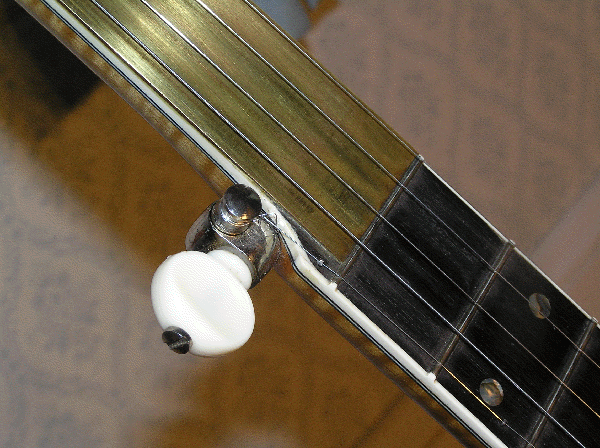
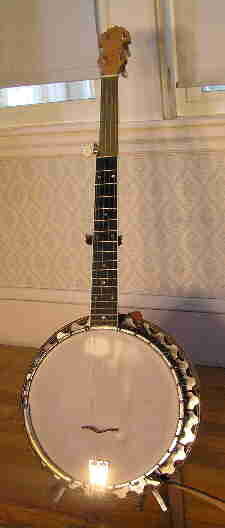
I use a brass plate, which tapers down to a knife edge starting about halfway between the 4th and 5th fret position, and ending right behind the 5th fret. Thus the 5th fret is functional. Some just have the plate end abruptly, so that your fretting finger basically falls off a micro-cliff when it leaves the plate.
Edited by - Don Borchelt on 10/03/2012 06:59:15
banjoak - Posted - 10/03/2012: 10:47:27
Intonation IMO is the most difficult part- on a fretted instrument your fingers are slightly behind the note, and can be a little loose in exactly where behind the fret. On a fretless your finger is the intonation, and needs to be much more precise. One aspect of letting your ears guide you is It might require you to improve your ear, hone your listening skills. I notice this struggle with many fretted players picking up fiddle; you would think mando players would easily get intonation, but it's as if they were never listening that close to intonation.
One thing I like about fretless is that you can play outside of equal temperament; use the "in-tune" just intonation; For gDGBD you would tune the B note slightly flat to ET tuner; as well as playing tunes with neutral thirds and sevenths; but it does require not thinking of the notes in a straight line of a fret.
maryzcox - Posted - 10/03/2012: 13:22:59
If you have your fretless custom made to you to fit your left hand--you won't have any intonation problems because when you put your fingers down, they will be in the exact right place. :) RD & I both have John Bowlin 1865 fretless banjos & John used tracings of our left hand to make the neck. I'm sure RD's hands are much bigger than mine--so although his banjo fits him--mine fits me just right too. :)
Best wishes,
Mary Z. Cox
conohawk - Posted - 10/25/2012: 20:20:55
I was delighted to find this thread. Eric Prust is sending me one of his A-scale fretless banjos. My intent is not to switch over 100%. But, I have duly noted the advice about putting aside my fretted banjo for a good while.
Terms of Use | Privacy Policy | Privacy Consent (EU/GDPR Only)
Copyright 2026 Banjo Hangout. All Rights Reserved.


