DVD-quality lessons (including tabs/sheet music) available for immediate viewing on any device.
Take your playing to the next level with the help of a local or online banjo teacher.
Weekly newsletter includes free lessons, favorite member content, banjo news and more.
Premier Sponsors


|
Please note this is an archived topic, so it is locked and unable to be replied to. You may, however, start a new topic and refer to this topic with a link: http://www.banjohangout.org/archive/243122
Page: 1 2
jbalch - Posted - 08/18/2012: 13:32:12
I bought this banjo on ebaY. It was sold as a Baldwin style B. But I don't really know what it is. Any ideas?
The parts look like original Baldwin/Ode to me. But it is a strange combination. This banjo shipped form north-central Arkansas. Maybe it is a floor sweep model of some sort dating from when the Baldwin factory was not too far away. Or maybe it is just a collection of parts....who knows?
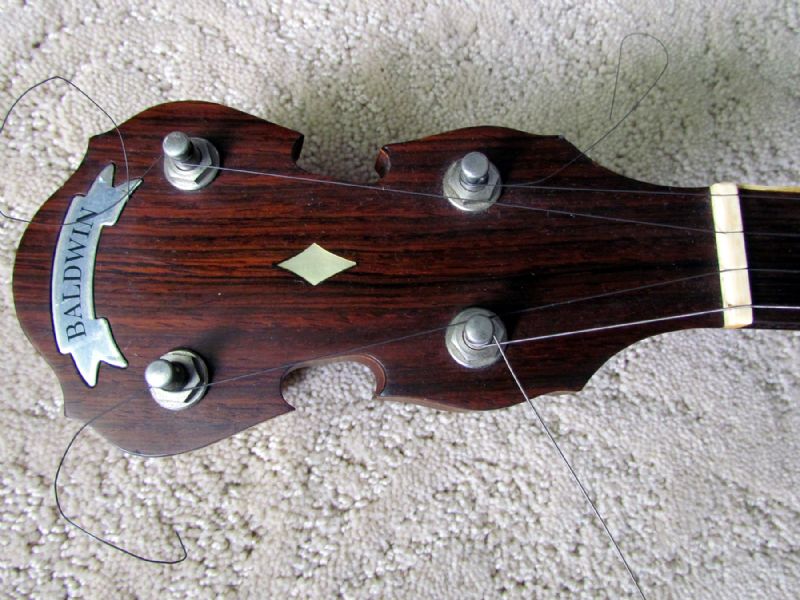
The fingerboard inlay looks like a style B
The armrest is engraved
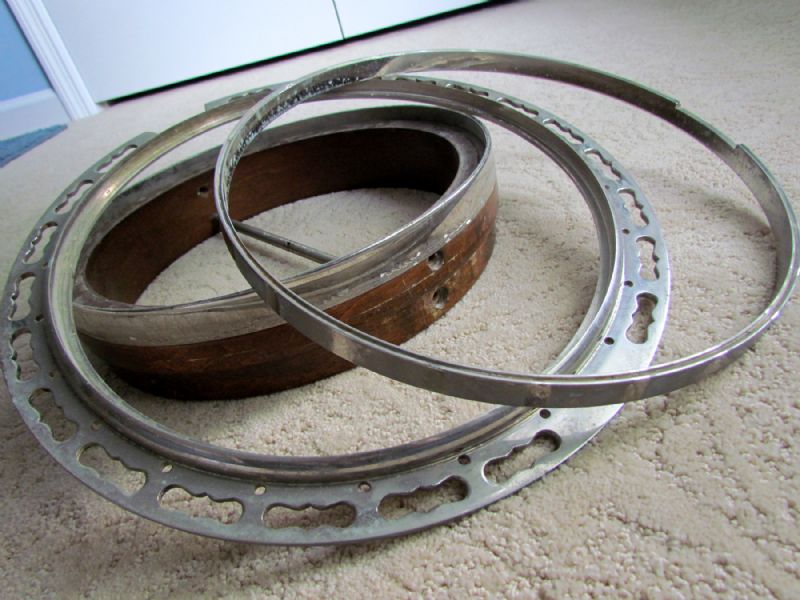
The tone hoop skirt is engraved
There is no cast tone ring - just a hoop.
I don't see a serial number
I'd really appreciate comments from any Ode/Baldwin experts.
Edited by - jbalch on 08/18/2012 13:34:46
 |  |  |  |
 |  |  |  |
 |  |  |  |
black flag - Posted - 08/18/2012: 14:02:16
John--Having worked at Ode during the transition to Baldwin, my distinct impression is that it is in fact a Boulder-made instrument. The atypical rococo curves on the heel and handstop were the signature shape on all necks by Monty N, who was one of the backroom craftsmen, and neither myself or any of the other few guys shaping necks were at all partial to that look. As you might guess, we had a certain amount of creative latitude before the days of CNC carvers. I don't know what to tell you about the absence of a true tone ring and the combination of engraved and non-engraved parts on a Model B makes me wonder if the banjo might not have escaped through the back door.
Chris
jbalch - Posted - 08/18/2012: 14:23:19
Thanks Chris:
"Back-door" I wondered the same thing. It shipped from Russellville, AR.
What can you tell me about the engraved parts ...do they look authentic?
I was disappointed to find no tone ring.
black flag - Posted - 08/18/2012: 17:38:43
The engraving is identifiable as the work of Al Gabriella, who did all Ode's engraving and who made bits and spurs in his shop downtown before Boulder got yuppiefied.
Wasn't Russellville the location of the Baldwin factory? Perhaps the banjo was put together out of leftover parts that were shipped from the Boulder shop when it was closed. It appears from the photo that the resonator is walnut rather than Honduran mahogany, which inclines me to think that it is a parts banjo.
Chris
jbalch - Posted - 08/18/2012: 18:59:25
Chris: Thank-you very much for the information.
The seller told me this banjo was from the estate of a 93 year old man who recently passed. Apparently he gifted it to a caregiver who placed it for sale. That is about all they knew. He was told the banjo was a style B based on the fingerboard inlay.
According to the OME history website, the Baldwin plant was in DeQueen, AR. Russellville is a good distance away. perhaps the Arkansas location is just a coincidence.
I agree, it appears to me that this banjo is a parts instrument. I'm really interested in the tone hoop. It would appear to be original with the rim.
Ernest M - Posted - 08/18/2012: 19:59:30
Please excuse my ignorance, but what is the difference between a tone hoop and a tone ring? I understand what a tone ring is, but the hoop part?
jbalch - Posted - 08/18/2012: 20:10:23
A proper Baldwin Ode style B should have a cast bronze full flathead tone ring (like a Gibson Mastertone).
This banjo has a simple rolled brass hoop instead of the expected cast tone ring. The hoop is just a ring rolled out of (brass) bar stock and set into a rabbet on the outside edge of the wood rim. The hoop is visible in the photo below:
I'm very curious about this unusual feature of the banjo.

Edited by - jbalch on 08/18/2012 20:12:55
black flag - Posted - 08/18/2012: 22:11:06
John--The rim is apparently cut for Ode's stock flathead tone ring and I really can't recall if I've ever seen one with a hoop like yours. I suspect that it will sound just fine once it's properly set up.
Chris
jbalch - Posted - 08/19/2012: 06:33:10
I thought it looked like a a flathead ring might fit. Here are some more photos taken after I cleaned the rim.
 |  |  |
jbalch - Posted - 08/19/2012: 06:49:07
One more question: The only mark on the banjo is a number "14" on the heel. Do you have any thoughts on the significance of that?
 |
black flag - Posted - 08/19/2012: 08:17:28
Sorry, I don't remember ever seeing batch numbers, but for all I know, they may have been added when the finished necks and pots were assembled out front.
Chris
mikehalloran - Posted - 08/19/2012: 08:36:42
I don't know... If it sounds good when assembled and set up, I'd leave it's is. It is certainly a unique bit of ODE history. This is the kind of banjo that attracts me. If I had the money and could still play, lord knows what my collection would look like.
OTOH, if it's a dog, throw a flat head in it.Thanks to the BHO, you now know the names of those who did the carving and the engraving. How cool is that?Edited by - mikehalloran on 08/19/2012 08:47:58
jbalch - Posted - 08/19/2012: 08:42:53
Mike: I'm like you - I'm inclined to keep it as-is. It is a mutt - for sure. I'd love to know how and why it came to be this way. It is not likely a bluegrass cannon ... but might make a really good Old-time banjo. Who knows?
The neck needs some work (to replace missing binding) so it will likely be a while before I get it back together.
tlong - Posted - 08/19/2012: 11:11:33
John
As others have said you have a parts banjo, what I call a back door special. Likely made in Arkansas from left over Boulder parts and some newer baldwin parts. The shell is Ark. Baldwin.Two cor. rods counter sinks for the oval head screws.
The neck is Boulder built style B with the ode tuners.The resonator is C or D as it is walnut The arm rest looks like Boulder ODE style F. The tension hoop on a B would have been notched with round hooks.The ring is the outer ring from an ODE style E or F archtop.It had twenty some tee shaped brackets that went into one eight in. holes in the top of the shell with an inner round rod ring Epiphone style It was made to interchange with a cast flathead ring. Dont know how I missed this one.
BrittDLD1 - Posted - 08/19/2012: 13:11:10
I've sent a LONG detailed email to John.
Edited by - BrittDLD1 on 08/19/2012 13:13:35
jbalch - Posted - 08/19/2012: 13:43:16
quote:
Originally posted by BrittDLD1
I've sent a LONG detailed email to John.
Hopfully, he can format it properly, so it reads better here.
Best- Ed Britt
Hi John --
My ancient Mac won't format text properly for the BHO Discussion
Topics. So I'm sending this as an email -- which I'd like YOU to COPY
and PASTE into the "Reply" box of the Topic. YOU should be able
to format the text more easily from Your computer.
Basically, Chris and "tlong" (Ted Heckman) have the mystery mostly
solved. The weird 'tonering' had me stumped, until I realized what it
was -- just before Ted answered, and provided the 'missing link'.
(If I'm guessing right, believe Ted might be the 'current' owner of
Bill Halsey's rare c'66 ODE F -- which is WHY he knows the answer...)
Best I can tell (as Chris points out) -- banjo is made almost entirely
Boulder-made parts, BUT made inder the Baldwin regime. It IS
basically built on a Style B Frame. The peghead IS cut on the Boulder
fixture -- the waist-cuts are done with a mall diameter router shaper
bit, and the inner surfaces are FLAT -- not curved like the Arkansas-
cut pegheads.
The rim appears to also be a Boulder-cut rim. Baldwin had switched
to the multiply-rim BEFORE leaving Boulder, and continued to produce
the BALDWIN Style B until it closed the Boulder shop, and moved
production to Arkansas.
With the neck pointing straight up: look on INSIDE surface of the
rim very carefully -- at the 3-o'clock, 6-o'clock, and 9-o'clock,
positions -- about 3/8" inward from the rear edge of the
rim.
The early Boulder-made Baldwins used the same TINY numeric
stamps for serial numbers as the ODES. The numbers are only
about .100" high, and stamped lightly at one or two of those
positions. If it has a serial -- It would be a 3-digit number.
The NEW Baldwin Style C (designed by Myron Koenig) replaced the
Baldwin Style B. The Baldwin Style C was ONLY produced in Arkansas.
The cast flange is an early flange. But finished to Baldwin specs. The
flat plate of the flange is MUCH thicker than the Boulder-ODE flanges --
which were lathe-turned, (or ground) to reduce the thickness.
The dual coordinator rods were also introduced, by Myron, during the
Boulder years.
The peghead also has the ORIGINAL ODE planetary tuners, with the
large knurled screw. Those were the FIRST reproductions of the
Ludwing "Planet-pegs". The Ludwigs were made in the 1920s.
Some oddities...
Which suggest the banjo was a floorsweep (or put together from
parts) -- purchased when they were closing-down the Boulder shop:
1. The Style B was cataloged with ROUND hooks, and a NOTCHED
hoop. This banjo has FLAT hooks and a GROOVED hoop. (As
used on the Aluminum-rim banjos...)
2. The Style B was mahogany. As Ted (tlong) points out -- the
resonator is walnut. But it IS a Boulder-made resonator!
3. The engraved armrest IS a Boulder-ODE version -- engraved by
Al Gabriella, as Chris states. When Myron Koenig re-introduced
the engraved armrest and tailpiece on the '68 Baldwin Style Ds --
he had Gabriella engrave the first dozen sets
4. The Missing Link -- Yes, Ted is correct. ODE produced their wood-
rim banjos with TWO different tonerings:
A. The typical CAST FLATHEAD ring. Which all of the Bluegrass
players prefer. (By Gibson standards, it's a "low-profile".)
Baldwin adopted the cast ring for its wood-rim banjos.
B. A 'fabricated" brass tone-system (based on the Paramount
and NY Epiphones of the 1920s) -- with a series of vertical
brass plates sitting on the top surface of the rim. The
plates have a short 'tooth' or 'pin' sticking downward, that
goes into holes drilled in the top surface of the wood rim.
(THIS rim doesn NOT have holes in the top -- so it never
had the plates installed.)
Sitting on top of the brass plates was a hoop made of round
brass rod. The hoop was made in TWO diameters:
11" Outside Diameter -- for a FLATTOP version.
10 " Outside Diameter -- for an ARCHTOP version.
Surrounding the combination of rod-and-plates was a tall
heavy brass hoop -- as seen in John's photos. It acted as
the "skirt' for the head's 'flesh-hoop' to bear against.
On the high-end ODE Style E's (nickle plated) and Style F's
(gold plated) that skirt was engraved with the undulating
pattern that you see.
AND... since only a large handful of THOSE rings were ever
produced... THAT ring -- alone -- is probably worth MORE
than the entire rest of the banjo!
(My friend, Bill Halsey, ordered BOTH the CAST tonering and
the Rod-on-Plates Archtop version, on his early Style F.
They were easily interchangeable.)
I've owned Boulder-ODE banjos (both aluminum rim and wood
rim) with BOTH types of tone rings. Since I'm a Folky, and
play mostly clawhammer -- MY preference is the rare Rod-on-
Plates FLATTOP version. It has the most mellow tone of the
various possibilities.
Hope that helps... More than it confuses...
Best-
Ed Britt
jbalch - Posted - 08/19/2012: 13:45:28
Thanks Ed and all! I'll keep you updated as I get this thing put back together.
BTW - I've searched under magnification and cannot find a serial number anywhere.
black flag - Posted - 08/19/2012: 15:31:47
Thanks for the clarification, Ed, particularly about the oddball "tone hoop" thing. I knew that it looked awfully familiar, but 40+ years out from the "Ode days", I just couldn't place it.
And thanks all, for a most entertaining thread.
Chris
BrittDLD1 - Posted - 08/20/2012: 08:13:04
The GOOD news for John is that a typical Baldwin CAST Flathead tonering
should fit the rim just fine.
John, you also might want to check with Tommy George -- to see if he has any
of the Rod-on-Plates internal parts. (An 11" rod hoop is easy to get thru
Stew-Mac, etc. -- to make the FLATTOP version.)
Even getting a tracing of one of the original brass plates would allow you to get
some repro parts made.
Best- Ed Britt
jbalch - Posted - 08/20/2012: 09:18:06
Ed:
Do you mean Tommy George in Somerville, TN? Do you think he might have an example of those parts?
JB
stanger - Posted - 08/20/2012: 10:28:45
Hi, John...
Yup. The Tommy George who lives in Somerville. he does a lot of Ode/Baldwin work.
Ed beat me to it- that tone ring looks like half of the archtop multi-piece Ode design. Those archtops are super-rare on the wood rimmed banjos; I have never seen one in person, only pictures.
The tension hoop is a leftover stock item. All Odes had them a year before the wood rimmed banjos were introduced.
The most mysterious bit to me is the engraving on the tone ring. Only the unicorn-rare Style E had engraved nickel plated parts, so lots of speculation could be made.
I agree with Chris. I think this was either an employee banjo, or a floor sweep. It's possible an employee just scored a bunch of odds and ends for next to nothing and assembled it. Monty Novotny could have done this; he continued to make banjos out of Ode parts after he left the company.
You sure have a rare duck there! Congratulations!
regards,
stanger
jbalch - Posted - 08/20/2012: 10:41:12
Thanks:
I know Tommy. he loaned me a very nice banjo UKE to play for a while. I'll contact him right away.
JB
mikehalloran - Posted - 08/20/2012: 23:00:25
"One Piece At A Time"
jbalch - Posted - 08/21/2012: 04:11:35
Mike: I though of the same song ... Thanks for posting the lyrics.
jbalch - Posted - 08/21/2012: 06:11:04
I've been in touch with Tommy George, He seems like the perfect guy to help me put this banjo back together. I think I'll drop it off at his shop next time I head over toward Memphis.
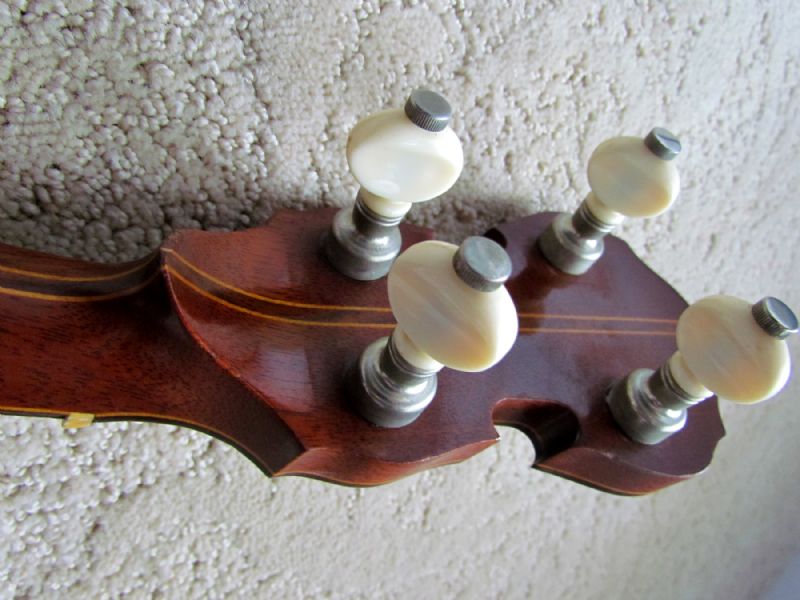
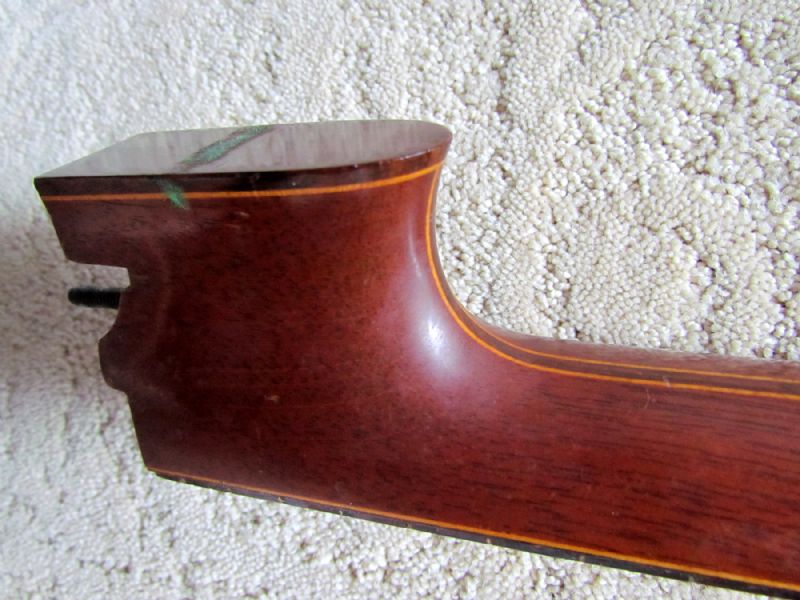
Rolf Seiker is providing some of the original style binding material to replace the missing pieces. The grain on the ivoriod binding runs horizontal rather than vertical. I don't know how hard it is to find that type (I imagine it is not easy). Rolf is generously sending me enough to fix this neck. THANKS!
I added some detail photos of the neck...as found.
 |  |  |  |
 |  |  |
BrittDLD1 - Posted - 08/21/2012: 07:44:32
I'm adding some photo attachments, from my BHO "Topics" Photo Album.
They show what the ARCHTOP version of the ODE 'Rod-on-Plates (R-o-P)
tonering looks like.
1. The ODE R-o-P tonering was based on the 1920s New York Epiphone
"Recording" model tonering. Here is a shot of a a '20s Epiphone "Recording
Concert" tonering through a clear head.
2. Here is a shot of the tonering in a '20s Epiphone "Recording B" rim, from
the inside
3. I don't have a photo of the Boulder-ODE ring, as seen through a clear
head. But here is a shot of a Boulder-ODE Style D w/ R-o-P ARCHTOP
tonering, from inside the rim. The similarity is VERY apparent.
4. Here is a shot showing the 3-digit SERIAL NUMBER on a Boulder-made
ODE woodrim. The serial is very tiny, and is stamped about 3/8" above
the inner-edge of the rim-back. With the neck pointing straight up the
ODE serials were typically stamped at either 3-o'clock, 6-o'clock (near
the co-rod) or at 9-o'clock. Some were stamped at BOTH 3-o'clock,
and at 9-o'clock.
Best- Ed Britt
BrittDLD1 - Posted - 08/21/2012: 08:06:14
Arrrgh! My computer crashed just as I was loading the photos...
took too long to re-start and verify stuff -- so I missed the
15-minute window to edit it.
Below are the photos that go with my post, above.
---
PS- Note on the Serial photo that the ODE/Baldwin resonator
banjos USUALLY have open-end nuts -- NOT ball-end.
Ball-ends were used on the openbacks.
Edited by - BrittDLD1 on 08/21/2012 08:15:02
 Late-20s Epiphone Recording Concert Spcl SN:6386 |  c1928 Epiphone Recording B Plectrum - SN 6083 |  ODE "Rod-on-plates" tonering - 1966 |  ODE Serial Number Location |
jbalch - Posted - 08/21/2012: 08:29:41
Thanks Ed: that is really good to see. It would be great to have the rest of those parts.
I'm thinking that I'll set this banjo back up the way I found it - with the head resting on that outer band and no real tone ring.
BTW: this banjo has closed end nuts - it really is an enigma.
Dogface - Posted - 08/21/2012: 13:30:23
Some years ago an old friend gifted me an Ode style F Plectrum. It had been dropped at some point and had some parts replaced. I had Baldwin B tenor neck from another project. Tommy George made a style F Ode tenor Neck for me out of the B neck and it is totally gorgeous. You can see it on my home page. What a nice guy he is too.
stanger - Posted - 08/22/2012: 15:34:47
quote:
Originally posted by jbalch
Thanks Ed: that is really good to see. It would be great to have the rest of those parts.
I'm thinking that I'll set this banjo back up the way I found it - with the head resting on that outer band and no real tone ring.
BTW: this banjo has closed end nuts - it really is an enigma.
That outer band is called a skirt. Skirts were commonly used with many of the early archtop tone designs to enclose the stuff on the top of the rim, which keeps the sound enclosure of the rim intact.
The early pre-Mastertone Gibsons used them as did the ball bearing mastertones. Orpheum and Paramount bot used skirts, but they were more modestly called 'aprons'.
regards,
stanger
FXHERE - Posted - 08/22/2012: 17:07:23
John I have an Ode Pot only, that has the closed nuts as well..I suppose it could be used as an openback...Interesting find and Tommy can fix it up for sure..enjoy..
DHutchens - Posted - 08/22/2012: 17:17:28
I have an early Baldwin D....#519 I think... and it came with ball end nuts...also had one of the 5 ply rims that was advertised in the last ODE Catalog....before Baldwin they went to the mini-ply rims....
BANJOBOB549 - Posted - 08/22/2012: 18:51:27
quote: For what its worth, I would venture to say you have a Johnny cash banjo. At one time Baldwin Was Located in BOONEVILLE ARKANSAS. Not far from Russeville Ar. If memrory hasn,t faded, The move to Mena came after Booneville Arkansas. Parts were ? out of the Booneville factory like hotcakes. You could get any combination you wanted. I,ve seen a Baldwin D style necks finished and ready to bolt bought for $5.00. At one time one person had 4-5 trunkloads of any part you wanted for a banjo. These were parts after the fire at the old T B Sanitorium,,,,Your armrest looks like some of those parts,,,,
Originally posted by jbalch
Chris: Thank-you very much for the information.
The seller told me this banjo was from the estate of a 93 year old man who recently passed. Apparently he gifted it to a caregiver who placed it for sale. That is about all they knew. He was told the banjo was a style B based on the fingerboard inlay.
According to the OME history website, the Baldwin plant was in DeQueen, AR. Russellville is a good distance away. perhaps the Arkansas location is just a coincidence.
I agree, it appears to me that this banjo is a parts instrument. I'm really interested in the tone hoop. It would appear to be original with the rim.
BANJOBOB549 - Posted - 08/22/2012: 19:00:33
quote: The armrest is from a style D The Tailpiece is from a style C. The Resonator is from a style D. The flange is a style C. All are Original. The Hoop, who knows. Your rim should have come with a tone ring. The banjo is a typical Back Door banjo from the hills of Arkansas,,,
Originally posted by jbalch
Thanks Chris:
"Back-door" I wondered the same thing. It shipped from Russellville, AR.
What can you tell me about the engraved parts ...do they look authentic?
I was disappointed to find no tone ring.
jbalch - Posted - 08/22/2012: 19:43:43
Someone should write the real history of this brand ... it seems like a great story.
I'm really enjoying the whole experience of finding and working with this banjo. I hope it makes a good player....
jbalch - Posted - 08/28/2012: 18:04:57
I delivered the banjo to Tommy George today ... and had a great visit. I saw a few of his Baldwin banjos and some of his work on them. I think my mutt is in great hands!
JB
stanger - Posted - 08/30/2012: 21:23:06
quote:
Originally posted by jbalch
Someone should write the real history of this brand ... it seems like a great story.
I'm really enjoying the whole experience of finding and working with this banjo. I hope it makes a good player....
The Ode/Baldwin history is complex and very interesting, but writing a comprehensive history is a daunting task, since everything- all the records, jigs, casting tools, etc. seem to be long gone. The last reliable existing records end fairly early on, leaving much of the 70's production and the people who made the banjos obscure. I'm sure a good historian who's a skilled researcher could dig up some of the former employees- it's likely that many are still living, but locating them would be difficult after so much time has passed.
I once thought about giving it a go, but I just don't have the skills as a researcher. I do think a history is a perfect subject for a grant, but it's relatively hard these days to land a grant large enough to cover the costs of the time and monetary requirements needed. Hopefully, one day, a young sleuth will see the potential and go for it. Books like these don't often sell very many copies, but they can sell in low numbers for a long time after the printing run.
regards,
stanger
MidMo - Posted - 08/31/2012: 07:05:30
Just when I have convinced myself it's OK to part with my "C" as a step toward proving to myself and others, that I can actually export as well as import banjos, I read a post like this that makes me realize how COOL the Ode story really is. More importantly, I don't seem to be anywhere near the only one that thinks so. I am relatively new to this, so let me ask. Is this type of following common to other brands that have come and gone ? Do you folks have a number of banjos from other builders which continue to maintain such a following ? Finally, how many climate controlled square feet do I need to plan for ? I am only in my mid fifties and might just be getting warmed up !!!!
jbalch - Posted - 08/31/2012: 09:23:14
MidMo: Ode/ Baldwin/ Ome - banjos do seem to evoke very strong sentiments for those who play them. I'm sure the same is true to some extent for other brands. But there does seem to be something special about these.
I don't have much personal history with the brand. I was attracted to it because of other devoted Ode/Ome players I've known like Bobby Thompson, Ed Brown, Ed Britt, Rolf Seiker and others...
I also have a good friend who is a fine plectrum banjo player. He lived near Bolder,CO back in the early Ode days and used to visit the shop from time to time. He knows Chuck Ogsbury very well and has fond memories of those days. the Boulder shop must have been a cool place staffed by an incredibly talented bunch of artists and crafstmen (not to mention a few who apparently indulged in recreational substances of the day - it was the 1960s after all) . The rest is history ... as they say.
Banjo Aqusistion Syndrome is unavoidable. So get the closets ready ... this stuff is the splice of life. Enjoy!
jbalch - Posted - 11/09/2012: 17:38:07
I just picked this banjo up from Tommy George in Somerville, TN georgebanjos.com/ . He did a masterful job of replacing the missing fingerboard binding. I am very impressed with Tommy's work. Also, it was great fun visiting his shop and seeing his many other projects.
BTW: Rolf Seiker supplied some original Ode style binding material that was very helpful!
Tommy set the banjo up in as-found condition (partial tone ring and all). I am truly amazed how great it sounds, looks and plays.
I'll post some updated photos soon.
THANKS AGAIN TOMMY (and Rolf)!
BrittDLD1 - Posted - 11/10/2012: 10:31:27
Hi John --
Glad you got it restored by Tommy. He KNOWS these
instruments -- and knows the various periods of them.
It looks great. Glad you kept it as original as possible.
It was also very kind of Rolf to supply some period binding.
Rolf is a good friend. Whenever I go down to visit my Mom,
in San Antonio -- I always try to visit Rolf (and his wife Beate),
up near Austin. (And also catch their act, if they are playing
anywhere nearby.)
Best - Ed Britt
Edited by - BrittDLD1 on 11/10/2012 10:33:10
jbalch - Posted - 11/10/2012: 10:55:19
Thanks Ed - The best surprise of all is how great this thing sounds. Even with no real tone ring (only the archtop ring skirt). It is loud and has great tone.

Edited by - jbalch on 11/10/2012 10:58:03
dmiller - Posted - 11/10/2012: 11:18:48

Is that the same banjo as in the original pictures?? 
Congratulations on getting it "done up right". It looks great!
jbalch - Posted - 11/10/2012: 11:39:23
Yes this is a mutt ... or floorsweep ... or whatever. It is parts from all different kinds of Baldwin/ Ode models. But based on what I've been told about the operations in Arkansas ...I think it has probably always been this way. I bet it was assembled from salvaged parts. I bought it on ebaY. It came from a estate ... sadly the seller knew nothing about the history. All I know is that the owner lived in Arkansas not too far from one of the old Baldwin locations.
Regardless I wanted to keep it as close to "as-found" as possible. Like I say the bonus is how truly great a banjo this really is. It plays and sounds fantastic.
Thanks again Tommy! and Rolf.

Edited by - jbalch on 11/10/2012 11:41:30
jbalch - Posted - 11/11/2012: 15:33:15
Here is a sound sample.
I really like the sound of this banjo. The recording doesn't really capture everything I hear and feel when playing it. Even without a tone ring it is bright, very responsive and reasonably loud. It has a very non-mastertone presence that I find really appealing.
Please excuse my rusty picking....
Edited by - jbalch on 11/11/2012 15:34:40
 Grandfather's Clock - Baldwin sample |
Page: 1 2
Terms of Use | Privacy Policy | Privacy Consent (EU/GDPR Only)
Copyright 2026 Banjo Hangout. All Rights Reserved.