
DVD-quality lessons (including tabs/sheet music) available for immediate viewing on any device.
Take your playing to the next level with the help of a local or online banjo teacher.
Weekly newsletter includes free lessons, favorite member content, banjo news and more.
Premier Sponsors


|
Please note this is an archived topic, so it is locked and unable to be replied to. You may, however, start a new topic and refer to this topic with a link: http://www.banjohangout.org/archive/222453
Jason Wilkerson - Posted - 12/08/2011: 13:27:10
I recently removed my Bill Miller pre-mounted vellum head in order to stain it with coffee (on purpose). I had treated the head with Rain and Stain spray waterproofer, and had never experienced any problems with humidity. When staining the head, it came off of the pre-mounted hoop. As a result, the only way I could get it remounted was by having it completely wet. Therefore, I was unable to re-seal it. The hot coffee applied to the head apparently compromised the waterproofing spray. As a result, the same head that gave me no trouble with humidity before now buzzes on a rainy day. The only conclusion I can come to is that the waterproofer was preventing this before, and keeping the skin stable on humid days. So it seems that spraying with waterproofing spray really does affect the skin head.
jbalch - Posted - 12/08/2011: 13:40:35
I usually treat new heads I mount with Rain & Stain spray from the shoe store. But I've never been in a position to campare before-and-after like you did. Good information.
I'm linking this to the Hide Heads group.
tdennis - Posted - 12/08/2011: 13:43:27
Putting coffee on your waterproofing is better than putting waterproofing in your coffee. I'm surprised that your head buzzes w/ high humidity. Heads loosen in the rain, but this seems a bit much. Have you checked the area that you said was not quite tucked in ? It doesn't take much to cause a buzz . ( Of course, sometimes skin heads require a ten minute break to tighten the head if too humid, or just position it at the right distance from a low watt lamp). My heads get slightly looser on rainy days, but just get a bit lower in tone. I usually just play it that way, & have never gotten a buzz.
Jason Wilkerson - Posted - 12/08/2011: 13:49:56
Buzz is probably too strong of a term..."metallic vibration" is probably better. I wouldn't call it an all out buzz, but the strings are definitely impacting on the frets when vibrating, not alot, but enough that's perceptive to the ear. I have pretty high action on this banjo, so an all-out buzz would take alot.
The other thing I'm going on is the head is tuned to F# on regular days, but it goes to E on rainy days. I monitored this head pretty closely before the coffee stain endeavor, and it definitely was much more stable than that. Everything else is the same, same strings, bridge, skin, etc. It's hard to imagine that the 1/4" untucked area could cause that, especially seeing as how the head goes back to a F# when the weather clears. I'm think I'm sold on the waterproofer.
TR Dockery - Posted - 12/08/2011: 18:45:34
For those who know, does it make a difference if you spray Rain and Stain before or after installing? Also, do you treat both the top and bottom of the head or just ---the top? the bottom?
Thanks in advance,
Randy in Germantown, TN
Edited by - TR Dockery on 12/08/2011 18:46:45
Jason Wilkerson - Posted - 12/08/2011: 19:10:47
I treated both top and bottom, I think that would be necessary. The idea is to keep moisture (humidity) out of the skin, so both sides would need to be treated. For practical reasons, it seems that treating before installing is the best option. Spraying around the dowel and rim and tension hoop seems extraordinarily difficult to me.
jbalch - Posted - 12/09/2011: 04:33:27
The head in this example is a Bill Miller died calfskin. Color should be applied before the head is mounted.
I install the head, leaving the tension hoop up high (with room to tighten as it stretches).
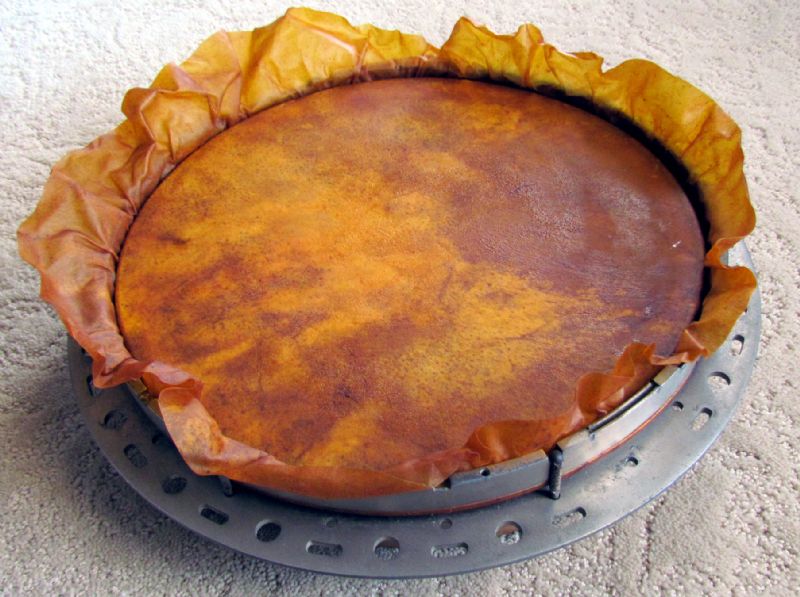
I then rough-trim the excess skin and and let it dry overnight.

When it is thoroughly dry, I remove the head from the banjo, trim the excess skin around the edge with scissors,

While it is off the banjo, I spray two coatsof Rain & Stain -on both top and bottom.


Re-install the head on the banjo - without wetting it again .
Edited by - jbalch on 12/09/2011 04:38:36
jbalch - Posted - 12/09/2011: 05:01:44
I should have said: "dyed" calfskin (above) ... but I guess it is "died" too. Oh well....
Edited by - jbalch on 12/09/2011 05:04:50
Tinfoot - Posted - 12/09/2011: 05:35:03
Just to add in, I had a mountain banjo handcrafted (literally, just the strings and the few screws weren't hand carved), and upon my request, the luthier waterproofed the calf skin head. I live in SW Florida, and you can well imagine the humidity here... But still nice and firm even after a couple months of 55-70% humidity.
TR Dockery - Posted - 12/09/2011: 05:52:06
quote:
Originally posted by Jason Wilkerson
I treated both top and bottom, I think that would be necessary. The idea is to keep moisture (humidity) out of the skin, so both sides would need to be treated. For practical reasons, it seems that treating before installing is the best option. Spraying around the dowel and rim and tension hoop seems extraordinarily difficult to me.
Hi, Jason--
Thanks for your insights. I guess doing it before installing is pretty much intuitive, but I got to thinking (a dangerous thing in and of itself for me) that maybe putting tension on the head after treatment might do something to damage/negate the treatment. I guess it is more elastic than I gave credit for. As for the hides being water/moisture absorbent on both sides, that makes sense, too. Anyway, now I know for when I get ready to try a hide head on one or two of my banjos.
Thanks again and happy trails,
Randy in Germantown, TN
Jason Wilkerson - Posted - 12/09/2011: 06:08:22
quote:
Originally posted by TR Dockery
quote:
Originally posted by Jason Wilkerson
I treated both top and bottom, I think that would be necessary. The idea is to keep moisture (humidity) out of the skin, so both sides would need to be treated. For practical reasons, it seems that treating before installing is the best option. Spraying around the dowel and rim and tension hoop seems extraordinarily difficult to me.
Hi, Jason--
Thanks for your insights. I guess doing it before installing is pretty much intuitive, but I got to thinking (a dangerous thing in and of itself for me) that maybe putting tension on the head after treatment might do something to damage/negate the treatment. I guess it is more elastic than I gave credit for. As for the hides being water/moisture absorbent on both sides, that makes sense, too. Anyway, now I know for when I get ready to try a hide head on one or two of my banjos.
Thanks again and happy trails,
Randy in Germantown, TN
You're most welcome, for what it's worth. There's been alot of talk on the hangout about waterproofing, and it seemed that no one was really certain that it helped, they seemed to be thinking, "This should really help." I thought it would be helpful to hear of an experience which seemed to prove that it did help to some degree to keep the head more stable. I would also imagine, as you're talking about the stretching of the skin compromising the waterproofing, that time would also do the same, such that a head would need to be removed and retreated after a certain time. I know that shoes need to be retreated after time.
jbalch - Posted - 12/09/2011: 06:18:26
Randy:
I think Dan Knowles in Paris, TN may use a spare rim or other jig in his shop to spray heads under tension ...before final mounting on a banjo. This does seem to be a good idea.
I've been warned that you do not want to spray the waterproofer on to the metal parts of your banjo. I think some of the sprays can possibly damage the metal or at least be very difficult to clean.
I've considered buying old 11" and 12" rims with hardware for pre-mounting and treating heads. That way I could spray them under reasonable tension too. But I don't sell heads...and I don't really install enought to justify spending the cost. Besides. I do like to custom fit the head to each banjo. Small variances in tone ring profile and other factors can make a difference in the fit. Pre-mounts definitely work. But a direct custom fit on the banjo is best.
Edited by - jbalch on 12/09/2011 06:22:09
Shawn Hoover - Posted - 12/09/2011: 06:59:01
Good info, Jason. Have you noticed any difference in tone, fully waterproofed vs. compromised/washed off (on an F# humidity day)?
Jason Wilkerson - Posted - 12/09/2011: 07:03:44
quote:
Originally posted by shoover
Good info, Jason. Have you noticed any difference in tone, fully waterproofed vs. compromised/washed off (on an F# humidity day)?
Not that I can tell. I'm not a good enough banjo player to be able to isolate such minor differences in tone. I often attribute differences in tone to my playing faults. As best as I can hear, the tone has not improved since the waterproofing is "washed off," so it should have no negative effect on tonality. And even if it was a minor loss in tone, it seems to me that the improved stability would be a good trade-off.
Terms of Use | Privacy Policy | Privacy Consent (EU/GDPR Only)
Copyright 2026 Banjo Hangout. All Rights Reserved.


